Amy Schemper breaks down core engagement: what it actually means, which muscles are involved, and how to activate them through breathing and posture. She shows how to apply these cues during crunches, bicycles, planks, and everyday movement.
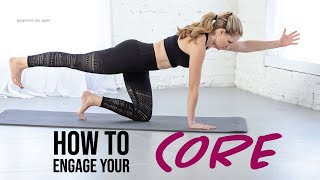
Hey, everybody, I'm Amy from Bodyfit by Amy. And today we are going to talk about how to engage your core and why is it so important? So in workouts, you hear me say all the time, zip up your core, or maybe you've heard other fitness instructors or trainers say, engage your core, core tight. What does that actually mean? So our core is the center of our bodies. It is where all of our movement begins and ends. So training our core is so important because all of our movement and all of our function and mobility comes from having a strong core. We often think about training our core to get those defined abs, to get that flat tummy, but really to be able to move well, to prevent injuries, to have a strong supported spine and back, we want to be training that core and we want to be training all of the core muscles, including that deep core. So let's talk about those core muscles. So our core is made up of a lot of different muscles, but we talk about that rectus abdominis, which is that big muscles down the front. We call those the superficial muscle, where we get those six pack muscles, right? Then we have our internal and external obliques. Sometimes we call those our side abs or our love handles, as we so affectionately call them. Then we have those muscles along our back, our erector spinae, because those core muscles go all the way around. And then we have our transverse abdominis, our deepest layer of core muscles. So transverse abdominis, your ta, or sometimes called tva, that set of muscles is the most important in my opinion, and often the one that most of us do not know how to engage and how to connect to. So we talk about the TA a lot in prenatal and postnatal training, as well as the pelvic floor muscles. We need that all to be working together and connecting, to be able to really get the most from our core exercises and to really, truly engage. So let's talk about how to do that. So first, engaging your core starts with good posture. So a lot of us have poor posture habits from sitting at our desk, looking at our phones, driving our cars, maybe pregnancy. There are a lot of reasons that maybe we're forward or back arched. So getting good posture starts with stacking all of those bony landmarks. So standing up straight, knees off, stacking your ears to your shoulders, your ribs right over your pelvis and your hips, your knees and your ankles, lifting up tall through the top of your head. Imagine that there's a string pulling you up or that you're lifting to try to hear a Conversation behind you. So we're not arched or forward. We're in that good, neutral spine, which is going to include a little bit of a natural curve in your spine. You're not completely straight, but we're not arched forward or back. Then the next key component to engaging your core is breathing. Breathing is so important. So we want to get a big TA breath and bring those TAs, those deep core muscles, in and up, while also lifting with that pelvic floor. So pelvic floor engagement. Sometimes we call that a kegel or a kegel. We're not squeezing our glutes or squeezing tight. It's actually a lift. Our. Our pelvic floor muscles sit like a hammock. So we want to lift everything up as we bring that TA in. So this is what the breathing on that looks like. A lot of us have what we call backwards breathing or shallow breathing. Inhale up, exhale down. We want to do the opposite. We want to inhale out and around. So imagine that your body is a barrel. I like to put my hands right here, so I encourage you to try this with me. Hands here, thumbs on the back. As you inhale, you want to expand all the way around. So tell me goes out, but also through your ribs, through your sides, through your back. Shoulders stay in place. As we exhale, deep core pulls in. That's that TA breathing, TA engagement. Pelvic floor comes up. What it's not is inhale here or inhale here. We're inhale here, all the way around. Exhale, pulling it in and up so you can practice the TA breath. Sometimes we call it belly breathing or diaphragmatic breathing. Again, we talk about this a lot in pre and postnatal fitness, but it is important to everybody when it comes to engaging your core. Practice that on the inhale and exhale in exercise. In Pilates, in a specific core work, it sometimes correlates to that inhale and exhale. But we also want to be learning how to hold that engagement while we're still breathing, while we're working through other parts of our workout or our lives. So another thing to practice is holding so big. Inhale, exhale. Deep core in tan, pelvic floor up. And then holding that while you can talk, while you can breathe, while you can do those exercises. Sometimes we refer to this in fitness as abdominal bracing. I don't use that term a lot because I think sometimes we think holding our breath or really tight, but the idea being that you can breathe through it, but that you've got that Nice tight core throughout. Right? So the posture, good posture, breathing on the inhale out on the exhale in and up that ta, breathing that pelvic floor engagement. And then once we're at that point, that is when we can engage our core throughout the exercises. So let's go down to the mat so I can show you a little bit about what it looks like when you're not engaging your deep core. When you don't have all of those core muscles working together in synergy, then you will know how to engage your core. Okay, so we are down on the mat. I want to show you what this.
Looks like when we're not engaging our entire core together, when we're mostly getting that outer core, that rectus abdominis, those superficial muscles.
So if I'm not engaged in my.
Deep core when I'm doing something, say like a crunch, often what you'll see is everything is pushing out and up. So it can come up like your coning or your doning that we talk about in, in prenatal and postnatal fitness, but everything kind of comes up to a point. I'm not really engaged. I'm just pushing out. Now when I bring everything in with.
That TA breath, that pelvic floor engagement.
Then I can go to that crunch motion and you can see it's tighter, it's flatter. Everything is more engaged. Same thing if I'm doing, say, like a bicycle. That's why I remind you to check in with yourself to. Because again, everything can be pushing out, but when we pull everything in again, you get that engagement. All of your core muscles are working together.
So that's why I remind you to check in with yourself, to look down.
At your core muscles and to start.
Always with that deep core TA breath to make sure you're in that neutral spine. You're not arching your back, you're not sucking in this way. Shoulders rolled forward, neutral spine and engaged. Before you start any of those core exercises, or if you're doing that in, say, a plank position, you're going to.
Hold it here and look at my tummy, it's going to look like this. So if I look down, I see it looks like everything is pointing down towards the center. Everything is almost looks like my insides are falling out towards the center and I'm not engaging that deep core.
So you can see that.
I'll show you from this other angle. See, it looks like a little point there. Coning or doming.
I'm not engaged.
When I engage that deep core with.
That big ta breath and pelvic floor engagement.
Everything up and in. Then I'm able to sustain. Everything flattens out a little bit more.
You still see those muscles and you.
Still might see some of my loose skin from pregnancies, but I'm much more.
Engaged and it doesn't feel like it's hanging down. I can feel that engagement all the way through my core and also connecting to my glutes, to my hamstrings, to my hips and hip flexors and to my upper body.
Everything's pulled up and in and same.
Thing on your back. When you engage, it flattens out and everything is able to engage. So keep those things in mind. That's how you engage that deep core, your entire core throughout exercise and throughout your daily life activities. Again, practice it in the mirror. Practice it that breathing and that engagement. So when you get to those workouts and when you're going throughout your day, you already know how to engage ra.