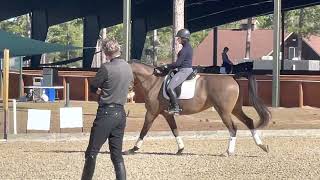
The video captures an on‑horse coaching session where the instructor guides a rider through advanced canter work and transitions. The instructor demonstrates how to use the outside spur and leg to cue forward movement, how to coordinate seat, legs, and hands to keep the horse straight on the line, and how to manage rein placement for balance and collection. Detailed cues are given for half‑pass execution (outside leg, inside rein, body alignment), flying changes (timing, leg aids, rein control), and collecting the canter (deepening the seat, using core balance). Throughout the lesson the coach emphasizes rhythm, cadence, and the rider’s posture, repeatedly correcting hand position, leg pressure, and seat depth to develop a balanced, responsive horse. The transcript reflects a step‑by‑step instructional style, with the instructor offering corrective feedback, encouragement, and practical tips for each maneuver.
Chapters
So5:01 said to me, and I think that's actually a very good way of describing it. You know when you watch the show, John. Yeah, it's a little bit like that, just not. But it's the same thing. More discreet. Yeah, I know. It. Now. I caught him a bit earlier with my outside spur because he was about to sink about it again. Now rather than sit and wait, I let him come back. I try and push it through this time. But see, I almost want him to go slightly from their left now. So once you get that right hind leg, I did it to Whiskey Road. Maybe it's the wrong Whiskey Road. Are there two on Whiskey Road? Is there one? Hold on, let me look at my app. I go a little bit like this in a smaller way with my hands to adjust his front end to the back. And then I just tickle enough with the spur. So he has to ideally step, stay straight and stepping onto that line, which he finds difficult, but that is that click. You know what we did with Thomas to do your transitions, whether it's into trot or whether it's into can, The outside is there. But if I feel that left hand leg going to the left in my strike off, I use more left leg for the strike off just to ask him to step straight it. So with my seat, I'm basically driving forward the whole time. I'm pushing into that rhythm with my feet. So that's how I start. And then my legs keep the activity and assist holding him on the line. He's tired. Now he tries to fall onto that outside shoulder. And your left hand needs to stay down. Now you need to half wood on that left, right, half wood on the left. You can now change. Then don't sit up. Yeah, that's it. You basically put your leg on and you keep asking for the chain. Forward. Left hand down and right down. Left hand down, left and right. All right, all right. So drop the right flex. Drop the right leg forward, forward. And then change forward. You stay straight behind and change now they're getting better. Give them a little break. Just push him. Keep them straight behind you. Forward, forward, line change. Left leg too. Good. Keep him on that line. Now unlock him to the right. But don't ride the chain. Only unlock him. He stayed dead straight. He needs to stay straight underneath. Automatic dead menu Sex it to the right. You look straight and squat. Yeah, yeah. Now you feel your legs. A slight change. Sit, don't sit up. Sit back or better. See, you're doing this again and then you're losing that shoulder stay here. Left hand to the left. On keeping them straight. Stay straight. Let them down and straight. Let them down. Now. That rounder outline. You get him rounder. Then he has to use his back. Jump. Now push more. Work that canter move. Allow yourself deeper into the saddle. Come, little kicks, come. So that is a canter now. And you need to get that same push off the floor when you're collecting that canter, not just when you're riding forward. Balance the outside. It's always the same. Balance the outside. Use both of your legs in the slide of a come. Yeah. Exit and half pounds from the outside onto the center line. Jump. Keep working away. Fingers closed. Jump into the corner. Into the corner. Let's wait on that outside rein. Sit longer. Sit deeper. Sit, sit. Slower. Sit. You need to sit more. You're not sitting enough. And he dives down. He dives down in his body. That outline, I don't mind that rounded neck, but he's still hanging onto the front end. So you need to give him with your posture, you need to give him that balance. That's it. That canta leave him there. Inside leg, inside leg. Now sit. Shoulders back, shoulders back. Oh, Zo, Zo. Exactly. Unlock him, unlock him there, but keep your posture. So come, come. So let him work there. That's it. Sit. Come on to that second quarter line. And then flying change. But change the selection curve. Push him forward. He needs to be straight behind you. Keep the right rein. Keep that right rein. So outside leg stays back. And then change. Good job. Yeah, exactly, exactly. Stay on that line. Yeah, that's why now you feel the necessity of your legs. That's why that is such a great exercise, people. Yeah, good job. That's a jumping canter now, but keep that, keep that when you slow it down, don't get weak in your body. And then sit there and do nothing. When you collect the same push that you're doing forward is what you do when you're collecting it. And half past. That's all right. Come. Oh, you want to have. It's that real seal that you can get this on that inside hind leg. And you have got to help that what I said with pushing that inside hip forward, outside half hold, sit. Don't get stuck on that left leg. Half, half, sit. Push into it. Push into two. That's it. Push into it. Left leg sends him forward. Now left leg forward half circle left. And again. Straighten them up on that right rein. So you get off that limb. Leg go up the left. And then you're flexing it again. On and off and half pass on that outside right. Half pass. Outside right. Sit. Go. Push. Push the horses under. Make him sit. Now you let that front end run away. Don't let that front end run away. He's got to spend. The idea is to spend more time on that left hind leg. Quarter on. Put that front end over. Half foot left. Keep your right leg in place. Come on, work that tensor. Keep that right leg active and change. Doesn't matter. If you wouldn't have lent forward, you would have controlled that a bit better. You can't get floppy in your body when you ride in those changes. Lengthen the strides again. Oh, flex is a bit to the outside and keep your right leg on. Hey, unlock him there. I love him there. Left hand, keep that all the way to the left. Moving it over. All right. Just show him where you want him to be. You're not getting stuck. And yeah, pushing on that. Push that ass back onto the track. Oh, yeah, that's what I said yesterday. It's. That's where you got to become a little bit more manual to get him to move that body. Because he's not going to do that on his own. He's got no reason to do it on his own. That's it. That's and on there. Yeah, Getting quicker off the floor, not faster in speed. Yeah, that's it. Yeah. So we're asking today, we're asking for that next step. That's it. That's it. Change brain and shoulder in half pass. Get that left hand leg under, right hand back, elbow back and over. Not pick a little bit. So you're pushing the steps forward and out. Oh, come. Emphasize that rhythm. Push into it, push into it. Come left hand down. Not too high with that left hand. Good. Do a few down your left hand. It's the same thing how you ride that corner and how you start your shoulder in. That's your preparation for that strike. Box. Now you got to push more into that center. Allow yourself deeper.