10 Work From Home Productivity Tips
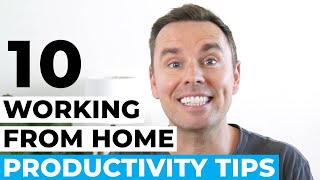
Brendon Burchard shares 10 strategies for working from home effectively, including goal setting, blocking time, and managing interruptions to maintain productivity and high performance.
Chapters
Hey, my friends, it's Brendon Burchard. And welcome to a special episode of the Brendon show. In this episode, we're going to talk about working from home effectively, joyously, productively, successfully. And for many people who are now just working from home for the very first time, I know it seems like a big hurdle and feels so different. Some of you love it, some of you hate it. Worse, most people think there's some, like, surprise secret that is going to allow you to be so much better at home than it was at work. And the truth is, what makes you a productive and effective and successful human being does not change based on where you happen to arrive that day. You know, people who've worked from home for a really long time or worked at cafes for a really long time or worked on the road have learned that it's really not necessarily about the context or the situation. It's how do you show up and get stuff done. Are you being prolific at creating the outputs or the deliverables that really matter to move your career and your mission and your life forward? That's ultimately one of the biggest questions. So today I'll be sharing with you 10 of sort of my like hit list, if you will. These are the 10 things that make me productive in working from home. I hope that they will serve you, but also remind you, listen, no matter where you're working or what you're doing, you've got to be a high performing person. And that's going to take a lot of mental management, energy management, emotional management, management of other people so you can set boundaries and get things done. But some of the very same rules apply when we teach high performance productivity at corporations or if you're at home working from the kitchen table. Many of the rules still apply. And so I hope that you'll find this session to be full of common sense type things. But now it's about making them common practice so that you can be on your A game, deliver excellent value and move your career and your mission and your life forward. So let's go through the 10 things that I do to work from home effectively. Number one, I never forget that when we talk about work, it must be contextualized in yearly, quarterly, monthly and weekly goals, baby. Like if you show up to your kitchen table or the side office that you set up over in the side of the house like this, nothing you do really matters unless you are aiming towards something that you have a clear vision, clear ambition, clear deadlines, clear deliverables. You must know what you're about this week, this month, this quarter and this year. What makes an efficient team in corporate America or an efficient team if it's a husband and wife or you're working with your friends or your brother. It's all about, what are we after this year? So I begin this entire thing with do you know what your goals are by the end of this year? Do you know what this month's goals are and next month's goals are? Do you know what this week's goals are like? Literally, as you're watching this, I'd love for you to think about, do you know the 10 things that you were after this week? Specifically what you're going to do this week? And if not, let's not fool ourselves that it's, oh gosh, working from home is hard because, you know, I'm interrupted by this person or that person, or now I'm doing a lot of videos, virtual zoom meetings. No, you don't know what you want. That is the problem. You don't have clarity. And no clarity, no change, no goals, no growth. So let's be honest, it doesn't matter where you're working from. Home, cafe, on the road, in the car, I don't care. At the end of the day, do you know what you are after? So doing the time, taking the time to know what your yearly, quarterly and weekly goals are absolutely essential to success. Number two, having my Friday finisher list. What does that mean? It means like, you know, I've got a list here of the things that have to happen by Friday. It's my Friday finisher list. It means that Monday when I go to work, I am aware of all the things I need to get done and complete by Friday. And, and that's what I use that unit of time called a week for is making sure I get all these things done by Friday. I know that by Friday, 5pm or whatever time I want to finish working on Friday, that these list of deliverables have happened and they are done and they are complete for the week. And if I can stay on track with that, oh my gosh, the year just proceeds so much more effectively. Now, I know some of you are going to be like, but it's hard to stay on track. So we'll talk about that too. Third big thing for me is block time. Block time means that you schedule blocks of time during the day in which that is the time you are specifically doing one thing. That's the time you are having the meeting. That is the time you are creating the presentation that is time you are outbound calling. That is the time that you do email. That is the time that you do social media. It's blocks of time that are scheduled and written out so that you're not always just going by the whim and by how you feel. Now, I know creatives always say, oh my gosh, that sounds miserable, Brendan. Because, you know, in all that structure, I lose my freedom. No, it's by having structure that you gain more freedom. Time, right. It's by having the discipline that you get more freedom. It's by having structure that then when you execute that structure, you have more free time. If you're just like going completely free all day, especially from home, it's like all of a sudden you were going to work that day, but then you did five loads of laundry, you did, you know, chat with the kids, you did this project over here and everything just kind of fell apart. You did a lot, you were busy. But things fall apart over a period of time without structured discipline. Sets of time, what we call block time, that allows you to move ahead. Block time is most efficiently scheduled in that 35 to 55 minute timeframe in our productivity studies. So usually for me, as an example, I'll say, okay, for the next 50 minutes, I'm gonna work on this email sequence to go out to my email newsletter list. Great. That's all I'm gonna do during that time. I don't check my phone, I don't check social media, I don't randomly check the news. I don't have any other browsers open that aren't exactly relevant to that one task. And that's what allows me not to be being pulled away from social media or notifications on my computer or randomly checking other stuff. Nope, that is the time that those things happen. And the more that I can do that, the better. Like this video right here. This block of time was scheduled, what, three days ago that I was going to sit here and do this session for you. And I think that's just what is necessary for all of us to succeed. Full disclaimer. I didn't know what the topic was going to be, but my team suggested this one. And you might like this. If you do like this topic, please let us know in the comments down below. Okay, so what else? Oh, gosh, I would say next big thing is hourly breaks every hour. So I tend to do my block time, you know, between 35 minute and 55 minute blocks of time where I just work on one thing, but on average about 50 minutes, I have a desk, a standing desk that has a timer and a button on it. And I can set it for 45 or 50 minutes. And when it goes off, I'm done. If I'm working from somewhere else in the house, I'm not at this specific desk. I have my phone with me and I set a timer. If my butt hits a chair, 50 minutes goes off. And when it goes off, 50 minutes, I get up, I drink some water, I might hit the ground and do like four or five vinyasa flows. A little yoga. I will stand in place, bounce in place, literally bouncing in place, closing my eyes, taking 10 deep breaths just to open up the airways, to close my eyes, to reset my eyes because the screen is so fatiguing on the mind and the eyes. And you know, I might only have a break of 2, 3, 4 minutes and then I'm back at it. But for you, listen, when you're home to work 50 minutes solid and then, you know, take a five minute break to get a snack, or a five minute break to throw in a load of laundry, or a five minute, you know, break to make sure the kids are still alive, whatever you have to do, that's a really great block of time. Why? Because the world's largest study of productivity that's ever been done, with over 2 million data points, 2 million people participating, I should say, found that the most productive people tended to take a break at 52 minutes. And every 52 minutes they took a break. And it almost didn't matter how long the break was, it was. Did they have the discipline of having a break? What, you know, I often call a pit stop to just recharge. Because if, listen, if you recharge throughout the day, well, obviously throughout the day, you're gonna have greater mental energy, greater physical vitality, greater stamina in doing your work than if you just burn straight through. Because then what happens? The you hit 2 o', clock, you're wasted, you hit 3 o', clock, 4 o', clock, you're completely ruined. Like, you're just, like your brain is so fried, you're not even effective anymore. And if you had just taken a few more breaks to reset those recharge sessions, right? Every 50 minutes, a little break on the hour. Every break. It just gives you more energy to make it throughout the day. I think that's important. Totally vital for me. I'm useless if I try to work five, six hours straight. It's just, it's awful. Nothing great comes from that. No great art, no great teaching, no great service. Next up. Number five, scheduling with family, right? Scheduling with whoever is in your household for them to know when you're going to work, how long you're going to work. That's so important. And like to have a Sunday meeting with your family and say, okay, this is what dad or mom is doing this week. Here's what's gonna happen. Monday, Tuesday, Wednesday, Thursday, Friday. Meaning getting everybody on board to the schedule and sticking to it, right? Maybe that's for some of you, that means you get up the same time every day. This happens with the kids. This happens with yourself to get your morning routine going. This is what you do when you go to work. And everyone knows, okay, Mommy doesn't come out of that room over there until noon. Like, she'll be in there. She'll be doing work. We have interruption rules, which we'll talk about, but people need to know, hey, you know what, honey? I'm going to be in the room where they're shooting video for the next two hours. You won't see me, I won't come out. I won't be checking messages, okay? It's communication of your schedule that is vital to everything. Now, number six, this is important. Interruption rules. If they know your schedule and when you're working, when are people okay to interrupt you and how should they go about it, right? Should the kid just be allowed to burst in the room and scream at you anytime that they want? Well, I know some people say, well, of course, that's what kids do. And other people, though, they've figured out a way to communicate with the kids, to set some of those boundaries. I know it's difficult at different times of their lives. At the same time. You can still teach kids or teach people in your life. Your spouse, your partner, others who walk in. How should they engage with you when they're interrupting you, right? It's like, okay, hey, you can come in here, but don't scream. That's the rule. Like, simple setting, simple rules. And you've got to stick to them. It's like you can't say it once, you can't say it twice. You have to teach people 50, 60, 70, 80, 90 requests before they absolutely get it. Because people are stuck in their own head, especially kids or other people in your house who are also working, right? Because something is coming up on their radar. They need your time and attention, and it's frustrating for them because they got to come and interrupt you. So you got to teach the interruption rules. And here's the secret. If you're in a house with other people. And you know their interruption rules, and you stick to those, they're more likely to return the favor. Number seven, working from home. This one's everything. Everything. Meal prep, okay? If you're working at some company and they provide lunch, you're so lucky. You just show up, there's lunch. If you're working for some company and they don't provide lunch, but you get that L hour, you know, you get to knock off, take a break, go get some lunch or go eat some lunch with some friends or by yourself. But it's kind of schedule and it's expected. But in real life, when you're at home, I bet many of you are like me. And all of a sudden it's like 2, 3, 4 in the afternoon. Like, I haven't eaten any lunch or I haven't eaten anything. You know, you just get busy doing your passion or your art or whatever. And you look at me like I'm like, I have not eaten. And then you go to the fridge and there's nothing. So you eat the crap in the pantry. Meal prep. I admit, on this one, Denise is my savior on this thing. Our fridge is always full of good and healthy things. That is a life changing thing for me because when I was a single young man, there was nothing ever in the fridge and I'd be super hungry, so I'd eat like crap and then I'd feel like crap, and I'd lose that ability to work in a productive and focused way. So what I recommend to you is just make sure that going into the end of your day, Sunday, or as you plan your day Sunday, you look out to Monday, Tuesday, Wednesday, Thursday, Friday, and you stock up on groceries that you're ready to go for the week that you know, like, okay, it doesn't mean you have to prepare every meal. It just means do you have the groceries that you need to survive the week? Right. Including healthy snacks that will support you throughout the day. I think that's really important. Meal prep, have that down. I would say in my opinion, diet and sleep are the two simple wins to nail. Just like when you're working from home, get those right, you're at home, you're at home. Get those right, everything will change. Okay, number eight, this is really important, and I mentioned this earlier, but it's really important. It's scheduling email and social media specifically, as an example, I only check social media twice per day on average. And unless there's something crazy going on in the world, which, as we've seen, has been a lot recently. But in general, I do about 15 minutes of email checking right before lunch each day. And then I do about 15 minutes right before. I'm sorry, not email. I do 15 minutes of social media before lunch each day and I do 15 minutes before dinner each day. And that way the rest of the day. What's happening? Work. Getting things done, doing the deliverables. Social media home kills people. And here's what I mean by that. When you're at work, you can't just sit at your desk on your phone checking social media coworkers like, hey, do something. But at home, you're totally allowed to get away with that nonsense. You're totally allowed to, like, at your work computer, you don't want to see people like notice you on Amazon or shopping all day. But at home, no one's seeing your screen and no one's seeing you on your phone. And so you tend to abuse those things at home. And people lose so many hours. I mean, if you spend 30 minutes just browsing like social media on the day, that's not purposeful. That 30 minutes ends up being almost a full month of work days gone throughout the year, literally that much. So you got to be very careful about it. And so that's why I schedule it. Email, social media and news are scheduled. And here's what the great thing is. Some days I don't have time for that crap, so I don't even look. And it keeps me mentally healthy. Next up, number nine, this is important for me, a significant afternoon break. When people work from home, they tend to work later because, you know, throughout the day they might have done some laundry or done some meal prep or been with the kids or had to run some errands, but they tend to work later when they're at home. And so for me, it's important to get a significant afternoon break. For me, that specifically means I take a long walk in the afternoon with my wife Denise, or I take a full 20 to 40 minute meditation session in the early afternoon, which for me means anywhere around that, anywhere between 3 and 4:30, I might take 20 full minutes of meditation or a nap if I don't take a walk with Denise, because it's just, it's a complete reset. And I can work later with that recharge than if I don't. And number 10, last big idea. Do everything you can to schedule less meetings. Everything you can to schedule less meetings. Because meetings at home lead to, okay, I did that meeting. I did that thing. Ugh. Okay, now let me go wander and do the, you know, clean up around the house or okay, that that task is done. That was the one thing I had to do to see people today. And then, you know, what do you end up doing right after that zoom call? Well, probably another five. And you're like, oh, why do I not listen to Brennan? Do less zoom calls. What you end up doing is you end up kind of blown off some stuff. Okay, these meetings were exhausting. I'm going to go watch a show or I'll consume some social media or clean some stuff up versus saying, okay, what are the deliverables that are necessary to get done today? What are the outputs that matter today? Maybe it's an email to your list, maybe it's a prospect call, maybe it's that keynote presentation, maybe it's that, that pitch you're gonna make, but something that you've got to complete, like you shouldn't. That should be the priorities. Meetings should never, ever, ever be a priority to someone who matter, who really cares about productive outputs. Meetings are not productive outputs, and they rarely move things forward that couldn't have got done over email. I know this is gonna be controversial. Cause people are gonna say, well, Brendan, I don't see people as much anymore. I'm not at work. Don't I have to check in with them more and, you know, be on zoom calls with them more? Well, how's that worked for you? If you've been working from home for a little while now, aren't you tired of those zoom calls? I'm totally okay to do, you know, virtual meetings, like when the team first goes working from home. Sure. That first month, check in a lot, be there a lot. But then don't get trapped in the same idea that people fallen for for years, which is that more meetings means more productivity. It doesn't. In almost everything that's ever been studied across the genre of productivity. More meetings does not mean more productivity. And when you're at home, like I said, because you derail after a meeting, it's super important to only do meetings that absolutely move the needle forward. If it doesn't move the needle forward for you, I suggest you delegate it to somebody else on your team. I suggest that you have another teammate run it and report back to you what happened on there. And I suggest that you focus instead on what needs to be produced by the end of that week. That will move you, your career, your mission, your company forward. It's all about productive quality outputs, not just a bunch of conversations about how you're doing. Yeah, it sure is crazy right now, huh? And I hope that that helps. These are my thoughts for what keeps me on my A game at home. All the other rules of high performance habits applies. So if you have not read my book High Performance Habits, please read it. There is nothing in that book that applies to you being at corporate America or you at home. Those habits of high performance are the things we know without any question whatsoever worldwide, in 190 countries helps people become more successful over the long term than their peers. So if you haven't picked up high performance habits recently, pick it up, check it out. Go get the audiobook version, go get the audible version. Just go get on Amazon. I don't care where you get it, but revisit your high performance habits because those apply as well. I hope this helps you. As a random check in, my team asked me to cover this. I hope it serves you. Please, down below in the comments area at least. If you're watching this on YouTube, would you please post your favorite things that you do while working from home? That helps you. What else am I missing? Do you light some incense and some candles? You know, do you get up and do jumping jacks? Do you take certain supplements? Do you manage your work meetings or your team in a certain way? What tools do you love to use? I would love to hear all of your recommendations in the comments down below. And last but not least, I wish you and your family safety and health and strength and optimism during these turbulent and chaotic times. People keep saying this is historic. This is unprecedented times. And you know what? It is. It is a great opportunity for you to show leadership in the world, to demonstrate a good attitude, to show up and serve with love and heart and excellence in kindness and patience. Patience at a time when a lot of the people have lost that. So if you show up and you're a role model now in a historical moment, people will recognize it and celebrate it later on. So be your best now. Demand the best of yourself. People say, well, Brandon, that's a lot to expect from people. I'm like, yep. And I expect it from myself and I expect it from other people. Because when we rise to becoming our best, when we are vibrant and connected and we are fulfilled because we're doing work that we love, we take care of people, we're being good leaders. That's when we get to change not only our lives, but we get to change the world. Hey y', all, I hope you enjoyed this episode. If you did, would you please smash that subscribe button and also post any questions you have down below, because it's these questions that you're all asking that inspires these episodes. I'd love to hear what you think about it. Also, if you would love to join us on our next upcoming live training. We call it our High Performance Experiment Coaching Program. If you like some coaching and have some perspective and get some two hours of live with me every single month, then click the link in the post down below so you can join us in HPX Coaching. I'd love to give you some more strategies, more insight, and more interaction to help you reach your next level of success. Until next time. Again, please subscribe, Share this video with anybody who could be inspired by it today. And thanks one more time for being part of my community.
More from Brendon
How Your Past Is Affecting Your MINDSET | Break Through to the Future You DESERVE