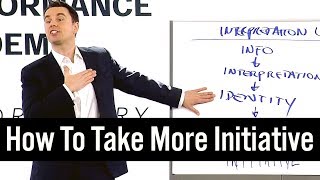
In this motivational talk Brendon Burchard outlines a mental framework that explains how raw information is processed in our brains and how that processing drives our behavior. He describes a four‑stage flow: (1) Information enters the brain and is instantly interpreted through fast, unconscious snap‑judgments (safe/unsafe, good/bad). (2) Those interpretations are filtered through our sense of identity – we ask, “What does this say about me?” and often misattribute external events to personal flaws. (3) From that identity lens we form intentions, which can be protective, fear‑driven, or truly purposeful. Burchard stresses that not all intentions are positive; even harmful actors have intentions. (4) Intentions generate initiative – the concrete actions we take in the world. He shows how low‑level initiative (e.g., a student not doing homework) often stems from mis‑aligned intentions rooted in fear or mis‑interpretation. Burchard encourages conscious observation of each stage, rewiring the process to align intentions with serving others and personal dreams, thereby enabling bold, resilient initiative. He also offers practical coaching tips for parents, leaders, and clients, and ends with a call to subscribe to his podcast and read his book on high‑performance habits.
Questions this video answers
June 7, 2018
The Brendon Show
iTunes and Stitcher ("wherever else you get your podcasts")
High Performance Habits
Chapters
In our lives, especially when we're being reactive, Information comes in, right? We're at an event, we're paying attention to how people treat us. We're studying something, we're trying to learn something, and we're just going about our regular day. Information is coming in, how people perceive us, the cause and effect of events. Things are just happening. Information comes into the brain from that point, the information immediately goes into interpretation. And what this usually means is interpretation in the fast, reactive thing is safe, unsafe, good, bad, like it, don't like it, recognize it, don't recognize it. Been there, done that. Unfamiliar, familiar, certain uncertain, fear, safe. All these things start triggering. It's pretty unconscious and it's pretty fast. Our biases come into play. It's just that speed, spontaneous, reactive part of us. And that's not always bad. Sometimes it can be good, right? Sometimes it can be good. Interpretation can be that event that's good for me or that events that's bad for me. But usually it's like a snap judgment. Think about that most when we're talking about an unconscious level. It's like a snap judgment, automatic, like you like her, don't like her, feel safe, don't feel safe. It's very fast. Then the next level. And this is not always linear, of course, because your brain is not left brain, right brain, kind of methodology. Your brain's more of a spider web of interconnectedness. That is something we still don't understand. Okay, you can study everything in neuroscience and you might learn something about this lobe or that, that cortex region. But then only to find out that later on, a year later, like, well, actually, it seems like it's also communicating over here. It's a spider web of unbelievable intelligence. It's happening that and everything can be millisecond, hundreds of milliseconds of transitions between neural networks. It's unbelievably fast, unbelievably capable. So this is just for our understanding. It's not necessarily real world linear like this. But what tends to happen is as information comes in, good, bad, we also then move it to a level of, well, what does this mean to me? Identity. What does this mean to me? What does this either mean to me or what does this say about me? How does this apply to me? And if we're not conscious here, this can be really troublesome. Some of you discovered that yesterday, I bet, when you released a few things. Sometimes we have these events in our life that we take on and we just assume it meant something about us and we didn't realize. No, that's more of a statement about them than it is about us. Right. Sometimes when you're hurt or someone was rude to you, it had nothing to do with you. Raise your hand if you follow. Had nothing to do with you. But if you're not careful, you could say mean person, unsafe means I'm bad child, Rude behavior, uncertain about this I must not belong, terrible situation, I feel bad I can never be safe again. How many follow how this happens? This is why we have to be very, very, very observational of our own thoughts and feelings. Because how these things get labeled can really change our lives forever. Can really change our lives forever. From here, once we've kind of looked through that lens and again, this can be unconscious and super speedy. But once we kind of information comes in, good, bad, here's what it means to me. We tend to then from there set an intention which means, so what do I want to do with this information? Intention, what's my next action from this? Or what am I going to do in the future because of this? And intentions can be very unhealthy too. Intentions can be like we talked about yesterday, sometimes if this is wired wrong or this goes in a way that doesn't support us, Sometimes that intention is I'm going to protect myself. I am never going to share who I am because that one person or those people hurt my feelings or did that thing. And all of a sudden our intentions become completely self protective. I talked about it yesterday how people button up or they put on the face mask or they build up the walls to the bad guys and then who can't get in the good guys. Like I said yesterday, sometimes in our own self protection, we block out the very thing that we so desperately desire. Connection. But a lot of people's intention has been throughout their lives because they weren't observing. Their thoughts became completely tilted towards safety. So they think there's a big difference between wanting to be safe and operating from fear. How many follow? There's a very big difference. Sometimes we tell ourselves stories, well, I'm just protecting myself. No, you're scared. And it's two different things, right? And we just have to be careful about where our intention is. Because sometimes not all intentions are good. In the self help industry you often say, well you have to have intention. I'm like, just, no, you have to have positive, conscious intention. It's different. Intention can be. Mass murderers also have intention and I don't like their intention. So intention in itself is not always positive. Some of your intentions have hurt you so bad. Intention to protect when you. You're not at risk. Intention to prove your point while you're at the same time wrecking your relationship. Intention to stand your ground and be firm and solid at the cost of allowing your team to collaborate and have fun at work. So we have to look at our intentions just like how we observe our interpretations or our identity. It's really important because from those intentions, of course, flow all of our initiative. Oh, my God. I spelled that right. I, n, I. Is that right? Looks funny. Okay, that's the big word for Montanan. And this initiative is now, what do you really go do in the world? What do you really go do? How are you really showing up? What goals are you going after? Like, yesterday we talked about the spark of motivation is ambition and expectancy. Well, guess what happens when sometimes your initiative is too small for you. Your ambition, the things you're chasing, is so small. I work with people all the time. I go, you're such a. I have to be honest. I feel like after knowing you for a while, you're a much more powerful woman than what you just said to me. She'll go, what? I said, well, from everything you shared with me and everything you've been through, I mean, don't you deserve at this stage of your life to dream a little bigger than that? I mean, you've been through so much. It's like I teased to my coaches the other day, I said, well, what more permission do you possibly need? I mean, what more indications does the universe give to you that you should be joyous at this stage of your life, that you deserve to chase good things at your life, that this is your time to start making new things happen again, that this is the time to enjoy life. Can I get an amen on a Friday? It's like, you've done enough. Turn the person left, right, shake them, say you've done enough. Often, what ends up happening? And this is really good for parents to learn this. Okay, so if you're a parent, really dial in for a minute. If you're a leader, really dial in for it. It'll benefit everybody. But those two groups, really dial in for a second. Sometimes you're gonna have people, good people, you know, like positive attitudes, smart people, like people you like and even respect. And their initiative at your workplace or in school is so low, it frustrates you. It's a good kid. They don't do their homework. It's a good person who had the resume and is smart, but they're not taking initiative at work. So what do you got to do? You got to help work backwards. You, you gotta help understand. I wonder what's happening with that kid. From top to bottom again, this doesn't mean this is truly linear, but as a metaphor, as a way of a framework of understanding things. Listen, sometimes even you're not taking enough action Monday to Friday because something happened on Tuesday of last week that you looked at and said, this means this project is going to fail. I'm going to be a failure again. So why should I even go out and try? So Netflix is looking good right now. Once you understand this framework. Who likes this framework? Say, that's me. Once you understand this, you can reverse psychology yourself a little bit sometimes. I'll be sitting there, I'm like, why am I not taking more action this week? Okay, let me think about it. Well, what was my intention this week? Oh, I forgot to have one bad move, number one. Or I had some good intentions, I had some good goals. But you know what?
I'm.
I'm kind of doubting myself this week. What's up with that? I wonder what happened that led me to doubt myself. And if you can use this as a tool in coaching your kids or coaching your clients or your team, it can really shape things. Because most people don't know where their initiative comes from. They don't know. And it's important for you all in this room, because I want. My desperate desire for you is when you leave these doors, is to go out and make such a big difference in the world and take such big bold moves for whatever you're next going to do, to be bold at it, to really go for it, to take initiative that would originally scare you. Big initiative. But you can make that initiative. If your intention is to serve others and to live out your dreams is true, you can take that bold action. If you say, I'm here, I'm ready, I deserve this. I am willing to deal with the hardships because I have the confidence in my ability to figure out things out. Yes. I know that things are going to be hard. It's going to be difficult. Information is going to come in that's going to say it's not nice. But you know what I'm going to do along that path? I'm going to honor that struggle. I'm going to bring the joy. So let's go. And that's a very different way of looking at life. It's being aware of how our unconscious is sorted. Putting this little framework together in our mind that's shaping our own initiative, shaping our own identity, shaping how we're doing things. It's so important. But the beauty of knowing something like this is you can also rewire it. You can also change it in such a way that almost everything on here works for you and is sourced from your heart so that come hell or high water, good or bad days, coming from a position in which you are grounded and sure and intentional of who you are that the world can't throw you off no more.
Thanks for watching. Make sure you subscribe to my new podcast, the Brendon Show. It's available on itunes and Stitcher and wherever else you get your podcasts. And it's the exclusive place where I share my thoughts about life, about current events, about what I'm going through, about my advice for you as you seek to live an even more extraordinary life. It's called the Brendon show and it's available anywhere you get your podcasts. So make sure you subscribe. And if you're ready to take your life to a whole new level, make sure you grab my book, High Performance Habits How Extraordinary People Become that Way. It's available on Amazon right now and when you order your copy, you're really supporting my channel and the message. And you're also getting a book that will reveal to you, 2020 years of my research into what is it that helps people go to a new level of success in their life?
What does it really take?
What habits are proven to help you reach long term success in your career, your health, your personal life, your relationships? It's called High Performance Habits, How Extraordinary People Become that Way. It's available on Amazon right now. And finally, make sure you subscribe to my channel so you get notifications and every time I release a new video and by subscribing you support me, my message and this channel. So I'd really appreciate it. Make sure you hit subscribe.