How to Stop Fighting
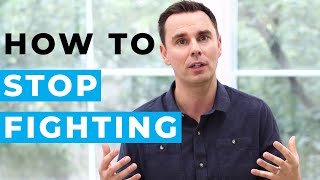
Brendon Burchard explains why chronic stress and fatigue trigger fights with people you love. He offers four fixes: restore personal balance, identify your emotional triggers and name them to your partner, pause and listen before responding, and assume good intent during conflict instead of trying to win.
Chapters
Brendon, why am I always fighting with the people I love? You know, I get this question all the time. Like, I keep fighting with my spouse, I keep fighting with my girlfriend or my boyfriend. I fight with my friends. I, I keep getting enrolled in these conflicts and I can't get myself out. And their lives, sometimes when that is happening, I get it because you're, you're all of a sudden you're like in this drama circle that is always going. There's always a fight, always a blow up, always a challenge. And then it's like, fight repair, fight repair, fight repair. And it's like literally exhausting when you're in that conflict circle that never ends. So let me share with you four ideas of what you can do in your relationships to kind of end that drama or at least better adapt and better be able to deal with all of the fighting. Okay. The first thing to realize is when people say, Brendan, why am I always fighting? The first thing I always go to is, you know what? If you have ongoing stress and fatigue and overwhelm in your life, do not be surprised when that shows up in your relationships as an argument. What a lot of people don't realize is like, the things that wouldn't usually bother you, they really bother you when you're tired. They really bother you when you have so much on your plate. They really bother you when your shoulders weight down with obligations and responsibilities. It's one of the reason I'm always telling people and begging them, please read my book High Performance Habits so you can learn to get a little bit more harmony in your life. Because when your physiology is off, when you've carried around stress for weeks, months and years, of course you're more likely to pop, right? It's like the steam entering the pipe and there's no outlet. One day, just like a simple tap on that pipe and it bursts. And that's what happens. You're in a situation where you're having like chronic levels of stress and fatigue. And then somebody, they just tap, they kind of just barely hit your pet peeve and you're like, rah. And you have this huge fight. And you have to realize that if you allow yourself to keep carrying stress, to keep doing things that draw you, draw you into mental fatigue or physical exhaustion, if you are doing things that is leading you there, do not be surprised that you're getting more fight with people. And you can't just blame other people. You have to say, okay, what am I doing to stress myself out consistently? What am I doing to Cause mental fatigue. What am I doing to not take care of my body? Because the more that you have balance or harmony or health in your life, you're way more. Way more likely to deal with the conflicts in a stronger way, right? In a better way, in a more productive way, in a more positive way. Because when you feel like crap, you treat people like crap. Isn't that true? So, number one, dial in your balance in your life. I know tons of people say, well, Brent, balance is impossible. You know, work, life, balance or balance in life is not possible. And I'm here to say if you are a defeatist in that way, if you've given up and said balance is never possible, I'm like, maybe you really need to reconstruct how you think of balance. See, a lot of people think of balance in terms of hours. You know, I should spend this many exact hours with my family every single day, and this many exact hours with my work, you know, over here, and this many exact hours on my hobbies over here. And their expectations of complete balance by the hours never comes to fruition. Right? Instead, what if you sought to seek balance not in terms of hours, but in terms of harmony and happiness? Right? There's times in my life where I'm very, very balanced. I feel very balanced. And in that amount of time, I'm spending a ton of time with family and not as much work as I'd like to, or sometimes as much work, way too much work. And not as much with family. But if I've consciously chosen that and I've scheduled that feel less stress. It's when your agenda is other people's agenda in life that all of a sudden you feel this ongoing stress, when you keep letting distractions make you mentally fatigued, when you keep not taking care of yourself and eating bad things that hurt your body over and over and over. That's what I mean. You're going to get to a point where it's chronic stress and chronic fatigue. And I don't use the word chronic lightly. I'm very well educated about what that means in terms of our psychology and physiology. It's real, and I don't want you to get there. And so if you are already there, take care of yourself. If you feel yourself heading there, just be aware a lot of your fights and your arguments are coming from how you feel in the moment that you've been dragging along with you for a long time. And once you recognize that and you get yourself in a better state and a better place in terms of your own Harmony and your own health, you'll deal with the storms much better in life. Alright? Second, big idea is to know your triggers. You have to know the things that hook you, right? The triggers, the mental and emotional triggers that other people hit that cause you to want to engage in a fight, right? Somebody can say something so simple and so innocent that outside observers would think, what's the big deal? But it throws you into a rage. Because that for you is a hot button issue. You need to know all of those, right? A good practice for you to do is sit down with your spouse, your significant other, your partner, sit them down and go, you know what? These are the things that tend to make me freak out, to make me get pissed, to make me get mad, to set me off. And it's not their responsibility to avoid all those all the time. But if they're aware of them, they can bring them up in a better way. If they're aware of them, they can avoid them when you're not feeling good. If they're aware, they're aware of them, they can learn to work with you through that. But if you're unaware of your triggers and they're unaware of their triggers, then guess what? You can be having a great conversation. You're taking a Sunday stroll, you go to the art museum, you have a nice coffee, you're having a great day and all of a sudden something tiny happens and bam, it's this huge fight. Have you ever done that where you're like, why are we fighting about this? Have you ever had like an hour long fight and thought that was stupid? Why did we do that? You did it because both of you were unclear about each other's emotional triggers. You know, people carry triggers a lot from their childhood, right? They were ignored when they were a kid. There was five kids in the house and they were ignored. And now when someone ignores them in a conversation, oh, they freak out. Or they grew up in a family where interruption was allowed and now they're in conversation with somebody where interruptions aren't allowed. And that's a trigger for that other person who's never had it before. And you're used to it, meaning it's like your natural style. But for them that's like sacrilege. How dare you interrupt me. That for them is a trigger, interruption is a trigger, disrespect is a trigger. A certain tone can be a trigger, a certain topic can be a trigger. And you need to know what these are for you. So what I encourage you to do is look back at your last 10 or 20 big fights that you've had, your arguments that you've had with other people. And when I say big fights, it doesn't mean you had to scream and yell and holler. It means that it was an incredibly uncomfortable and disheartening argument where you felt terrible. And likely they felt terrible. Maybe they were really heightened emotions. But those emotions could have been crying, not yelling. It just depends. So when I say a big fight, that means something different for everybody, doesn't it? Well, so are triggers. It's different for everybody. It really is. Like, for me, like a pet peeve. Like a trigger for me is if you said something to me once or twice, and on the third time, you don't do that, I know that's a trigger for me because to me, integrity, consistency, congruence, that's a big deal. Where I grew up and how I grew up, it's like if somebody said something and they didn't do it, where I grew up with the household I grew up in and the people I grew up in, oh, you're going to get smacked. You're going to get in trouble. So for me, it's a big trigger. If someone says they're gonna do something and they say it over and over and over and I find out they didn't, I'm like, I'm freaking out. But I know that's a trigger for me, and I know that I have an unproductive response to that. So when it does happen, I move on to step number three. Step number three, you've got to teach yourself to breathe and hold. And here's what I mean by that. When a trigger is hit, or someone wants to get you in an argument, or someone's trying to engage, or someone trying to start a fight, your job is to learn to breathe and hold your comments, hold your judgment, hold your need to be right, to argue, to make your point. Because when you're triggered, when you're emotionally there now, it's like that steam pipe. It's full, it's about to burst. You got to breathe through it, man. You got to, like, calm yourself down. You got to just let them engage. And you know, if someone's going at you and they're firing and fuming, let them blow out. You know, it's the dragon that's about to run out of steam. It's like, let the dragon blow its air out. Hold a solid place, be present, be open, be aware. But don't feel like you need to win the argument. When somebody's super heated. Your best bet when you feel superheated or somebody else is superheated is to breathe and hold. Just like literally focus on your breath and calming yourself down. Just breathe in through the nose, out through the mouth, nice and deep and just kind of engage. Don't try to argue, don't try to fight. Just breathe and hold. Be aware of what they're saying and hold your tongue until you are ready to speak. And here's the thing. Most often arguments really escalate. But because people are trying to win many arguments within the argument, right? Instead, what I would suggest you do, let someone make all of their arguments. Like literally let them blow out all their fire. Let them say everything they have to say. And you listen and you acknowledge. You validate if it's true, if you agree with it. But when you don't agree with it, don't feel like you have to jump in there. Let them get it all out. And as they've shared, all breathe through it and then say, okay, I heard what you said. It sounds like these things are important to you. And validate and reflect back to them the things that are important to them. Start there, meet them where they're at before you try to make your case. Be like, okay, you know, I can see you. Really, this means something really important to you. I heard you. You said these three things. Am I right? People are completely disarmed when you do that. Because what most people do is they fight point by point by point by point. But guess what? One person loses, one person wins, One person loses, one person wins, and everyone feels not validated. The fight keeps escalating. They keep. You ever been in a fight where people keep bringing up stuff and you're like, wait, we just resolved this thing. Where did this thing come from? You know where that thing came from? They didn't feel validated yet. Even if they won the argument, they're going to throw more in this fire because they're waiting for you to validate. And I know you're going to say, well, Brendan, they're unreasonable. I shouldn't have to validate them. I'm not saying that you tell them you agree. I'm suggesting that you reflect back to them what's important to them so they feel validated and heard. Because when someone doesn't feel heard, guess what? Their mouth keeps running. So once you realize that, oh, they're throwing in more fuel to the fire here, they must not feel heard, validated, respected, or part of this conversation. And what do you do in that? Telling you Come right back, breathe and hold. Let them blow out that air. Sit there and just wait. Valid. I heard you say this is important. This is important. This important. Okay, great. Can I share with you what I think about that? And then you get to make your case and just address one point, say I know that's important to both of us. Address another point I know that's both important to both of us and share your point. I know this is. It just means you're being more mature through the process. I'm not saying you're going to win or lose more fights doing that here to say you getting a hold of your breath, getting centered, you caring about listening, those things almost never go wrong in an argument. What usually goes wrong in the argument is you just react and you say something that was like too much, too fast, big fight and you don't know that you're helping it escalate. Now, obviously at this point, I know people are going to be commenting, but Brendon, this person's the son of a gun and you don't understand this person. You don't understand this person. You don't understand this person. And I'm here to tell you, don't miss the universality of these messages to you because I can't control the other person and you can't control the other person. And your job is not to control the other person. Your job is to manage your own state of being in conflict situations when they happen because they'll always happen, right? There's going to be more conflict in your life. There's going to be more fights. Your job is to manage yourself. It's old thing. Please be responsible for the energy you are projecting into this world. You can't be responsible for the energy they're projecting at you. They're just going to do it right. So you got to meet them where they are at and you've got to manage yourself. And the better you learn to manage yourself, the better that relationship goes. I also want to share this fourth big idea. And I know if you're dealing with a real son of a gun, you're going to be like, all right, Brendan, but listen, I'll share with this. I can't think of a better strategy than this in conflicts and in fighting situations for you to challenge yourself to be the generous one. Be generous. And what does that mean in a fight? Being generous means breathing and holding and letting them go first. Being generous gives them the benefit of the doubt. Being generous says maybe they think this way. Tell me more and learn from Them being generous means you don't have to feel like you need to win immediately. And for me, in conflicts where I do a good job, I'm just generous with the other person. I assume there's a reason they have that viewpoint. I'm generous with the person. Give them what they need. I'm generous with the person. Let them go first. I'm generous with the person. Just understand that, you know, this is maybe important to them and it's not important to me. And. Okay, here you go. And I'll tell you, I can't always say I get this right. In fact, I'm sure my wife could tell you I screw up on a lot of these things. And I'm often the person for me, in almost all my relationships, because you see what I do. I'm the guy known for being passionate, right? So in an argument, I can be very passionate, very intense, very fired up, very focused, very logical. I suck to be in argument with. But when people allow me to do my style and not try to correct my style, they're being generous with me. When I'm in an argument and I allow you to do your style of argument, that's being generous. What most people screw up and the reason fights escalate is they get off the topic. They get off what the needs are. And what they do is they start pointing and blaming. You shouldn't do your style. I hate your style. And now they're talking about conflict styles versus what are we trying to figure out together? Because real fights tend to end faster when both people realize, oh, we're actually together. We have different styles, and we need to work on this problem together with our different styles. But the opposite of generosity is trying to close somebody down for their style being wrong. And I know this is tough. You know, there's a lot of relationships in my life where I'm the passionate one and somebody else might be quieter, or I'm the person who's very logical in these moments. And when I think, you can see, sometimes when I'm thinking, my eyes furrow like this and I look like I'm disapproving of you. But really, this is me thinking. And people go, brennan, you're so disapproving. I'm like, I'm thinking over here, dude, I'm sorry. I gotta fix these things, right? So it's like, oh, okay. I have to know that other people have different styles. And when you let other people have their own ideas, you let other people have their own voice, you let other people have different needs. Than yours. You let other people do conflict differently than you do. And you breathe and you hold and you make your case when it's time to make your case. And you engage with them in a generous way, in a way that values the relationship more than any person being completely right. Because they're never gonna be completely right and you're never gonna be completely right. And once you accept that and anticipate that, you're generous with trying to meet in the middle and caring for and respecting each other, obviously these are just ideas about how you might be able to improve the fights that you have. If you'd like some more tips on how to have good relationships, make sure you check out my YouTube channel. Just type in my name. Type in relationships. I'm sure a bunch of videos will come up for you. We talk about this topic quite a bit. I appreciate you watching this one. I know it can hook. I know there's probably a lot of emotional triggers happening in your own life as I'm talking about this, and you're already thinking about somebody you're mad at, but I hope that you'll revisit this. Learn to breathe and hold and be generous and improve your relationships. Because at the end of our lives, the quality of our life is so much reflected upon how we felt the quality of our relationships were. So if we can handle this one part a little better moving forward, I think you'll feel much more like you really lived, you really loved, and, and you really made a difference. All right. Hey, guys, it's Brendan. And I hope you enjoyed my video today. If you did, would you do me? Two simple things. Number one, share with somebody else. And number two, click subscribe down below. That will help so much. And then you'll get notices every time I post a new video. Also, if you're somebody who's always, like, looking at my work and you're wondering, like, how does he do it all? We have two new tools that can really help you reach what we call that high performance experience. As you know, I call you guys Team hpx, which HPX stands for High Performance Experience. It's that idea and that philosophy of living that says, I want to live the highest version of myself. I want a life that's, you know, vibrant and connected and excellence driven. Like, you want to reach that next level of high performance and success in your life. That's why I call you guys Team hpx. And we have two new tools for Team HPX that everyone is freaking out about. So I'll help you check it out. The first one is our new High Performance Planner. This is what I fill out every day to keep my mindset good and positive, to live a happy life, to really prepare myself for the day. So it helps me not only just set my goals, but make sure my priorities are clear. Keep a clean schedule, review and rate and measure myself at the end of each day on the high performance habits that we know make you more successful. This is available on Amazon or most bookstores anywhere. It's called the High Performance Planner. Pick up a copy of it. It's what I fill out every morning. And our new HPX Optimize. Many of you have wondered how I keep the mental clarity and mental motivation and creative edge. This is our new supplement. It's called HPX Optimize. You can also find it on Amazon. This is the thing that gives me that, like that, that energy and that focus each day to be my best, which as many of you all know, was really important to me. And I developed this because I had a brain injury in 2011 and it threw me off my A game and my mind wasn't right and I just didn't have the ability to focus anymore. And this is not a product to cure, you know, brain injuries. This is a product for any person out there who says, I want a little more focus in the day, I want a little more creative edge. I want my mind to be just more alert and aware. And this is what the product does without caffeine, without gmo, without soy, without all the nonsense. Look it up on Amazon. It's called HPX Optimize. These are the two new tools for HPX Committee. I hope you engage. I'll be able to look them up on Amazon. There's some links in the post down below where you can get them at the best rate. So please engage again. Please subscribe, please share, stay part of Team hpx and please, as you know, every single day you have a choice. You can go be average or ordinary or you can choose to be extraordinary. So my friends go be extraordinary.
More from Brendon
How Your Past Is Affecting Your MINDSET | Break Through to the Future You DESERVE