From $13M to $60M: What It Really Takes to Scale an MSP w/ Kevin Cook
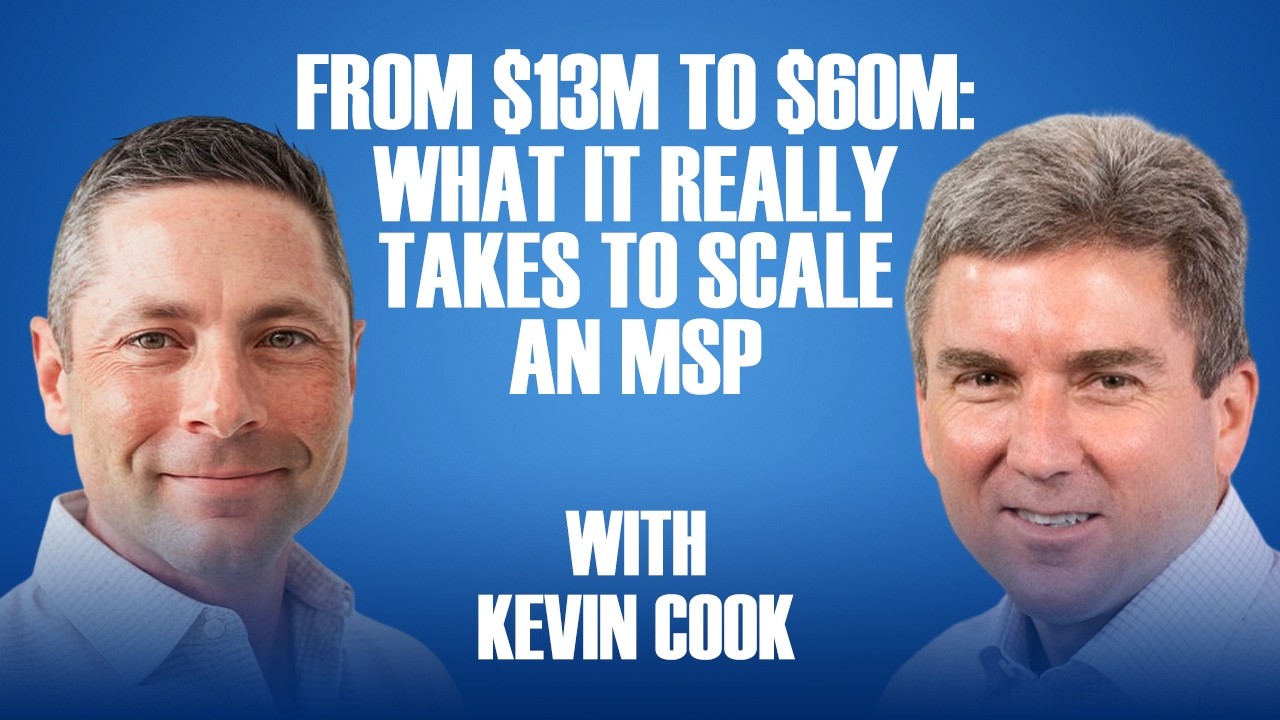
Kevin Cook scaled his MSP from $13M to $60M through ten acquisitions, focusing on recurring revenue, cultural fit, and strong leadership development. He emphasizes building an owner-independent organization, professionalizing finance and sales, and becoming a trusted advisor as AI reshapes service delivery.
Chapters
Welcome to the $10 Million MSP Podcast. This podcast is where I dive into the real stories of MSP leaders who have gone beyond $10 million in revenue, how they built their teams, created scalable systems, and turned their businesses into valuable wealth-building assets. I'm Brian Hoppe, strategic coach to MSPs. I work with MSPs generally in the $5 to $50 million range. In each episode, I sit down with leaders who have built MSPs beyond $10 million in revenue to unpack the inflection points that truly matter. From the personal stories behind their journeys to the fundamentals like culture, operational maturity, and driving profitability. This isn't another MSP podcast about tools and tech. On the $10 Million MSP Podcast, you'll get behind-the-scenes conversations with leaders who've built thriving MSPs, their biggest wins, their toughest lessons, and the practical takeaways that you can take back and use right now. If you're an MSP owner who knows that growth starts from within, that mindset, leadership, and strategy align to create both wealth and meaning, then this show is for you. New episodes are released every other week. So let's jump in. All right. Welcome back to another episode of the $10 Million MSP Podcast. I am here today with Kevin Cook, who is the Chief Strategy Officer at Intiva and also the formerly the CEO of the Purple Guys. Kevin, welcome to the show.
Thank you, Brian. Happy to be here today.
Well, I'm glad to have you and I'm looking forward to a great conversation. So just as we jump in, I just kind of want to start with like, if an MSP owner came to you and said, hey, what's the single biggest thing that I could do to drive value in my business? What would you say?
You know, I have for years always believed that that the goal is, because usually what happens is they're thinking about selling this thing at some point in time. So how do I really create maximized value? Build a great company, right? Build a really solid foundation in your business. Um, something that you are proud to run every day and something that someone will want to take over and own, you know, as part of their, you know, larger organization typically. And so it's really about building an organization that is not dependent on you. For all things. That's where a lot of MSP owners get trapped. And so build a great team around you and empower them to do great things, and you'll land in a fantastic spot.
Okay, so, so a business that's not dependent on you, would you say, or would you say that's probably one of the biggest things that owners tend to get wrong?
It's, it's usually the biggest thing that owners get wrong. I found myself trapped in that spot many years ago when I was building my first MSP. You know, you literally— a lot of times in our industry traditionally started by technical people who are used to doing the work themselves, and they tend to be involved in everything, you know, in the early days. And you have to find a way to pull yourself up out of that as you grow and evolve the business. And if you, if you can't do that effectively, You will just forever be limited in the amount of growth that you're able to actually achieve.
Totally, totally makes sense. So kind of as we, as we move in here, like maybe you can give us a, you know, quick version of your journey in the industry. So, you know, just kind of where did you come from? And yeah, and how did you end up where you're at today?
You know, it's a long winding story. I'll try to get to it and hit the high points really. So, I did not start personally in IT. So, I have a degree in accounting and a minor in economics, but had a passion for technology and was trying to build really a technology practice inside a CPA firm, which in many ways was limiting.
Okay.
It was back, this was back in the early kind of mid-'90s. And it was really challenging to do that. They, they loved me doing technology except for when it was taxes, and then they really wanted me to do a bunch of tax returns. And for me, I felt like I had to pick a path, right? And my passion was the technology side of the business that I was in. And so I had met a guy who had formed a small company called ECS here in Shreveport, Louisiana, which is fairly small town USA. And convinced the managing partner at that CPA firm to let me take one of my resources, spin us out and merge with this really small company. We had a grand total of 6 people after what I refer to as the mega merger of 1997. And that was really my launching point into the— well, there weren't really MSPs back in 1997, right?
Right.
But into technology, you know, a lot of T&M and project kind of work. recurring services for clients. And so that launched me in. And I look, I built and grew that MSP for a whole bunch of years, kind of the way that I had learned from, from the CPA firm, which was do great work for your clients. They'll tell their friends. And we grew and we grew and it grew. And, you know, at some point, you know, it was time to professionalize things a little bit and add sales and do all of the things And then, you know, for a whole bunch of reasons, you know, some of it legacy planning and other things, you know, we decided ultimately back in 2020 that we were going to take on our first private equity partner. And so, you know, went through a pretty extensive process that we managed ourselves. Not sure if that was smart or not. It was a lot of work, but we did it.
Right.
And ultimately landed with a really, really quality partner. And so, you know, January of 2020, we recapped the business and then launched what became the Purple Guys.
Okay.
You know, we spent about 4 years really building that business to a little over $60 million in revenue. And when I had— when I recapped the first time, I was right around $13 million. And so—
Okay.
It was a lot of growth, you know, in a hurry. We did 10 acquisitions in that timeframe and then ultimately decided that the right next step for the business, so, and which really means what's the right next step for our clients and for our people, was ultimately to become part of Intiva. You know, it was a larger organization than us, but, you know, in many ways it was a merger of equals where we had an opportunity to really kind of pick the best of both worlds. and move forward together. So, that's how I landed where I am today in this chief strategy officer role.
Excellent. Okay. So, starting kind of in 1997, built it up to around $13 million by 2020. And then, I mean, basically over 5 years went from $13 to $60-ish roughly, right? And so, that's quite a lot of growth, 10 acquisitions in that time period. And all of that. So, yeah, so obviously you've felt some scale. And where— so where were you at roughly in employee count at when you were around, you know, before you recapped into Intiva?
47 people.
47 people?
Yeah, 47 was the first inflection point when we became the purple guys, right? When we came— when we became part of Intiva, about 280 people.
280. Okay, awesome. And then, well, and I'd imagine you guys are well over double that now. Where are you at now employee-wise?
Yeah, right around, as we sit here today, right around 700 people across the industry.
700 people. Okay, excellent. All right. So, when you think back to kind of that point when you decided to take on some private equity, what was— maybe talk through that a little bit. Like, what was your thought process? As far as like, as you were thinking about growth and all of that and what made you ultimately decide to go down that path?
You know, there's a lot of considerations that go into that. Many of them are personal choice and goals. Like, what are your personal goals you're trying to get to? And, you know, for us, I had one partner in the business at that time. You know, look, we both had kids, none of whom are interested. in owning, operating an MSP and were thinking a lot about legacy, had been in the business for a long time. You think about that from 1997 to 2020, it's like 23 years of my life. Most of my professional career was spent building that business. And so like most MSP owners, you know, most of my personal wealth was tied up in the business. Not all, but most.
Absolutely.
And look, we've sat down and talked about all the options. Do we want to do our own acquisitions and grow this business significantly? There's a lot of risk associated with that. We felt like that risk, personal risk, you talk about personal guarantees and all those considerations.
Mm-hmm.
We just decided was not worth the outcome. Any potential additional upside was not worth it to us. You know, we were just then really starting to see a, you know, a bit of a significant wave of private equity moving into the space, you know, in a really material way. We decided that we wanted to be the platform, you know, as opposed to, you know, being absorbed into a larger entity so that we could control, you know, kind of our own destiny.
Mm-hmm.
Understanding when you take on a private equity partner, you are ceding a lot of the control, which is a consideration for—
Yeah.
That folks really have to understand, right? We were very fortunate. Things went very well for us, so we maintained control throughout. I was CEO. Our leadership team stayed, you know, fairly unchanged from the beginning to the end, which I feel very fortunate to have happen. But, you know, for us, it was the way for us to really maintain control And the direction, it was very important to me that, you know, the community, this community in Shreveport, Louisiana, which is, like I alluded to earlier, fairly small, has been incredibly good to me and my family. You know, we've built a large presence here. You know, we're well known in the community. We have clients who've been with us since 1997.
Mm-hmm.
You know, when we first started doing this, and that meant a lot to me and to us.
Yeah.
And so we felt like, you know, that was for us the best way to allow us to take some chips off the table, but allow us to still maintain, you know, as much control as possible and to preserve our legacy in many ways. And so, you know, for us it was about setting this business up in a way that it could survive into, I say, into perpetuity. You know, we'll see how long is perpetuity, right? But it'll outlive me, you know, which was my goal, you know, to take care of our people. You know, and our clients. So that was, that's how we landed here.
Yeah, absolutely. That's great. And so maybe now, like, talk about the, you know, the role change for you. Obviously, I mean, going from CEO to Chief Strategy Officer and then what do you stay focused on now?
Yeah, it's been an interesting change. I will say, you know, when you are when you're used to being, you know, the CEO, which I was for, you know, a very long time, you know, taking a step— I try to say, I prefer to say sideways and not back, you know, in the business makes me feel better anyway when I say it that way. It can be challenging, you know, quite frankly, you know, all the conversations that our current founder, Stephen, and today's CEO, you know, is having conversations that, that sometimes I'm not a part of. And those are conversations I used to have directly with the board and things like that. I'm still very involved in all of that, you know, but my Chief Strategy Officer role really focused in 2 primary areas. You know, one, I work closely with Stephen, CEO, and our board. You know, where are we going as an organization? Where's the industry heading? How do we How do we try to stay in the forefront and be real leaders in the industry so that we can more effectively deliver the things to our clients that they need? And then I focus probably 65-70% of my time is really spent on M&A.
Okay.
I spend time out talking to guys like you and in peer groups and trying to meet literally the best MSPs around the country. And convince them to become part of Intiva.
Yeah. Okay, fantastic. So, so a very M&A heavy focus for you, and obviously you have a lot of experience in that area. So, so I want to talk for a little bit about value. I talk a lot about, you know, value creation and, you know, I mean, it's kind of the end goal for MSP owners, right? It's like, hey, The business should serve your personal wealth goals, right? And so how do we get to where we want to be? And you alluded to that earlier. So when you think about what actually creates value and then building a great business, what are some of the key factors that you look at besides what you've already mentioned, like owner dependence and that kind of a thing? What are some of the other key factors you're looking at when you say, hey, I'm looking at potentially purchasing an MSP. What are the things that are going to be like, okay, yeah, this is a great business?
Yeah, I mean, you know, for us, as we think about creating enterprise value, there's some ingredients that go into that formula, right? So as we think about an acquisition, we want it to be accretive to Intiva as a whole. We want it to drive additional enterprise value. And so, you know, as we think about recurring revenue percentage as an example, you know, I'm looking to find, find businesses that, that will not dilute that. Right. And so I'm not looking to go backwards in terms of— so high recurring revenue, you know, percentage is really important to us.
Okay.
High performers, you know, are really important to us. We are— look, acquisitions and integrations are hard. Uh, anyone that tells you otherwise is just lying. Um, I just— I'm just— they just are. Anybody who's been through this process, we've now done it combined 25 times, uh, at Intiva, uh, 25 acquisitions and integrations, and they're really challenging. And so when you— if you buy a business that is challenged, it just makes that exponentially more difficult. And so we're looking for companies that really align with us in terms of The TCP, the clients that they serve, the industry expertise that they have, the size of client they serve. What does the offering look like? Does the offering align? Are there contracts, preferably longer term rather than shorter, etc.?
Right.
Because there's a lot of risk when you do these acquisitions. And quite frankly, you know, look, we have Lots of smart people at Intiva that on my team that help me work through a lot of the, you know, the spreadsheet analysis and, you know, is the business trending in the right way? And those things are all critically important. A big piece of my job is assessing the cultural fit.
Mm-hmm.
You know, is this organization or its people going to fit into what we're trying to accomplish at Intiva? You know, can Can those people work with our people effectively and become part of a larger organization? It can be hard. Most of the MSPs we've acquired historically are 30, 40, 50, 60 people. Obviously, TPG and Intiva coming together was different than that.
Right.
And those folks were all used to working in a larger MSP, but most of the acquisitions we do Or smaller, and life is different in a smaller MSP. You know, oftentimes folks are wearing multiple hats, and, you know, when you get into a bigger business like Intivo, we get, you know, really structured and focused, which we think is a good thing, not only for our clients to have our people really focused, you know, wearing one hat as opposed to many. We think it's good for our people in the long term too. Everybody always wants to take off a couple of the hats that they're wearing. But really figuring out how that would work. And you don't always get it right, you know, but it's, it's, it's one of the most important functions of my role today is to, is to very quickly assess that and to get it right way more than I get it wrong.
Yeah. Yeah. Those are all, those are all really big things. And, and as we've had these conversations on the podcast and as I have them with my clients, it's, you know, the culture fit piece is really big because you can have a great business and it— but it's just not going to align with certain acquirers. And that can be okay, right? Like, hey, we've decided to build it this way. You've built it that way. It's probably not a good idea for these to come together. But there's, well, there's plenty of acquirers out there, right? And so, if I'm building an MSP and thinking about, you know, thinking about my offerings and culture and all that kind of thing. You know, I mean, what would you, I mean, what kind of advice would you give as far as like how to build that on purpose and, and or in a way that's going to be the, the most attractive to the most potential buyers?
Yeah, look, I think you need to understand, I think, a few things. You know, you need to be intentional about industries you serve. I think, look, if you really want to, if you want to build the most attractive MSP to be acquired today, you know, have a singular vertical focus, you know, but that's hard to do. And you kind of have to really have that mentality from day one. So if you've built a broader business like we have at Intiva, that can be challenging. And so I think what you have to do is build a business that is focused on long-term customer value. And, you know, sometimes this world we're living in of private equity and everybody's measuring things month to month and, you know, quarter to quarter and there's pressure to make returns. I think what's made MSPs great historically is they focus less on what happens every month. But what happens in the long term. And so creating a business that has clients who stay for a very long time and who has people that stay for a very long time. You know, when I was CEO, when I was building my company over many years, I used to, in the early days, I would greet every new employee on their first day. And it's one of the things I would always communicate to them was, listen, when we hire someone here, it is my expectation that you're going to be here with us for the rest of your professional career. Like, that was real. That was our goal, was to build that kind of long-term enduring relationship. And when you do that and you have the same people who work with the same clients over long periods of time, it builds huge amounts of trust, institutional knowledge, all of those things that in this, in our world, AI could potentially be changing some of those things as we go forward. Some of the focus may move. We're all trying to figure that out. But building a business in that way, building a business that, that has very clean and easy-to-read financial statements, like having real accounting systems and infrastructure. And by a real accounting system, it can be QuickBooks, right? But, but doing accrual-based accounting, doing things to set you up in a way you know, be able to measure gross margin on a customer level, right?
Yeah.
The basic things like when I come in and I'm looking at your business, if you can't, if you can't give me a certain baseline of data, I'm going to have a really hard time, you know, getting my head wrapped around how do I, how do I value this business if I don't have clear, easy to consume and digest information? And that's not a thing that many MSPs think about, certainly in the early days. There are organizations that can help you get that stuff cleaned up. As you know, folks like Service Leadership and peer groups, Evolve Peer Groups and others do a great job of structure and standardization. Quite frankly, I would tell you, I'll put in a plug for the peer groups because I'm a very long-term member. Being a part of an organization like an Evolve or Service Leadership Peer Group can just exponentially accelerate the growth of your business, in my opinion. It's changed. I'll say it's changed my life. I could do the commercial for them.
Uh-huh.
And I've offered to a few times, but I really do think that if you, if you are building a business specifically with the intention to sell it at some point in time, getting engaged in organizations like those helps you really build structure. Um, in consistency and clarity and the way that you present information in ways that is very easy for acquirers like myself to understand. And the, the fewer questions that somebody like me has to ask you in that process, the better off you're going to be, for sure.
Absolutely. Absolutely. Well, and, and I have no pro— I have no problem with you putting in a plug there because, uh, well, I talk about it all the time and, uh, you know, it's one of, it's one of the 3, you you know, 3 biggest things I ever did as well was joining a peer group. And then, you know, and specifically around what you're talking about with, you know, having financials that are easy to digest and all of that, like, that's where I learned how to do all that, right?
Yeah.
Like, you know, understanding, hey, what is a, you know, what does a normalized chart of accounts look like? And how do you accurately measure gross margin by line of business? And how do those things compare to what everyone else in the industry is doing? And what does best in class look like? What are the top 25% doing? And that just allows you to, you know, it allows you to, well, increase your profitability now, but also by increasing your profitability now, your valuation is going to be higher, right? You know, they're very correlated, right? So, yes, by all means, you know, do the commercial there. I'm always encouraging everybody. I'm like, Whether it's, whether it's Evolve or, or any of the, you know, Pax 8 or any of the other peer groups out there, get, get in a situation where you're learning from other people who have gone before you. Right. Yeah, 100%.
It's, it's not a matter of which one, it's just get, get in one, like, go figure it out. And, and it helps you get better every day is the way I always looked at it.
Yeah, absolutely. Okay. Yeah. So, so all of that's like, all of that's super helpful. You kind of, alluded to another thing there, which, you know, which is maybe around AI. And, and I'm curious, your, you know, from, from where you sit, your perspective, because there, there might be this kind of inflection point for MSP owners. So, so how are you thinking about that right now?
You know, what's, what's really interesting, you know, so in Teva, I would say we're very early into the AI game. as compared to most of the MSP world, have made significant investments here. You know, look, some of which is third-party things we're acquiring, some of which we're developing internally. I'm not sure there's a right answer there. It's probably the right answer is some of both, right? Depends on the situation.
Yeah.
But I'll tell you that the trend that I'm seeing in the industry right now is, look, guys have reinvented their MSP a couple of times over, you know, since its inception. And I'm literally having a couple of conversations with potential sellers right now where they're just like, you know, how am I going to compete? You know, my 30-person MSP, how do I really effectively compete with Intiva as an example, insert any larger scaled MSP who theoretically has, you know, the war chest to invest in and really rapidly accelerating what AI can do in our business. It makes us far more efficient. You know, does that mean it's lower cost, you know, solutions to clients, or does that just mean more value and higher margin? The answer probably depends somewhere in the middle, depending on the outcome.
Right.
But I think it really is. I think in some ways it is really accelerating. You know, the acquisition landscape in the industry has ebbed and flowed a little bit based on a number of variables and interest rate increases and all those things. Right. But I'm seeing an influx. Currently of MSPs who are just thinking, man, now's the time or else I need to, you know, MSPs have typically had these, I get to an inflection point and either I need to sell it now or I need to go spend the next 4 or 5 years making all these investments and building these things. So maybe now's the time.
Mm-hmm.
AI, in my view, has turned into an accelerator for Not all, but quite a few MSPs are thinking, okay, I need to build a sales team and now I got to go solve this thing. Maybe it's time to capitalize on what is, in my opinion at least anyway, still a pretty frothy market.
Right.
For acquisitions. And so a lot of that's happening. So that's to my benefit. So I won't complain.
I won't complain. Yeah. Yeah. Well, and I'd agree that there's, that there is kind of this, and anecdotally, I mean, I've had conversations with multiple of my clients who are like, yeah, I know, I know what I would need to do in order to, you know, move forward with, with the change that's coming with AI. And, you know, I'm not sure that I want to take that, you know, take that ride. I already did it with cloud, I already did it with security. I'm getting, you know, I'm getting to, you know, upper 50s, you know, kind of a thing. I've already kind of met my financial goals. Maybe now's the time to move on. You know, so I definitely see some of that happening. But, you know, as you kind of think about it, like, well, so let's say that somebody's like, okay, you know, I want to push through for 5 more years. What are they going to have to do in order to essentially keep up with folks like you, with folks like Intiva?
I think maybe the bigger challenge, I think that MSP owners, like all of us, are feeling our way through this a little bit. Look, it is new and it is rapidly evolving. So one of the biggest challenges is deciding, you know, well, potentially what technologies and what third parties am I going to bet on? You know, because when you make those decisions, they're typically, you know, tied to agreements, you know, that, you know, generally are going to last multiple years. And so you got to get those things right. That's a challenge. I think potentially the bigger challenge that we all face is how do we help our clients through this? You know, we are, we are living in a world where you know, we have focused largely on the SMB for many years, but even those clients have a sophistication level where they're coming to us for advice. And so how do we educate our workforce? Right. How do we build teams of people in a way that we can accurately and effectively advise our clients? And quite frankly, One of the bigger challenges, how do we monetize that as MSPs? How do we get paid for doing those things? Because it is a pretty massive effort, in my opinion, to kind of retrain and retool our teams to be able to live in that world. Not so much to use it in their daily life, right, to make their job easier and more efficient, but to— to really have conversations with clients and guide them through what's a rapidly evolving landscape is the biggest challenge. And so, I think those that figure that outcome out are going to win the game ultimately.
Yeah, yeah, that makes a lot of sense. And, you know, you have all the, I mean, very different aspects of it, right? Like, how do we become the advisor? to our clients as it relates to AI? You know, how do we continue to own the relationship so that somebody else who's an expert doesn't come in and kind of, you know, I mean, become the expert to the client on the topic? And, you know, and my thinking is, and I think it's remained the same through a lot of the big transitions, is that, hey, as the MSP, You are, you are the relationship. So if, if you're building that relationship and showing your expertise and saying, hey, we're thinking about this, let us help you with it, you're going to be able to retain that. It's just that you've got to build those skills and you have to find a way ultimately to monetize it, right?
Yeah, that's 100% right. You know, it's, look, we've, this industry, has, has proven itself to be incredibly resilient. So we've, we've been through some of these inflection points before, and we have figured out how to, how to manage our way through it and come out better than we were before we started the process. So I'm, I'm confident we will, we will figure it out as an industry.
I really am. Yeah, yeah. And it's, and it's still going to take some time yet. And we're seeing the changes. I think some of the changes are probably coming slower than than many people thought. But, um, but we'll, you know, time will tell. I mean, right, like, it's all, it's all, you know, kind of conjecture at this point. But, but things are moving for sure. And, um, and, and at least in the, the rooms that I'm in and the people I'm talking to, it's like, okay, we're figuring it out slowly but surely, right? So, you know, slowly but surely. Um, so, so let me, you know, I want to take a slightly, you know, kind of go back a little bit. and think about, you know, as you were, and I think a lot of people will be interested in this, like, so you're sitting there, you're, you know, you're a $13 million company, you decide to go down the private equity path. And you get, you know, you get your funding. What are, I mean, what are the first things that you're thinking about? Like, how are you kind of then going going through the process of kind of capitalizing on the funds? And I guess maybe, obviously, like acquiring companies is a big part of that. But what are the other things that you kind of had to think about before you could even move down that path?
Yeah, well, maybe we were half crazy, Brian, but when I recapped the business the first time, We simultaneously closed on our first acquisition.
Okay. All right.
So, there you go. We were really, we were drinking out of the fire hose in a hurry. And that was 60 days before the country shut down with COVID which made it extra interesting for us. But I would say that, you know, some of the things, and look, when you're at that level and you take on outside investment for the first time, some of the value that, that, that, that outside group can bring to you is how do we professionalize this business in some ways?
Mm-hmm.
Your world, like my world changed as, as CEO of a $13 million MSP, you know, still focused on, you know, doing, you know, a lot of outward-facing things. But I still spent time with clients and all those kind of— we still do some of that. But my world turned into board meetings and You know, board decks and, you know, banker meetings and debt covenants and all of those kinds of things. And so in order to be able to do those things effectively, you've got to have a team around you. And so, you know, for us at the level we were, as an example, CFO was a fractional thing for us in our business at $13 million without that complexity. Overnight, we had to have a real CFO and frankly, one who had lived in the private equity world and, you know, knew how to, you know, complete the court— all the quarterly reporting that has to go to senior lenders and all those kinds of things. So, so helping us recruit and hire the right CFO, you know, very quickly, it was really— it was priority number one as we, as we put—
Okay.
As we started to really build the platform out, and then and then it was a process of professionalizing. You know, it's what are all the functions in the business that we feel like have to get up leveled in order for us to really build the foundation of what would become a sixty plus million dollar, you know, MSP platform. And so, you know, it was CFO, it was sales, it was marketing. You know, were kind of the key functions we we had. We had built the operational engine in a way that scaled really well. And so we knew we had that part of the foundation, which I would argue is the most important if you're going to build something of scale. Having that figured out is critical. But it was those next layers of services where we could build truly consistent, repeatable sales engine that delivered month after month, quarter after quarter. Yeah. Quarter after quarter, those types of things was, those were the right next steps. And I think that's probably, I think that's pretty true for anyone who takes that leap from, you know, kind of single location, you know, just high-performing MSP that decides we're going to be a platform and then go operate in, you know, 7 or 8 different states and, you know, and turn into 300 people from Right, right.
Okay. So, so let's talk, I mean, so the kind of the theme around professionalizing the business, which you have to be at a certain level of sophistication at $13 million. But so, so when you think about the, you know, professionalizing, I heard, you know, I heard having a CFO, you know, in place that's, you know, that has experience. at that level and probably well beyond, professionalizing the sales function. You said you kind of already had operations in a pretty good spot. So, I mean, talk more about like, you know, if I'm sitting at $10 million and I'm saying, okay, I want to go to $20 million, what are the specific things that I can be working on to, you know, to professionalize in some of those areas or maybe other ones that I didn't Uh, mention?
Well, look, I'll, I'll say this, and maybe it's not a popular answer, but I do think that part of that process can oftentimes be going and getting help from the outside, um, which is part of what we did. But I think that, look, the reality of the situation, it's the old saying, the people that got you here may not take you, you know, there. Um, and, and I've just seen that be true, you know, many times over the years. And look, I think, I think MSPs tend to— like, we're people people at the end of the day. We got in the business because we love serving clients. You know, I use the term servant leader a lot. I certainly was, you know, as I built my business. I like to think I still am today. We tend to take care of people and hold on to people. And oftentimes longer than we should. And maybe it's not hold on to them, it's put them into roles for which they just really are not qualified. And so, I think one of the most important things that you can do is if you're going to really rapidly scale an organization, like build a real program around leadership development because it's going to take layers of leaders.
Mm-hmm.
That you likely don't have in your business. So, that's the, that's kind of the one tactical thing I would do is to build that leadership program in a very intentional way so that you are constantly developing those people. It takes time and it takes a financial commitment from the organization to make that happen, which is, I think, mostly the reason why it doesn't happen in most organizations. But there will come a time in, in, where the business will implode on itself if you're not building those next-level leaders in a way that they can run the business day to day without having to stop and ask questions of their leader, you know, all day, every day. So that's my one big thing.
All right. So thinking about that, and, you know, I hear that a lot, like holding on to people a little bit too long or You know, it's kind of like promoting people to their level of incompetence, right? You hear that a lot. You know, we kind of take the best, you know, the best tech and make them the manager when really that might not be their, you know, their best place in the organization. And then, you know, and then most of the time for MSPs, well, all of the leaders are leading at the highest level they ever have before. And so if you want to make a leap from $13 to $60 million, you're probably gonna have to bring in some outside help and that kind of a thing. And then, you know, kind of your statement around the, you know, the folks that got you where you're at may not be the people that get you to where you wanna be, which is all, you know, I hear this, you know, over and over again, and that combined with bringing on the CFO and all of those things. So maybe dig in a little bit, 'cause you mentioned the sales part of things. So how did you go about, I guess, professionalizing the sales function into, you know, into something that was actually going to generate revenue consistently month after month?
Well, I mean, it was, it was two-pronged really for us because, you know, creating an inbound engine, you know, is critical to that. And so what we did at TPG, we actually used a third party. We use an outsourced marketing firm.
Mm-hmm.
That was focused solely on MSPs. It took us a little while to get comfortable with the fact they were working for others and making sure as we had a lot of conversations about that. But for us, we were also looking for speed, speed to execution, right? And so we brought in third-party marketing firm to help us very quickly stand up that function, you know, in the business simultaneously. You know, went and found— went through a recruiting firm focused solely on MSP to help us find the right CRO. Probably overbought, you know, to be blunt, given the size we were at the time. But, you know, found a candidate that was really well qualified, had been there and done that at a scale that was, you know, much larger than we were and really where we were, even larger than where our initial goal was to get to, which we thought was really important because you just, you need that person, those people in the business who've seen it before and know, right? And then they bring along with them relationships. How do we then find the right people for the outside sales team? Well, when you bring in the right leader, he has all these connections in the industry, pipeline of candidates, etc., as opposed to Because part of the— and I hate to call it a game, but part of the game you are playing here is about speed, right? When you get into the private equity world, it's almost run more like a public company in many ways where there is pressure to produce month over month, quarter over quarter. And so there is no time to waste. Well, we'll try this. Well, we'll try that. No, you've got to go find the people who have the formula. the playbook, if you will, that they can run the playbook again and know it will produce the kind of outcome that you're looking for. And so that's what we did. We felt like, look, we spent a lot of money in the early days. Our G&A expense increased exponentially as we went and found the right people. But in the long run, those things pay tremendous dividends. And so My advice is to, is to maybe over, overbuy a little bit early. And it will keep you, it also will keep you from having to then, you know, replace that level, you know, you bring them in, and then you grow, you know, you double your size. And now we've outgrown this group of folks, we got to go get another group. And so, you know, our plan was to overbuy and grow into the business.
Gotcha. Gotcha. Okay. Yeah. Yeah. And as long as you understand the impact that's going to have on the you know, on your G&A and, uh, and resulting in, you know, on the EBITDA, obviously. Um, then, uh, you know, but that's okay as long as you, you know, end up with the, the growth that you're, that you're actually going for, right?
As long as it works.
Um, yeah, yeah, as long as it works. Yeah, I mean, I do see, I do see people that are like, yeah, we're over-investing in sales. And I'm like, okay, so where are the sales? You know, that's a problem, um, if you're, if you're not seeing the the results. So maybe talk for a little bit about, you know, because for instance, you, you know, you as the CEO, you know, you probably hadn't led anything, you know, at a $60 million, you know, range of revenue before you actually did it. And I would imagine that you had to experience a lot of growth yourself in your leadership. And I, you know, I have this theory that it's like, hey, the business can't outgrow the, you know, the level of the main leader, right? So, you've got to grow in order for the business to grow. So, maybe you could talk a little bit about that. Like, how did you experience growth on your way from, you know, from $13 to $60 million?
It was a big change for me. And so, I was expecting That, like, I've had some really good mentors in my career, not necessarily in the MSP space, from various industries, just people that I respect who have been part of bigger businesses than I'm in even today at Intiva. I leaned on those people, you know.
Yeah.
Partly I leaned on them before I made the decision to go the private equity route to make sure I really understood what was coming. and how to operate there. You know, for years I had a business partner, you know, and we had to lose— we had a very loose meeting schedule. You know, our offices were next door and we met when we met and, you know, we did monthly financials and all the things and peer groups. We had structure. I don't want to say we didn't have structure, but, you know, I had to very quickly elevate my game. And I did that in a number of ways. And frankly, part of it was going directly to the private equity firm and saying, hey, I need to understand what your expectations are of me. I'd spent some time in volunteer boards and had been chair of some of those things. So, I was used to running meetings, but these are different meetings with a whole different level of expectations.
Right.
I think one of the most important things that I did, you know, really day one was sit down with private equity group and say, hey, I need to know what you expect so I can deliver that and to very clearly communicate with that group with regularity. So, you know, for the first 2 years we had a standing weekly call.
Okay.
at the time felt a little heavy-handed, but the value that I got from that as a CEO, they weren't telling me what to do or how to do it, but just guiding in a direction and helping me to elevate my game. These are guys that have been, these are professionals, right, that have been doing this for a long time.
Yeah.
And I could learn from them every day. And so I did that. And I also You know, at the time, like Kevin Blake is a friend of mine. He was on your podcast here recently. I reached out to the guys like that. He and I were kind of running parallel paths. We recapped our businesses within about 60 days of each other.
Okay.
And so, had constant conversations about how does this work for you? What am I missing here? How do I do this better? You know, I did the peer group plug earlier, but it really is about finding peers that you respect and asking for help, you know, and—
Yeah.
And, you know, finding your own, you know, recognizing your blind spots and going and plugging those gaps. You know, there's certain things in the business I was really good at. I came from, you know, public accounting world, so financials and audits and things like that were were not new to me. The sales, like a really big sales organization was new to me. So learning, understanding that, finding the right partner that I could in many ways learn from while I'm setting goals and expectations, but still learning, you know, from, from those that reporting to me was, was important too.
Yeah. Yeah, totally makes sense. I mean, it's a, it's a whole evolutionary thing, right? Like we've, we've got to grow as As individuals. And I mean, you got to have an appetite for it, right? Like, like, hey, if you're not, if you're not up for the challenge, well, it's going to be, it's going to be very difficult. As you, you know, if you step into something like that.
I think that's so— I'll just, if I could, I'll just say, look, that was a great comment, Brian. And I would just say, that's 100% right. I mean, if that's, if that's something that you're thinking about It takes an incredible amount of energy and effort. And so, you got to be ready to run at a sprinter's pace for a marathon is the way that I talk about it.
Yeah.
I run a lot and so, I tend to use a lot of running analogies, but it's a, you know, you got to love it and you got to want to grow yourself as a leader in order to have a chance at being effective. And so it's maybe one of the most important things I think we need to ask ourselves as we're thinking about what's next. And is this a journey that I want to try to take? Make sure you can answer that question with an emphatic yes if you decide that's what you want to do.
Right. Yeah. Yeah. And it sounds like too, for you, it was a thing that you were passionate about learning. And you kind of, you have to be, you kind of have to be all in in order for that to be successful and be like, hey, I'm, I'm going to, I'm going to do this thing. This is going to be awesome. And it's got to be, and it has, has to at least feel fun in, in some way, shape, or form as well. Um, you know, because otherwise I'd imagine, well, it's just going to be a huge drain on you for a very long time, or, or you're going to end up, you know, stepping aside and, and another CEO would come in. Right? Right.
Yeah. And that, and that happens, you know, um, with regularity, not just in the MSP world, but just in, right, in business in general when that happens, you know, because businesses do outgrow people. And leaders. So, yeah, be prepared for some of that too.
Absolutely. Yeah. Okay. So, you know, we're kind of coming to the end of our time, but I always like to, you know, to ask, like, in thinking about, you know, thinking back along your path and your leadership, you know, we all, we all have those moments where it's like, oh man, I messed this up, or I really shouldn't have done that, or This or made a mistake. So, like, what comes to mind when you think about that as far as like, hmm, yeah, this is maybe my biggest mistake as a leader?
Wow. Yeah, you said we're almost out of time. I've got a list, Brian. We all make plenty of mistakes, right? And so, we just got to be right more than we're wrong. But for me, I think that Look, I'll be blunt. Doing my biggest mistake early on was not understanding truly the power that I had as the founder and CEO of the business, right? So, I probably spent my first year after my recap as CEO allowing You know, my private equity partners, all with great intentions to push me in directions that maybe I didn't think I wanted to go. And it took me some time and frankly, some conversations with peers and others to really recognize, look, these guys don't want to— they don't know how to run an MSP and they don't want to. And so, you know, having the confidence in yourself in the room To really dig in when, when it's important to dig in, which I ultimately did. It just took me— I didn't— day one, I didn't realize the power that I had. And so for me, I think that set me, set us back in some ways as an organization in my very early days as I allowed them to guide some things.
Classic example.
So, we talked about CFO and CRO and all those things. Like, this is an area of expertise they have, right? Finding the right CFO. I did not agree with our first CFO hire. And a year after we brought him in, I had to exit him.
Yeah.
And I should, I should have trusted myself in that moment early on. Hey, I hear you're the experts here and you brought in your firm, but when I know it's not right, I should say it's not right. And I didn't do that in that moment. Because I thought, hey, this is their thing to do and it's their call, you know. And so, yeah, that was, that's the biggest mistake because that put us, it set us back in some ways, right? When you were out of CFO, which we were then for about 6 months while we tried to find the right next one, that hurts as a CEO. It's hard. So yeah. Yeah.
And when speed is important and everything, then it's Yeah, it makes a huge difference. Okay, so thank you for that. That's, you know, it's always one of my favorite ones because you— because it really gets to, okay, yeah, hey, well, it helps others. Like, okay, avoid this.
Absolutely.
Right. Don't make that mistake.
Don't screw up what I did.
Yeah, exactly. Exactly. And in a lot of ways, that's just— that's trusting, trusting yourself and your instincts and your ability to run the business that you built. So, okay, so I always like to end with a, you know, a lightning round. So this is just kind of like the first thing that comes to mind, quick answers. You don't have to expand on it a lot. But so the first one of these is, what's a belief or an idea that you've changed your mind about over the last few years, maybe, or recently? Oh, wow.
There's lots of things that I changed. I try to be a guy who doesn't get locked into his positions on anything. And so, I've changed my mind on all sorts of things. I've changed my mind on— you said quick answers. The way that I think about acquiring companies and the things that I value in those companies, I've changed my opinion on for sure, leaning towards the people side over the financial side.
Yeah.
Every time.
Okay. Okay. Awesome. And then, and what's something you've been curious about lately?
Oh God. Well, the easy answer is AI, but I'm incredibly curious about AI. And so I just, I'm spending all sorts of time. A bunch of people in our organization are just really trying to figure it out. I use it. I try to use it for everything in my life. I had it build me a marathon plan. for a marathon I plan to do later this year. I actually did it last night. So it's a very recent example. It's incredible. It's incredible what these things can do, you know? And so that's, that's my biggest curiosity today.
Okay, awesome. Awesome. So what's something that you can't live without in your daily routine?
My run, quite frankly. You know, this world we live in can make you insane. If you let it. And so I've been a lifelong kind of runner, at least my adult life, and so almost 30 years.
Yeah.
And so I ran 5 miles this morning, you know, before the sun was up, and that's my thing that I do to help me come back. There are times when I'll leave the office and just go for a run because I need to chew on something. I think really well. Sometimes I think about nothing. But that's the thing that, that, that does it for me every day.
Okay, nice. And then, well, and this may be, this may be the same answer, but what's your, what's your go-to way to unwind?
Yeah, it kind of is. So it's, it's, it's, it serves 2 purposes for me. You know, I, I, I do it, you know, for, for business purposes, for, you know, to, to get away from things. I also have a group of friends that I run with on the weekends. Which is kind of my big social thing, which is probably the most fun. And I own a hockey team, which is rather unique. And so I try to spend some time.
Oh, nice.
It's a passion I have. It's something my son and I have shared for many years. And so I spend some time. I have a hard time spending as much time as I like to down at the rink and interacting with the staff and the team, the coaches. and folks like that, it brings me a lot of joy.
Oh, that's, that's really fun. That's, that's maybe the most unique answer I've heard on that question. So awesome.
Certainly from a guy from Louisiana, for sure.
Right. Not a ton of hockey teams in Louisiana, probably. Okay. And then last but not least, what is a book or an idea or a piece of advice that has shaped you the most?
The AI-Driven Leader. This is probably the most impactful book that I've read in the last year. I try to be fairly well-read. That's a fantastic one. If you haven't seen it, I'd suggest you check it out.
Okay. Yes. And I believe we've heard that one as well from another guest. So, excellent. That's awesome, man. Well, hey, Kevin, thank you so much for taking the time here. I know this is going to be really helpful to a lot of people. Um, and, and where, you know, where can people, uh, find you if they, if they'd like to get in touch?
Yeah, so kevin.cook@antiva.com. Pretty easy one to remember. Um, easy name, easy company name. So, uh, welcome any and all conversations about all things MSP. Appreciate you having me.
Excellent. Absolutely. Thanks so much, Kevin. And, um, we will talk soon. Thanks for listening to the $10 Million MSP Podcast. I'd like to encourage you to take just one insight that you heard today and put it into practice because small shifts create big momentum. If you enjoy the episode, make sure to rate and subscribe on your favorite platform so you never miss a conversation. Thanks again for tuning in, and I'll see you in the next episode.