Scaling An MSP From $10 Million to $60 Million w/ Kevin Blake
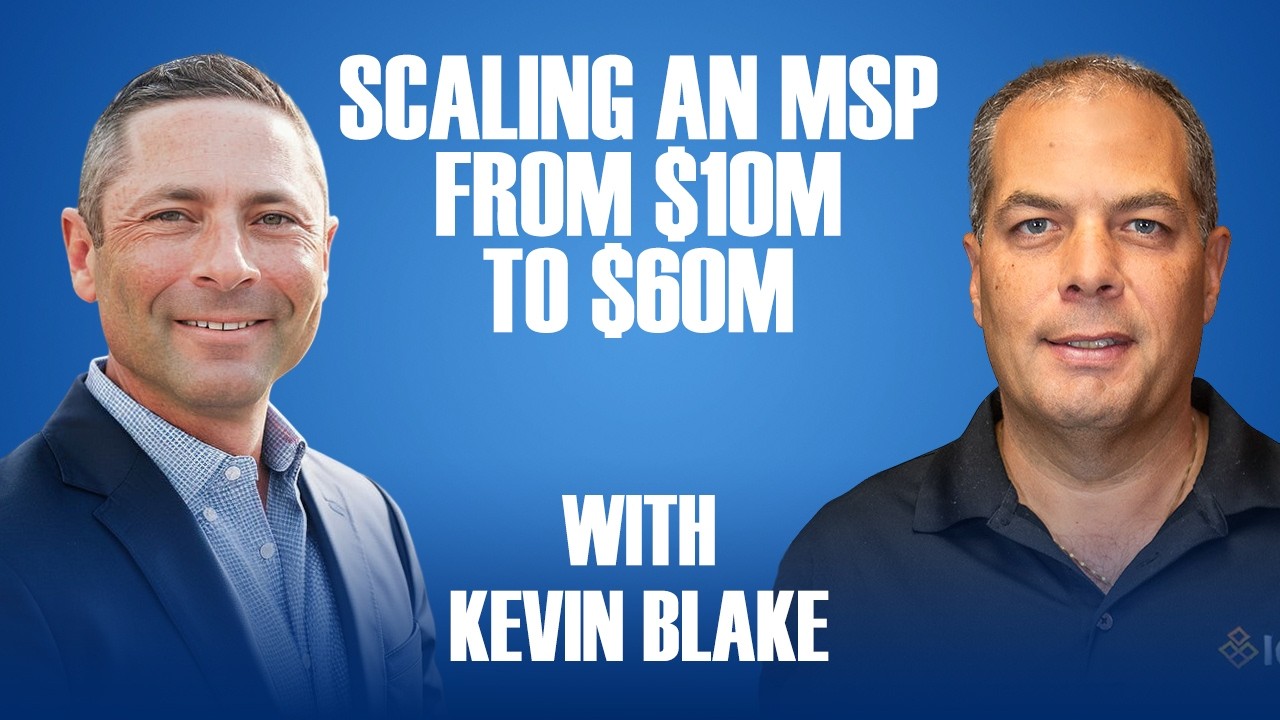
Kevin Blake grew TechMD from $2-3 million to $60-65 million by building senior leadership, structured communication, and a disciplined acquisition strategy. His biggest lesson: MSP owners underestimate how much organizational infrastructure scales require. He hired a CFO, defined an Ideal Customer Profile, and used EOS to move from founder-centric to multi-layered operations.
Chapters
Welcome to the $10 Million MSP Podcast. This podcast is where I dive into the real stories of MSP leaders who have gone beyond $10 million in revenue, how they built their teams, created scalable systems, and turned their businesses into valuable wealth-building assets. I'm Brian Hoppe, strategic coach to MSPs. I work with MSPs generally in the $5 to $50 million range. In each episode, I sit down with leaders who have built MSPs beyond $10 million in revenue to unpack the inflection points that truly matter. From the personal stories behind their journeys to the fundamentals like culture, operational maturity, and driving profitability. This isn't another MSP podcast about tools and tech. On the $10 Million MSP Podcast, you'll get behind-the-scenes conversations with leaders who've built thriving MSPs, their biggest wins, their toughest lessons, and the practical takeaways that you can take back and use right now. If you're an MSP owner who knows that growth starts from within, that mindset, leadership, and strategy align to create both wealth and meaning, then this show is for you. New episodes are released every other week. So let's jump in. All right. Well, today I am joined by Kevin Blake, who is the former CEO of TechMD and currently in corporate business development and an executive advisor with Entegris. Kevin, welcome to the show.
Thanks, Brian. Thanks for having me.
Absolutely. Well, I always like to just dive right in with a good question. And so my question for you is, what would you say that most MSP owners fundamentally misunderstand about what it actually takes to grow from $10 million in revenue to $50 million in revenue and beyond?
That's an easy one because as going through it, it's hard when you're actually running the business. A lot of times with a lot of folks that helped you get to a certain level, but it's all about those key leadership positions and finding folks that have the capacity and the know-how and kind of seen the story to take you through those growth barriers. Running a $10 million business is a lot different than running a $50 or $100 million business, so leadership is key.
Leadership. Okay, so you would say that finding the right people in the right seats on the leadership level is one of the biggest things that enabled you to kind of make that journey?
Yeah, absolutely. I mean, growing from $1 million to $3 million, $3 million to $5 million, to get to that $10 million mark, which is impressive in the MSP landscape, there's some of that, right? So generally an MSP is started by a great tech and They have to figure out how to empower the next great tech, right? Generally, they're also head of sales, right? Because nobody knows their business better than them. Bringing in folks underneath them and building those layers of people that live the culture, and that can— it's the only way to grow, right?
Mm-hmm.
It's no different when you get to $10 million trying to go to $50 million. It's just at different levels of the business, right? It's more of those leadership levels, those middle management levels. being clear and transparent on who reports to what and what are the KPIs we're all looking for. And so everybody's on the same page, rolling the same direction. It's, it's, it's a different animal when you have, you know, 4, 5, 6, 7 layers, you know, from the CEO down, right?
Yeah.
So I might say something, you know, when we're a 20-person company, I could say something to 20 people and the message is received. We're a 200-person company, I say something It's got to go down through executive leadership layer to a middle management leadership layer to a service manager layer to a frontline worker. A lot of times that translation, you just take it for granted that it should just get there.
Yeah.
You have to be very intentional about the communication and the messaging in order to make sure everybody in the organization is doing what's necessary to keep your clients happy and to work towards that vision you've set.
Yeah, absolutely. Yeah. Well, it's like a big game of telephone at that point.
Yeah.
It gets— and the message can get diluted, right? When it's getting passed along among so many folks. So totally makes sense. And thanks for sharing that because, you know, I think that a lot of times people tend to see, you know, leadership as kind of like a squishy type of concept. You know, when you say leadership is key, well, it actually really is. And it's not like a, you know, something that's like this, oh, well, you know, it's not really that important. It's this kind of squishy concept that, you know, yeah, I'm a good leader and they just move on from the idea, right? So building that leadership level at the top of the organization is extremely important as you're scaling for sure.
I would say also leading a frontline worker is different than leading another leadership member, another leader in your organization. You're holding somebody accountable to a different skill and it's one that always needs to be fine-tuned and honed in. Folks that have the skill and are— I've had incredible leaders that care, that fit the culture, right, that just haven't kind of been there and know the difference between leading a group of leaders versus leading frontline workers. It's just a little bit different.
It's a very different skill set, right? Absolutely. Okay, so for those that aren't familiar with you, TechMD, Entegris, maybe just kind of walk us through a little bit of your background. Where'd the business start and where did it ultimately scale to?
Yep, so I didn't found the business, but I was the second hire, right? One of the partners at a local Computerland I was working at went off and started ICS, and I joined him shortly after he had left and started it. Back then, it was in 1996, it was just Novell Networking, and we did some accounting consulting, mass accounting consulting. So I joined at a really good time, right? Windows was just kind of coming out.
Mm-hmm.
being prevalent in the workforce. I was full of energy at the ripe age of, I don't know, maybe 19 or 20 years old. I wanted to grow the business. I really wanted to build something special. I wasn't married at the time, didn't have kids, so I was working 100 hours a week.
No way.
The founder didn't really want a big business. It was evident as I was bringing in new customers and then servicing the customers that he just didn't want to invest in more people. That was not something— our visions really, what we wanted to build, were different. So I approached him after a series of years of going back and forth and realizing that we wanted different things, and I bought him out. Today he still is operating as a sole proprietor and servicing some of our clients from an accounting standpoint, which is what he likes to do. So the year I bought him out, I think we had maybe 3 employees, and we set off to grow. I think it was 2005. We grew organically, a lot on my back, right? So I was still technical, I was still doing a lot of the sales, I was learning how to do accounting and all those things. But I quickly grew to $2.5 to $3 million of revenue, but started having things kind of break down in different levels. I was dealing with— Not technical issues, but one tech saying to another tech, I don't like this guy. What do you mean you don't like this guy? We fix computers. Quickly learned that in order to build, to scale the business and keep growing, I had to figure out how to be a better leader. Right around that time was when I joined, which was HTG, now Evolve, Peer Group System. I joined, I probably had I don't know, 8 to 10 employees. And I'm still in that ecosystem today. I'm now in a group of private equity-backed companies. And that was essential to kind of learn from other folks that were having similar issues as I was trying to grow the business. So, you know, so we grew nicely, kind of went through some of those little growth plateaus with the help of my peer group. And I did my first acquisition in 2010. I bought a company We bought a company about an hour and a half north of us in Syracuse, New York, and naively just thought, you know, the best of what we do, the best of what they do. Went in and told their, you know, 15 or 18 staff that, hey, nothing's gonna change, it's gonna be great. And I spent the next year driving up and down 81 trying to make that work and made a lot of mistakes, but I learned, right? I learned a lot. I learned it was a fast way to grow, but I needed to have a playbook. I needed to be more intentional about it. I liked the acquisition side of it. So again, I turned to Arlen, which has been one of my coaches and mentors for the last 15, 18, probably almost 20 years. He came in and did a SWOT analysis and said, you're the problem. You've got to do better planning. Generally, when there's a problem in the business, you can look in the mirror from the CEO standpoint.
Right.
Absolutely. You have to empower more people. You have to figure out how— You can't be everywhere and everything to everybody. And that's kind of the state I was at. I think I had about 40 or 50 employees and really all of them kind of rolled up to me. So I took the SWOT analysis and with their help went and hired a COO and put a level of leadership layer in. Intentionally, right? I made some mistakes there figuring out how to comp that layer and how to be more transparent, how to open books.
Yeah.
know how everybody's winning at the same time.
Yep.
And I built out the M&A playbook, right? So that was the start of it. So when we did our second acquisition, maybe 2 years later, it went a lot better. Not perfect, you still learn from your mistakes, but I did, over a series of 7, 8 years, I did 4 acquisitions on my own, and they were all $1 to $3 million MSPs in, you know, in about a 2-hour radius of my headquarters here in Endicott, New York. Um, you know, so in 2019, you know, I had done the, the all the different, uh, planning that you all teach you to do, right? So what do you want to grow? Be intentional about what you're trying to grow, right? So come up with your personal wealth target and what does the business have to be worth to achieve your personal wealth target? So I had done that.
Right.
In 2019, I kind of lifted my head when, you know, private equity entered the space. They did their first acquisition, I think it was Wolfe Consulting. I was like, what was that about? And hearing about multiples. And so I kind of did the math of where I was at. I think it was about $12 million of EBITDA and roughly $2 million of revenue, roughly $2 million of EBITDA. I said, my God, at these multiples, I'm well ahead of my business wealth target. So I also wanted to prove to myself that I could do bigger acquisitions, right? But all my assets were sitting inside ICS. So it wasn't fair to my wife to go out and take on more debt to go do a bigger acquisition. So I again turned to my group of advisors and created, if I'm going to do a deal, what would a perfect deal look like to sell part of the company to a private equity firm? And I crafted a must-have list and a nice-to-have list and talked to my peer groups and peers that were kind of in the same boat. I had this blueprint of what I was looking for. Then I went off and treated it like a job, just like I treat it when I'm going to look for M&A targets. No different than looking for new clients in your MSP.
Right.
What's the ideal customer profile? What's the geography? What's the culture got to look like? What's the business maturity? I treated it the same way I treated a customer acquisition. Who's going to be a buyer of ICS that will check off every one of my must-have lists? Maybe tick a few of my nice-to-have lists. So, must-have list is be a platform, double-digit multiple, certain salary, believe in my M&A strategy. Nice-to-have list might be a country club membership.
Right.
So, I talked to a lot of different suitors in that year. And ultimately, I met a small private equity firm out of California called Clearlight Partners. I flew out and I met with them. I was very direct. This is what I'm looking for. This is kind of the deal breakers, and they checked every box. So when they did, I did the deal in March of 2020, which was an interesting time. I did it March 10th, 2020.
Oh, interesting.
We did not know at that time that 6 days later we'd have a stay-at-home order for the better part of 2 years. So that was interesting. But it worked, right? So we did the deal. I sold 80% of ICS. I kept 20%. And we did our first larger acquisition. We bought a roughly $1.4 million EBITDA company in New England and integrated that company in. And then did 4 more acquisitions. We did 3 in 1 year.
Mm-hmm.
And, you know, kind of, so we quickly grew up to roughly $65 million range.
Yeah.
Learned a ton. So one thing private equity does as a partner is teaches you how to use debt. Historically, debt was bad. I didn't want any debt anywhere, so I would try to cash flow everything. But when you really learn their playbook and how they utilize debt and the returns you can get if you use it properly, it's incredible. Absolutely incredible. So, we did, from mid-2020 to June of this year is when we recapped with Integris. We had grown from $12 million in revenue to about $60 million of revenue, $65 million in revenue. And then, Rashad Bajwa, who I think has been on your podcast, we were very close. We were in the same peer group for 5 years, a large company group in Evolve. We had talked a lot, and we were on similar paths. deal in 2020 as well, but grew a bigger company. They did bigger acquisitions. They had a little bit more aggressive private equity firm. But at the heart of it, we were both trying to build people first, right?
Absolutely.
A culture-centric MSP, fully integrated. We both believed the same thing, right? In order to unlock the power of your size, your breadth in every area of the company, you had to be fully integrated. There's a lot of different playbooks out there, and a lot of different levels of integration. The one that both of us chose was the really hard, everybody does everything the same way in every piece of the company.
Yeah.
But it unlocked a lot of value. When I say hard, you have to take, for firm lines, and it does cause some customer noise and ultimately some churn when you're doing that full integration. But when you get to the other side of it, it's far worth the benefits. You have an organization that is very powerful, it can do a lot of things, and the folks underneath you have great career opportunities.
Yeah.
One of my nice-to-haves, must-haves, when I originally thought out of this platform MSBO was trying to build and have a private equity sponsor invest in was I only wanted to be in the Northeast and I only wanted to be on the road no more than 30 days a year. Both were 2 years in, we bought another peer group member of mine, a good friend of mine. It was a $3 million, roughly $3 million EBITDA acquisition in California. I was flying across the country integrating that company. So you can see how things change a little bit as you get into it. But I also think COVID changed the world, right? It shrunk.
Yeah.
So a lot of that was when you buy companies, everybody has a little bit different culture, right? So you try to do as much due diligence upfront to understand how that organization ticks. What are the important things to keep people still happy and motivated? And then you cast your vision. I watched Rashad kind of go through it as he did his 9 acquisitions, and we did our 5 with Clearlight. I did 4 on my own. So when he recapped in December of 2024, at the end of the year, we were talking along the ways and he was like, we gotta come together. We have similar visions. We're fully integrated. I have a big new partner in Omer's. It's a It's a pension fund. So it was— we weren't on the market. You know, we had talked, you know, me and Clearlight, to hold the business and run a process, uh, mid-2026. But, uh, this made a lot of sense. And, you know, I, I watched a bunch of my friends that are in this peer group kind of go through the full process, like Medicus and, uh, Thrive and, um, Integris. And, you know, I, I didn't really want to go through 20 management meetings and ultimately not have full control over where I land. So I was happy that we were able to get the deal done. It was a preemptive offer. It was quick, right? So we started talking end of January, beginning of February, got to LOI in March, and we're closed in June.
Wow.
So now we're 800+ employees, national, I was originally going to stay on for 6 months to just help transition the business, but I got involved in the M&A side of it, and now I'm kind of heading that up. I'm having a lot of fun. There's a lot of activity in our space right now, as you probably know.
Yes.
We're roughly a $250 million MSP, organically and inorganically growing. I kind of am living in the inorganic Yeah, I love that.
I love that, man. So, well, thank you for sharing all of that because it's, I mean, that I think that all informs, well, your deep level of experience as well as, you know, as well as what's possible for MSPs out there. You know, I don't think that it's over. I don't think, you know, I think we're going to continue to see a lot of this kind of activity happening. And so, you know, I think that's really exciting. You know, there's definitely places where others can do the same or similar to what you did.
Absolutely.
So, yeah. So let me ask you, how did you kind of decide on your strategy for growth? Or, I mean, obviously you were trying to grow organically throughout that whole process, but throughout there you did a lot of acquisition on your own and then with private equity. So, talk about how you decided to do that and decided that was a great idea for you.
To grow— the strategy to grow organically, you mean?
Yeah, to grow by acquisition, because it seems like that's the majority of the growth that you experienced.
No, I mean, we still achieved year over year, I would say, 12 to 15% organic growth. That was harder than the Inorganic is easier, right? You can buy EBITDA, right? The hard part is integrating it. We got good at that. But the organic side is actually hard. It's challenging, right? So we had, I don't know, a 25, 30-person go-to-market team. We threw a lot of stuff against the wall in terms of marketing, in terms of events, in terms of SDRs.
Yeah.
You have to have both. To get the valuations that people are hearing about out there, you're not going to get it by just buying a bunch of EBITDA and trying to hold on to it. You have to be intentional and very strategic about what you do after you buy it. How are you integrating it? And track the results. How much of the customers are you maintaining? How much of the customers fit your ICP and even can you be successful with?
Right.
One of the early acquisitions I did on my own, I bought a company and they were more break-fix/Var than MSP. I was all MSP. I didn't realize the importance of that. It taught me the importance of ICP. I thought, oh, we're going to go in there. That company probably just didn't figure out managed services, so I'm going to go take all their clients and flip them over to an all-you-can-eat model and it'll be great. No, the clients they had didn't want an all-you-can-eat model. They liked being at a break-fix shop. They made that choice and they didn't want it.
Right.
The importance of defining your ICP and spending your marketing dollars to go get the right customer pays so many dividends. When you veer from that, you might land some clients, but it costs so much pain to your people, to your organization. Ultimately, you're kind of swimming uphill, and it's hard against the current.
Yeah.
So, we had set out, the other thing private equity did is, Really, you know, the first thing they did when they invested in us was, hey, we're gonna go hire a CFO, and it's gonna be this caliber CFO, and it's gonna cost this much. I'm like, we're gonna spend $300,000 on a CFO? And I'm like, I think we've been doing pretty good without it. And they're like, no, trust us, trust us. And I don't know how I made it, you know, before I had that level of expertise, right? So having the data in front of you And being able to know what levers to pull, what's working, what's not working. You can't grow, particularly from $10 million of EBITDA on up, unless you have incredible business intelligence and clean data, right? And know that you're looking at the right numbers.
Yeah.
If you don't have that, I don't know how you get past— you might be able to get to $10 million of EBITDA, but It won't be— you won't get to the next level.
Gotcha. So let's talk about that. So was it when you were around $12 million, the first private equity, and that's when you brought on the CFO?
Yeah, it was about $2 million, a little over $2 million of EBITDA, maybe $2.2 million of EBITDA. We brought on a CFO, and that was new to me. I mean, I had an outsourced CIO, but not a true— or CFO, not a true private equity experienced CFO.
Mm-hmm.
These guys aren't figuring out taxes and bank recs. They are integral to every decision-making process in the organization. Pricing out deals, building out models for comp, insurance. They just know how to take data and put it in a format That's digestible to all the leaders in the organization so you can make good decisions and grow the right way. That was my first— it was like 3 months after we did the deal, we had onboarded our first CFO who built out the accounting, finance, business intelligence function inside our organization.
Okay, gotcha. Looking back, would you have Knowing what you know now, would you have made that hire earlier in your process?
You mean before I took on private equity money?
Yeah.
It's hard to say because I was so focused on getting the EBITDA above $2 million, or as close as possible. To spend $300,000+ on a CFO with variable comp, it would have been tough. And I didn't know the value of it. So having the partner who's been there and done it and, you know, seen the movie, uh, say, no, no, trust us, this will pay for itself. Um, you know, there's some trust there. I mean, ultimately they own the majority of the company. Not that they exercised it like that very often, but, um, it would have been difficult for me as the sole— as the main owner to, um, make that call on my own and trust the fact that, hey, I'm gonna go spend— I probably would have tried to cut the corner and found a You know, a comptroller that could do the modeling stuff or spreadsheet stuff, but would I have grown faster if I did? Yes.
Gotcha.
But when you're in that world and you're in every aspect of the business, and even at, I don't know what we're at, maybe 80, 90 employees when I did the deal, I had an executive leadership team. that were fantastic, but they were all kind of grew up in the business. This was mostly the largest company they ever worked at, and we were trying to take it from $12 to ultimately $65 million in 4 and a half years. Having leaders in the organization that had been there and done it and seen it made that a lot easier. What I would have done quicker is brought in leadership members that that were better than me in those areas quicker. We would have grown faster if we did. I was probably too slow to make harder decisions on folks that I cared about a lot, but were a little bit over their skis in the size company we had gotten to.
Yeah, gotcha. This is an interesting question that I think probably a lot of MSP owners have, right? When you look at businesses that are maybe in the $5 to $10 million range, like you said, there are— it's a lot of homegrown kind of talent, right? And everybody's operating at the highest level that they ever have before, right? Correct.
And you're a very close-knit group because you work arm in arm every day, all day together.
Yeah. And which is great for culture. It's great for the camaraderie of the team and just how well they all tend to work together because it's been like 10 or 15 years. Everybody's been working together or something. So, as you think about that, based on what you know now, at what stage do you think it's critical to start bringing in outside expertise to the leadership team?
Yeah, I think we're talking in terms of EBITDA, right? So, $5 to $10 million EBITDA. I think that finance function is critical before even the $2 million mark of EBITDA.
Okay.
You know, when you get—
And sorry, just to clarify, I was talking about revenue.
Oh, revenue, yeah, yeah. It was revenue. So $10 million in revenue. $10 million in revenue, you are, you have to have pretty much every level at the executive leadership level, I think, needs the experience, who's been there and done that in order to be successful. I say that in my own ability as CEO, who I am in the largest company I have ever worked for, right? So I graduated college and started at ICL, the Monday after.
Yeah.
But a lot of, being my main job at that point at $10 million of revenue was to catch the vision and really be the glorified cheerleader to keep everybody, but I couldn't be the guy that was actually talking and touching. So the message I was sending out needed to come down through the leaders so that when the frontline workers had questions, they could go back up to their leader and they're getting the same answer of what I was preaching up here. That's different, right? You have another layer in there. At $10 million in revenue, you can have your hands on a lot of things, right? We were at $12 million in revenue. Like I said, I think we had roughly 80 employees. I could still touch a lot of them. We were in 3 offices, 4 offices, but all within an hour and a half drive. When you start going and spreading out geography and you now have more of a hybrid workforce, that messaging and the leadership layers, right? So I think people that— having people that have been there and done it is essential, and you'll grow faster. You're gonna make some mistakes. There's signs, you'll see signs, you'll just chalk them up to, oh, this is just unfortunate. But if you had the different leader there, you know, you look back, I look back, you know, if I would have made some of those changes quicker, we would have been farther along in those 4 and a half years.
Yeah, yeah, that's, that's, I think that's a good point, uh, because, and I think it's something that a lot of folks miss is, uh, you know, how, and, and now, um, where we're at in the industry today, there's a lot more experienced people out there than there were even 5 years ago, right? People who have done more and been in there.
There is, in the, especially the finance area, right? So yeah, when you look at like operations and VP layers of people that have been there and understand MSP ecosystem. Particularly where we're at today, Integris, I think we're one of the top 5, definitely, probably 2 or 3 largest MSPs in the country. Not a lot of folks out there that have been there, so you're hiring out of industry for some of these roles.
Yeah.
And hoping they can come up to speed on MSP. MSP's unique. Even private equity, I'm now working with 2 different private equity firms, Clearlight Omers, it's unique. Even the way, you know, how close the industry is between the peer group structures that are out there and how the key vendors, you know, the Kaseyas and the ConnectWises of the world have brought everybody together for their conferences. Everybody knows everybody. I know personally, I'm close with, you know, all of my competitors' CEOs and, you know, a lot of times other leaders because of how intertwined our ecosystem is. It's pretty special. I mean, when I explain to my private equity firm about our peer group and how we're in the same room with the other private equity-backed largest MSPs in the country every quarter face-to-face and we share financials and we hold each other accountable, they're like, what? We bid against these guys. We're trying to get large customers from these guys. We're trying to buy companies against these guys. That never comes up. It doesn't. The peer group structure is basically kind of lonely at the top. It's hard to go talk to folks when you're struggling with decisions, like leaders, right? So having to replace someone that's been with you a long time, that's a hard thing to do. And to be able to go talk to somebody in a similar role with private equity backing that is really trying to grow to get a good return, it's nice to have that support system.
Yeah, absolutely. So I guess on a On a slightly different note, where do you think that you kind of, I guess, underestimated what the complexity would be as you were scaling?
As I was scaling?
Does that make sense? Yeah, yeah. So, like, where did you see complexities show up that you did not expect?
Yeah, for sure on the inorganic side, right? So merging cultures is Really hard. When you do 3 acquisitions in a 6-month time and have 100 new employees come under your umbrella and try to vision cast down through and be able to understand little things that were important to an office in Maryland versus an office in California versus an office in upstate New York versus an office in Massachusetts, that's hard to do. For sure, when you bring in leaders that have been there and done it, they know what to look out for and they know how to ask the right questions and they know how to capture those data points. But that was hard. The other hard part was I didn't realize when I was at $12 million in revenue and took on institutional money, private equity money, that my role, I mean, at least 50% of my job was managing the board and managing your investors. So the way private equity works is they take money from investors and they invest in companies like ours. and they are beholden to them, we're beholden to them, so information and being aligned and understanding the strategies, understanding the gotchas when things don't go right, reporting up fast and talking through it, it's collaborative and it can be helpful. I didn't realize how much of my time was gonna be spent right there. So for the most of my time was, yes, I was the CEO and ultimately cast the vision and had to manage the executive leadership team to make sure they were going all swimming in the same direction. But those leaders needed to be able to work on their own because between acquisitions and managing the board, I didn't have much free time.
Right.
And I was working a lot of hours, a lot harder, different type of working than I was, $10 million and below revenue, you're in the weeds in a lot of areas of the business. You just are. You're getting pulled into large customer meetings, you're getting pulled into upset customer meetings, you're getting pulled into sensitive employee issues. To grow from $10 million to $50 million, that leadership level underneath you needs to be able to handle those steps without you involved. And to be able to handle it in a similar way and keep me, the CEO, informed on the important things so I could report to the board, but not have to actually go down and be working through every step of problem resolution.
Right.
I didn't see my role when I did the deal and what it would take to grow from $10 to $12 million in revenue to $65 million, as being— I figured I'd be more involved in large customers and stuff like that.
Yeah.
But you learn a lot, right? So I'm a lifelong learner. I learned so much through that first hold period. I made a great network. I have no regrets. And now in my new role, And it's an adjustment not being the CEO, but I will tell you, the other thing is I don't have a huge ego. You can't. I don't know how, if folks have big egos. Egos, when you're hiring leaders, if you sense a big ego, it's really hard to scale a company, right? So you gotta have team players that are, and you gotta make sure they're all swimming towards the same goals. That's why comp structure is so important. I spend a lot of time on that.
Yep.
Because you might bring in a leader that, you know, just where they're at and to get them, it might be $100K more annually than another peer on a leadership team. There's a reason for that, right? And having— it's not like you do that, all of a sudden you make everybody equal. So you have to manage through those things, and that takes a lot of time and effort and work.
Yeah, 100%. So speaking of, like, as far as your growth as you grew the company. Obviously, you have to grow as an individual. You're a lifelong learner. What do you think were the biggest things that, or the biggest ways that you had to grow personally as you grew the company?
It was investing in things like personality training and understanding how people tick and then delivering that training down through all the different leaders in the organization and the employees. It's the soft skills. It's the listening skills. It's the— you'd think it's the basics and people just inherently understand that, but they don't.
Yeah.
Through Evolve, we learned about Make a Difference, which is a personality test We give that to every employee, and every employee has a dominant personality trait, right? So I'm a lion, you know, every employee has a Beanie Baby on their desk, so they know what personality they are, right? Are they more extroverted, more introverted, right? So how do they tick? And that fosters good communication between, up and down the org. Those are areas when I was, you know, below $10 million that I would say, you know, that should Hire people that get it, right? So you can't hire everybody that gets it, right? You have to train folks. You have to invest in training, and not just technical training, right? The technical training is the easiest part of it. It's the soft skills, it's leadership, it's personality differences. Those are the areas where I did not see the importance when I was smaller, but as you're bigger, they're essential.
Okay, gotcha. And, and you've mentioned a few times with With peer groups and those kind of things. I mean, where— I would imagine, I can imagine the answer to this question. Where do you think you would have gotten had you not participated in a peer group?
I can't even imagine. I can't even begin to think where— how people do it without having a peer network. I just don't, right? So it might not be the Evolves or Gary Pikas of the world, the True Methods or Rob Robbins. It might be folks can get it through a Vistage or a coach, business coach, but I can't even tell you where I think I would be. I wouldn't be where I am today, that's for sure.
Yeah.
I leaned on that group and that ecosystem a lot, especially when I hit plateaus, right? So I got stuck at certain levels, certain growth levels. you just kind of bang your head against the wall because everything you know inherently isn't working.
Mm-hmm.
You need an outside perspective, somebody to help you kind of get outside of the business and get above it and really understand what is the true issue here. Why aren't we growing from $20 million to $50 million? Is the org chart set up right? Are the comp plans set up right? We originally tried to find homes for a lot of folks and created this regional-based org chart, which just didn't work. So you gave— we made, you know, kind of people had P&L control over certain regions, and that doesn't foster a team. We want to be fully integrated. If someone's really geared to grow one region versus the other, that doesn't work when you have centralized services. So tearing that down and going back to a roles-based org chart. That took me a while to figure that out, that this just wasn't working, and to be able to abandon that and pivot and create the roles-based org chart and roll that out, that was a big turning point for us, and it unlocked a lot of growth once we did that. It freed up a lot of capacity in the business. People were generally happier. But it was a hard decision, and I used my coaches and my peer group structure to kind of help me make that decision.
Yeah, absolutely. And so I'm always talking about that as I looked back after selling my business, the 3 big things for me and for our team: joining a peer group, implementing EOS in the organization, a business operating system, and a coach.
With an outside facilitator?
What's that?
Implementing EOS with an outside facilitator?
Well, we self-implemented, but we also had a coach, which was kind of, you know, it wasn't an EOS implementer, but, you know, but yeah, the coach being the third one.
Yeah.
All of those things together just created an ecosystem for success inside the business that was not there before that. Before that, it was just like, I'm not really sure what to do here. But if you've got people to bounce stuff off of, If you've got a system for running the business and if you have somebody telling you, you're not just like doing it all on your own, you've got somebody who's holding up a mirror and saying, hey, this is not so good. Well, maybe we should do something different here. That being a coach, all of those things, like, were just, I mean, just catalysts for growth for us. And so it sounds like that was a very similar view.
Same for us, right? I should have called that out. EOS, like when we rolled that out, I think we were probably $7 or $8 million in revenue. That was a game changer. That was kind of like, we were at kind of a plateau where we were at, but when we rolled out EOS, I did try to self-facilitate myself for maybe 2 or 3 quarters. The rest of the ELTs were like, no, you're too ADD, it's not working. So we brought in an outside consultant.
There you go.
And it was a game changer, right?
Yeah.
We made decisions faster as a team. We talked about the right things. We didn't squirrel. I mean, I don't care if it's EOS or whatever system you implement. Having that system that gets the right issues to be discussing out in open and problem solving is going to get you growing faster. No question. That was influential to us.
Yeah, okay, gotcha. So, so I want to get into—
That was like the get it, want it, have capacity exercise. I mean, doing that every quarter and really having each person in the organization that owns each, you know, ops and sales and back office, HR, finance, having to go through that exercise, you know, it really highlighted when the same name kept popping up quarter after quarter. We got to do something here.
Yeah, we got to do something about that. Yep. And did you use EOS all the way through to $65 million?
Oh yeah.
To run the business?
Yeah.
And as I've had conversations, probably at some point beyond—
We did morph it a little.
$100 million?
Yeah, we got to about $50 million and it wasn't— we kind of morphed. It still was EOS, we were still using whatever Traction Tools is called now and capturing all of our to-dos and creating our VTO and Tying it back to our 1-year forecast. But we relaxed some of the rules of the good news and all that stuff. But we still used— the heart and soul of it was to get to the issues and the right to-do and make sure everything reporting back each quarter, what has been done, what has not been done. We still use that.
Yeah, and some of that stuff does start to break at scale, but you can adapt as you did and change in every I want to talk for a minute about the culture because you've mentioned culture a few times. What would you— how would you consider, A, the importance of it, and B, how you manage to maintain and support the culture that you wanted inside the organization as you scaled?
Yeah, culture is everything, right? So you are nothing without the people that work for you. Our culture was really driven off my personal mission, which was our vision, to make a difference in every person I encounter. Business mission, same thing. How to have a positive impact on our employees, our employees' families, our customers, our communities we serve. Having that and having people— yeah, you can pay people to come to work. And they'll give you the allotted time. But if you want them to go above and beyond, and, you know, it's because they're doing it for something greater, right? So because you've created a culture that, you know, rewards that, and, you know, people want to be a part of something that isn't just making money, right? So they don't care about making money, which is another one of the real big things why I wanted to take the preemptive offer with Entegris to sell TechMD. just because the private equity sponsor is a pension fund, right? So I'm able to go back to my, you know, 300 employees and say, hey, we have— we are now backed by OMERS, which is investing frontline workers' money, right? So we're trying to get a better return for hardworking frontline municipal workers in Ontario County.
Yeah.
That resonated, right? That resonates across the org, right? So that was important I mean, it aligns with the culture that I've always put front and center, right? People first. We don't make decisions based on bottom line, right? So yes, bottom line impacts budgeting and planning, but as far as day-to-day decisions, if Brian has a sick kid or an ailing parent and needs to take an extra month off of work this— fine, go do it, right? So that resonates across the org. Right, so I don't know how anybody grows a business without a strong culture. And you see some other platforms that are struggling right now that just, they have gone through so much turnover from the top down, the culture's kind of, people don't know what the culture is or what the vision is. And you start to see employee turnover, which then leads to customer turnover. That's a hard spot to be in.
Yeah, 100%. So yeah, and that's a common message that I hear throughout these kind of conversations with folks who are $50 million plus, it's like, you know, the culture is the lifeblood of the organization. And it also takes a different skill set at that level for a CEO to kind of like perpetuate that culture throughout the organization, right? Than it does obviously when you're, you know, $5 or $10 million in revenue. And so obviously—
$5 or $10 million in revenue, you can go down and touch a lot of people. When you're at $50 million in revenue, you are trusting that everybody you have working underneath you is fostering that culture, is living those core values. So you try to hire and fire and reward on the core values that ultimately speak to the vision, but it's much harder at that level because you just— a CEO can't touch 900 people. You just can't. Yeah.
Yeah, yeah, absolutely. And, um, yeah, and, and just the people-first aspect of things. And I hear that a lot, you know, where it's like—
That's one of our core values, people first.
Yeah, yeah. Well, and you tend to see people that are a little bit stingy with perhaps something like you mentioned, hey, I need a month off to go take care of this life crisis. Uh, well, we can't really do that, you know, that kind of a thing. And, um, and, and I hear that over and over again from from folks in your spot and beyond. It's like, hey, it's all about the people. It's all about the people.
Yeah, which is why egos are bad.
There you go. There you go. I love that.
I like to think of an org chart as— I always say this, especially when I'm hiring leaders— flip it upside down. Your job is to unleash the roadblocks and help enable the person above you to be successful, right? And you want that person thinking the exact same way, right? So it's not a, you do this, you do this, you do this. It's a, what do you need? How can I help you? It just goes a lot farther.
Yeah, 100%. I love that. So for a minute, put on your— speak to the guy who's maybe running an $8 or $10 million MSP. They want to hit the $20 million mark in the next 4 years and do a private equity exit. What are the things you're telling them that they've got to get under control or hammered out, or where are the places that they ultimately specifically need to focus in order to have the best possible outcome?
Yeah, so $8 to $10 million is a decent-sized MSP in our space. They have probably done some work on operational maturity. They probably have a layer of leaders inside the org. They probably have a sales team deployed. And they want to grow from 8 to 10 to 20+, to get to that— you get above $3 million of EBITDA, you're now in 12 to 15x range multiples.
Yeah.
Assuming certain things are true. ICP, my guess is an $8 to $10 million revenue company probably still has some bad revenue under the hood, and it doesn't want to make a hard decision because that customer has been with me for 10 years. But they won't accept price increases, they won't adopt your standards. They pay late, right? So, you know, that's doing more damage than good, and those are the hard decisions that need to be made in order to grow, right? Because your people see that you're allowing customers like that to stay here, right? I call it bad revenue.
Mm-hmm.
Defining that ICP and having as much of the revenue sit in those ICPs, whether it's verticalized, whether it's SMB. If you're a 20 to 100 user SMB-focused managed service provider, yet you go land a help desk only contract with a 2,000-person organization, that breaks. Yes, it's revenue, and you might think that's counterintuitive. We said we want to grow. That's the wrong revenue.
Right.
That's going to consume your resources. Your resources are not going to be happy. because the rest of their time is spent supporting 20 to 100 computer users, right? Maybe a company bound by compliance or whatever, a certain vertical.
Yep.
So, tightening up the discipline around the ICP, I know it sounds counterintuitive, but when you do that and you spend your sales and marketing dollars on that to go find those customers and bring that revenue in, you'll start to have a flywheel, right? So, your sales team will know how to win with those customers. Their time will not be spent chasing those 2,000-user help desk only type engagements that you might be able to support for a year or two, but ultimately they're probably going to go shop for the lowest person out there. ICP is one, right? Stay true to the culture.
Mm-hmm.
I'm assuming the organic, inorganic is part of the growth. It would be hard to grow in the next year or 2 organically to double the business, an $8 or $10 million business, you'd have to figure out the inorganic strategy, the M&A strategy. What kind of companies do you want to buy? You want them in your geo, operational maturity, culture, that is key. I've learned a lot of lessons and it's hard to start. Your first acquisition, you're going to make mistakes. support you stronger, you're gonna make some mistakes. So I would, if you're not in a peer group, be in a peer group. Look at every avenue to grow the business, right? So channel right now, channel is, you know, the Tolarises and the Sandlers of the world are out there. People are seeing a lot of success leveraging them, you know, but you have to still stay true to your ICP.
Mm-hmm.
So those are some of the things.
Yeah.
You look at margin of your customer and do you have— by client, right? So one of the key KPIs we look at when we're looking at buying businesses is what is your all-in C price? Because that tells you a lot about the maturity of a client. And if you can go back and start looking at some of their agreements that are in place, looking at the all-in C price and it's coming out to $70 or $80, you're like, What are they doing for that? Are they doing price increases? Those are some of the key things. Staying true and not just taking revenue at all costs. I know it also sounds counterintuitive, but when you stay true, it just starts to— the flywheel starts.
Mm-hmm.
Everybody in the organization knows how you win. You know what customers to get. When the opportunities arise, you know how to win them, and you win them. So on the organic side, those are the keys, right? Investing in marketing. Usually you can probably get to $8 to $10 million and not spend a lot of money on marketing, if any at all, right? A lot of referral-type growth. At that level, to go to the next level, you have to understand marketing. You have to understand where to spend the dollars, right? Is search still the right answer? You have to understand white space mapped across your clients. You might have 500 clients, and 200 of them buy your all-you-can-eat, but then also buy their hardware, and all their licensing, and their backup. Now you have some AI go-to-market solutions you're starting to sell them, but you have another 300 clients. What's your strategy and plan? You have to spend money to make money. You might need to add some resource on the sales side to go capture the rest of the white space and the customers. That's the lowest-hanging fruit. You have a client that's already paying. Right, so how do you maximize that? Building out those strategies around cross-sell, upsell, new logo attainment, and all the different areas to do that. Is there another product that you don't currently sell today that you can go learn and bring in-house and sell across? You have a captive audience, right?
Yeah.
So at $8 to $10 million, you have a good client base, and understanding that and creating the plan to go get it. You can buy it too. That's probably the fastest way to get there, but now it's your integration strategy. Do you have the right people that can integrate it? If I was at $8 to $10 million today and I hadn't done an acquisition, I would go hire somebody, and they would probably be a $150,000 to $200,000 resource that has done it. Maybe an ex-CEO, maybe an ex-somebody from the vendor side who understands MSP, that knows if you're ConnectWise shop, whatever it is, can help integrate the databases in a way that everybody can start using things the same way. 'Cause that's gonna unlock capacity, right? So you won't need 2 service managers or whatever. You'll be able to reduce some headcount if you integrate properly.
Yeah, yeah, that's great. That's a, that's a whole great list of stuff. And a lot of it is, that's all pieces of operational maturity, right? Like the TCP, the, you know, kind of your strategy for selling into that and, you know, increasing your all-in seat price. All of those different things definitely go into that. So thank you for sharing that. I'm sure that'll be very helpful.
I would also say that I didn't talk about the vendor side, but the vendor side, we had a lot of success with, right? So don't treat vendors— don't try to beat them up to the lowest price. Build relationships with them, right? Join their boards, understand how they win. They, they, they, they send— they could send a lot of business. They can provide you a lot of MDF funds to pay for your marketing, right? Investing in on the vendor side, that's a piece of that maturity as we talked about. Usually $10 million, you don't have somebody dedicated to go work those relationships. When we set some budget aside and we hired someone dedicated to that, it unlocked a ton of us, particularly around the Microsoft stack.
Yeah, that's great. Okay, so just as we kind of wrap up here, this is a question I always like to ask because, well, it just brings out some different things that we've been talking about. So, what would you say is the biggest mistake that you've made as a leader?
Not making decisions faster, right? Particularly around people, right? Whether it was someone that was a direct report of mine or a direct report of, you know, one of my direct reports. And, you know, you've probably done it yourself, sitting in a EOS meeting and and hear the person's name, but also hear the excuse. Well, that person's on our largest client, and that person's brother is an employee there, but that person's a cancer, right? So you're gonna end up in the same spot. One thing I've learned over the years of doing this, you end up in the same spot.
Right.
You do. If that name is popping on your EOS board every quarter, you're better off just peeling the bandaid off and dealing with it right away. So I would like to think that we would have been Probably closer to $80 to $100 million of revenue with the same amount of acquisitions we did if we would have made decisions faster.
Yeah, that's a really good one and one that I hear commonly, especially around people. And it reminds me of the, you know, Gino Wickman did these 10 Commandments of Decision Making or something like that. Or solving issues. And one of them is thou shalt choose short-term pain and suffering, right? So it's like, hey, you're gonna end up in the same spot.
So do you want to control the narrative or do you want to let the narrative happen to you?
Yeah, exactly. And so it's like, you know, and then another one is, well, thou shalt live with it, end it, or change it, right? So if you're dealing with that people issue, well, you got to live with it, end it, or change it. Those are the only options. And a lot of times we just live with it for way too long and living with it should be absolutely the last resort as we're doing this stuff, right?
Yeah.
So making the hard decisions quicker. That's a really good lesson. And thank you for sharing that. So, okay. So as we wrap up, I like to do a quick lightning round. And so the whole thing here is what comes to mind first? Short answers. Yeah, first thing that comes to mind. So, first one is, what's a belief that you've changed your mind about recently?
A belief I changed my mind about? Not all churn is bad. Employee churn is bad, right? So, Understanding that because I want to grow a business fast, not every employee wants the same thing I want. Being able to be happy for that person to leave and go work at a small competitor, that's what makes them happy. Be happy for it. Not all employee churn is bad.
Good, that's great. What's something that you've been curious about Oh, AI.
I am consuming everything and everything possible around AI. I think it's going to change our businesses. I think it's going to change our customers' businesses. And I am all in and want to understand. I don't think the answers are right in front of us right now. I think there's a lot of noise around it, but it's going to be revolutionary. And I lived through Windows. I lived through internet dial-up to cloud to— I think this one's coming faster than all of them.
Yeah, wow. Yeah, and adoption is definitely faster than most anything, right? So, okay, and so what's something you can't live without in your daily routine?
Oh, my workouts.
Workouts, okay.
Yeah, I'm just, I have such a, I go to the gym at 5:00 AM. As you get a little older, I'm 52 now, your metabolism slows down and I just, I feel so much better when I work out in the morning. I got a good group that keeps me accountable at 5:00 AM. And the days I am traveling or I miss it, it's just, it's not as good a day.
Yeah, there you go. Okay. And what is your go-to way to unwind, like in the evenings?
Go-to way at the end of the evening?
Yeah. Your go-to way to unwind.
Uh, it's, it's spend time with the family and exercise. Um, you know, we have, we, we have a lake house, which I'm fortunate to have, and that time there is— it's, it's only an hour and a half from our house, but it's, uh, it's, it's, it's 100% stress relieving. Um, you know, and just, just going for long walks, you know, with my wife. Uh, that's the number one way I unwind.
I love it. Um, okay, and then what is a book or idea or a piece of advice What's the business book or resource that you feel like has shaped you the most?
I would go all the way back to when Arlen Swanson, who's been my coach, said, you need to get tech dumb if you want to grow this business. I was a good tech, and that is so true. You got to work on the business. E-Myth, the good technician isn't going to be the the good $50 million business operator. So always be learning, right? I consume podcasts and read books, leverage my network. Where can I be personally growing? Where am I not holding myself accountable in all the different areas of life, right? So yes, vocation, but family. And I can easily put my head down. Work's an addiction. and miss 3 weeks' worth of date nights with my wife. So having that structure there and just always be learning and having people hold you accountable in the different aspects of life.
That's great. Awesome. I love it. Okay. So Kevin, really, really appreciate you joining me. This has been great and I'm sure it's going to be helpful to a lot of people. Where can folks get in touch with you if they wanted to reach out?
kevin.blake@integrisit.com.
Okay, awesome. And I'd imagine you'd be happy to have a discussion if they want to sell their MSP to you or that kind of thing.
I go to a lot of events. I speak at IT Nation a lot. I'm usually at the DataCons, so I'm out there, happy to have conversations. That Go-Giver mentality, that was another influential book, reading that. That book. That's who I am. That's what wires me. So if I can help anybody, I'm happy to help them.
Awesome. Awesome. Well, Kevin, you've been helpful to me, so I sincerely appreciate it. Thanks so much for joining us on the podcast, and we will definitely talk soon. Great.
Thanks, Brian. Love being on.
Thanks a lot. Thanks for listening to the $10 Million MSP Podcast. I'd like to encourage you to take just one insight that you heard today and put it into practice. Because small shifts create big momentum. If you enjoyed the episode, make sure to rate and subscribe on your favorite platform so you never miss a conversation. Thanks again for tuning in, and I'll see you in the next episode.