Scaling an MSP from $8M to $47M w/ Shawn Torres
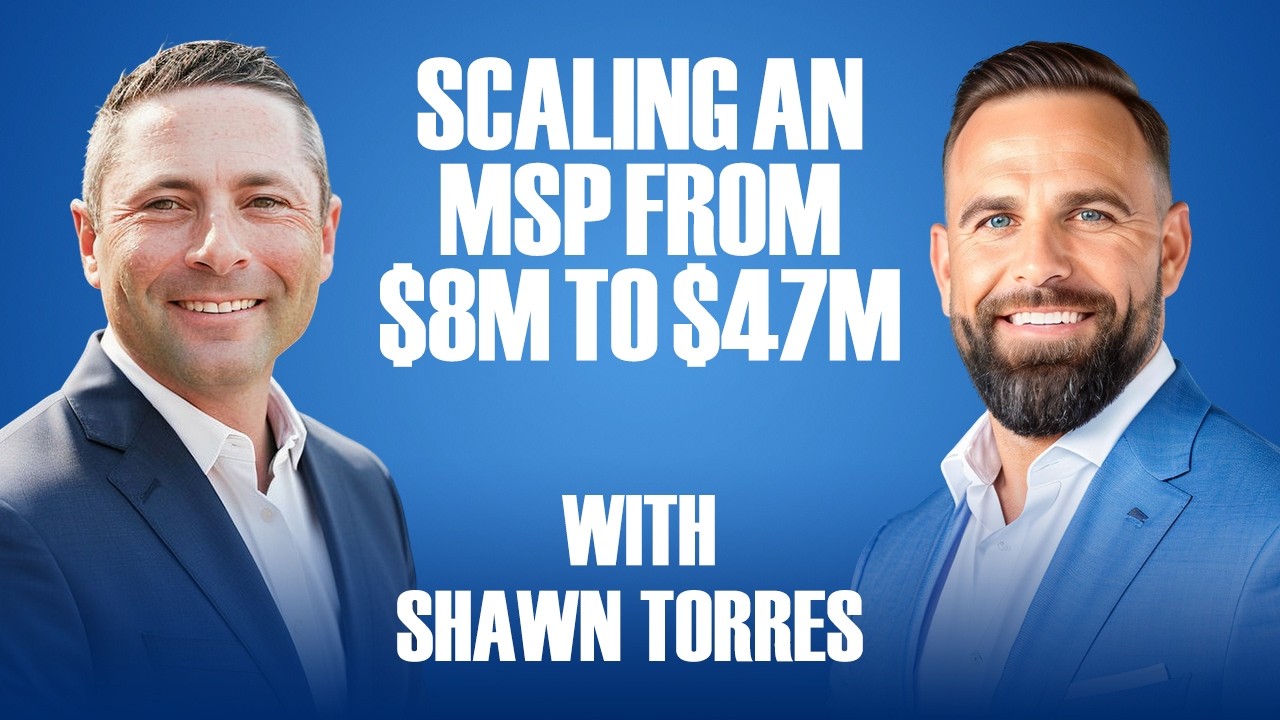
In this episode of the $10 Million MSP Podcast, host Brian Hoppe interviews Shawn (Sean) Torres, CEO of Intelecom, about how the company grew from a $8 M telecom start‑up to a $47 M managed‑services provider with multiple locations. Torres shares his biggest leadership lesson – patience and adaptability – and describes his personal development journey through competitive bodybuilding, reading "Traction" and implementing EOS. He outlines the company’s aggressive goal‑setting process (reverse‑engineering revenue targets, BHAG of $100 M by 2030), the shift from pure VoIP to a full‑service MSP, the creation of a BDR program, performance‑based compensation tied to gross margin and EBITDA, and the importance of budgeting, forecasting, and a strong CFO partnership. The conversation covers the role of acquisitions ($18 M in deals, cultural integration, service‑plan alignment), non‑obvious scaling challenges (tax, insurance, internal IT, ATS, process‑management hires, compliance, AI initiatives), and the value of coaching, peer groups, and continuous personal growth. Torres also shares personal habits (gym, hunting) and influential books ("The Challenger Sale", a deposit/withdrawal principle from his father). The episode ends with practical takeaways for MSP owners looking to scale beyond $10 M.
Chapters
Welcome to the $10 Million MSP Podcast. This podcast is where I dive into the real stories of MSP leaders who have gone beyond $10 million in revenue, how they built their teams, created scalable systems, and turned their businesses into valuable wealth-building assets. I'm Brian Hoppe, strategic coach to MSPs. I work with MSPs generally in the $5 to $50 million range. In each episode, I sit down with leaders who have built MSPs beyond $10 million in revenue to unpack the inflection points that truly matter. From the personal stories behind their journeys to the fundamentals like culture, operational maturity, and driving profitability. This isn't another MSP podcast about tools and tech. On the $10 Million MSP Podcast, you'll get behind-the-scenes conversations with leaders who've built thriving MSPs, their biggest wins, their toughest lessons, and the practical takeaways that you can take back and use right now. If you're an MSP owner who knows that growth starts from within, That mindset, leadership, and strategy align to create both wealth and meaning, then this show is for you. New episodes are released every other week. So let's jump in. Oh, brilliant. All right. So hey, welcome everyone to the Ten Million Dollar MSP Podcast. Today my guest is Sean Torres. Sean is the CEO of Intelecom out of Louisiana, which I just learned is on the technically the North Shore is what they call it. In the Slidell area there in Louisiana. Sean, welcome to the show, man.
All right, man. Thanks for having me.
Absolutely. Absolutely.
I know we've been talking about this for a while, so.
Yeah, yeah. We've gotten to see each other in person several times. We talked about it for a while. We're making it happen. So, yeah. So, I always like to start off with a good question that might make you think a little bit. So, as you think back on your journey as a founder and CEO, what's the biggest leadership lesson that you have had to learn?
Oh, I got a bunch of those. You know, I, I think the biggest thing, and it's definitely for my personality, would be patience and, and letting individuals evolve. You know, I think that it gets hard, especially at scale. When you're trying to put it all together, you know?
Mm-hmm.
Um, and it, and it's, I, I've had to work a lot on that. Um, and a lot on myself, man. You know, I'll tell you, um, even this year I'm trying to be a different leader, a different CEO. Um, lead from a different angle. You know, things, I think you have to be adaptive to change.
Mm-hmm.
As a leader. And I think that takes a lot of, uh, patience. You know, and that's not something I have a lot of, you know, but I think one of the biggest lessons that I've learned is to be a little more patient with people, um, and work with them.
Yeah. Wow. That's a, that's a good one. And, uh, you know, well, I'm sure we'll get more into that. One of the things that's like, uh, I don't know, I heard this thing one time that was like, um, never ask God for patience because then he'll put you in situations that require a lot of patience. And we don't really like those situations, do we? Right?
No.
And so, uh, so anyways, um, thanks for sharing that because it, because, because I've found in, in conversations with MSP owners, um, that it's a lot about changing ourselves as a leader. Like that's a lot of what's required in order to grow the business. Um, as like unsexy as that sounds, it's like it takes a lot of inner work too, right?
A lot. Yeah, a whole bunch more. Yeah, I tell people be careful what they ask for. You know, I go to these conferences and I'll have a lot of these folks ask me, you know, you know, I want to grow my MSP and I want to be big. And, and I get it, man. Like, it's the dream, right? And you start this company with this idea and then you want to go scale it up. But I always tell people be careful what you ask for because it doesn't get easier. You know, it definitely gets harder.
Yeah. Yeah.
As you grow for sure. Absolutely.
Yep. I mean, hey, so, um, yeah, so thanks for that. Um, and then, yeah, I'd love to just kind of get an idea of, okay, Intelecom, where, uh, how did, how did it get to be where it's at today? What's kind of your, your story? Um, I mean, I guess maybe the shorter version of the story of how you got to where you're at, right?
Uh, you know, I was a B2B sales rep for Verizon. Really had no technical background. I mean, I was always good with like a phone and a computer and I was always into the cool stuff, you know.
Mm-hmm.
Got into B2B sales out of retail, graduated college. Life was good. I was an incredible sales rep and they bought Altel and, well, they merged with Altel and I got let go. When I got let go, I told my wife that I was going to go start my own business. I was going to go do wireless consulting where I would go consult with people on their wireless bills and do telecom expense management, save a percentage of the cell phone bill and charge them a consulting fee. It didn't go that well. You know, got a few contracts. I convinced Jimmy, my business partner, to quit his job and come on the journey with me. And we did it and we kind of pivoted in 2010. And we had a client that we were managing that wanted to buy a phone system. We originally started out in telecom, hence the name Intellicom. Right.
So makes sense.
So sold him a phone system, didn't know what we were doing there. Watch YouTube videos and pretty much taught myself on how to put a phone system in. It was an Avaya phone system, which was pretty tough at the time.
Right. I look back— Still on-prem, right? Yeah, still on-prem.
And we were doing multi-site. So not only were we doing a phone system, we were actually putting SonicWall routers in at the time. I'll never forget TZ100s.
Wow.
And we were putting VPN connections in to get 3-digit dialing amongst 3 different locations. So I learned a lot about networking and LAN and WAN all in that moment, you know, in the beginning and didn't really have a background of it. Watch YouTube videos and got it up and going. And that was kind of what where we started, you know. That evolved into 2012. We had made a decision that we wanted to put our phone system in the cloud because this company RingCentral had beat me on a sales deal for an all-comms phone system.
Never heard of them. Yeah.
This is when cloud was just kind of like getting going. VoIP, right?
Yeah.
And my theory was, if I could get 3-digit dialing to work between 2 locations, why couldn't I put a phone system in a data center and get a phone to hang off of it over a VPN connection? So that's what we did. Created our own VoIP platform, started hanging phones out. You know, as we were building up that book of business, I recognized that the phones are really relying on the network.
Mm-hmm.
And had to teach myself network because my theory always was if your phones didn't work, you weren't going to pay me. And, and I got tired of fighting with MSPs, so I would just do it myself. So we got really good at networking and hiring some network engineers so we didn't have finger pointing. That evolved, kept scaling the company, got that business up to about $8 million in revenue, you know, and then in 2019, we decided that we would adapt a managed service practice. And start offering IT services. We were already managing the network. I was already managing the voice front. I already had a help desk, already had everything built. And then we started a managed service practice, which is a big learning lesson for me. We did it terrible in the very beginning. It's a lot harder than you think.
Yeah.
To stand that up. I didn't know what a tool stack was. I didn't know, you know, I didn't go buy an MSP and figure it out. We did it on our own and kind of built it out and then scaled it from there. Today, We're a company of about 165 FTEs. We just finished up our biggest year. We did $47 million in revenue this past year. And we're in Atlanta, Dallas, Tyler, Texas, right outside of Chattanooga and Kennesaw. And then Louisiana, we have offices in Slidell, 2 in Slidell and 1 in Gonzales.
Wow. Okay. Amazing. Now, okay. And so did I hear that right? That you've had $40 million in growth over the last, uh, like since 2019?
Yes.
6 years?
That's about right.
Okay. Wow. We're gonna have, we're gonna have to talk about that some because, uh, that is a significant, um, amount of growth. And, and, and is that, um, has the majority of that been in the, on the MSP side of things? Or is it, or is it really a mix?
Uh, it's really a mix, man. But obviously our focus is on managed services. We have a physical security division too. Um, that's the scaling and growing. So we definitely, we definitely, that's more project-based. There are, there are some recurring there, but the majority of it's project-based. So we definitely have had some of that. Um, but I mean, the managed services side is what's scaling. It's where our focus and time and energy is going. It's where you see, uh, the majority of our MRR growth. You know, we organically grew our MRR last year, uh, about 37%.
Amazing. Okay. So, okay.
It's, yeah, they're all scaling. Like, that's what's crazy, man. The whole company in general, every division that we have today is still growing, right? Because as every time I take on an MSP client, Their phones come along with it, and then we start doing their cameras and access control, you know. So it's like, yeah, it's just, it keeps happening. And then it compounds. And then we get clients that we're going to do a camera system for, and then we recognize that their, their network is a mess because we got to plug cameras into it. So then we take that over, and then where does that lead? That opens up the MSP. It all— it always does. Yeah, it's, it's so Uh, we've done very well from a cross-sell perspective in our internal base. You know, it's worked very well. That client success team is killing it and has done an incredible job. Uh, and again, we can't do that without a good service team, you know?
Yeah. Yeah, absolutely. Okay. That, that's great. Yeah. So, so we're going to, so we have to make sure to dive into that growth story, uh, some more. What I'd, what I'd love to kind of touch back on of, of what we hit a little bit earlier. But, you know, when you think about your growth as a leader, I mean, like holding that amount of growth in a relatively short period of time, I mean, you know, over 6 years or so, you know, what have you found has been the best for you as far as how you grow yourself as a leader?
Well, you know, in 2019, Um, I, I'd never gotten into reading books. Um, I just was a grinder, man. You know, I never did self-development. Um, you know, in, in 2017, I take that back. 2017, I got into competitive bodybuilding.
Okay.
And that's really what taught me a lot about, uh, setting goals, putting a plan in play, being consistent, and Like delayed gratification. That's what I always tell everybody.
Yeah, I would imagine that that's that takes a lot of that, right? Like don't eat.
Yeah, a lot. Don't eat what you were eating. Eat this specific food, you know, six times a day. Do this workout plan. It seems easy on paper, and to do it is takes a lot of discipline, right? And it's just I think it just it's just like running a business, man. You have to be very disciplined. You have to stick to the plan. Um, you know, so in 2019 we, we implemented EOS.
Okay.
And, and I think really that there is what taught me a lot about, uh, self-development. I read a book called Traction, you know, started there. Buddy of mine had told me, man, you got a great business. You know, I see the problems you're having. You ought to read Traction. And I'm like, okay. I didn't know what that meant. So I read Traction, really enjoyed it. Uh, made a decision that we would implement EOS. Um, you know, and it was a perfect timing, man. It was a mess. You know, the company was growing, but it was just so unstructured, you know?
Yeah.
Uh, no processes, no accountability chart, uh, no real goal. Like, we just wanted to grow. Like, it wasn't like I got the business to $8 million. Like, and I hate to tell people that all the time. Like, I had no plan. It was just like my theory always was. And it goes back, Brian, in the beginning. When Jimmy and I— I never forget, we're sitting there. So to kind of give you some context, man, on how this went, and this is pretty eye-opening, I think viewers like to hear this because I think this makes things realistic for people. In 2009, I did $8,400 in revenue.
Mm-hmm.
Top line.
Yeah.
In 2010, I did $46,000 in revenue and top line. Wow. 2011, I did about $286,000 in revenue. And in 2012, I did $1 million. And I'll tell you how I got to $1 million. All I did is I remember I just thought it was cool to do $1 million in revenue, man. I was 27 years old, right? Like, that would be cool to do $1 million. Like, that'd be awesome. Like, we'd be rich if we did $1 million.
Right.
And I just reverse engineered $1 million. I took $1 million divided by 12, which is $83,333. I wrote that on a whiteboard.
33 cents.
I wrote that on a whiteboard.
Yeah.
And I wrote the 12 months and I was doing all the billing in QuickBooks.
Yeah.
So my theory was like, if one month I did $80,000, like the next month I needed to add $3,333. And if I went over and I was literally, I would write that number on the board and I would focus on selling that number every single month because I knew I had to convert the revenue to— it was just cash in, cash out accounting at the time. Right.
Yeah.
I just, I just know I needed to sell a little more than that so I can do the, do the work. And that we did $1 million, you know. And then I remember the next year Jimmy said, I said, man, like, that wasn't that bad. Like, let's do $2 million. And he was like, what? How are we going to do $2 million? I was like, $166,000 a month. You know, I just— and I hate to say that, man, but that's like we do that today, Brian. You know, we just set the goal this year. We're going to do $60 million in revenue this year, you know, so we're going to go from, from $47 to $60 is the plan, right?
Yeah.
I've never not set a goal since 2019. I went from 8 to 10, you know, well, I went from 8 to 8.5 in '20. I set the goal in the beginning of 2020, missed it, right?
Okay.
8.5, set to do 10. The next year, reset, did 10. Then I set the goal of 15. We did 16.5. Then from 16.5, I went to 21. From 21, I went to 31. From 31, I went to 47. And here we are today.
Wow.
So, um, yeah, I think it's setting targets. The goal this year actually was 44.
Mm-hmm.
And we kind of hit the mark, you know, went above it. And this goes, this goes back to the BHAG, right? And I'll never forget when I told people our BHAG was that by 2030, I want to be a $100 million company. Everybody kind of laughed, right? Like, yeah. And it seems unrealistic, but like, I was being serious. Like, because I just was like, took years and took growth and was like, well, I'll just grow. a little more than 27% every year and I'll get there. And then I've had people tell me like, well, you can't grow your business 27%. And I'm like, why not?
Right.
And then they're like, well, you can't do that at scale, Sean. It's easy to grow a business at 27% from $8 million to $10 million. Like, you're right. Like, that's, that's, that's different. I'm like, why? Why is it different?
And questioning the status quo, right? Whatever he says.
I'm reading a book right now. and called The Science of Scaling.
Mm-hmm.
And a lot of it, like, makes a lot of sense to me because, like, if you set a target and Elon Musk says this all the time, if you give yourself 5 years, it'll take you 5 years. So how do you take your 5-year goal and reduce it down into a year? And I know that sounds crazy, man. And I've had people, my entire leadership team looked at me when I told them we're going to go from 10 to 15. And do 50% growth. Every single person in that room looked at me and told me I was crazy. And I think they just did it because I'm, I'm, I'm this aggressive guy and I think they just did it to appease me. But I think when we hit the market 16.5% that year, I earned the understanding of, of what we're going to do. And now they believe, man. And I really think it goes back to believing, right? So now I'll never forget Frank Nazario, my CFO, walking in my office one day. He told me, he said, you know, Sean, Man, I'm kind of like working this backwards and like, we are going to hit $100 million before about 2030. He's like, I think we'll hit it before. And I was like, oh, I know, Frank. I wouldn't— I didn't make this up.
I wasn't BSing you, Frank. Yeah, we're doing this thing.
Yeah, we're doing it. Like, that's the goal.
Yeah.
You know, so look, it's hard. I don't think it's easy. I think it's about hiring the right people and letting them do their job and educating them and pushing them and coaching them. And like, as a leader, man, like, you got to keep people motivated. And motivation means I'm in here every day with them. I'm working towards the goal alongside of them, and I'm here to support them. That's my job. You know, I'm here to work for all the people that work here. And sometimes you got to make the tough decisions, and that's hard, you know? But it's cool and it's been fun.
Yeah. Yeah, absolutely. Okay. So, so I know. So I've— so everybody's asking. Okay, so how do you grow a company, an MSP, from $30 million to $47 million in a year? What are the mechanics of that? What does that even look like? I mean, it's blowing minds right now, right?
You sell.
Yeah, right. Okay.
You set targets. And you got to remember, man, like at this size, obviously we're on accrual accounting, right? As you should be. And it's about recognized revenue. So it's not just selling it, it's converting it. Right. Because we went through that phase where it's like, oh, you can go sell a bunch of stuff, but can you convert it?
Yeah. Can you actually get it to billing?
Can you get it to billing? Like, it's hard, man. Like, there's been— so you manage backlog and you really start to understand the components of the data. And I think what a lot of companies forget is the data that we have is super powerful and understanding the datasets and saying, If I got to sell X to convert Y and I want to hit this number and I base it on a timing and I start building out a real budget, because I think that's what a lot of companies don't do is they don't build budgets. Like, their budget is like, I want to do $10 million in revenue. That's not a budget. Like, that's not a real budget. Budget has expenses and you budget expenses.
Mm-hmm.
And you budget all of it.
Yeah.
Like you budget your W-2 multiple, you budget your sales expense.
Mm-hmm.
And you stick to the plan and you don't— you, you divert if things aren't going right. Right. You adjust budget. And I think that's okay. But I think a lot of times, man, and I've done this myself and I think I stalled like, Brian, I really think I would be a bigger company today than I am right now. If I wouldn't have stalled the company a bunch of times because I got scared.
Yeah, yeah, yeah. That happens. That happens all the time.
I remember one time my banker tells me this all the time. Corey laughs at me. He goes, dude, I remember when you called me and you were like freaking out because your payroll was $75,000 a month. I mean, my payroll is $1.3 million a month.
It's a little bit different nowadays.
Yeah, way different. So I think, I think You got to, you got to, you got to lay the plan and have an understanding on how you're going to get there. You can't just—
Mm-hmm.
Now, don't get me wrong, man. Have I said it? Yeah. And I'm a grinder, man. Like, I'm a guy that's going to— if I know that numbers are looking off, like, I'm going to get in the trenches with my sales team. We're going to go get some deals done and we're going to move it up quick, you know? But you got to be careful with that too, man, because, like, I've gotten addicted to top line.
Right.
Which is really easy to do. And you start to deteriorate gross margin. And that's a problem, man. Like, but, but I also believe— and they get mad at me at Evolve when I talk about this all the time because I love SLI. Don't get me wrong, benchmarking is great. But everybody in that room, when you look at my SLI, it says that my sales and marketing expense is more than it should be. I don't really manage it that way. I manage it based around the rule of 40 because I know this. I'm maintaining about a 12 to 15% net income bottom line and scaling at 50%.
You're well over the rule of 40 then, right?
I'm over the number, man. So it doesn't matter, you know? So like, I'm not going to listen to that noise. And I think a lot of people in the MSP space start to like— and I get it. I'm not saying you shouldn't pay attention to those things if you're not yielding the results. You know, but I think it's understanding it and paying attention to it and setting the plan. Like we, we knew we were going to scale to that. Like we had the pipeline. And again, man, it goes back to understanding your pipeline, that dataset, man, knowing what pipeline's there and understanding like we know when we have 6 times pipeline in the beginning stage where it ends up on the other side. And we're pretty accurate, man. Like that's how, that's how we're doing this. And now look, this took a lot of years. Of like, all right, so reset, understand it, look at the data set, what works, and evolving it, Brian, because it's getting harder, man. You know, like it really is. It's definitely getting tough.
Yeah.
But when you break it down like quarter by quarter, it's, it's not rocket science. I'm really— I just, I think too many, too many guys I'm talking to, man, overthink it. Like, dude, Aaron Underhill at Dedicated IT, Is a stud, man. Like, this dude sets targets and he gets them. Like, it's non-negotiable, man. Like, and it's non-negotiable across the whole company. This isn't just me that it's non-negotiable for. And too many, too many MSPs, in my opinion, they don't talk to their staff about what's going on. Yeah.
Yeah. So, okay. So, so let's, so let, if we can break it down a little bit, like, let's, so, so obviously you don't grow 50% by just saying, hey, I'm gonna grow 50%. You like the, the growth that you start to achieve early in that year, you've already been working on 6 months earlier, right? So what is the— so, so let's talk about what the, what are the mechanics of that? What does the team look like? What is, what, what are, what are their targets? How are, and how are they going about actually generating that net new business?
So, It, it's a BDR program that's setting meetings. So you got Ben Bergeron is our VP of Revenue. Ben has 3 sales managers that report to him, one in each market. Those sales managers have a team between 5 to 7 on their teams that are driving revenue, that are based quotas on. Then you have client success, which is a whole nother component of this.
Right.
You have a direct— you have a director of client success. 3 market managers and then CSMs that report to them that are driving revenue in the internal base. And that's kind of really how it's built out today. There's a marketing component to it that's driving through events and outbound campaigns, trade shows, and really, man, a bunch of stuff you got to try to keep it moving, you know?
Yeah.
And then it's— and then in my opinion, from a leadership level, All I do is, look, man, I'm coin operated, okay? And most people are coin operated, okay? And the way I look at it is I'm all about performance-based pay. So you set the targets. Yeah. What do you want? Like, when someone first told me that, man, I had a business coach tell me that one time, Brian. They're like, you know, Sean, just set the targets on what you want, base pay around the targets. I'm like, I didn't know what that meant. I'm like, yeah, okay. So like, start thinking about it, man. And then what you do, you set up sales to drive top line.
Mm-hmm.
But they got to maintain margin because there's a bonus component to it around EBITDA.
Mm-hmm.
So they won't sell bad deals.
Right, right.
Your, your guys selling the project revenue are based around gross margin because gross margin is what counts, not top line.
Absolutely.
Gross margin is everything. Then you take your project and service delivery components, you base them around a W-2 multiple. So you're building in your profit like it's, you know, the money, it's contract-based. We know we're taking in.
Yeah.
Then you base a lot of metrics inside of there around gross margin and maintaining your gross margin there and their bonus components against it. And then you take your finance team and your finance teams all around EBITDA and cash flow.
Yeah.
And now, now you get this leadership team that is all fighting for different pieces that affect their, their, their compensation.
Right.
But they work together because you can't do one without the other.
Yeah.
Right.
And all of that aligns on the budget, right? It's all based on what you budget.
Your budget and your budget based on percentage of revenue, right? Your expenses get based around percentage of revenue. It's pretty easy.
Right.
We spend 12 to 14% on top line of sales and marketing, and we know what it yields at. So if I'm going to go higher in my market and what I need, like, I know if my budget is $60 million, I take 14% of $60 million, and that's what I'm willing to spend on sales and marketing. And I reassess that because in the beginning quarter, like January, we're going to finish up the month around $4.7. 4.8, right? So we're on pace. You just assess it, man. And like, that's all you do.
Yeah.
And, and, and you stop at the end of the quarter. And if you got to adjust budget, you adjust budget. And too many people, man, like, they don't do that shit. And it's a problem.
Like, yeah.
You know, and you got to be honest with yourself on what's working. But you also can't do what I used to do is I've had one bad month. And I freak out and want to— want to blow it up and ruin it.
Yeah.
You know?
Yeah.
And I think that's the wrong way. You know, you got to— you got to be patient and be a little more calm with it and understanding it right now. Look, a lot of it goes around your reputation. There's a lot of factors that go into this, your market that you're in. What can you capture? You know, there's a lot of components into this. What's market share look like in your market? Again, man, you got to start looking at the datasets. And I think that's where a lot of people forget to start looking and really studying the data. With AI today, man, it's making it so much easier to take the datasets and scrub it and build models against it. And that's all you do is you build the model, man. I'm a firm believer if you're an MSP and you're at $8 million in revenue, you should go hire a $250,000 CFO. That's a real CFO that's going to help you strategize.
Right.
And if you want to grow your company, go spend some money And hire the right people. Because I see a lot of that too, man, Brian, where people hesitate to go hire the right people and then they wonder why the company stalls, man. Like, you don't get to keep all the money. It doesn't work that way.
What? Why not? Oh my gosh. And we had this, yeah, we had this exact same conversation about the CFO early on. So I want to probe that for just a second. Uh, you know, previous guest was like, when we did, when we made that decision, It was, it was night and day. And I think, I think we tend to, as owners, it's like, well, I know enough. I can, I can manage the finance. I could also be the CEO and the CFO. No big deal. What? So, so tell me what was so key about bringing in that position to you?
Look, man, Frank's my right hand, man. Like, me and him talk every day. That is my guy. Without him, I would not be able to do this. And, and he keeps me focused on the things that I need to focus on. And he focuses on the thing that he needs to focus on. It doesn't stress. I used to get stressed, Brian. I would, I would see the ups and downs, right? And start to want to pivot off budget because it's easy to do that. And he doesn't allow me to do that. Like, I used to look at the P&L like every day.
Yeah.
I don't do that anymore. I get, I get a, I get a, I get a forecast.
Mm-hmm.
I get a mid-month update and I got my closeout meeting. That's what I look at, man. Like, I'm not driving myself crazy and I'm gonna control the controllables and do the things that I can do in that. And I think that's what really helped me start to understand and what really gave some clear visibility for me, man, is understanding and looking at forecasts and through a different lens and really understanding what a real forecast looks like. And now I'm not— I'm no longer being reactive, right? We talk about, hey, we're in IT, we do reactive and proactive, right? All the time.
Yeah, we're all proactive. Yeah, we're always—
you got to be reactive and proactive in your financial data too. And that's what clarity I think that gives you, man, is a real CFO is going to really understand the budget and the model. And it takes a little while. They're not going to come in day one like Frank didn't come here day one and was like, man, here you go, I'll build this model. Right. It's taken— Frank's been here now coming up on 4 years, you know, so it's taken years. And now, like, he's gotten better and better and better. We as a company have gotten better and better and better of forecasting our data. And I think that's what's important. We don't, we don't report to a board today, right? We're not private equity held.
Mm-hmm.
Our board, in my opinion, are the staff that work here. And that's who we report to. Because when I, when I commit to the company that we're going to do $60 million, Like I gotta do it.
Yeah.
Yeah. Like that, that's who I report to.
You know? Yeah. You're ultimately responsible here. Yeah. So it sounds like that level of financial discipline and also like letting you know, hey, it's, it's actually okay. You know, this month looks off, but here's why. You were, we were gonna be fine. Let's stay the course.
Know the why. You, you got it. Frank says it all the time. Sean, here's what happened. Here's where, what went on. We're okay. Yeah, let's keep going. Yeah.
You know, there you go. That's perfect.
Yeah, it is a huge component though, man. You're so right. You know, it— so many, so many guys and ladies I see running companies don't do it early enough and it is a bad decision.
Yeah. Yeah. And I've heard— I mean, it's just interesting that it's kind of become a trend, right? Like, and myself being a former CFO, It's like, oh, you know, it warms my heart to hear, you know, experienced guys that have experienced a lot of growth saying, hey, yeah, this is, this is a really important piece.
Well, especially when you start getting acquisitions, man. Like, yeah, yeah. Like, that's a tool, you know, if you're going to have that strategy as part of your growth strategy, I'd recommend 1,000% to find you a good CFO that understands M&A. It'll save you a bunch of money, too.
Yeah, 100%. So, so, so let's talk about that for a minute. What, how much of your growth has been, you know, acquisitive?
About $18 million has been acquired.
Okay. Okay. Gotcha. And, and, and so when you, when you think about that and kind of the decision to do that, where, you know, I mean, at what point did you kind of start that journey acquiring companies?
You know, early in, I'd acquired, I'd done a few small, like I acquired a company that was like doing like $700,000 2000 years ago. We fired probably, I don't know, I think I kept 2 clients out of that whole thing.
Okay.
It was a bad decision. A buddy of mine was retiring and I took it on and I didn't even realize he was doing a bunch of like residential stuff. We don't do that. A bunch of one-user accounts. We got rid of so much, man. So I did my first real acquisition in In May of '24.
Okay.
Yeah. May of '24, I acquired a company, Lantana, in Dallas. They were about a $9 million shop that we acquired. Same blend. And they're about, they're about a 50/50 mix, 50 MRR, 50 project. So that's what their blend was at the time. We were about, we were about a 60/40. When we acquired them, 60 MRR, 40 project. I learned a lot, man. I learned a lot about culture. I learned a lot about people. Yeah, I learned a lot about what not to do in an acquisition. I think it was a great acquisition. We've got some incredible talent with that acquisition, some great people. Their culture definitely aligned with our culture. And I didn't look at that in the beginning, you know. I would say that's really, really, really, really important. Yeah. When, when acquiring a company, because that can make or break you for sure.
Yeah.
You know, especially like when they don't have growth, right? When they haven't had growth.
Mm-hmm.
Years. And now you're going to go in there and you're going to go like turn it on. Like, that's a lot. That's a lot for those folks, man.
Yeah.
You know, like, absolutely. So I think there's a component there too, to have an understanding what you're buying, know what you're buying. You know, and then, and then in October of last year, I bought another $10 million company, Realm, that is in Georgia.
Mm-hmm.
So we just acquired that. So we got to recognize 3 months of that revenue. Right. So that's kind of, that's kind of how we know. Yeah. Like I knew some of the growth this year is going to come from that, right?
Yeah.
So and then last year, You know, whatever. We had one quarter of revenue from them, which is actually a light quarter for them, you know, which is the last quarter. So that's kind of where some of that growth came from from last year that kind of threw us over the line a little bit.
Gotcha.
It was about $900,000 in there that came from them that kind of pushed us over.
Yeah. Push, push over the edge there. So. Okay. Yeah. So I think and that's really important is thinking about Um, the culture piece and also, um, you know, kind of going back to the, you know, the original acquisition, right? It's, it's kind of like, uh, what, what a lot of people forget is, hey, the way that this other MSP has been servicing their clients is in ways different than we have been servicing our clients. So the really important thing is how do, how do our managed services plans line up with one another?
Mm-hmm.
And what's included, what's not included? Like a lot of people don't run that exercise. I didn't buy a company.
I didn't. And I didn't know that. Like, we never did mobile device management. I got myself in all kinds of trouble, man. We had a client, they got super mad at me because we go roll everything out. And then all of a sudden I get a phone call one day and like the CEO screaming at me about managing these Apple iPads. And I'm like, what are you talking about? That, man, my contract states y'all manage these Apple iPads, blah, blah, blah. We didn't know that. So then I'm like, oh man, how many other clients do we have out there that weren't there?
Yeah.
It was just— you are spot on, man. Like, know that. Know the hourly rate because that's going to change probably. Average size client. Like, what does that look like? You know, like, are you buying good margin or bad margin? You know, what are the expectations of the service contract? Because there's so many different varieties of that in our world, you know. So I think you're spot on, man. You got to Look at those things. So again, like, as I did my second one, I kind of knew what I kind of knew. And then I'm gonna just tell you, man, I learned a little bit on this one too. So now, like, in this one, like, we documented it a lot better. We brought in an internal program manager that documented the whole process. So now when we go do the next one, like, it's going to be much easier.
Yeah. Yep. It's, uh, yeah, it's a whole thing.
They're not easy. Yeah, they're—
it's like almost—
it's really hard. Yeah, it's really hard. I've had a lot of people tell me like, oh yeah, man, I'm just gonna go buy companies. I'm like, okay, I got you.
You know, you have to keep running your company too.
And you got to integrate. You got to integrate. There's so many people that I know in this space right now, man, that have bought 3 and 4 MSPs and nothing's integrated. I will tell you right now that every company that I bought Is 100%. And I integrated the last one in 90 days.
Amazing. Yep. But it took you a while to get there, right? Yeah, it took you some laps around the block.
We're still dealing with some of that right now. Like, there's still some backlash, man. Accounting. Think about it. When you're, when you're integrating P&Ls, like, how do you make them look the same? The way they recognize revenue may not be the way you recognize revenue. You got to fix all that. Like it's, it's, it's a lot, man, you know, and I think billing systems and website marketing and you forget about these components, man. And I think building a team that can go do it for you is key.
Yeah, absolutely. So, um, so just kind of like, uh, you know, I'm switching gears a little bit. So, okay. So, so as you're, as you've grown, you know, the experience of this rapid growth, uh, over the years and you're going to continue experiencing it. You know, for those listening, like, what do you think are some of the non-obvious things that really drive success as you're, you know, pushing past the $30 and $40 million mark? What do you, what would you point to as some of those kind of things that may not be obvious that drive success?
You know, I think it's starting to segment roles and responsibilities in the company. Like, I'll give you an example, man. It's a good example. Like, you're going to go scale, you're going to be hiring like crazy.
Yeah.
So you think about recruitment, okay? And at one time, like, we just had the managers did the recruiting. Well, when— and they did their interviews and they hired people, right? That's their job. Well, when you, when you're running a fast growth company and you need to go hire 12 people in the next 45 days, In multiple different departments. Who's doing that? Those managers do not have the bandwidth nor the capacity. So you start thinking about building these engines that support you as an organization. Like, I have an internal IT department. I'm an IT company that has its own internal IT department.
Yep.
Like, to support us.
Mm-hmm.
Right. So you start thinking about that, man. Like, you start evolving. And I think that's where some of the non-obvious, like, That I think going back to EOS, like that accountability chart is a living, breathing thing. Like if you're not reassessing your org chart every quarter and having an understanding there what that looks like, even down to like some of your systems, man, accounting systems, how are you looking at the data? We just did a big move from QuickBooks to Sage Intacct because the way we want to look at our data is a lot different. You know, so I think you got to start thinking about that. I think you got to get ahead of the curve, Brian. I think as a leader, your leadership team should be focusing on the next 90 days, if not the next 12 months, all the time.
Yeah.
And if they're not, that's a problem.
Absolutely. Big time.
And it's really hard to do that, to let things be, you know. So I think the components there. I think reassessing how you do your staff, how do you manage your staff? How do you give them feedback? You know, are you assessing those things? You know, I'm trying to think of some like just non-obvious things that go on as you scale. I think you gotta start tax planning because that gets, that gets hard, right?
Mm-hmm.
Because you start making more money, you got a lot more taxes you gotta pay. Um, you gotta think about insurance. Insurance is critical as you grow and scale, understanding what that looks like as you go upstream on your client base, what your umbrella policies look like that you may not be assessing and looking at to make sure you got the right coverage. Um, those things are crucial. Um, you know, I think there's probably a lot more that I'm skipping.
You know, there's, there's tons. There's tons. But I mean, that's good. All of that's like, I mean, all of that's a lot of important stuff, right? And what I'm reminded of too is like, well, when you kind of were talking about recruiting, right? It's like, hey, at a certain point you're always, I mean, you're always interviewing people, right?
Always.
Once you, at this point where you're at now.
Every day.
And it kind of becomes like, not only with recruiting, but also with acquisitions, It's like you've actually spun up 2 other marketing funnels, right? Inside your business. So now you're marketing for people and you're marketing for companies to acquire and you're trying to get clients, right? So you got 3 different marketing funnels, at least, probably more going inside your company.
It's, you think about like, man, like I was like stressed out recently. We didn't even have an applicant tracking system. But I never, I didn't, I didn't even know what that was. You know, that's what's been so great for me for being involved and networking with great people is like, you know, like Sean, like, how do you manage all your applicants? I'm like, email. They're like, oh, okay. So now we have, we have an ATS today with workflow management. And, you know, you think about internal operations, Brian, like you got to have a team managing internal operations.
Mm-hmm.
You get all these components, man. I mean, it's, it's, it's crazy. And I'm even looking at right now, we're bringing in, we're bringing in somebody just for process management. Right now. Like, that's the next hire we're making. I interviewed her today. I really like her a lot. She's coming in next week to meet the leadership team, and we're bringing somebody in that's just going to— their sole job responsibility is, is understanding the issues that are going on in departments and laying out process nonstop.
Wow.
You know, and it's not, it's not a cheap employee, you know, and I think she's going to kill it, you know, because you need somebody that has a high-level business acumen that can take really complex processes and put them into one-page sheets. So simplify, simplify, simplify.
Yeah.
So I think that's where you start thinking about those things and how do you— we always talk about how do we go put other people into compliance? What about your own company being in a form of compliance and understanding it today? That takes strain and starts testing you as an organization. So I think there's a lot of components that start going into this and you got so many things that service the internal organization as a whole to absorb the scale that's happening on the other side.
Yeah.
Yeah.
Yeah.
And you forget that. You don't think about those things.
Yeah. It's just a lot of stuff that comes up. I mean, it, well, and I'm sure, you know, in your journey, you've probably had things that are like, man, I, you know, I just was surprised when this thing hit, like, uh, and, and as somebody who's been there before knows it, but like, What? Yeah. What would be like some of those things that you were just like, oh my gosh, I did not even know this was a thing as I'm scaling my company?
A whole bunch, man. You know, it's funny you say that. I had a guy that I really respect a lot, and he came and worked here and the growth wasn't for him. The chaos wasn't for him. And he got super frustrated and ended up leaving. And we're still friends today. And I'm— and, you know, he talked around the company and made a comment to somebody one day and said, man, Sean and Jimmy, you know, they're way ahead of their skis. They don't know what they're doing, blah blah blah. And, uh, you know, I was upset.
And I was—
when it first— when I first found out and they said it, it kind of, you know, look, man, it pissed me off, you know. Um, but I called them and I was like, hey man, look, um, you're right. You are 100% right. that I'm in above my skis. And, and when we were an $8 million company, I never ran an $8 million company. And we were a $10 million company. I never ran a $10 million company. And we were $20 million. I never ran that either.
Right.
And next year it's gonna be new again. And every year has been new for me, Brian. And that's why I said in the beginning, like, it's all about working on yourself and leaning into the right people and surrounding yourself with good people that have been there. to have those conversations and leveling you, leveling. I've been in 4 different peer groups where I've had to level myself out of those peer groups. And not that I didn't like those people, but I wanted to put myself in a room with people that have been at a different level. So when I have conversations with them, it's, man, what's your problem? You did $5 million this month. You know? Well, no, you know, again, like, I'd love to do $5 million. Again, it's all the same, but you gotta, you gotta be, set yourself and put yourself around those people.
Yeah.
Be a little vulnerable. Be willing to learn and have an understanding. And I think that's where, you know, I do know this, and I told Trace this when we had that conversation. I said, Trace, you know what, man, you're right. But I also will say this. If I look at the corporate world today, a CEO's job is to grow the business and be profitable. I've never not grown and I've never not been profitable. So I got something.
I mean, hey, You got something happening there. That's, that's good.
I think the things that really surprised me, man, was like really looking at— I thought I understood the P&L and the balance sheet and I didn't. And I had to focus a lot of time and energy on my financial acumen. Mm-hmm. To be prepared to be in the position I'm in. You know, I'll give you an example. When I hired a CFO, I was a— we were cash hoarding. And I'll never forget, Frank walked in my office one day and he said, hey, Sean, why do we have $6 million sitting in our checking account? And I was like, I don't know, man, we might need it. He's like, feels good.
Probably, right? It feels good.
For what? What do you need it for? I'm like, I don't know. Like, what if we get slow? He's like, you got contracts. What are you talking about? Like, When have you been slow?
It's never happened.
But Brian, in all transparency, I didn't know. I didn't know about investment accounts and deployment of capital. I didn't understand that world. So, what did I do? I started researching and understanding that. So, those are some big surprises for me and starting to understand how to deploy capital. I never had debt. I'm like, man. He's like, man, we can just take on debt if you need something. And I've taken on a little debt recently and it's like, Debt is a tool. Is it? Is it? It is a great tool, you know, if you know how to do it right, you know. So that's new for me. That's a surprise for me. I've never, I've never had that and understanding that world and what that feels like, you know. So I think that those things to me are as you start to grow and start to understand, you know, how business works at a different level. But it's always been a surprise for me, man. It really has. Every year has been a blessing. And when we finished the year this year and we sat at our annual just recently, it was just amazing to see like we did it. Like I told the whole leadership team, I'm like, look what we did, you know?
Yeah.
I'll tell you one thing that I could give advice to everybody.
Yeah.
Find a leadership team and stick with them. Make sure they're the right people.
Yeah.
That, that, that consistency is so Crucial to growing your business.
Mm-hmm.
We, we've maintained the same team now. We went through a lot of trial and error and we've maintained that same team now, Brian. And it's been a game changer, man.
Amazing. Yeah. And, and if they, if they work well together, if there's a high level of trust and if they get stuff done, hey, it, it, you know, that's, that's if they're the right people in the right seat. Yeah. Then absolutely. 100%. Um, so in, in on that note, are they, I mean, have, have most of your leaders been in the business for a very long time?
Not a very long time. I would say they're consistent for the past 4 years.
Okay.
Yeah.
And interestingly, probably most of them are now— well, they're working at the highest level they've ever worked at before.
Right? Yeah.
Most of them, at least, I would imagine. Right.
So making sure they're leveling up, Brian, making sure they're developing is crucial. Yeah. Making sure your teams are developing, self-development in the company. Like from the top to the bottom.
Yeah.
It is so important, man. I did not think that that was a thing. I believe that today. You better invest, invest in these people. And so many— I hear so many people say, well, man, I invest in these people and they quit. I'm like, yeah, but it's like that old saying. But what if you invest in them and they stay? Don't invest in them.
Yeah.
Yeah.
Then you got a different problem.
Yeah, different problem. So you got to do it, man. And it's a blessing, man. It's a blessing to see people. I've watched people come in here. I've had 2 employees that worked underneath me that went out and started their own companies. They're both 7-figure companies today. It's incredible, man. It's a blessing to see. I didn't want them to leave, but it's been a blessing to see them leave here and go create something special that changed their families' lives. So again, man, you know, that's what it's all about. And I've seen people leave here from our engineering department and go get jobs at NASA. We just had a guy, great Azure engineer, Glenn, uh, just got a job at Working, running, running cloud for Capital One, huge pay increase. Like, awesome, man. Like, I hate it because I want them to stay here, but at the same time, like, it's my job as a leader to develop these people, and I hope they elevate, man. I just had a round of new hires. That's what I told them. I said, look, I hope y'all stay here. I said, but anything, the best thing that I could do for you, I hope you learn. And I hope even if you go elevate to somewhere else in a different career, like, I hope it elevates your life because at the end of the day, that's my mission. You know, um, and you gotta be okay with that, man. Like, it's gonna happen.
I love that. That's so cool. Yeah. Love it, man. Yeah. And, and, um, uh, you know, as far as development, developing your people, developing yourself, like I'm, I always say, you know, people probably are like, you say this all the time, but 3, the 3 biggest things for me in my business. One was joining the peer group, which we've talked about some.
Huge.
Second one was, um, was getting, uh, EOS implemented. Third one was, you know, getting some kind of a coach or advisor.
Huge.
That was, you know, a big thing for me. So was that— did that third one kind of play a role for you? Absolutely.
Along the way, I've had, I've had 4 or 5 different coaches.
Yeah.
And I'm a firm believer in that, man. Tom Brady's got a coach. I'm just saying, man. Like, yeah. And look, man, I learned that in bodybuilding, Brian. Like, as I bodybuild, I knew what to do, but I kept the coach for accountability.
Yeah, right.
Like, we need that. We all need accountability. And I think that's where it kind of started. And that's what kind of evolved that, man, is like, I'm a firm believer in coach now. I'm a firm believer in getting your staff and the people in the company coaches.
Yeah, absolutely.
I'm real big. I'm literally about to bring in a coach for middle management right now. Yeah, I got somebody about to come in and be working with nothing. They're not working with leadership, they're working with middle management and elevating them. And it's going to be expensive, but it's going to work. Yeah, I'm absolutely a firm believer in that, man.
Yeah. Investing in your people in that way.
It's huge, man. Not just tech certifications.
Yeah, it's not about that.
I'm not saying that's not a component of it, right? That's what we do. You know, they should have their A+, they should have their Net+, they should have their Microsoft certs and all these things. Those are all things. But like, what about understanding personal development? What about understanding making them better people? Just people in general. Like, you know, how do, how do you make people become better husbands and wives and better parents? And like, because when life's good at home, man, I'm a firm believer, when life's good at home, life's good at work.
Yeah.
To think that people are gonna come to work and not be stressed with things that go on at home, like, and say, I, I always hear people say, and I've said this in my career, oh, you can't bring that shit to work. That's not true. It doesn't work like that. It's not real. You know?
You're a whole person, right?
Yes.
Everybody's a whole person.
Everybody's a whole person. We all have emotions. We all have all these different pieces and components that go along with it, man. So I think investing in those people, uh, pushing them to invest in themselves. Like pushing really hard, man. Like my whole leadership team's, we're reading a book this quarter and we got homework at every, at every budget meeting. We're gonna get up and we're gonna discuss what we learned. 'Cause it's not just about reading the book, it's about taking the information and being able to apply the information into your life. And I want them to tell me how they're applying it into their life. And that's what's important to me.
Yeah.
And like, those are the things that are really gonna start driving your business and getting you where you want to go. Like that, that is how to scale your business.
Brilliant. Brilliant, man. Okay. So, hey, so as we're kind of wrapping up here, we only have a couple more minutes, but tell me, what is the— as you look back for, you know, over, over everything, what do you think is the biggest mistake that you've made as a leader?
Oh, I made a lot of those, man. Oh, you know, I, I think Not developing people. I think being afraid to hire above people because you feel like they've been with you and you should put those people in leadership positions, even though that's not what they really want. A lot of mistakes there.
Yeah.
Not Setting the right KPIs and adjusting KPIs over time based on your objectives. KPIs have to change because they're going to be different and different things are going to be important at that time and where you are in your journey. Knowing when to recognize that, you know, not getting out the way, man. You know, I think that's probably the biggest mistake that I ever made. in my career as doing this is just getting all in the way and screwing it up. Um, honestly, you know, uh, look, I'm passionate about what we do. Um, I, I can tend to be aggressive and like, it didn't work, you know, uh, beating people down when they make mistakes and making them fear you.
Yeah.
Um, you know, I've, I've done a lot, man. I, I've made a lot of mistakes and, and I'm probably gonna make more. tomorrow, you know.
Yeah.
But I think it's reassessing on who you are as a person and, and reflecting on those things that you did wrong, talking about it with people. You know, I've run some really good people out of here, Brian, over the years that I'd probably be in a different place if I wouldn't have done that. And I'm wrong for it, you know. So I think that is, is really important to reflect on. And so you don't make those mistakes again. And do I have regrets? Maybe some, you know, but I think it's okay. But also look at like, I try to be a forward-facing CEO and there's a reason airplanes don't have a rearview mirror.
Yeah.
It's not about where you were, it's about where you're going. And that's all I try to do is, is reflect on those things. And just try to be different, man. Be okay to step down into departments and coach and lead from the front. And I've been facilitating some middle management L10s recently, and I'm having a lot of fun, man. I'm learning like that certain leaders didn't know how to facilitate.
That's okay.
And I'm gonna teach them, you know.
Yeah.
I, I, I, I've led one of my finance L10s recently, and I've had multiple people reaching out to me saying, Sean, thank you so much for your time and coming in and leading this and making them think a little different. You know, helping them understand the why behind certain things and digging deep. I just reflect back to sales, Brian. And when you're selling somebody, sometimes you got to do that. You got to reset the sales process. You got to dig deep. You got to ask questions and get answers and really understand the why and help them understand why they need to move forward with your product or service or whatever you're selling them. So it's the same concept. And management and working through that, you know, my kids are bad all the time and I didn't want to put them up for adoption.
Right. There you go.
So I think it's working through some of that, man. And, but a lot of mistakes there, man. And I'm trying to be better at that.
Yeah, man. Well, hey, thank you for being open about that. We've all made mistakes. I think it's, you know, it's what do we learn from it and how do we, how do we change and grow moving forward, right?
Yes.
So.
Yeah.
Okay. So I always like to do a quick lightning round at the end. And so the goal here is, okay, what comes to mind first? And in short answers. All right, cool. So, okay, so first, what's a belief or something you thought before that you've changed your mind about recently?
Work from home.
Hmm. Okay. All right. So yeah, it doesn't have to be all in the office.
Yeah, I didn't break from it, man.
Okay. All right. And then what's something you've been curious about lately?
Um, I would say AI. I'm pretty curious, man. And I've been doing— we have an AI committee internally with a group of people that are working on some really cool things. It's pretty interesting to like understand it. And I'm kind of like a little bit obsessive on it right now. Like understanding it.
A lot of us are. Yeah.
A lot of us, that's probably top of mind, you know?
Yeah. A lot of people. Okay, awesome. So, and then what's one thing you can't live without in your daily routine?
Oh, the gym, man.
All right.
I need the gym.
Got to get pumped.
I got to have it. It's a thing, man, for me. For sure.
Okay. And what's your go-to way to unwind?
Um, you know, I don't do that well.
Oh, oh.
I really like to hunt, man. I enjoy hunting. I enjoy being in the woods and not having my cell phone and disconnecting and sitting and just looking at the woods. I didn't think I would do that. I would like that being the type of person I am. And I really, really enjoy it. Um, the experiences, um, the time to just think. Yeah. You know, and I never, you never think about that until you take time. Yeah. You know, like I took 2 weeks off the end of the year last year. Um, 2 solid weeks off and really disconnected. And Brian, it was so powerful, man. Like that, that alone time is really important.
Yeah. That's amazing. Yeah. That's, that's really good. Um, yeah. And sometimes like, Those situations tell us like, hey, you probably need some more of this, right? Like unwind, right? Um, okay. And then last but not least, what is, uh, what's a book or an idea or a piece of advice that has shaped you the most?
Look, man, there's a bunch of books out there. I would say a book that really helped me from a sales perspective would be The Challenger Sale. I recommend people read that. Um, I think there's a saying that my dad told me my whole life that really stuck with me that I like to tell everybody. Um, and it's make no deposits and you get no withdrawals.
Hmm.
And I think there's a lot to say behind that, not just financially, but I think about as being a husband, uh, a father, a business leader, you gotta make deposits. And into what your relationship, your children, your business, and you get a lot more out of it. And it's something that stuck with me my whole life. My dad used to just always tell me that, son, you make no deposits, you get no withdrawals. So I use that phrase a lot around here. And it's true. You know, your career, you make deposits, you get withdrawals, man. And I think that's where I'd like to end it. And I think that's a powerful statement for people to think about.
Yeah, perfect. That's actually, I know, I was like, that is totally perfect ending. So Sean, really, really appreciate you being here. I'm sure this, um, has been very helpful for a lot of people. Um, thanks again, man. And, um, hey, we'll see you soon.
I'll see you soon, Brian.
Thank you, man. Thank you. All right.
Thanks.
Thanks for listening to the $10 Million MSP Podcast. I'd like to encourage you to take just one insight that you heard today and put it into practice because small shifts create big momentum. If you enjoy the episode, make sure to rate and subscribe on your favorite platform so you never miss a conversation. Thanks again for tuning in, and I'll see you in the next episode.