The $27m MSP Playbook for Scaling Past $10M w/ Willis Cantey
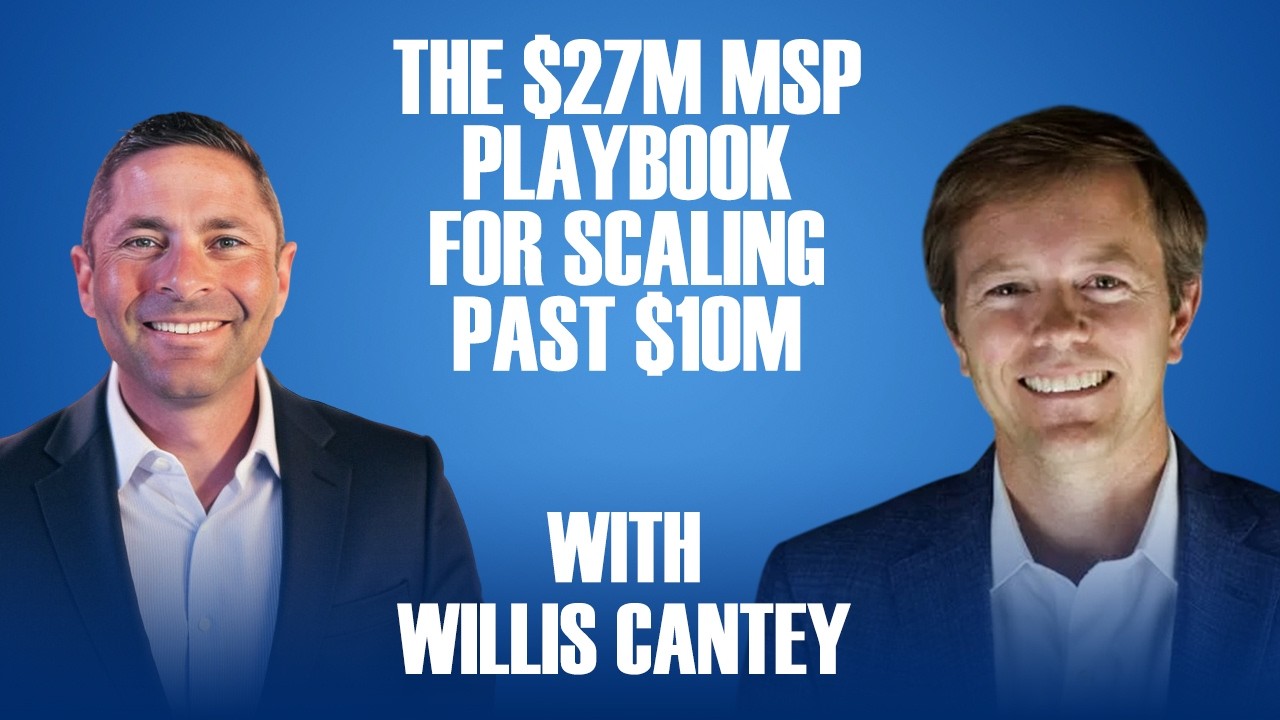
Willis Cantey grew Cantey Tech from a two-person shop to $27 million in revenue over 19 years by focusing on vertical markets, building strong middle management, and hiring salespeople instead of trying to scale with technicians alone. He describes the "Superman cape" problem of over-relying on star employees and why clear processes and leadership development matter more than raw headcount.
Chapters
Welcome to the $10 Million MSP Podcast. This podcast is where I dive into the real stories of MSP leaders who have gone beyond $10 million in revenue, how they built their teams, created scalable systems, and turned their businesses into valuable wealth-building assets. I'm Brian Hoppe, strategic coach to MSPs. I work with MSPs generally in the $5 to $50 million range. In each episode, I sit down with leaders who have built MSPs beyond $10 million in revenue to unpack the inflection points that truly matter. From the personal stories behind their journeys to the fundamentals like culture, operational maturity, and driving profitability. This isn't another MSP podcast about tools and tech. On the $10 Million MSP Podcast, you'll get behind-the-scenes conversations with leaders who've built thriving MSPs, their biggest wins, their toughest lessons, and the practical takeaways that you can take back and use right now. If you're an MSP owner who knows that growth starts from within, that mindset, leadership, and strategy align to create both wealth and meaning, then this show is for you. New episodes are released every other week. So, let's jump in. All right. Well, we are back. Welcome to the show. I am here today with Willis Canty, and Willis was introduced to me by a previous guest, and I'm excited to jump into the conversation here. So, Willis, welcome to the show, man.
Yeah, thanks, Brian. Thanks for having me. I'm excited to do this.
Yeah, awesome, man. Awesome. Well, um, yeah, so I always like to start with a, with a question that kind of, um, you know, that's going to help a lot of people. So let's say, um, I dropped you into a $5 million MSP tomorrow and you, your goal was, okay, I have to get it to $10 million. Um, what are the first few things that you focus on?
So how do you get it to grow, right? How did we go when we were at that stage to go to $10 million? And a big part of it is getting that, maybe it's the CEO or maybe it's someone in sales, getting them out of the office and into the community. I feel like this is a trust sell that people go with you when they know you and they trust you. So I think you need to get out there and get connected, get out from behind that desk. And even if you don't have to be Johnny Carson going out there and knowing everybody and slapping a lot of backs, but you do have to be visible. And I think that's a way that got us in front of people and also asking for referrals. That's the best way to get going and to get in the door. And those things, we were going maybe from 3 or 4 to 10. That's, that's what got us there. And we had some Maybe one or two great salespeople, but it wasn't hiring an army of salespeople. It was just hiring until you found the right one.
Okay, so so that so big focus on sales, getting out from behind the desk. I think well there I know because there's a lot of MSP owners I talk to and and that you know we you know we're we tend to be tech guys and we tend to you know want to want to sit behind the desk and work on operations and. and maybe do some server installs because it's easier, right, than getting out there. And so that's a good one. And I'm sure like there's already a few things that I want to probe into there in what you said. And so we'll get back around to that. But maybe you can just give everybody listening an idea of where you came from. So like, how did you get this thing started? Where, you know, what's been your kind of growth trajectory? And then how, you know, and then where's the business at today?
Sure. So I'll— and you threw in a couple of questions there. I'll try to get to all of them. But if I forget one, bring me back.
I'll bring it back. Absolutely.
It's easy for me to say get away from behind the desk and get out there in the community or in front of business leaders or whatever it may be, because I bring very little value behind the desk. So Brian, there are a lot of people, and I'm sure a lot of your listeners, that were technical in the beginning. They did that, and maybe they started out this business with their cell phone and a bag of tools, right, to begin to do this.
Yeah.
And a bunch of thumb drives. Who knows, whatever it might have been, some extra switches in their trunk. I didn't, so that's not what I bring to the table. And I'll tell you, if I'm working on a networking issue for a client, it's not going to end well for either of us. So it was easier for me to say, look, if I wasn't doing that, if I wasn't bringing value there, then I needed to bring value by getting out and selling and hiring and focusing on the people side and on the sales side and then finding the right people to run those operations. So we did that. My background is much more on the business side. I've been in technology Really since the probably late '90s and was in a dot-com in New York during the dot-com days and you know how that ended.
Mm-hmm.
And then moved to work in software and then just about 19 years ago bought a 2-person IT support company that became Cantey Tech. And they had an existing client list and they were 2 great people, but it was losing money. It might have been cheaper starting from scratch. But it turned out to be a good thing over time.
Okay. Okay. Very cool. All right. So, so 19 years ago, started with 2 people and then maybe just kind of walk through the growth trajectory from there. So, yeah. So, so where'd you get maybe in the first 5 years and then, yeah, kind of maybe kind of talk through that a little bit.
Sure. So, so what we did is that we knew there was, there was an existing company that had been an accounting firm and they did this as a service to their business.
Mm-hmm.
They were doing accounting and they also said, well, we can do another service line, which is IT support.
Mm-hmm.
And I don't think they loved it, but they wanted to make sure their clients were taken care of. So they wanted to get out of that business. They'd had an employee issue, so they wanted to get out of that business. So the first thing I did is that I wanted to leave the software company and take a month off, take a break, maybe even a couple of weeks.
Yeah.
And one of the employees said, if you do that, there might not be any clients left. They, they, they could use some help. We need to get more of me. I'm doing as much as I can.
Yep.
And so I, I think I took an afternoon off and then started on Monday. And the first thing I wanted to do was hire other great people.
Yeah.
And one of them came from the software company where I'd worked before. And then we started the interview process. And really, once you Once you build that responsiveness, everybody on this phone call can tell you that, you know, when you only have 3 people, one of them gets sick, you just start praying that the other, that it wasn't contagious.
Right.
Because if it's contagious, you've got a real problem on your hands. You can only get to so many. You have to cancel clients and juggle things. And it's, of course, it's more important now. But at the time, you could tell a client, listen, I have the servers down. But we can be out there tomorrow afternoon and that might be okay.
Yep.
Now we're just, we expect uptime and our clients do. And most of them don't have physical servers in the broom closets anymore. So we did that. I did some sales training. I thought I knew sales. Turns out I really needed a lot of training. Did some sales training, but also I knew that once we started hiring, and again, this is a reinvestment process. You're not pulling a lot out of the business. We needed to find someone to help really drive sales. Maybe that was in year 4.
Okay.
And not just me. So we're building it up and that ended up being a game-changing hire for us. So we had some technical hires that were game changers and we had a sales hire that still to this day, the best sales hire still works with our team. that we've ever had. So part of it was we had a strategy to provide more responsive service, to do more outreach, to get out there in the community. And part of it, frankly, was luck. We've got some really great people early. When you get the great people early, you build on that momentum over time. Okay.
And thinking about You know, that being a key point, that hire. So about where were you in revenue at that point?
Brian, who knows? I don't know.
You're like, I don't know.
We might have been, you know, at year 5, we might have been at $3 million and at year 10, we might have been at $13 million and at year 15, we might have been at $23 million. So we really hit a growth trajectory. Quickly. And we did that by, there were certain verticals that the word got out that we were good in these areas.
Mm-hmm.
And that helped our growth for a long time is that people would talk about it within their groups, maybe an organization had a peer group. And it wasn't always smooth sailing. I mean, we had to nurture those relationships. Any MSP will tell you it's a relationship. And there will be problems.
Yeah.
But if they know that you're doing everything you can to help them when it does take a dip, then they'll stick with you.
Yeah. Yeah. Okay. Okay. Gotcha. All right. And so, and I want to, I'm going to want to dig into some of those kind of like some of those things that you did along the way. So, so where are you at today as far as, as far as employees, revenue, that kind of thing?
Yeah. So we're at about $27 million. And, you know, I know those numbers, but I don't focus on those numbers. What I really want to do is continue to grow. We've done several acquisitions. Most of them were on the smaller side, but they've been successful acquisitions. You know, there's still things we need to work on. I would do some things differently if I could do it all over again, and we will do it again.
Yeah.
But we've been able to grow, and we've had hiccups along the way. You know, we lost our largest client at one point. They loved us, but there was a new leader that came in and they made a change.
Yeah.
So we were unable to really hold on to that one. And that set us back. But everybody's got some of that, those stories they can tell you about.
If you have—
and you know, it's probably 115, 120 people.
Okay.
And the vast majority of those are here in the US and the Southeast. And we do have some that help us cover some of the calls and some of the 24/7 support that we want to provide that are outside of the US.
Okay, gotcha, gotcha. Okay, so, um, yeah, so about, you know, well, a little, little over 100 employees, around $27 million in revenue. Uh, did I get that right?
Yeah, closer to about, closer to $120 million.
$120 million. Okay, gotcha. Okay, uh, just making sure that we got the, you know, the stats there because, I mean, it's, it's meaningful in a lot of ways just so folks can understand, okay, what, what Where's this, where's the scale at this point? And so, um, so I, so I want to kind of, uh, kind of explore something that we, that we talked about in, um, in our, in our previous call, which was, you know, there's kind of this stage where MSPs have to invest in kind of management and process and structure before you actually see the financial payoff for that.
Mm-hmm.
And so, so maybe talk a little bit about that, about your experience with that. It's— and, and it's been said, and with some other folks that I've talked to, you know, it's kind of like professionalizing in some ways, right? A lot of the functions of the company. And so, so maybe talk a little bit about that. What did that look like for you?
So it's funny you say that. I'm looking over here. 20 years ago, probably, maybe sooner, I've got this book.
Okay.
And here it is. I'll show it to you.
Oh, you know what? I have that one right down here as well.
Okay.
Yeah.
So a lot of people do. It's not that well known, but I think for a small business of any kind, I think it can be helpful. And I think some of those service ideas that it has are applicable whether you're, you know, we say we're in tech. I think we're really in service. But Simple Numbers, Straight Talk, Big Profits. It's not a very catchy title, right? But in that book, if I remember the term—
Yeah. And it's by Crabtree, right?
Right. It's by Crabtree.
So, okay. Yeah. So for those who aren't watching, who are just listening, Simple Numbers, Straight Talk, Big Profits by Crabtree. It's a good one.
And I think he's a CPA, maybe out of Huntsville, Alabama or something like this. And he talks about At a certain point, you have to invest in people or in middle management like you're talking about, Brian. And you may go from $3.5 million to $4.5 million and you may not put any more money in your pocket at the end of the year, which is frustrating, right?
Correct.
Because before, you certainly put more money in your pocket when you were at $1.5 to $2.5. And so what's happening here? And I think he might have even referred to it as like the black hole where you've got to Push Through It. If I remember correctly, I haven't read this book in a while, but you made me think of it. So whether it's $3.5 million or $4 million, it's definitely before you get to $5 million. You have to bring in leaders that might not be fully billable. And before, the more people you hired, they were billable. Even if you weren't billing hourly, I get it. Most people aren't doing that anymore.
Yeah.
But either way, it's a position that whose job is to help you grow through things and help you get more efficient, not whose job is just to help solve technical problems for clients. Maybe that's someone in administration like purchasing or handling this, or maybe you hire a controller, not just the bookkeepers, right?
Mm-hmm.
Maybe those types of things that you don't realize how much will help you. Accounting is a good example because You don't realize what you're not getting until you hire that next level person.
Yep.
And we take it on private equity too. So accounting takes another level of nuance, right? There's a lot of interaction between our accounting folks and our private equity sponsors. So you need to provide that to help you grow. So there is an investment point. And I remember going through it thinking, man, we're working harder. but our margins are smaller. And we knew that before we went into it. People think of the same things. We used to buy all this hardware and we did hosting directly in a co-located data center that we used. We knew that we had to invest in those racks. We tried to get the most we could out of the equipment we had, but we knew that we had to invest. And at one point, I had someone who I had him wearing 3 different hats. It's too many.
Yeah.
He's wearing 3 different hats. He's sort of the head tech and head of the technical team and in charge of the colocation and all this. And he said, Willis, we're going to continue to struggle unless you spend $45,000 or something like this on new equipment right away. And we may— and also we need to hire somebody. So we hired this new person. I said, listen, this person on our team has said we need to spend $45,000. I know we don't need to do that, but how much do we need to spend? And he said, you don't need to spend $45,000. You need to spend $90,000. But that made us more efficient and made it work better. It provided more. It's the same. You're providing more capacity for your team to grow. The only trick is you've got to keep growing. And that has gotten harder in recent years.
Yeah. Yeah. Well, yeah. And obviously as you get bigger, you know, growing percentage-wise is more difficult, right, than it was when you were when you were smaller, but also it's, you know, sales is tough for, uh, for a lot of MSPs out there, right? And, and I see that often where it's like, hey, we're making this investment and, you know, and I'm like, that's great. Um, that investment only pays off if you're actually adding clients. Um, if you don't, then you're just spending money, right? And so, yeah.
Correct. Correct. And, and, you know, the, Things are harder now than they were then. So an example is a lot of our target clients, a lot of ours have been acquired, right? So we joke around about it is that we love helping the trades, right? We have a ton of folks in the trades that we help. It's been great, but they're all consolidating very quickly. So we need to get on the side of the consolidator, not the side of the consolidated because we, you know, we have that. So the easiest way to grow is to hold on to your existing clients. We also, as you do acquisitions, there's a 100% chance that the way you provide support isn't exactly the way that they provide support. So you've got to communicate with those clients. You've got to work through that. You've got to work with the team. So you want to retain your existing clients and then continue to steadily add clients and hope they don't get acquired.
Yeah, yeah, yeah, yeah. Well, and I consistently see this in my clients and peer groups that The majority of attrition, client attrition, is related to M&A for the most part. I mean, it's not usually, oh, you guys do really bad service for us and so we're leaving. Majority is, man, this really huge client of mine just got acquired.
Yeah.
You seeing that as well?
Yeah. I mean, I think it is well over half. And I think MSPs too will say, oh, 90% of our losses have been to that. That seems a little— maybe you're just in a tough industry, right? But maybe too, our service is not perfect. It needs to be better. I know where it needs to get better. We are working on it, right?
Mm-hmm.
But with those, with the service, you have control. With acquisitions or some companies don't make it. You know, we have well over 300 clients. Not all of them make it every year. Some of them close down.
Yeah.
So, you know, we do have that. And sometimes it's in areas where you wouldn't expect it. But we are, we want to stay close to our clients as they do that. And we try to throttle back, right? Let's suppose a client went from, we had one go from 50 to 6. Well, we did do a good job when they were at 50. 6 is smaller than we would like. There's no doubt about that. We do have a minimum, right, about what we can do, but we can still help them. And we like to do that because I've seen the ones go— we had a client that went from 4 people to 300 to 15.
Wow.
So who knows, maybe they'll go back. So we just, you know, we want to stay with them and grow with them as they move forward.
Yeah, yeah, absolutely. Okay. Yeah. And so kind of, you know, continuing on this topic of that, like, you know, kind of professionalizing and those kinds of things, you kind of alluded to this kind of Superman cape problem. Talk to me about a little bit about that and what that means to you.
Yeah. So if you and I are thinking about the same thing, because I use that term, hopefully we use it the same way.
Yeah, yeah, no. Yeah. Yeah, go for it.
We say, so there's, I am yet to see, knock on wood, a technical problem of any kind that if I get some of the top several techs on our company to focus on, that they can't solve it. Maybe it's working with a software company or whatever, maybe we're doing something, but that they can't solve it. But if all you're doing is having them put on a Superman cape every Tuesday and every Friday at 6 o'clock, it's not just bad for them. It's not really a scalable business. It's, you know, it's a cult. So we try to make this more of a company, not a cult. So what's the process? Why does it— why do so many issues need to get escalated so somebody has to put on the Superman cape? And sometimes I need to do that as the CEO. So we had a client, they were really upset. I had to fly 3 states away and back the same day to deal with them to try to make them happy. The truth is, Brian, it ended up not working out, but at least we turned it around in that short term.
Yeah.
And we tried. And I want people to know that we all need to give that effort sometimes. It's just not scalable If every week I'm going to visit 3 clients who had a, you know, we were slow to fix a technical issue. It's not scalable.
Right, right, right, right.
You can't just rely on the Superman cape like you did when you were 3 or 4 people.
Yep, yep. And yeah, yeah, absolutely. And where I see it a lot of times is, yeah, you know, there's like the one tech who knows every client and they're fantastic and all of that. But, you know, the problem is like we think they're completely indispensable because if I lost this person, my business would totally go under. And often they're also not willing to follow process and or not willing to enter their time or, or various other things. And so it ends up being kind of like a leech on the organization. Because, you know, we kind of think, oh, well, I just have to keep this person happy because otherwise things are just going to be terrible. And so, you know, often the answer to that is, well, they can't be part of the company anymore. You know, when I run into those situations, but also making that transition from like that superhero mentality, like this is our superhero to Hey, no, actually we have a process for all this stuff and it's not just dependent on this one person. Do you see that as well?
Yeah, I see it all the time. And sort of the smaller the company, the more that person is the superhero and they're loved and admired and all those great things. But they might not like being part of a larger organization. I mean, I think in a larger organization you have an opportunity to rise and to try new things. But you might not be the biggest fish in that smaller pond anymore.
Mm-hmm.
You might not be, and you need to figure out, is that okay? I will tell you this, Brian. You mentioned that there are some people who are really great, but they really, they don't want to do, they don't want to be a part of the team. They just really want to solve the technical problem. Just let me get in there and I'll call Brian and we'll, I'll solve this. Right. But that doesn't scale. So as you get bigger and they want to do that, it piles more and more clients on. Clients are just calling them on their cell phones. They're not calling the help desk line.
Yeah.
They're not emailing help@cantytech. They're not doing any of those things. It's bad for everybody.
Yep.
It's bad for that person.
Yeah.
It's bad for the company. It's bad for the people they're sort of mentoring. Because they're not teaching them the way that the company does it. They're just doing it their way. So you have to be, you have to be careful. And we've had people that have started out that way and have, have come around to sort of our way of doing things and it's worked out great.
Yeah.
But we've also had other folks that, that really didn't want to be a part of the process. And man, I made plenty of mistakes, Brian, but my biggest mistake is Holding on to those folks for too long.
Yep. Yeah, absolutely. And, and I see that often, and it, and it's, and it, it's kind of like, oh man, if I, if, if this person wasn't here anymore, it would just be terrible. And every, every time I've seen it happen where that person either left or was gracefully exited from the company, uh, the company was better for it. Um, afterwards, right? Those are, and those are the difficult, those are the decisions that are really difficult to make. Um, but if you want to scale, you're going to have to make that decision at some point, right? And, and those are, those are always really, really hard. Quick pause. Let me ask you a question. If you stepped away from your MSP for 90 days, would the business keep getting stronger or would it slow down? Your answer tells you a lot about the operational maturity of the business. I created a short MSP maturity assessment to help you identify what's working, what's breaking, and what might be capping your growth. You can take it at brianhoppe.com/assessment, and the link is in the show notes. All right, back to the episode.
It is. So on the ones where we made the decision, or somebody at Kandi Tech management or whatever made the decision to ask somebody to leave, I don't really know of a lot of regrets. There might be a few, but I don't know a lot of regrets. We said we wish we hadn't done this. I know I have a couple, but I've been at it 19 years. That's a couple is not too bad, right?
Yeah.
Out of the ones that the employees made the decision to leave, um, there were a couple that I thought, man, I don't want them to go. But if you really care, but they found something better for them. For whatever reason, they found something that's better for them. So if you really care about your team, what does that mean? It means you want what's best for them, not just what's best for you.
Yeah.
What's best for them might be going out and doing something else. But here's the good thing. In the last 6 weeks, we had 2 people that chose to leave years ago, and they just came back. And man, I am thrilled to have them back. And the new people who started since those folks left a year, a couple years ago, 3, 4 years, they were like, oh, I get it why you were so excited about them coming back because they really are great. So that's one thing. You know, you love to have folks that left, that tried other things and that came back. It's sort of proof positive that this is a good place to work.
Mm-hmm.
You really love it when clients come back. I want to have more of those, but you really love it when clients come back. I don't count on it, right? But, but it is great to know that you're doing something right.
Yeah, absolutely. Absolutely. Okay, so, so I want to explore for a little bit, if, you know, looking back 19 years, if you could point to some things that were decisions that you made or things that you did that kind of created disproportionate results? What do you, what do you think of when you think about that?
Certainly. So we mentioned the impact of hiring good people. And I'd like to say that I'm a master interviewer and all this. On sales, we've been through a lot of salespeople.
Yeah.
We have had our best for a very long time and some other good ones too that we've kept around. But it had a huge impact and it opened up a new vertical for us. So we're in a lot of different verticals, right? We think that we can provide support and there's a real need across a lot of different verticals. But in particular, this person introduced us to the education vertical.
Okay.
And that really took off for us. It's an area where we were focused and a lot of others weren't, and there's a huge need. So that really took things off. Also, we did an acquisition. Our first acquisition was in Florida. Not only was there great talent, as there has been in a lot of our acquisitions, but, you know, the owner stuck around. Which I sort of have really grown to appreciate what he did because he was very flexible. We tried several different things. We found the right spot. And so that contributed in a huge way to our success.
Mm-hmm.
Right? We were also flexible in terms of locations. So we moved to more central locations to make commuting easier for our clients. And now we have a hybrid model. Where some offices that people can get to more easily are going directly into the office, but a lot of people are hybrid or working fully remote. And that has worked well for us. We just need to make sure we have enough people so that I can't have all my field techs being remote because they need to be in the field at the client.
Right.
So some of the hiring strategy changed too as we did that.
Okay.
And then Building out, building out sort of the administrative function. We could really grow without adding a lot of people because it's a process-driven side there on accounting and things like that. Doesn't mean we don't have issues, especially when you do an integration and we believe in full integration. That's part of what we're trying to do here. I know not everybody does that.
Right.
When you do an integration, I think that billing is one of the hardest parts. So, um, because, because clients say, what is this? And normally if you can make sure the bottom right corner says the same thing that the last voice said, they're okay with it. Um, but we now have a system to make that work a lot better.
Okay. Gotcha. Okay. So, so, so I'm hearing like expanding into new verticals or specifically the education vertical. Um, do you, well, at this point, do you have Do you have, you know, a few primary verticals that you focus on, or is it still, is it kind of all over the board?
You know, I'd like your thoughts on this, Brian, but I think we're like a lot of MSPs. So we do a lot of legal, a lot of small and medium-sized businesses, a good bit of healthcare. We do a good bit in education. So it sort of reflects the markets we're in. So our primary markets, We're in Charleston, South Carolina, but we're throughout the state. And we did 2 acquisitions in the upstate, which is the Greenville-Spartanburg area. Those are huge growth areas. Also, we're in South Florida, just outside of Fort Lauderdale, another great growth area. So we're reflecting those markets. And then in Western Virginia, in Roanoke, which in addition to being beautiful now is catching on too. So a lot of our clients reflect the markets where we operate. If you were to go to the Chamber of Commerce at any of those locations, those would be a lot of our target market clients. If you would go to a practice manager meeting at independent medical practices, those would all be target market clients.
Mm-hmm.
And if you would go to— we do a lot of charter schools, a lot of virtual charter schools, some brick and mortar, more on the public sector, but we are open to doing some in the private sector. With schools, those would be great targets.
Yeah.
I don't, we do not, I know MSPs that say we don't work with any lawyers.
Mm-hmm.
I understand that, but we do. And some don't want to work with dentists, but we have a few dentist practices.
Yeah. Okay.
And we break it up into pods so that the person in manufacturing, for example, maybe I didn't mention that we do a lot in manufacturing. There's a manufacturing team. So we know the lingo, we understand the issues, we can focus on— we understand their business. And that's been very helpful to us. Same in financial services. You know, all of these groups, people say everybody's— everything says security is important, but it is different, right? HIPAA is different from CJIS, which we see around the police forces. We do a good bit of municipal work.
Yep.
So we need to CMMC, we do a lot of that. So we need to know, I always joke around, we need to know all the security acronyms and we've worked with all of them. So we break that up into teams so we can speak those languages.
Right, right.
Yeah.
And that's something that comes with scale, right? Like you can, you can have, you know, specialized teams that work in, in particular verticals. I've seen, you know, well, when I built my MSP, I decided to build it around one vertical, which was banking and credit unions, which, you know, especially on the, you know, when you're smaller, it just makes things a lot easier in a lot of ways, right? Like your marketing becomes easier, your sales become easier. You can speak their language. Hey, we have, you know, all of these other businesses that are just like yours. We can totally take care of you. And then things start to change as you get some scale, you know, and You know, I think it's— there are those who would say, like, the only way to go is one vertical focus. And there's plenty of people who say, hey, it doesn't matter that much. Are you, you know, but are you building a business that's going to be— that's profitable and sustainable? You know, you're going to be able to sell it, right? Either way. And so, you know, so the question more becomes, okay, what are you— you know, what do you want to be focused on? And is it, you know, and can you sell into that space? Right. So you're selling into a bunch of different spaces. And I'd imagine you probably have some sales folks that are focused on, you know, more on some industries than others as well. Is that right?
Certainly. So we do. And you do get to a— like we do some work for some credit unions here. There are only so many in our market. Part of it depends on the market. I mean, if you're in a major metropolitan area, which we are not, I mean, South Florida would be the largest equivalent. And so we do go all the way down to the south side, south end of Miami and farther up. But if you're in one of these huge cities, you can just focus on, you could build a $50 million MSP in New York doing just— Orthodontist offices.
Yeah.
Right? And you could be the person and you could sponsor the orthodontist gathering they do every year. And the great thing about that, and you probably saw it, Brian, is that you become a known quantity and people know and trust you. And at that annual banquet, somebody says, oh, you use Brian's company? And then somebody else at the table, oh, we do too, they're great.
Yeah, yeah, yeah. It becomes a kind of a self-fulfilling thing. You know, I know, I know MSPs that are, you know, they're, they're focused on a really specific healthcare niche, like, you know, ambulatory surgery centers. And that's all that we do. And they're nationwide and they go to all the, you know, all of the conferences and everything else. And so they're walking the halls and they know everybody, everybody knows them. And so it's, it's just become a thing where it's like, yeah, and actually there's— they have the people who are acquiring, right? And so, or the, you know, the private equities and those type of things where it's like, oh, okay, you know, now we're, we're on the right side of all of this stuff and it just makes growth come a lot easier in a lot of those situations.
It does. So I get it when people are focused on one vertical. But I'll tell you, we are not. We're in multiple verticals and it's been a successful thing for us. And, you know, I knew someone that was focused on dentist offices and during COVID no one went to the dentist unless you had to.
Right, yeah.
So, you know, it was a tough time for him.
Yeah, it was problematic for sure. No, it makes sense. Well, when you think about, you know, your— because we were kind of, we were talking about things that made a disproportionate, um, impact on your growth. Um, what do you, what do you think about the things that, um, you maybe had to say no to along the way? Or, or you, you were just like, this is something we're not going to do because it's not go— I mean, even though it might be some money in the door, it It's, it's not what we do, or we don't— we, we can't do it that way. Have there been, have there been things that you're like, yeah, I really had to say no?
There are probably more things that I said no to after I tried it once. And it, and it burned us. So, you know, at one point, we wanted to take care of everything for clients. And can we do a website? Well, I think that technically our team knows how websites work. This is before vibe coding became a thing. But if we do it, it's going to look like your IT guys did the website.
Yeah, right.
So I think we did stay away from that. At one point, we were staying away from voice when voice was all about that gigantic machine in your broom closet that was 20 years old and nobody could touch it except for the phone people. So we stayed away from that. That's That's totally different now.
Yeah.
We do a lot of that now. We have stayed away from cabling. We found good partners in the markets where we operate. They can do it more efficiently for our clients. I think we're too expensive, frankly, to pull cable. And it's a totally different set of tools and insurance and ladders and trucks. So we've stayed away from that. We're careful about custom coding. Now with AI, we're happy to work with folks and play with APIs and all that, that's a little bit different. But we historically have stayed away from custom development.
Right.
There are people who do that better. And we frankly like the idea of bringing them in.
Yeah. Partners and that sort of thing, right? Yeah.
And I'm also, when something off the shelf can do 85% of what you want, use what's off the shelf.
As opposed to customizing.
Yes, but, and most of our clients we talk to about that, they still want to explore writing some custom code, but what I don't think they understand is that this is not going to be $4,000. You know, you might be talking about a $50,000, $75,000 project.
Right.
So most of our clients are not walking down that path. Yeah.
Yeah. Okay. So, so you've done a lot of acquisitions, or at least a handful, as we've discussed. How do you, how do you think about acquiring companies and but also keeping the culture in place that you've built over time?
Yeah. So it's hard to have both, right? It's hard to have multiple cultures. Cultural is If culture is plural, that's complicated.
Right.
We are trying to do this in the Southeast. So there is some proximity that I think is helpful there. And we passed on some opportunities that were just outside of that. When I say Southeast, we would go to Texas. I know Texas doesn't consider itself the Southeast.
Hey, I'm in Texas and they would be, you know, they don't even think, we don't even think we're the South.
Well, yeah, it's Texas.
Yes.
And I appreciate that.
I get it.
So, but what we're really looking to do is, so proximity helps.
Yeah.
I can go and visit and see folks, and I have been doing that. I'm trying to do more of that now. That's part one. Part 2 is if it feels too hard when you're having initial conversations, think about when you're married.
Right.
Right? Like, think about once you sign that dotted line, then you've got to work together, and those things that you knew was They were kind of painful and totally different. Man, it's hard when you actually do it. And it's been a challenge. We had a really great acquisition and it has been a success, but their mode was a little more call, you'll talk to so-and-so, and if they can't fix it pretty quickly, they'll just hang up the phone and drive over to your office.
Right.
Whereas we're more, okay, we're going to try to fix it remotely. We think that's faster for the client. We might even escalate it once before we send somebody over.
Mm-hmm.
It might not be the same person you talk to. That, that was a culturally different thing.
Mm-hmm. Mm-hmm.
Or, you know, there was a different way of handling dispatch or morning meetings, and we follow a level 10 meeting, right? More of the EOS model is what we follow. So there are some things, and in the end, we want to convince people that what we're doing Is the right way going forward. And I tell folks, you've got to be flexible. I mean, I get it. Some people love their tool stack.
Yeah.
I get it. But we did 2 acquisitions and we were winding them down, but— or winding down the tech stack, but at one point we had 9 different backups. That's not scalable. You can't do that. So Right. There's the culture, there's the tech stack, there's the way you respond to client issues. There's sort of, you know, you don't have to make it corporate, but you do have to be process-driven. And we like to be upfront about that. These are the values that we have. These are things that we are important and we really want you to stick around. I mean, I want people to stick around. But if it's not for them, You know, then we, we probably need to make the decision. They or us need to probably make the decision early on in the process.
Yeah. Yeah. And that is, you know, with acquisitions, because I've been, you know, a part of or acquired many companies over the years and, you know, and integrating the cultures is, it's a challenge, right? And a lot of times, well, You know, however, however difficult it is to get the acquisition done, like once you've signed, that's when the real work begins, right? Of actually, you know, doing the, doing the integrating, making the team a part of the team, getting them in the tech stack, in all of your, all of the processes, you know, meeting the clients and building the relationships with the clients. So like all of the different things that go into it. So, so totally makes sense. And, and, and I, and I like what kind of what you said about, you know, if those initial discussions are a little bit shaky, it's kind of like, well, you know, if you didn't have a good first date, why are you, why are you going to get married to somebody, right? Like this, this doesn't make a lot of sense, right?
I am. I think that we've been lucky in that we brought on good people and they've been able to rise up, right, in the organization. So a good example is with the acquisition that we did in Virginia, there was a security person there that was his main thing was security. And it was really him. I mean, there were other people who did this, but this was his main thing. Well, now he's head of our security team.
Mm-hmm.
He brings it. So, and, you know, he hadn't been with Cantitech 15 years. You've been with the other company for a long time. But so you bring in people and for folks that are on board and do this, there's some opportunities to move up.
Mm-hmm. Yeah, for sure. For sure. And so I believe when we previously talked, you mentioned that still, I mean, even you've done acquisitions, but majority of your growth has been organic, you know, or growing your client, you know, your client's revenue, but also getting new clients. Is that You know, is that the case that it's majority kind of coming from your sales engine?
It has been. It has been. And, you know, for a long time we had a really great run. We're working to get back there. And I think a lot of MSPs, you've probably seen some of this. I've heard people say, well, 10% is the new 20% when it comes to growth of these midsize, let's say $20 million plus MSPs. organic side. I don't know if that's really the case or not, but most of our growth came through sales. And it wasn't like we had a magic bullet with marketing. I mean, we've done a good bit with digital marketing. We've tried it. We've pushed it. It's been okay. It's been okay. I don't think we've cracked the code. We have done a good bit with cold calling.
Mm-hmm.
We definitely have not cracked the code there.
Right.
You know, we've done different types of outreach. In the end, it's connecting to people through other people that has worked best for us.
Yeah. Okay. Okay. So yeah, so let's talk about that for a minute. Like, so you've got a sales team and how many, about how many people are on your sales team?
So we have 2 to 3 outside salespeople. We have the same of inside sales.
Okay.
We have a sales leader who's in charge of this and marketing. We do outsource some of our lead generation and we have an outsourced caller and business development person who's doing that. And what we're trying to do is experiment with different things and sort of fail quickly.
Yeah.
I don't want to spend a year on something that didn't work the first 6 months. Been there and done that. And I think that world is changing. I mean, if someone happens to call me and I happen to pick up because I think it might be a client or something and they're trying to sell me something, I'm not always at my best.
Right.
So I think some of those older methods of outreach, even if you tie in AI about who might have a propensity to sell and who's the right contact and all this, it's still hard.
Yeah, yeah, yeah, for sure, for sure.
And on the inside, we are seeing clients that are more open to security, which is very important for us and for them. And to AI, clients are curious. They want to know what can we be doing? And it's not a one-size-fits-all. So that's a consultative type scenario that we want to get into, not just here are the tools, best of luck.
Right.
Let's talk about what's going on with your business and see if we can help you somehow.
Yeah.
Yep.
Makes a lot of sense. So I want to, I want to talk for a little bit about people, right? Because, you know, I think this is one of those concepts that, you know, especially when you're small, it's difficult to kind of grasp. But developing leaders, right? Leadership development. And, you know, and I kind of, you know, in our previous conversation, you know, you kind of— it sounds like you get a lot of energy from seeing people grow. And so maybe talk a little bit about that. Like, when did you realize, oh wow, it is actually really important to develop leaders inside the company? And what's that looked like for you?
So I'll tell you one thing. For the CEOs that might be listening to this podcast, right? We always probably wanted this chair, right? We thought that's what we wanted to do. We thought we wanted to get this chair. So what do I need to do to get there?
Yep.
And I have great people that over the years I've wanted to be leaders that didn't want to do it. They didn't want to do it. I mean, sure, I think people would like a little more money and things like that, but they don't want to hold people accountable.
Mm-hmm.
Which is one of the big things that I want our leaders to do. It's not, you know, it's not just saying, hey, the troops want us to do this differently, or this. It's managing down. And that's not always easy, and a lot of people don't want to do it. But when they do, when people move up from within, which is what I would always prefer, it's the best feeling in the world.
Mm-hmm.
You see them grow in their careers. You see them take on a new set of challenges. They're able to say to the folks that might have been working side by side, hey, I'm doing this now. And I know we joked about it in the past, but you really do have to do it.
Mm-hmm.
So you see those leaders come and grow. We don't do a ton. We have managers meetings, which I think they are very well put together and very well run. That's probably because I don't do any of those roles. We have a team that puts it together. I think the content is really good. And I think that it's a great morale booster when you get those leaders together that aren't always together. You know, might be working in different corners of the Southeast.
Yep.
Yep. So seeing them grow and seeing them develop, and we, again, we talked about the EOS model. That sort of gives you a framework for doing it.
Right.
And I think without that framework, you know, the technical resources that work at Kandi-Tak, and I think this is the way it is with techs all around, they tend to be logically driven and process driven. So if there's a process behind it, I think that's easier to follow than we just say, hey, listen, Be empathetic. Good luck, man. You know, you know, it sort of gives you this and we have a process too. And then we have a process for when things aren't going well and you have to have the uncomfortable conversations.
Yeah.
How we have those with people. And sometimes it takes us a while. If we know we have the right person, we will move people into different seats. Right? You want that right person, right seat, and you don't always get it right the first time.
Right. Yeah. And, uh, and it kind of strikes me— well, there's— you kind of hear, um, often that people tend— I think it's, I think it's the Peter Principle, um, where, you know, people tend to get promoted to their level of incompetency, um, you know, where it's like, oh, I'm gonna take my best tech and then I'm gonna make them the manager of techs or, or things like that. How have you seen that play out inside the company as you've grown?
Here's the frustrating thing, Brian. Not only am I aware of this problem, but even though I was aware of the problem, I still did it, right? I still did it. It doesn't mean that people can't do that, but there are times, there are times that you want to provide a path To people that doesn't just involve being a manager.
Right.
Being a manager means you're a manager of people. Or maybe a manager of projects, which project management is a lot of it's people management. It's sort of the toughest job because it's— you're accountable for something but not responsible for it at the same time. You're not hiring, firing, promoting, what have you, but you got to get these people to do what you want them to do.
Yeah.
So, and I know this because at one point I was a project manager.
Yep.
But yes, you always need to be aware of it. And what, what we need to be able to do is, is tell people that just because you're promoted to a manager role or this role, if you don't do well this role, it doesn't mean you're a failure as a team member of CantiTag.
Right.
If they can set ego aside and say, oh, I was a manager, but I want to go back to being a tech. We can consistently work that out. And it doesn't mean, you know, that, that you've been, you're a failure. These other roles just means that maybe this role wasn't the right fit. And, and I've realized that a lot of times those folks are sort of relieved.
Yeah. Yeah.
Yeah.
It's a, it makes sense too. It's like, yeah, this doesn't really fit my skillset or, um, or I just don't have the desire to figure out how to you know, have those hard conversations and, and hold people accountable and, and things like that, right?
Well, sort of this trifecta of complication, right? Because you have clients who are— there's curveballs there, right? And you have computers or technology, which there are curveballs there. And now you're also managing a third set, which is people. And so this is not, this is not an easy, it's not an easy role to be a leader at an MSP. So it's okay if it doesn't work on the first try.
Yeah, yeah, for sure. Um, do— have you seen anything, you know, when you've looked at leaders, uh, or, you know, or promoting people, um, giving people bigger roles, um, have you seen any common things where it's like, okay, yeah, this is the, the, the right The right kind of person, the right traits, um, for those folks who have made it?
Yeah, so one part of it was they tell us they would like to be considered for this one day, right? So they, they tell us that, like, I, I would like that one day. And what we may say is, sounds good, there's nothing— or we might say, great, there's something open right now, let's Let's consider you for it. We also have to interview for it, but let's consider you for it. 2, we might say, okay, it's good that we know this.
Okay.
We're going to keep you in mind going forward. Or it gives us the opportunity to say, I get it. Here's why you're not ready for this yet. Right?
Yeah.
So we did an acquisition one time. It's sort of a side story. We did an acquisition one time and the guy, There was a guy that came to me and said, hey, I want to get promoted. I feel like I've been passed over for promotion, all this kind of stuff. And I said, okay, well, let me look into this. Give me a week. I understand this is important to you. I'm new to this team, so let's check it out. And it turned out that he had had an inappropriate relationship, not with one, but with 2 clients.
Oh, wow.
With 2 clients. And because he came to me and this opened up, I was like, okay, how do I handle this? Because that's a, that's a no-go at CantuTech. Right. You can't do that.
Yeah.
And I talked to him about it and he said, well, but those clients, we're fine now. And I'm like, no, I'm not asking about the status of your relationship. That's not what we're talking about here.
Right, right.
I'm saying that this is— and 2, I've talked to some members of the team and you've made decisions that probably meant this was not going to be a leadership opportunity for you. So I owed it to him to tell him that there were some reasons this hadn't happened in the past. And maybe people had told him that in the past and maybe they hadn't. But you've got to know that too. Are they, are they good listeners? And are they willing to hold people accountable? Right? So if, don't hold me to these numbers, but let's suppose your service tech is supposed to close 30 tickets a week on average. That's the goal, let's say. I don't know. Or that people want to have 75% or 80% or 70% billable utilization. Or you're expected to handle this many escalations. Whatever it may be, there's some metric.
Mm-hmm.
It can't— and those people are on your team. If they continue to miss their metrics week after week after week after week, What do we need to do to help them? It's a problem that needs to be addressed. Or we have clients continue to say, Jack always says he'll call me back at 2 o'clock and he never does. And it's driving us crazy.
Yeah.
It's driving us crazy or we're going to leave because of it because we're so unhappy about this. Well, I expect that manager to sit down with Jack to talk with him about it. If Jack does it again, then there's a formal write-up process. If he does it again, then Then it's either out or there's the final write-up, right? It's holding people accountable, spending the time to do that. And managers need to do that, but they have to be good listeners too.
Yeah, yeah, absolutely. Absolutely. Well, yeah. So just as we're kind of wrapping up here, I want to talk for a second about your— about the role. So when you think about the role of the CEO at a company that's your size, kind of pushing $30 million, Well, what should a CEO be spending most of their time doing?
Brian, that's an excellent question.
You have it all figured out, right?
I'll call you. Right. It's funny, somebody gave me this book. It says the CEO only does 3 things.
Uh-huh.
So I want to read that and find out what those 3 things are.
I think it says people, numbers, and culture, if I'm not mistaken.
It says finding your focus in the C-suite.
Yeah, yeah. But yeah.
Maybe I should have read that 20 years ago. Yeah. I'm not telling you I've got it all figured out, Brian.
Yeah.
But I will tell you, I try to spend a lot of time dealing with my direct team. And sometimes I do have to go down, you know, to a layer deeper. And, you know, I've spent a lot of time with my direct team and hoping that we're coming up with the right plan and tactics and goals to move forward and that everybody is following along those steps, right? I want to hold them accountable. Right? 2, I try to spend time with our clients, both ones that might be in distress and also reaching out to them and contacting them. I do spend some time with our private equity group, but I will tell you, we've got a good one and they're not bugging me a lot. They're supportive. We picked a great partner. So our quarterly meeting is conversational. It's some slides, but it's not 160 slides. It's not 80 hours of prep. So it's not that. And also, I want to help with sales because frankly, I like sales. I like dealing with clients. I like talking about Cantey Tech. I'm really proud of what we're doing here.
Yeah.
So the more I can get out and do that, the better off we'll be in leading that team. And people say you're the keeper of the culture. Again, I feel like that's cultish. We're a company. But I do try to head up communications and our monthly team meeting, company-wide meeting, which is short, and get out there and see our folks at our offices. Yeah.
Love it. Love it. And if you had to say, hey, here's a thing or two that I probably need to let go of, what would that be in your role as CEO?
So letting go of the vine, what do I need to let go of? I can't help but digging into some tickets sometimes. And really, the joke was, is that they were going to take my ConnectWise license. So because I do dig into, hey, what's the story with this? What's happening with this?
Yeah.
You know, there's probably a level of detail with that that I should be focused on, on sales. And that's sort of where I've shifted it to and less on the Service and operations. You know, we've got a lot of happy clients, but when a client is unhappy, I want to know everything that happened incorrectly. And that, that, um, even when my team has it under control. So I need to let go of the vine of some of the tickets and the service ticky-tack type things.
Yeah. Yeah. And I think, you know, at your level and a lot of the folks that I work with, it is difficult to let go of some of those things. And sometimes, uh, sometimes that letting go is actually what the team needs in order to be able to thrive, right? And so I'm sure there's a lot of things you've let go of throughout the course of your growth and all that kind of a thing, but—
Yeah.
Yeah, so, okay, so one question, this is always my favorite question as we wrap up is what is the biggest mistake that you have made as a leader in your journey?
I have consistently given too many chances.
Okay.
And it has been, you know, I believe in redemption on all levels, right? And I think that people can turn around and do better. But I think it has cost us clients over time. You know, there were problems with people and we continue to try to make it work. And I know it's tough to let go of those folks that might be good at their jobs and some clients might really like them. And so, but there were problems. And again, there aren't a lot of regrets with the decisions that we ended up having to make. They probably should have made sooner. And I know a lot of CEOs that would, they would feel that way as well.
Yeah. Yeah. Well, absolutely makes sense. And I, I have a, I have a thing with, with my clients at this point where It's like, hey, once we get to the 3rd time where we're having a conversation about a problem employee, it's time, right? You've tried enough and all of that. I know it's a really difficult decision. We want to be humane. We want to have empathy. We want to help people. And still yet, I have yet to talk to anybody who's really regretful of letting somebody go that they knew they needed to let go. Um, it's, you know, it's very rare that you're like, man, I really wish I hadn't do— hadn't done that. And so, um, so that's a good one. That's a good one. So, um, awesome, man. Well, so a couple, uh, so, so we always like to end with, uh, with a rapid fire. And so, um, so I'm just gonna, you know, this is— it's like the first thing that comes to mind, quick answers, right? So what's, what's something that you have changed your mind about, um, over the last few years?
AI. AI, I did think it was great when some of it first came out. I thought this is not— we were trying to use it to solve some technical issues, some IT support issues, and it just wasn't working. I think that changed after 60 days. I'm really excited about what we're doing with that now.
Awesome. Awesome. Okay. And what's something that you've been curious about lately?
You don't have time, Brian. It's everything. You don't have time. Trust me, it won't be a rapid-fire conversation.
Right. Okay. Well, we'll pass on that one. I'm sure there's a lot. What's one thing that you can't live without in your daily routine?
Exercise.
Okay. Awesome. What's your go-to way to unwind, relax? Reading. Reading.
Typically nonfiction, but sometimes fiction without feeling like I'm wasting my time.
Love it. Love it. And then last but not least, what's a book or an idea or a piece of advice that has shaped you the most?
Wow. I think it goes back to one version or another of treat people the way you would want to be treated. And that's the way my father raised me. He passed away 3 months ago. And I think about that now, but I thought about it then. And there's all sorts of things that as CEO or as a person running a department or anything, there are all sorts of compromises that you have to make.
Mm-hmm.
And we do things for clients that sometimes they appreciate and sometimes they don't understand. But you run into ethical questions. And in the end, I am proud of the way we deal with those decisions and the way that we put our clients first.
Awesome.
I'm really proud of that. So that is— we think about when a client is upset, I said, how would this feel if you were on the other side of this? It always makes sense. And so we're always trying to come up with something that sort of bends in their favor.
Yeah. Well, well, thank you for sharing that. And I'm very sorry for your loss as well.
Yeah, thank you. But it's good things to remember people by. Yeah. So, you know, yes, my 14-year-old, what I taught him, it would be probably a few moments of silence. So hopefully I'll teach him something in the meantime.
There you go. There you go. I love it, man. Well, thank you so much for this. This— I know this is going to help a lot of people. And, you know, I always like to give an opportunity if somebody wanted to get in touch with you or anything like that, how would they— how would they go about doing that?
I'd love to hear from them. willis@cantytag.com. I would love to hear from anybody.
Awesome. Awesome. Well, and just so you know, like multiple guests have gotten calls from potential clients who listened to the podcast, which, you know, hey, we'll keep the streak going on that one, hopefully.
Thank you.
Yeah. Right. Yeah. And if— and the invitation's always open on my end as well. There should be Excuse me. There should be a link in the, in the show notes if you want to get in touch with me as well. Willis just gave you his, his email. Willis, thank you so much for, for taking the time. Really, really appreciate it.
Brian, this has been a blast and you've made it easy for me. So thank you. Let's talk again in the future.
Awesome. Awesome. Well, thanks a lot and we'll see everybody next time. Great.
Take care.
Thanks for listening to this episode of the $10 Million MSP Podcast. If this conversation got you thinking about growth, profitability, or what might be holding your MSP back, I invite you to take my MSP maturity assessment. It's a short assessment designed to help you identify what's working, what's breaking, and where the biggest opportunities in your MSP may be. You can take it at brianhoppe.com/assessment. And again, that link is in the show notes. I'll see you next time.