I hosted my first mastermind in Miami on NYE (Exclusive BTS)
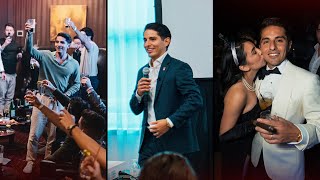
Brian Moncada hosted his first mastermind in Miami on New Year's Eve with speakers including Brandon Carter, Jeremy Haynes, and Mark Dahmer. They covered mindset, business growth, content creation, and marketing strategies for scaling.
Sam, you have to buy this journal. Just 5.99.
Just cover handling and shipping and it's yours.
Right here. 80% of the battle in this business and in life is mental. But the reality is some of us wake up sometimes and we're like, what the fuck's going on? I'm not doing anything right? Like, nothing's going right. My life sucks. I hate this fucking business. I want to get out of there. Right? Like, you know that happens. But we have to get this right. So day one is all about becoming the person you need to become and shifting your identity. Day one, to be able to intake the information through the collaboration on day two. Does that make sense? Brandon Carter is the best person I could ever imagine bringing to this mastermind. To speak to you guys about discipline, hard work, and more importantly, make it some baller growing. All right? He's a good client of ours, one of the best clients I've ever had. And I love working with Brandon Carter. Dude, thank you so much, Brandon. Come on and give big round of applause for Brandon Carter. Let's go.
You know, you become like the people you're around. You see people year round having these sort of outcomes, and if you're involved in a lot of the same stuff they're involved in, it's. It's kind of like a wake up call. Does that make sense?
Yeah.
So I figured I needed to stop doing what I was doing and pursue something more honorable.
Was there a certain, like, variation of content that hit for you or did you work with someone that made the content better or do you just do it for a while until you got better?
It's difficult to maintain consistency because you're not getting positive reinforcement. You might post something that gets no views or just one comment and it's a hater.
Right.
You know, that's normal. You just got to really have like a long term focus with content. I mean, obviously you got to see what's working and what's not. You know, what I don't want you to do is give up because you haven't seen the results yet.
Right.
You probably just have to get better at it. And I'm not saying this is your case, but a lot of times it's. The consistency is they've been posting the whole time, but not like three videos a week. It's. I post three videos this month, next month I post 18 next. You know, it's like, it's sporadic. That's typically what I see. It's taking people that long to start to penetrate the Market.
I want to bring the next speaker up as well. The biggest thing that I wanted him to come speak to you guys about is just the way he thinks about business and just operating his life internally. His belief in himself is undeniable. But ultimately what Jeremy helped us with the most was just being able to think about getting richer. And I'm excited for him to speak on this today and for him coming out here. Jeremy Haynes, thank you so much. Give it up for Jeremy. Which number do you choose? Because with the platforms and how they attribute the cash link. What do you look at Hiro? It was like bond number at the end.
Yeah, we actually do a tool like Hiros for sure. It's also simplified versions of what we do. We'll just have a unique version of a funnel for what we send our traffic to that's gonna tag those people in a CRM. And then we can run a CRM report against tools like Hiros. We wanna do what's called triangulating the truth. We don't wanna have two different tools that are against one another. We wanna have ideally like two to three. At least three. So if one of em's false, the other one's kind of disagreeing with that one. We have a third that can help. So as an example, like if I'm running a call funnel as a unique click funnels or go high level, like that unique type form, unique calendly. Those things pass unique tags into the CRM that we run. Those things don't have traffic ran to them from anything else. If they do, they count as our.
Revenue or like the biggest mindset things that you learn from Grant Cardone while you're working with him.
Good question. First of all, you could do way more than what you think you can. Grant would come in like it. Okay, so there's a seven to nine person creative team. I was the digital marketer. We had two graphic designers, two web developers, a copywriter and a videographer. You know, we were like a very capable team. Grant would come in and he would encourage us to like do a specific big project that I'm sure most of you would think would take like a month. He would tell us we had until like Thursday, you know, if he came out like a Tuesday, he'd be like, all right, you got like two days to get that done. All of us would like gripe and complain. And then Wednesday he would come in with like a whole nother one of those types of projects and he would put that on us too. And then we'd like Gripe and complain even more. But then by Thursday we probably had both done. And then we all kind of realized like, oh, we could do it. You know, we just didn't think that we could. So that was one big thing. And that happened all the time with like major, major marketing related projects. There's also just a big push to make more money all the time. Like, I'll give you a good example. How many emails do you guys send for brands on a day to day basis if you manage their email marketing? For me it was like, I don't know, maybe like one a day was being too aggressive, right? Grant would tell his email like 15 times a day and then after we got to that number he'd be like bored. I remember like SMS texting came out. Same kind of thing. Like I'd be like, Grant, like this is different than emails. Like we shouldn't text people all the time. He'd be like. Or you know, like everything was always more. And it never really played against us. You know, we always had more people coming in than we did, like unsubscribing and things like that. So like never really diminished the list. The accountability. I remember for the sales team, there was a wall of statistics. There were line graphs and it was all of their individual week over week productivity for the sales revenue that they brought in. If anybody had a flat or a declining line, they would get brought in at the end of the week and then get asked, why are your statistics declining? What do you need from us in order to improve this? And they'd either say like, this is the training I need, or they'd say like, no, I got this, like, don't worry. And if they didn't turn around by the next week, they'd probably fire. He fired the bottom 10% of his sales team every month. Bring new people in. Everybody was an A player. There's a lot of organizations I work in that think they have A players and in reality they're like D players that they convinced are A's. True A players are like very obvious A players. And like literally every person from like the accounting department to the sales team, the marketing team, everybody was, was a true A player. I mean, it just never shut off, you know, like the machine. Just a perpetual motion machine. It's like there was no such thing as burnout in any buddy who worked there or Grant himself. Yeah, I mean I could go on, but those are a lot of the major ones that I think came to mind.
Beautiful. Okay, so the reason why day one is so Important, as I already talked about before, is, you know, all the tactical stuff. We already know pretty much what we need to do, right? But the most important thing that Day one is all about here at the Admin Mastermind is the mindset. Thinking bigger, playing bigger, and really leveling up your standards and being in a room like this where you can challenge yourself to grow. I've had many discussions with each and every one of you after talks, and that's been the biggest thing so far right now. The reason why I wanted to end it with Mark Dahmer specifically is because a little story. Mark and I met actually back in Sam Oven's mastermind in Quantum. And although we didn't talk too much then, I knew who he was because he was the person that helped Sam Ovens with his peak performance. Okay, so when Sam was in the Manhattan penthouse. You remember Sam back when he was wearing the blue suit, right. In the Manhattan penthouse. You know, beautiful views of the city. You know, he was making a lot of money at 36 million at that time. That's when he was doing the real, real, real catch. But the problem was he was burning himself out. He would, you know, sprint for weeks, and then he would take a whole week off just to recover because of how, you know, tired he was, how burned out he was. And, you know, one of the only testimonials I've ever seen Sam give to anybody in my entire life was to Mark DMA because of the work that Mark's helped him with. And without further ado, Mark D, please take the stage.
So, a written agenda with this template. He gave me this template. He said, write this out in advance the day before. Don't keep it on your computer. Make sure you print it out and keep it in your pocket every day. Having it in your pocket at all times and planning out day by day, hour by hour, what you're actually doing in that time, you won't have any time to waste. You'll be focused on the things that are most important for you, but you'll have thought about it the night before.
Do it.
I've been doing that since 2015. It's a little bit different when you write it out and you plan everything, including your free time, especially your days off. Who plans the days off? So, one of my professors, a guy called Dr. Mihaly Csikszentmihalyi. He wrote the book Flow.
Yeah, he.
He was a huge proponent of planning your days off. Planning your days off. Things are gonna fulfill, you, restore you, make your best. Because if you don't plan your days off. Most entrepreneurs are probably going to be getting some work in somewhere, like thinking about work, getting some working, or the time just goes and you don't really use it how you go. Plenty days off, the same, thank you very much.
The point of a mastermind is not to learn 20, 50, 100 different things, right? Is to take away one, two, maybe three things max that you're actually going to implement when you get back home. Especially as we head into the new year. It's not about doing 20 different things, changing your whole life around, doing the Fleet 180. It's about doing one, two or three things that will compound for you in 2024. Get the benefits from this. Don't go back to wherever you live all across the world and do nothing. That's the worst thing you can do. You're here. Let's have a good time. All right, day one is officially wrapped up, so thank you guys for being here. But ultimately, now let your brain marinate it, okay? You wrote your one thing down. Just let it simmer, right? Just that one thing is all you have to focus on for today and for moving forward. Tomorrow, we'll do the same thing. What's the one thing from day two? Now you have two things. Day three, you might have three. Those are the only things you need to focus on in 2024. Sam, thanks to you. Cheers to you, to us, to where we're going in 2024. The bucket admin mastermind. Day one. Thank you guys for being here. Cheers. Day two. Day two. What's up, everybody? How you. How'd you guys sleep? You guys sleep good? The first session of today before lunch is going to be traffic. I think that makes sense because, you know, unless you have enough traffic to get enough leads, to get enough calls, to get enough clients, you really have no business probably hiring a team if you can't have them fulfill them in. So we gotta solve the traffic piece first from the content side, from the ad side, and then in the second half of the day after launch, we'll go into team, and I'll obviously have my team involved in there, and they'll be involved in the first part as well. We can talk about team and how we. We've built a pretty solid team so far here, for the most part. And ultimately, I'm still learning as a leader. You know, I've made a lot of mistakes. I'm not perfect. But we'll share what has worked and more importantly, what hasn't worked for us.
As well, so I'm with clients on demand and I do my business on the side. But like already with the amount of work that I have first, I don't know what to share, which I can overcome for sure. It's not about it reason, but how do you manage, like building a product and working and doing content at the same time.
So the first part about that, right, is like when I was working for Dean and I was, I wish I was building my personal brand, how I would have done it back then, if I could go back in time, would I would have just literally been sharing what I was doing for Dean on a weekly, daily basis. So like with you being with Russ Ruffino, right, one of the biggest coaches in the entire high ticket coaching space, you're learning so much by working with him and it's actually a benefit and value add to him, in my opinion, because you're also building and uplifting his brand while you're talking about what you're doing for him. Does that make sense? So the way I would approach it would be, you know, I would just simply share what you're working on with him on a daily basis. Right? Like today I was working with Russ on this BSL because we realized leading with done for you was attracting us the wrong clients. We've since switched back to the done with you approach and now the team's happier, the clients are better, we're in more control, and everything's different. The lesson here is you don't have to switch your business model completely from done for you to done with you. But if you're someone who's experiencing client expectation issues, it might be the way you're approaching the messaging. So keep that in mind the next time you run an ad for your offer. You see how valuable that is for somebody and all you're doing is sharing what you're already learning with them. Does that make sense? Just listen to what Brandon said yesterday with the calendar. Just put it on your calendar. So like, for me, again, like I mentioned yesterday, my one thing in 2024 is just writing. Mark Dahmer talked about needlework, right? Those 90 second sessions of needlework. Every morning I'm blocking off three hours of my morning to just focus on writing. Because my highest ROI activity is writing. Like my daily email. My daily email becomes my YouTube video. My daily email also repurposes in my Twitter thread. My daily email also repurposes as my adspend.com free school community post. My daily email also repurposes as my YouTube community post. My daily email also repurposes as something that I would teach to my team on team training on Fridays. And as well as, you know, my public speaking, it helps everything. So the one thing that I can do in the new year that would help the business the most, I'll make everything else uneven, easy or unnecessary is just writing more and posting more content. So for you, I would just do it in the mornings, right? What did you do yesterday? What are the insights? What are the conversations you have? Just write it, bro.
Yeah, so the question comes like, what is the priority between creating content and creating the coaching?
Here's how I would approach it. Again, you already have your income kind of solved with Russ, right? So you're already good. Like, you're building this other thing for. For you. And that's the best place to be in my opinion. So I would just be documenting and posting content primarily first using the insights you're learning from Russ Ruffino. And that's going to help you build your product. I wouldn't, like, I would get. I wouldn't be so hard on yourself if, like, I have to have the product done in like three months or whatever. It'll take some tweaks and iterations, but I would dedicate like at least 90 minutes of the three hours a day on writing and then the other 90 minutes on building the product. How you structure your videos, primarily intros and cooks. What would you recommend for someone looking to kind of come up with that initial outline for the YouTube video that they're posting? So it's not boring. The title and the thumbnail are the two most important things. First and foremost, the title and the thumbnail. And then your hook is literally the title just reworded. So in this video, I'm going to show you the. The top three Amazon products that are going to make you the most money with your Amazon FBA store right now, the title would probably be something like top three products working for Amazon FBA owners right now. It's very congruent. It's very much exactly why they clicked. And then now that you've said that, you go right into the. You go. You can go right into the teaching. I think that's what you do. Cameron. Right.
I used to make fun of myself, so I've always been following people, like a lot of like the case study stuff and even like breaking down other people, people's funnels I think is great. And obviously you've got the option of being like, here's the top three elements of sales page should have is how it should flow. Breaking down like case studies of like the BPW page and being like, here's how I created it, what the elements are on there, why it's important and then obviously breaking down the actual funnel metrics because that'll be the biggest, biggest thing for people. But I think even doing like audits on other people's pages and being like, here's why it, here's why it doesn't flow correctly, here's why the bounce rate's high, you know, things like that.
Yeah, I think one of the easiest hacks you can do is just create a Google Doc outline of your, of your, of your flow. It's, it's the same format. Hook, story, close. It's the same as an ad. Hook, story close. What's the hook? Right, today I'm going to show you how to break. Today I'm going to break down Iman G's most viral YouTube ad in the last year to show you why it works and how you can replicate it for your business too. That's the hook, the story. By the way, if you don't know, my name is Brian Wongala. I'm the founder of adspin.com we're the most sought after advertising agency in the entire info marketing industry, specifically on YouTube ads. But that's not, that's not the point. Let's get into it right now, right? Boom. Then I go into the teaching mode, right? So it's a quick, quick intro if they don't know me yet or if it's a viral video. And then I go right into the teaching education, right? You start breaking down the content. So you usually it's three bullet points, right? And I learned this from Clark Kegley, actually Tyler Hook. And in the story you have three bullet points. Bullet point number one, bullet point number two, bullet point number three. Because he doesn't script any of his videos and I, I personally don't like scripting them entirely either. I just do bullet points. So what's the, what's the one, what's the thing I'm going to educate them on? Or what's point number one? What's point number two? What's point number three? And when I'm going through those bullet points, I'm showing my personality, I'm teaching them and then there's a cta, right, the close. What's the thing I want them to do next? I want to watch another video. Hook, story close. So what's the hook? All right, same as the title. Then you know you can go into. What Cameron said as well is, like, the reason why this is so important for them. I would keep it to, like, less than 30 seconds max, before you get into teaching. Like, 30 seconds is the cutoff of the intro. Then you go right into education, which is a story. And then once you're done with bullet point number three, however long that takes, transition to the close, what's the next thing you want them to do? Watch this video next. But, yeah, like Billy said, you have a cheat sheet right there. You're just breaking down funnels, bro. That's your thing. That's a huge series for you. Funnel breakdowns. And you can literally just show all your case studies, too. That's what I'll do. SA.
Sir, Good to see you.
Yeah, good to see you.
More from Brian








CASE STUDY: How Usman scaled to $200k+/month after joining The Ad Men Mastermind


