Is The Evil Eye Real?
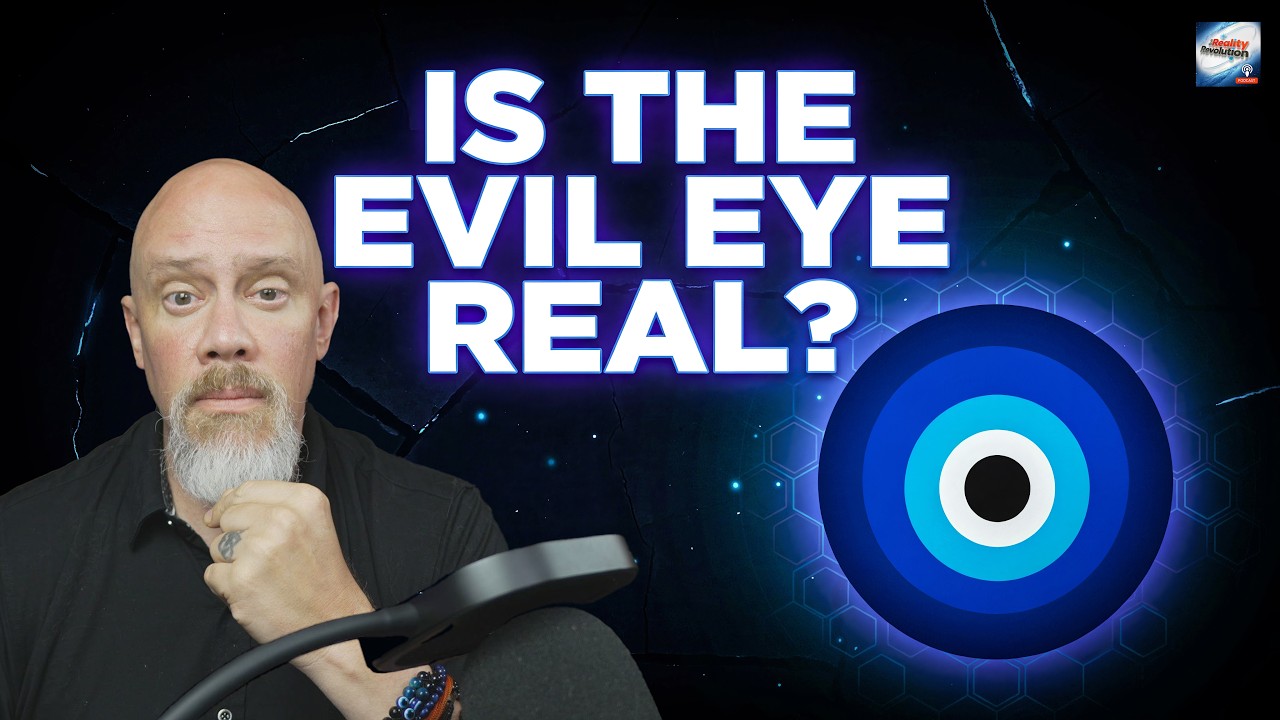
Brian Scott traces the evil eye from ancient Sumerian incantations and 4th-millennium figurines through medieval European anecdotes to modern science. He examines the ancient extramission theory of vision, cross-cultural protective practices like Greek mati and Turkish nazar beads, and research showing the belief functions as social leveling against envy. Whether real depends on acceptance: the same psychological and physiological mechanisms produce measurable effects.
Chapters
We must first of all bear in mind that there is a great need of caution in presuming that a psychic attack is being made. Psychic attacks are comparably rare things. We must not assume that we are dealing with one until we have exhausted all other things it can possibly be. Welcome to the Reality Revolution. Today we're talking about the evil eye, something I wanted to talk about forever. And I'm asking you a question: is the evil eye real? So today we're going to talk about where it came from, why roughly a third of all human societies built a defense against it, what the occultists said was actually traveling, and what happens inside a measured human body that believes it has been struck by one. The question underneath all of it is The one everybody actually wants answered: Is it real? Let's take a look. Let me take you back. In 1843, Alexandre Dumas published a travel book about southern Italy called Le Coricolo and gave 3 entire chapters of it to one subject: the Neapolitan belief In the Zedatura, the word comes from getare, to throw or to cast. A Zedator or Zedatura is a person who casts something with his eyes. Neapolitans held that such a person could carry the power his entire life, harm everyone around him, and remain completely innocent of doing it. And Dumas devoted most of three chapters to one man. He described him precisely, in Dumas's own words: thin lips, large fixed eyes, a hooked nose like a raven's beak. Then Dumas told the man's life, and the life reads as a single continuous catalogue. His mother died giving birth to him in 1776. The wet nurse engaged to feed him lost her milk the moment she took the infant in her arms. His father, an ambassador for the Bourbon court, was disgraced and stripped of his post. On his first day at seminary, everybody in his class came down with a convulsive cough. The new arrival stayed perfectly well. He entered an academic competition and took second prize. The boy who took first broke his leg on the stage walking up to collect it. He went to the opera at the Teatro San Carlo. The theater burned. Went on to attribute to that man's gaze the impotence Of his own son-in-law, the death of Pope Pius VIII, and the fall of the Kingdom of the Two Sicilies. Through every year of it, he stayed healthy, prosperous, and entirely unharmed. One Italian writer describes the arrangement exactly: misfortune treated the man as its employer. Naples knew who he was. Everyone in the city knew. He was Cesare del Valle. Duke of Ventinagno, a poet, historian, tragedian, a public literary figure. Alexander Dumas, who fought duels, who published attacks on kings, who feared very little in this world, wrote three chapters about the man who withheld his name from every page of them. Dumas called him only "Il Principe di," the prince of, followed by three asterisks. The reason he gave. was that setting the name down in ink might draw the eye toward whoever read it. Here's the second one. This one has a date on it. Canon Andrea Di Iorio was a Neapolitan archaeologist, director of the Pompeii collections, and author of the classic scholarly study of Neapolitan hand gestures. Naples also held him to be among the most dangerous giudicatori in the city. De Jorio wanted an audience with King Ferdinand I to present a book he had written. The King of Naples refused him for 15 years. Eventually, the petitions wore him down and he agreed. Stendhal, who was in Italy and kept a dated diary, records that the king gripped a coral horn in his hand throughout the entire 20-minute meeting. Ferdinand I died within days. Court physicians recorded apoplexy. Naples recorded the canon. One honest footnote: Stendhal dates the audience to July of 1824, and Dumas dates it the 2nd of January, 1825, and the king died on the 4th of January, 1825. The story got tidied on its way through the century, which is worth saying a lot. And then the 3rd one, which is the largest: Pope Pius IX. Held the longest reign in the history of the papacy— 31 years. His council was the First Vatican, and his doctrine was papal infallibility. Rome believed he had the evil eye. The American sculptor William Wetmore Story lived in Rome and wrote down what Romans said to him. Frederick Thomas Ellsworthy quoted him at length in 1895 in the standard English study of the subject. Pope Pio IX Was supposed to be a jettitor, and the most devout Catholics, whilst asking his blessing, used to point two fingers at him, kneeling for the blessing of the Vicar of Christ with the horns pointed at him the whole time. The Romans had a catalogue too. They said so, and it seems really to be true. If he had not the jettitura, it is very odd that everything he blessed made fiasco. We all did very well in the campaign against the Austrians in '48. We were winning battle after battle, and all was gaiety and hope, when suddenly he blessed the cause and everything went bad at once. When he went to St. Agnès to hold a great festival, down went the floor and the people were all smashed together. Lord C came from Albano being rather unwell. The Pope sent him his blessing. When pop, he died right off in a twinkling. There is a code. The tragedienne Rachel, the most celebrated actress in Europe, was given a rosary blessed by Pius IX. Her sister lay ill in the Pyrenees. Rachel left her improving and traveled on. Then a message arrived saying she must return at once. Her eye fell on the rosary. She tore it from her wrist and cried out, O fatal gift, 'tis thou hast entailed this curse upon me. Her sister died the following day. Sit with that. A duke whose name the bravest writer in Europe declined to print. A king who held out for 15 years and clutched a piece of coral through the meeting. A city that knelt for papal blessing while pointing the horns. Court policy, publishing decisions, the physical position of A crowd's hands, all of it arranged around what one person's eyes might be doing. What sharpens the question? Whatever moves in those stories, what carries it? Sometime in the early 20th century in India, a man went to have his fortune told. He was in excellent health, vigorous, robust, working with the family waiting for him at home. The woman across the table read the glass and told him 2 things. His heart was diseased. And he would die at the next new moon. He went home. Everyone in the household heard what she had said, repeated word for word. He sent for his lawyer and made out his will. On the night of the new moon, he died. That account survives because the man was related to a minister named Joseph Murphy, who later wrote a book about the human subconscious that has sold in the tens of millions, who spent part of a chapter on the death Inside his own family. Murphy's verdict came with 8 words: he was the cause of his own death. Now come forward about 70 years to a hospital in the United States where the same mechanism appears with instruments attached to it. A 26-year-old man arrives pale, sweating and shaking. Blood pressure 80/40. Heart rate 110. He had swallowed 29 capsules out of a bottle of antidepressants After an argument with his girlfriend. Staff got a line into him and started fluids. Over 4 hours, they pushed roughly 6 liters of saline into his body. His pressure climbed while the drip ran fast and sank again the moment it slowed. He stayed gray and lethargic. Then the physician running his clinical trial arrived, checked the paperwork, and told him the capsules were a placebo. Every one of them. 29 capsules of inert filler. The patient expressed surprise and almost tearful relief. Within 15 minutes, he was fully alert. Blood pressure was 126/80. Heart rate was 80. 6 liters of fluid failed to correct him. One sentence corrected him in a quarter of an hour. Between those 2 states, the only thing that entered that man's body was information. Which put Naples and that emergency room on one axis. A belief arrives from outside a person, the person accepts it, and the body carries out the instruction using its own hormones, its own blood pressure, its own heart. Whether anything additional travels between 2 people is the question this episode is about. Here's where we're going. The oldest written record of it in Sumerian incantation texts, a scientific theory taught in universities for 1,500 years and overturned in Cairo around the year 1021, which every protective charm on Earth still quietly assumes to be true, the living traditions, and what each one says to do about it. Then the occultists: Blavatsky on the will as a projectile, Bessant and Leadbeater on thought that travels and bounces, and Dion Fortune, who wrote the standard Western manual on defending yourself and spent most of it talking people out of the diagnosis. Finally, the laboratory nocebo research, The Neuroscience of Being Looked At, and a 2010 paper out of a Dutch psychology department titled in those words, Warding Off the Evil Eye. Some of this is personal. I carry a Greek eye, and there's a red string on my left wrist. And by the end, I will tell you what the historical record says about both. It turned out to be more interesting than what I had been told. And at the very end, a clearing you can use, 2 or 3 minutes. For any time you come out of a room heavier than you went in. So this year I went to Santorini. The island is a strip of volcanic rock in the southern Aegean, about 15,000 people living on the rim of a caldera. Tourists arrive by cruise ship. Every lane above the harbor turns into a shop, and in every single one of those shops, they were selling eyes. T-shirts, oil paintings hanging in galleries, gold pendants on a chain, leather cords, fridge magnets, tote bags, ceramic tiles stacked by the crate. Blue, white, black, blue again. A very specific eye, concentric circles, staring out of every doorway on the island.
Everywhere I went.
One of them was already in my pocket. Mine arrived the way these things usually arrive. Somebody who cared about me handed it over and said it would keep me safe. So I came home and started reading. What sits underneath all this turned out to be older, stranger, and far more literal than the souvenir suggests. When I asked our guide, what's going on with all the eyes? He explained, someone else has to buy it for you, and then when you hold the eye or see it, you say the word fitao. That will reject the evil eye all around you, and everybody on the island was doing it. So as I started to research this, the bead encodes a scientific theory, a real one taught in the universities. The object outlived the theory by thousands of years. The earliest secure written evidence sits in Mesopotamia, in Sumerian and Akkadian incantation texts. The Sumerian phrase is igihul. Akkadian renders it inu lemuthu. Both translate as the evil eye. These texts treat the eye as an agent with its own verbs. The eye approaches. The eye enters a house. The eye follows a man down a street. Priests wrote formulas to send it back where it came from. An actual projection coming out of your eyes at all times, sometimes with negative intention. There's a site in northeastern Syria called Tell Brak. Archaeologists excavating There were recovered thousands of small alabaster figures with vast staring eyes, dated roughly 3700 to 3300 BCE, in a structure now called the Eye Temple. You will read online that these are evil eye amulets. Scholarship says otherwise. 5 competing interpretations circulate for what the idols were: votive offerings, representations of deities, stylized worshippers, Ex-votos left by pilgrims, symbolic stand-ins for the donor. A 2016 doctoral thesis surveying the debate concluded that evidence for any of them stays inconclusive. The evil eye reading sits outside the serious lists altogether. So, somebody in Syria, 5,500 years ago, filled a temple with thousands of pairs of eyes. Egypt gives us The Wadjet, the Eye of Horus. In tomb after tomb, the Wadjet is a healing and restorative symbol tied to a specific myth cycle rather than a shield against envy. Museums and gift shops have merged the 2 objects. Egyptology keeps them apart. For the belief in its recognizable modern form, the record gets clear in Greece and Rome. Here's the idea that organizes everything else. For most of recorded history, educated people held that the eye emits. The theory is called extramission. Vision, on this account, works by sending something out— a visual fire, a ray, a stream of pneuma— which travels to the object, touches it, and reports back. Seeing becomes a form of contact at a distance. Empedocles argued it around 450 BCE. Plato set it out in the Timaeus: a gentle fire flows from the eye and coalesces with daylight. Euclid built the geometry of visual rays around 300 BCE. Ptolemy refined the mathematics, and Galen described a visual pneuma traveling out along the optic nerve To convert the air itself into an organ of sense. Follow the consequence: an eye that emits is an eye that acts. Looking becomes doing. And whatever a person carries inside— appetite, resentment, envy— rides out along the beam and arrives at the thing looked at. Around the year 100 of the Common Era, Plutarch wrote the argument down. It appears in the Table Talk. Book 5, Question 7. The setting is a dinner party. Someone raises the subject of the evil eye, and most of the guests laugh. A man named Maestrus Florius presses the point: the effects are observable, whatever the cause turns out to be. What follows is one of the most interesting passages in ancient natural philosophy, because Plutarch treats the whole thing as a physics problem. His argument runs in stages. Affluences stream continuously out of the eye. The eye sits nearest the soul, so the stream carries the soul's conditions with it. Children suffer most because their bodies remain soft and unformed. Love supplies the proof case. The lovers glance visibly across a room, and a look able to do that is a look able to do harm. Envy poisons the stream at the source. Democritus on the eidola— films of image peeling off bodies and moving through the air. Then Plutarch explains the amulet, and his explanation is mechanical: the strange object catches the eye and diverts the sight so that it cannot make so strong an impression upon the patient. An amulet, on Plutarch's account, works as optics— something visually peculiar sits between the sender and the target intercepts the beam and bends it aside. That single sentence makes the entire global apparatus legible: the bead, the horn, the grotesque face on the temple roof, the coal smudged on a baby's cheek, the lemon and chili hung in a shop doorway, the mirror sewn onto a Rastasthani shirt. Every one of them is engineering built on the top of physics. Rome mass-produced the hardware. The Latin for the affliction is Fascinato. The standard countermeasure was the fascinum, a winged phallus cast in bronze, hung over doorways and around the necks of children. Wind chimes made of them survive from Herculaneum. Phallic wreaths are carved into Hadrian's Wall, and the largest known hoard came out of Colchester. The Roman army carried the technology across a continent. An army of soldiers carrying this amulet To protect against the evil eye. So it's a part of our history. The physics fell in the 11th century. Ibn al-Haytham, born in Basra around 965, Latinized in Europe as Alhazen, composed the Book of Optics between 1011 and 1021 in Cairo. Tradition holds that he wrote it under house arrest after feigning madness to escape the consequences of a failed engineering promise to the caliph. Treat that part as a colorful biography. The work itself dismantled Extremition by argument and by experiment. He used the camera obscura. Pain from looking at the sun and the persistence of afterimages both entered the argument as evidence. The geometry of reflection and refraction got worked through in detail, and out of it came the opposite account: from each point of every colored body, illumined by any light, issue light and color along every straight line that can be drawn from that point. Light travels to the eye. The eye receives. Latin Europe absorbed the work in the 13th century through Roger Bacon, Witello, and John Peckham. Kepler closed the case in 1604 with the retinal image. 1,005 years later, that shop in Fira sells 200 of these a day. A last piece here comes from psychology rather than history. Researchers at Ohio State publishing in Current Directions in Psychological Science in 2002 found that a large minority of educated American adults and a majority of children endorse extramission. When asked directly how vision works, they believe something comes out of the eye. Instruction corrects the belief temporarily and it returns. The intuition that looking is doing appears to run deeper than schooling. The belief spread across a specific territory, and the boundaries matter. Economist Boris Gurnman, publishing in the Journal of Development Economics in 2014, went through a standard anthropological sample of 186 societies. Evil eye belief appears in 36% of them. Concentration runs through the Mediterranean, the Middle East, North Africa, the Balkans, The Caucasus, Central and South Asia, and everywhere those populations later migrated— East Asia and pre-contact Americas— developed the idea rarely. One correction, because this gets repeated: the apparent gap across sub-Saharan Africa reflects a classification habit as much as a cultural fact. Comparable envy attack beliefs there get filed under witchcraft instead. Gershman's own contemporary survey data shows endorsement Above 42% across the region. Greek mati, the eye, the affliction matiasma, the cure, zema matiasma. The formal ecclesiastical term is yaskania, and the Greek Orthodox Church carries an official prayer against it in the Euchologion, a liturgical form in a mainstream church for Exactly this. Symptoms run somatic and specific: sudden violent headache, yawning, lethargy, nausea. Diagnosis: use olive oil dripped into water while a prayer is said silently. Tradition holds that the prayer transfers only at a particular time of year and only across the sexes, woman to man or man to woman, and loses power when spoken aloud to others. I have a client who is in Greece, and I asked her, and she said that exact thing. She could give me the prayer. I could give it to my wife, but I can't give it to my friend Kyle or another guy. And a very specific prayer is told. Turkish Nazar comes from the Arabic and means simply gaze. The bead is Nazar Bankugu, the gaze bead. It hangs on cradles, door frames, taxi mirrors, aircraft phone cases, and the tail livery of Turkish Airlines. A cracked bead counts as a success. Local reading holds that it absorbed the hit and gave way. Italy is Malocchio, the bad eye, and the Neapolitan south Getatura, the casting, and the gettolori. The person who carries it. The gettatore is typically an unlucky, socially marginal figure rather than a witch, and frequently unaware of his own effect. Protection comes as the cornicello. And I may be mispronouncing all of this. The twisted red horn descended straight from the Roman phallic tradition. The mano comuta, horns made with index and little finger, Protective when aimed at the threat and insulting when aimed at a person. The monofico, thumb thrust between the fingers, an explicit vulvar gesture working on the same principle as the fascinium. Obscenity arrests the gaze. Diagnosis uses 3 drops of olive oil in a bowl of water. Oil that disperses or forms an eye shape confirms the affliction. Beating that holds together clears the patient. Italian-American families still hold to the rule that the prayer transfers only at midnight on Christmas Eve. The Jewish tradition, Hebrew ayin hara, Yiddish kane ayin hara, contracted to kinehora, said immediately after any praise, often accompanied by 3 dry ritual spits, The rabbinic sources go deep. Bava Metzia 107b records Rav visiting a graveyard and reporting that of those buried there, 99 had died by the evil eye and one by entirely natural means. Berakhot 20a has Rabbi Yochanan, famously beautiful, seated at the gates of the immersion pools so that women emerging would look at him and bear beautiful children. And answering the obvious challenge by claiming descent from Joseph, a line the eye passes over. Pirkei Avot supplies the other register entirely. Asked to name the good way a person should cling to, Rabbi Eliezer answers, ayin tova, a good eye. His answer for the evil way is ayin ra'ah. Here, the term describes a character trait: stinginess, begrudging, the inability to feel glad at another person's good fortune. The tradition holds both readings at once: the eye as moral disposition and the eye as hazard. In Islam, Arabic al-ayn, Surah al-Falaq, chapter 113 of the Quran, seeks refuge from the evil of an envier when he envies. Precision matters here: the text names envy hasad, and the link to the eye specifically comes Through the hadith and the exegetical tradition, in Sahih al-Bukhari 5740, the statement is flat: "ال عينو حك." The effect of an evil eye is a fact. Sahih Muslim adds that if anything could precede divine decree, this would. Everyday practice centers on a single verbal habit, saying. Masha'Allah, when admiring something, which reassigns credit to God and diffuses the envy at source. Worth flagging, amulets remain theologically contested in Islam, with many scholars holding that hanging beads verges on shirk. The nazar in the Turkish street sits inside a live internal argument. In South Asia, nazar, buri nazar, dristi, Kajal smudged on a baby's cheek, deliberately spoiling the perfection so admiration has somewhere to snag. Lemon and green chilies hung in a shop doorway, very similar to the garlic hung by your doors as recommended by Ra in the Law of One. The ritual removal Nazar Utarna, in Latin American, my de ojo, treating as the genuine pediatric illness with fever, vomiting, and sleeplessness. The limpia con huevo— an egg passes over the body, then cracked into a glass of water and read. Underneath every one of those variations sits the same engine: envy. Hatred plays a small role in this material. Malice barely features. The danger everywhere in all these cultures is envy. The sharpest form of the danger is admiration. Pliny the Elder, collating the ethnographic reports in the Natural History, records families in Africa whose praise was said to be lethal. Meadows dried, trees withered, infants died— praise rather than curse. That inversion explains the single most widespread rule attached to the belief: Withhold compliments from a baby. Anthropologist George Foster gave the underlying logic a name in 1965: the image of limited good. In a pleasant society, everything desirable exists in fixed supply. Your gain therefore came out of someone else's share. Visible good fortune becomes visible theft, and the envy it generates becomes a physical hazard. The belief clusters where inequality is visible and resources are finite, Anthropologists have long argued it functions as a leveling device, a social pressure toward modesty, concealment, and sharing. In 2010, 3 researchers at Tilburg University put that argument in a laboratory and published the results in Psychological Science. The paper is titled Warding Off the Evil Eye. Niels van de Ven, Marcel Zelenberg, and Rick Peters ran a series of studies with Dutch Undergraduates, a population with zero folkloric investment in any of this. Participants who had reason to believe another person envied them became measurably more generous, and the generosity was targeted. It went specifically to the envier and to the person alone. Fear of the envious eye produces appeasement behavior in a Dutch psychologist's lab. The anthropologist's functional argument reproduced experimentally in people who had zero belief in the eye. Time to turn this on my own equipment. Hebrew, the Scarlet Thread. Yiddish, worn on the left wrist, tied with several knots, traditionally by another person. The story attached to it says the thread had been wound 7 times around Rachel's tomb in Bethlehem, drawing on Rachel as the compassionate mother who weeps for her children. The story further says the practice is ancient Kabbalah. Here's the documented record: scarlet thread appears in the Hebrew Bible. A midwife ties one on the hand of Zerah in Genesis 38, marking birth order. Crimson wool features in Leviticus. Both texts get cited as precedent. Both describe something else entirely. The Torah omits the practice. The Zohar omits it. Lurianic Kabbalah omits it. Anyone citing the Zohar for the red string has been misinformed. The earliest rabbinic mention is a prohibition. The Toseftalists tying a red string among Darkei Ha-Amorai, the ways of the Amorites, meaning forbidden Gentile superstition borrowed from the neighbors. The rabbis are recorded arguing about it. One holds it prohibited, another The first known public advocacy arrives in the 1490s from Rabbi Abraham Seba during the Spanish Expulsion. Rav Shmuel ben Hafni Gaon, who died in 1013, had earlier noted that a red string on the hand might serve as a good omen. Rachel's Tomb enters the record much later. My Jewish learning describes the 7 wraps claim in explicitly commercial terms. As something asserted by people selling the bracelets. Documentation of its age stays absent from every source I could find. The global version is traceable to a specific decade. Philip Berg's Kabbalah Center packaged and marketed the red string internationally in the 1990s. Madonna wore one. Britney Spears wore one. Demi Moore wore one. Retail ran around $26 a string, which generated open criticism from rabbis and journalists at time? For me, I'm aware it's superstitious. I am harnessing the forces that have been used in the past and convincing my own subconscious that the evil eye is protecting me. That's all I'm doing. The tradition of the red string is associated more with folklore than with spirituality. I'm still wearing mine. What the record actually shows is more interesting than the marketing. The earliest Jewish source on the red string is a group of rabbis arguing about whether their neighbor's custom is acceptable to adopt. Somebody adopted it anyway. It survived thousands of years. Age and reality are separate questions. A practice that people keep choosing generation after generation across every attempt to suppress it is a real artifact of how religion works from the bottom up. Same treatment for the bead. The eye motif glass beads are genuinely old. Stratified eye beads are well attested archaeologically from the 1st millennium BCE. Claims that Nazar dates to 3300 BCE fall on material grounds. And the specific object in my pocket, the flat concentric disc, cobalt and white and pale blue and black, is a modern Anatolian folk craft. It is made by a small number of Boncuku families at Göreş and Kuru Dere near Izmir. A traditional wood-fired furnace, its standardized shape, its mass production, and its global ubiquity belong to the 20th and 21st centuries. The belief runs thousands of years deep. The object might be nothing more than a superstition. The Western esoteric tradition took the evil eye seriously and tried to give it a mechanism. Helena Blavatsky addressed it directly in Isis Unveiled. Her frame treats the effect as real and the demonology as unnecessary. What operates is the human will compressing and projecting the astral fluid. She states, many persons firmly believe that certain individuals possess the power of the evil eye. The malocchio, or getatura, is a belief which is prevalent throughout Italy and southern Europe. She then names the Pope as a suspected carrier with a parenthesis that carries the whole idea: the Pope is held to be possessed, perchance unconsciously, of that disagreeable gift. Blavatsky allows for the harmful radiator Who remains unaware of his own effect. Her own stronger claim runs further. There are persons who can kill toads by merely looking at them and can even slay individuals. The malignance of that desire brings evil forces to a focus, and the death-dealing bolt is projected as though it were a bullet from a rifle. Annie Besant and Charles Leadbeater published Thought Forms in 1901 and supplied the engineering. There are 3 principles: quality of thought determines color, nature of thought determines form, definiteness of thought determines clearness of outline. A thought aimed at a person becomes an object that travels. They state, if a man's thought or feeling is directly connected with someone else, the resultant thought form moves forward that person, that discharges itself upon his astral mental body. Then the passage that maps On the Mediterranean mirror amulet, exactly. Any combination of matter can only vibrate within certain definite limits, and if the thought form can be outside all the limits within which the aura is capable of vibrating, it cannot affect that aura at all. It consequently rebounds from it, and that with a force proportionate to the energy with which it impinged upon it. It is flung back with all its own energy. It then flies backward Along the magnetic line of least resistance, that which has just traversed and strikes its projector. So Charles Leadbeater and Anne Besant could see thoughts as living things. Check out my episode on thoughts as living things. So they could see when people tried to use the evil eye, they would project a thought, and if someone's aura was not vibrating with that, and it would be rejected and come back. So if you have a negative thought, what What they would see in most cases, the evil thought or selfish thought would come back. When they would watch the thought, it would come back to the person projecting it. Leadbeater states the governing condition flatly: it cannot act upon a person at all unless he has in him something which is harmonious with the vibrant energy which ensouls it. So if some part of you carries an energy that is consistent with the evil that's being projected, Then it can let it in. Transmission requires a matching frequency at the receiving end. Something in you has to answer the incoming thing for the incoming thing to land. One caution belongs here, because the modern descendant of that axiom has drifted a long way from the original. These writers describe a mechanism. They are explaining what makes transmission physically possible. Blavatsky allows an attacker who is unconscious of his own gift Dion Fortune, who we come to next, describes an injury as accidental as that inflicted by a skidding car. Her entire clinical apparatus assumes real victims with real injuries. The popular modern version, you attracted this, is a verdict on the sufferer. The original is a statement about physics. Those are separate claims. The second one carries the cruelty. Violet Mary Firth, born in 1980, took the magical name Dion Fortune. She trained as a lay psychotherapist, worked in the Golden Dawn tradition, and check out my episode The Woman Who Weaponized Magic for a deeper dive on Dion Fortune. In her book Psychic Self-Defense, it opens with her own case. In her early 20s, Fortune worked at an educational establishment run by a woman who had lived in India, acquired some knowledge of yogic and hypnotic technique after After a dispute, Fortune says that woman turned the technique on her, holding her in a sustained interview, fixing her with a concentrated gaze and repeating a single suggestion: You are incompetent and you know it. You have no self-confidence and you've got to admit it. She said, my body was like an electric battery that has been completely discharged. I lay in bed with all the physical symptoms of intense fear— dry mouth, sweating palms, Thumping heart and hasty breathing. She states she was ill for roughly 3 years afterwards. The entire book descends from these 3 years. Fortune spends the middle third of her book arguing people out of this diagnosis, stating, We must first of all bear in mind that there is a great need of caution in presuming that a psychic attack is being made. Psychic attacks are comparably rare things. We must not assume that we are dealing with one until we have exhausted all other things it can possibly be. Her example is memorable. Not so long ago, I came across a case of alleged obsession which turned out to be a neglected constipation, and which was effectually exorcised with castor oil. Her instruction is a medical referral. If there are any physical symptoms at all, even if there are no more than a bad color or a bad breath, A diagnosis ought to be made by a qualified medical practitioner. And on the people most likely to misdiagnose themselves, she says, psychism, however genuine, is a fruitful cause of self-delusion. A psychic is invariably highly sensitive and suggestible. This is the basis of his gifts. Her 3 stages of an ordinary person's education in the subject: first, he thinks it is all superstitious and fraud; second, his skepticism being breached, he will believe anything; and third, If he ever gets as far as 3rd, he learns discrimination. The phrase evil eye stays absent from the whole book. What she has instead arrives at the same place from a different direction: the accidental attack. All attacks are not deliberately motivated. The injury may be as accidental as that inflicted by a skidding car. Our prosecutor may himself be a victim. The involuntary radiator, her description of an advanced initiate whose sheer magnetic output destabilizes unprepared people around him. He emanates force involuntarily and cannot help himself. That is the jetator described by an English occultist in 1930 in The Language of Magnetism. And then the practical instruction, which is the most immediately usable thing in the entire book. She says, if anyone tries to dominate you by gazing intently into the eyes, do not attempt to return gaze for gaze. For this only leads to an exhausting struggle in which you may get the worst of it. But look steadily at the spot just above the base of their nose, between the inner ends of the eyebrows. Now, I have used this and it works. Look at the glabella, the point between the brows. An ordinary bully collapses immediately, and someone with real training produces a stalemate rather than a defeat. So if you ever are playing with your friend and you do a stare-down, look right here instead of into the eyes. And her account of the mechanism sits in chapter 12. She says, there are 3 factors in a psychic attack, any or all of which may be employed in a given instance. The first of these is telepathic hypnotic suggestion. The second is the reinforcement of the suggestion by the invocation of certain invisible agencies. The third is the employment of some physical substance as a point of contact or magnetic link. And on the wax image with the nail driven through it, she is deflationary. The actual driving of the nail has no conceivable effect upon the victim, but it helps the concentration of the operator. She's talking about voodoo dolls. The doll works on the person holding the hammer. Fortune's defensive material comes in tears. And the architecture of the book is in the argument. The physical plane first, and she is famously practical about it: sunlight, hot bath with, with a mustard foot bath, food every 2 hours, a hot water bottle on the solar plexus, sleep. She argues against a vegetarian diet during an attack specifically because she wants the patient heavier and more grounded in physical matter. Then the everyday devices: salt and water, the imagined plate of glass, the brick wall, the closed circuit, and the sealing of the aura— an old formula whose potency, she notes dryly, lasts about 4 hours. Her stated objective: the exorcist has to achieve 3 things. He must repair his patient's aura, clear the atmosphere of his environment, and break his contact with the forces that are causing the trouble. And then Chapter 19 introduces the method she rates the highest, which she calls absorption. The distinction here is the heart of the whole subject. Blocking keeps a hostile force outside you. Absorption takes the force in, converts it, and ends it. That's what I have found. I'm not afraid of your energy. Bring it in and I will transmute it. Her sequence: harmonize yourself by meditating until your own vibration's steady. Call up the image of the hostile form and identify its nature. Malice. Lust. And vampiric drain cover most cases. Then meditate on the opposite quality. Malice calls for compassion, lust for purity, and the draining force for God as a sustainer of all life. Continue until, in her phrasing, malice causes him to feel nothing but compassion. She warns about the recoil. As the form comes in, the operator feels the corresponding quality rise in his own nature. A malicious form produces anger. The instruction is to meet that rise immediately and return to the meditation. So you start to feel these dangerous feelings, anger or malice, and you meditate. The adept who proposes to perform a magical absorption has to reach the point where he has clearly realized the nothingness of the evil he proposes to absorb and no longer has any feeling towards it but pity for an ignorance that thinks it can gain anything good for itself. In this way. And her comparison of the 2 approaches: the great advantage of this method is that it actually destroys the evil root and branch, whereas the mere destruction of a thought form is like cutting off the top of a weed. Blocking cuts the weed; transmuting takes the root. Leadbeater tells the same doctrine as a story in The Hidden Side of Things. A monastery in the desert behind Alexandria— the abbot possessed clairvoyance, and 2 of his young monks had reputations for exceptional purity. One day during the singing, the abbot turned his faculty on both of them to find out if they had managed it. The first monk had built himself a shell as of glittering crystal. Tempting thought-forms rushing at him stuck at the shell and fell black. He remained inside, Ledbetter's words calm and cold and pure. The second monk had left himself entirely open. His heart was so full of love of God that it radiated out of him continuously in every direction, and when the tempting forms sprang at him, they were all washed away in that mighty outpouring stream. The abbot judged the second monk nearer to the kingdom of heaven. The outpouring of love is a better defense than the strongest of shells, and the man who is filled with the powers of that divine love needs no protection because he lives within the heart of God himself, as Leadbeater said in his book The Hidden Side of Things. Leadbeater wrote that in the middle of a chapter teaching the reader how to build shells. So back to Joseph Murphy and the man from the top of this episode. Murphy published The Power of Your Subconscious Mind in 1963. It has sold tens of millions of copies. I've read it on the channel. We've studied it. He states, the suggestions of others in themselves have absolutely no power whatever over you except the power that you give them Through your own thoughts. You have to give your mental consent. You have to entertain the thought. Then it becomes your thought, and you do the thinking. The only power is the movement of your own thought. His verdict on his own relative was quoted at the top of the episode. The sentence that precedes it in the book supplies the mechanism. My relative was happy, healthy, vigorous, and robust when he went to see the fortune teller. She gave him a very negative suggestion, which he accepted. Murphy's model is a 2-stage lock. A hostile suggestion arrives. The conscious mind acts as a gatekeeper. The acceptance by the conscious mind passes the suggestion to the subconscious, which skips evaluation altogether. On that account, the curse requires the victim's signature. His remedy is a 3-move protocol. Refuse the suggestion at the gate. Never finish a negative statement. Reverse it immediately. Address the subconscious directly, aloud, in the imperative. Be still. Be quiet. I am in control. You must obey me. You are subject to my command. Murphy's rationalist counter to a curse takes the form of a spoken charm. One more figure belongs here because the belief regenerates far outside the expected map. Mary Baker Eddy founded Christian Science, and in her hands, the old term animal magnetism became malicious animal magnetism. The claim that a hostile mind projects harmful thought at a distance and produces real sickness, ruin and death. The doctrine filled a 46-page chapter of Science and Health in 1881. In May 1878, she sued Daniel Spofford in Salem alleging he was harming her followers by mesmerism. The press called it the Second Salem Witchcraft Trial. Judge Horace Gray dismissed it, reportedly on the grounds that the court lacked power to control the man's mind. Eddy then organized her students into rotas of mental workers who would take up the enemy in thought, a counter-curse ministry inside a modern American church. The evil eye gets filed as pre-modern, Mediterranean, rural. Boston in 1878 argues otherwise. Which brings us to the man on the gurney. Recall the numbers because they are charted in a peer-reviewed case report, and they are the reason this episode exists. Blood pressure 80/40. 4 hours, 6 liters of saline delivered steadily, then one sentence about the contents of a capsule, and 15 minutes later, a blood pressure of 126/80. Between those 2 states, the only thing that entered that man's body was information. The effect has a name. Placebo describes benefit produced by expectation. Nocebo describes harm produced by expectation, and the research on it has become precise. Fabrizio Benedetti's group at the University of Turin published a key study in the Journal of Neuroscience in 2006. They induced pain expectation verbally in healthy volunteers, measured the result, and then took the causal chain apart pharmacologically. 2 findings in sequence: Diazepam An anxiolytic abolished both the nocebo pain and the stress hormone response, placing anxiety upstream of both. Then prolumide, which blocks cholexicotinin receptors, or however it's pronounced, abolished the nocebo pain completely while leaving the stress hormones entirely intact. This is a specific molecular link converting anxiety into pain, and it can be cut. There's a drug that interrupts a curse. Where the harm runs through nocebo pathways, proglamide stops it at the receptor. Folklore called for an amulet; the pharmacology calls for CCX antagonist. The shape of the claim survives intact. The founding paper on the extreme end is Walter Cannon's, published in American Anthropologist in 1942 under the title Voodoo Death. Cannon coined the word homeostasis and described the flight-or-fight response, and he spent the end of his career collecting reports from Australia, New Zealand, Africa, South America, and the Caribbean of healthy people dying within hours or days of learning they had been cursed. The evidence base was anecdotal, and commentators who accept the phenomenon say so openly. Anthropologist Harry Eastwell, working in East Arnhem in 1982, argued that Many such deaths come down to dehydration. Once a person is socially designated as dying, the community withdraws fluids and begins mourning, which preserves the essential point and moves the intermediary from a hormone to the neighbors. The modern rebuild is solid. Harvard neurologist Martin Samuels grounded Cannon's case in toxicity: sympathetic nerve terminals dumping norepinephrine straight into heart muscle, producing a lesion visible at autopsy. The clinical entity is stress-induced and reversible, and it sits in cardiology textbooks. One detail from Cannon's 1942 collection outranks all the rest. He reports a young man given up for dead who recovered immediately upon learning he had been mistaken and the curse had been aimed elsewhere. The curse is revocable by information which locates the causal agent precisely. The last thing, it explains why the eye specifically. In 1997, Hiroshi Kobayashi and Shiro Koshima published a survey in Nature covering roughly half of all primate species. Their finding: humans have the largest ratio of exposed sclera in the eye outline, which itself is elongated horizontally. Every other primate conceals its gaze behind pigmented sclera. Humans alone painted the whites of their eyes a high-contrast color that advertises exactly where the attention is pointed. A species that evolved to broadcast its gaze also evolved to read gaze and to care intensely when a gaze lands on it, which produces one of the most tested findings in social psychology. In 2006, Melissa Bateson and colleagues put an honesty box above a coffee price list at Newcastle University and alternating the image above it weekly between a pair of eyes and a picture of flowers. Contributions ran 2.76 times higher during the eye weeks. The measured science of one person reaching another is better than the borrowed vocabulary. A number of research studies have also shown that through our heart, through our body, we can electromagnetically reach and contact someone else. It's been proven by HeartMath. Bring all the sources together, and there's many more that I found here, and they point in the same direction. Plutarch located the mechanism in an emission from the eye carrying the state of the soul. For Blavatsky, it was the will compressing astral fluid. Bessant and Leadbeater describing thought forms. Fortune named telepathic hypnotic suggestion. Murphy put the whole apparatus in conscious consent. Benedetti found A specific molecule. 6 vocabularies across 1,900 years describing one thing, and every one of them agrees on the practical point. Fortune's attacker succeeds by finding the thing you already half believe about yourself and leaning on it. Her own attacker used the sentence, you are incompetent and you know it. Ledbetter requires something harmonious inside you. Murphy requires your signature. Cannon's precondition was absolute belief plus perceived helplessness. The medical condition begins with an expectation. The hostile thing arrives. Whether it lands depends on what you find when it gets here. Which returns me to the 2 objects I carry. Blocking works. Fortune taught it. If you feel comfortable carrying an object with you that you believe will block the evil eye, then you should do it. Transmuting is the next Here. Don't be afraid of the energy as it comes to you. If you express enough love, rather than holding the thing outside, you take it in, you meet it with the opposite, and you end it. Let me show you how the second one goes. Put your feet flat on the floor. Let your hand rest open, palms up, wherever they land. Breathe in through your nose for a count of 4.
Hold.
And out through the mouth for 6. Again, in, breathing in, hold it, and then out long and slow. Bring your attention to the space about an arm's length around your body, all the way around, above your head, under your feet, behind your back, All of it belongs to you. Find the edge of it. Feel where you end and the room begins. Now firm that edge. Make it definite, solid all the way around, sealed. Say this with me: everything inside this edge is mine to govern. Whatever arrives here waits for my permission. You can imagine a bright white light flowing through you out into this edge, into this shell that surrounds you, sending love, sending joy. Now just hold that. You have a protective sphere around you. Now gently bring to mind something that has been sitting on you, a commitment somebody made, a room you walked out of feeling heavier. A worry or concern of something somebody said, or a belief that somebody's sending you the evil eye. Locate it in your body. Put your attention on that spot. Now name it. Ask yourself what it's made of. Resentment, envy, contempt, fear, anger, whatever arrives. Now find its opposite. Contempt asks for dignity. Envy asks for abundance. Fear asks for steadiness. Anger asks for love. Malice for compassion. Just find the opposite of it, of whoever is sending you this evil energy. Fill up with it. Let it get warm. Let it grow past the size of the thing you started with. Now, holding that, Draw the heavy thing toward the center of your chest.
Let it come.
Let this curse, let this evil, let this negative energy— it doesn't need to be blocked. Let it in, and then feel it converting, feeling the love flowing out. Whatever rises in you as it converts— maybe you start to feel anger or a flare of heat— meet it. Return back to this quality. It's only temporary. Breathe in slowly again. Hold it, and then breathe out. The thing that was sitting on you that you were worried about has been changed into something usable. It's been projected out, dissolved, completely changed. Check the edge now of your field. All the way around, sealed underneath. And now say this: I am the only thinker in my own mind. What comes here, I convert. Take a full breath all the way in and let it go. Run that once a day for a week and the boundary starts holding itself up. 5,000 years of people handing each other objects And saying this will keep you safe. Now you have the thing objects were standing in for. I also recommend that you check out my episode on the banishing ritual, a ritual that was used by Dion Fortune and Golden Dawn, a daily ritual that eliminates negative energies from your environment. I also say, I will draw a circle around me. I encompass myself within this divine circle within which no negative energy dare cross. Just like that. I know within me, within this circle, no energy can cross. If it's helpful for you, then wear that bracelet, wear that amulet, wear that broken bead, because you're telling your subconscious that this works. And that can also work. It is you. You are the one that gives it power, and you are the one that takes it it away. Yes, the evil eye is real if you think it is. You can find all episodes of The Reality Revolution at therealityrevolution.com. You're invited to join the Reality Revolution tribe. You can find the link in the description where I hold weekly group coaching sessions, advanced teachings, and exclusive content you can't find anywhere else. I'm sending all my light, all my love to you. Dissolving any negative energies that find their way to you. And welcome to the Reality Revolution. Welcome to the Reality Revolution.
I am so excited to cordially invite you to an amazing event we're hosting in Austin on September 18th through the 20th. We're going to take you into the large sums of money portal, into the vortex where you live in the reality where large sums of money come to you. Almost 10 million of you have listened to one meditation on my channel, and my comment section is filled every single day with people telling me the same impossible story. Money showed up, unexpected checks, refunds out of nowhere, raises, clients, windfalls. And the amazing thing is, it's not just a little bit, it's large sums of money, just as those words denote. From one affirmation This September 18th through the 20th in Austin at the Hyatt Regency, we're going to do it together in one room for the very first time. Years ago, I found the affirmation that I changed my entire financial life with. I have read it thousands of times. Millions of you have fallen asleep to it. People call it the master code. And here it is. You know it well. You can probably say it with me. I am so happy and grateful now that large sums of money come to me easily and quickly in increasing quantities from multiple sources on a continuous basis, in the best interests of all, that I get to keep, give, spend, and invest joyfully. This has been the master code of my life and so many of you. It has changed my life in so many ways. Every single word in that affirmation has come true in my life. And there's nothing I want more than for you to experience the same thing. Every word is deliberate. Large sums coming to you easily and quickly from many sources continuously in the best interest of all. This is the affirmation people have written to me about from their cars after an unexpected deposit, from their kitchens the morning a check arrived, from lives that changed after they simply kept listening. It works. You had told me it works. Tens of millions of views later and a comment section that reads like a miracle log. Read the comments under that meditation right now. Real people, strangers to each other, saying the same thing in thousands of different ways. The money came, the exact amount they needed, the opportunity they had given up on, the doors that opened the week they started listening. And here's what stays with me the most. The people who come to my live events tell me the same thing every single time. That being in the room in 3 days does what years of listening alone was building toward. The meditation opens the door, the room walks you through it. For the first time ever, I'm taking the Master Code deep for 3 days into a room for 3 days this September. An entire event built around shifting you into the large sums of money future that is available to you, not 9 immersive sessions. We open by unleashing infinite streams of money. We walk through a rains of money. We quantum jump into large sums of money together. You come face to face with the wealthiest self of you in the multiverse, and we live inside this affirmation for 3 days until it becomes deeply embedded in our DNA, until it is no longer something that you listen to.
It is who you are. This is the most powerful way I've ever found to transform money in a person's life, and I've only ever been able to give you a piece of it through the screen.
I'm going to give you all the most advanced teachings on money, ways I was able to make money. I want to show you that in this new economy, in this new age, that you have access to infinite streams of money, that it's available to you now. We're living in the best time ever to be prosperous and free. I'm also bringing things into the room that I've never done at any event.
I'm keeping them a surprise.
What I will tell you, this is the first time gathering around the Master Code in person for 3 days, and it will only be the first time once. You're going to want to say that you were there when it happened. You're going to want to be the one sharing your success story in the way that it changed your life, in the way large sums of money came to you.
Today was my first day with It was just a wonderful experience. I really— so my favorite one that has always resonated with me is the, um, the manifesting abundance mindset. So like, I am so happy and grateful, um, that large sums of money come to me easily and quickly. I've been a fan of Brian Scott's for years, and the opportunity to see this event It exceeded my expectations. I'm so grateful to be here. I've been listening to Brian's stuff for 2 years. I, I'd say Brian really changed my life.
When we come together, everybody's affected by it, even if you don't necessarily believe. The energy of it is so incredibly powerful and magnetic. The room is small on purpose, every seat within arm's reach of me, and these These seats are going quickly. We have a lower early bird price than any of my other events, specifically targeted so that if you're interested in going to one of my events, this is the perfect time to go. I'm so excited to go to Austin, one of my favorite places in the world. Austin is such a creative, unique, vibrant city. It is the perfect place for us to manifest large sums of money into our life. September 18th through the 20th. You can find the link in the description at www.brianscottlive.com/austin-2026. I cannot wait to see you there.
More from Brian

The Man Who Mapped The Other Side-The Story Of Robert Monroe, Hemi Sync And The What He Found There


The Woman Who Spoke Her Life Into Existence - Florence Scovel Shinn And The Power Of The Word



4 Hour Deep Sleep Meditation - The Operators Reprogram Your Reality While You Sleep


