The Five Tibetan Rites - The Forgotten 1939 Book That Discovered The Fountain Of Youth
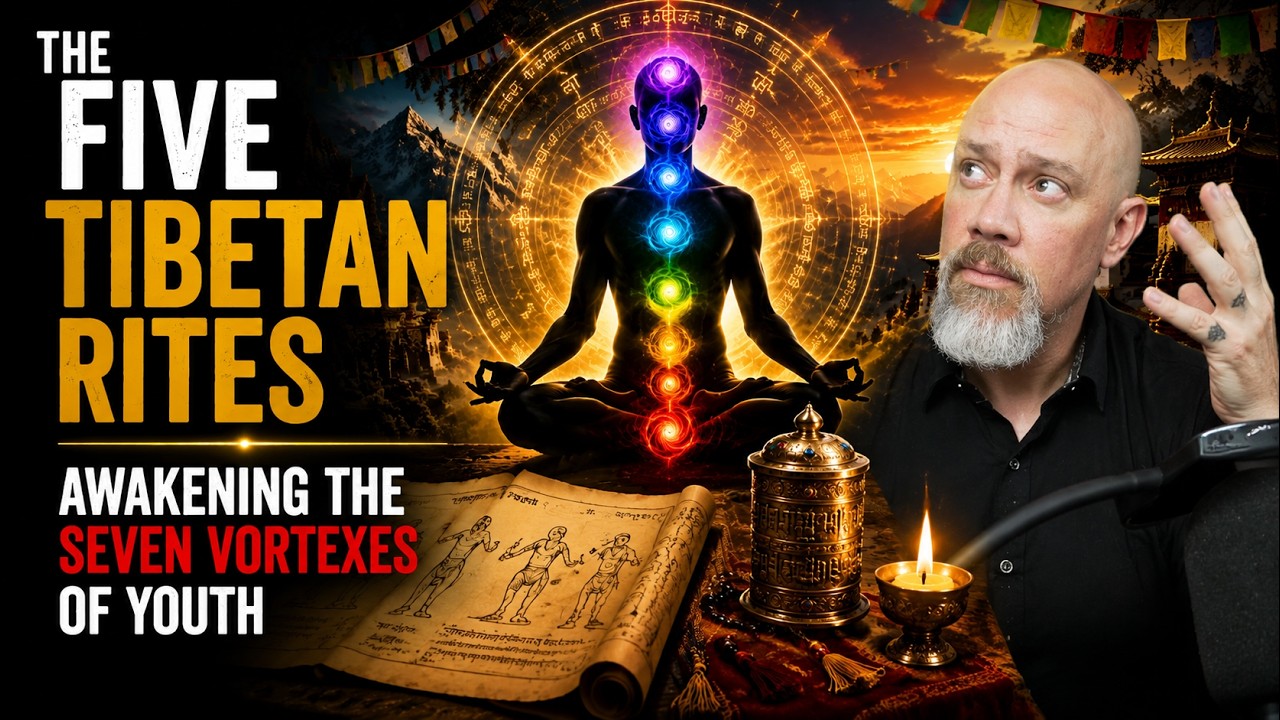
Brian Scott explores Peter Kelder's 1939 booklet The Eye of Revelation, which introduced the Five Tibetan Rites tied to chakras and endocrine glands. The system includes five main rites plus two hidden ones: a sixth that transmutates sexual energy, and a seventh that chants Om to stimulate the pineal gland. Scott details the postures, breathing, repetitions, and a strict diet, then examines skeptical scholarship linking the booklet to Lost Horizon and early physical-culture gymnastics, while sharing his own decades of practice.
Chapters
That a person struggling against the attraction is incapable of transmuting it because the energy will get misdirected into the struggle itself. The rite is described as being only for those who feel complete in that area and have a genuine desire to move toward different goals. And the book states plainly that for the great majority of people, a celibate life is an unworkable choice, and that those people should perform the first 5 rites only. Welcome to the Reality Revolution. I'm your host, Brian Scott, and today we're going to do a deep dive on the Eye of Revelation, the book that brought us the 5 Tibetans, a forgotten book from 1939 that claims the discovery of the Fountain of Youth 2,500 years ago. The King of Persia sent spies into Africa. Cambyses wanted to conquer a people at the southern edge of the known world. And before he moved his army, he sent men ahead disguised as ambassadors, carrying gifts with instructions to observe everything. Herodotus recorded what they found. The people they visited were called Macrobians, which means the long-lived. And the spies reported that these people commonly reached 120 years of age, and that many lived well beyond it. The Persians asked, how? They were taken to a spring. The water had a strange quality, and the report says that anything placed in it would sink rather than float, including wood, including objects that would have floated easily. Those who bathed in it came out with their skin glistening. The spies concluded that the water was the reason for the lifespan. That account is one of the oldest surviving versions of a story that human beings have been telling for as long as we have written anything down. Alexander the Great went looking for it. The romances that grew around his campaign describe him searching for the Water of Life at the edge of the world, guided by a figure who found it and drank and became immortal while Alexander arrived too late. Medieval Europe put it in the Kingdom of Prester John, a Christian empire somewhere east of everything, where a spring ran that returned a man to the age of 32 and held him there. And in the 16th century, the story attached itself to a Spanish soldier named Juan Ponce de León, who sailed north from Puerto Rico in 1513 and made landfall On a peninsula he named Florida. The claim that he was searching for a Fountain of Youth appears in accounts written after his death, rather than anything he wrote himself. The story found him because the story was always going to find somebody. Every culture has a version. Every century produces someone willing to go looking. And in every version, the fountain is somewhere else. Somewhere remote. Somewhere across an ocean or a desert. Or a mountain range guarded by distance, available only to whoever is willing to travel far enough. In 1939, a thin booklet came off the press at a small publishing house in Burbank, California. It ran a few dozen pages, it carried the name Peter Kelder, about whom almost nothing is known, and it was titled The Eye of Revelation. The claim inside it was straightforward: Somebody found it. A retired British Army officer walked into a monastery in the Himalayas as an old man leaning on a cane and walked out looking decades younger, carrying 5 exercises that anybody could do in a bedroom in 15 minutes. The booklet sold quietly and went out of print. It was reprinted in 1946 with new material, went quiet again, and stayed nearly invisible for 4 decades. Then, in 1985, it was republished under a different title, and it sold millions of copies, and the practice inside it spread across the world under a name Kelder never used: the 5 Tibetan Rites. Today we're going to go through the entire book, all 7 rites, including the 2 that most editions leave out, the model of the human body it describes, the manifestation method hidden in a chapter that vanished from print for decades, And then we're going to ask where it actually came from, because that question has a genuinely strange answer. The book opens on an afternoon in a park. Kelder is sitting on a bench reading a newspaper. An elderly man walks up and sits down beside him. Kelder puts him in his late 60s. He is gray and balding. His shoulders droop, and he leans on a cane. They start talking, and the conversation runs long. The old man turns out to be a retired British Army officer who served in the diplomatic corps, which took him to nearly every corner of the world. He tells stories Kelder is captivated. They agree to meet again, and a friendship forms, with evenings at one apartment or the other running late into the night. Kelder calls him Colonel Bradford and states plainly in the text that this is a pseudonym. Then one evening, the Colonel has something he wants to say and appears reluctant to say it. Kelder assures him of confidence, and slowly then, with increasing trust, the story comes out. While stationed in India, the Colonel had encountered wandering people from remote regions of the interior and had collected stories from them. One story kept recurring, and it came only from the people of one particular district. Anyone from elsewhere had never heard of it. It concerned a group of lamas who held the secret of the Fountain of Youth. The secret had been handed down within the sect for thousands of years. The lamas made no effort to conceal it. Their monastery was simply so remote that they were cut off from the world entirely. The locals told stories about old men who went there and regained their health, their strength, and their vigor. Nobody could say exactly where it was. The Colonel had become old at 40 and had continued in that direction ever since. He started collecting information— directions, terrain, climate, anything that might narrow the location. And the search took hold of him. He announced to Kelder that he was returning to India to find it, and he asked Kelder to come. Kelder thought about it, weighed the practical realities, and declined. The moment the Colonel left, he began to doubt the decision. He reasoned with himself. Perhaps it is a mistake to want to conquer aging. Perhaps a person should resign himself to growing old gracefully. And underneath the reasoning, one thought stayed: a fountain of youth. Years passed. The Colonel faded from Kelder's mind. Then one evening, Kelder returned to his apartment and found a letter in the Colonel's handwriting. It had been written in what Kelder describes as joyous desperation, Through frustrating delays and setbacks, the Colonel believed he was on the verge of finding it. There was no return address. The only certainty the letter provided was that the man was still alive. Many more months went by. A second letter arrived, and Kelder says his hands almost trembled opening it. The Colonel had found it. He was bringing it back to the States. He would arrive within 2 months. 4 years had passed since Kelder last saw him. He began to wonder what the Colonel would look like— whether the Fountain of Youth had stopped the clock, whether the man would appear the same as before or perhaps only 1 year older instead of 4. One evening, the house phone rang, and the doorman announced that Colonel Bradford was there to see him. Kelder threw open the door. Standing there was a much younger man. The stranger asked whether he was expected. Kelder said he was expecting somebody else, The visitor remarked that he had anticipated a warmer welcome and told Kelder to look closely at his face and decide whether an introduction was necessary. Kelder stared. The features did resemble Colonel Bradford's, but this was the Colonel as he might have looked years earlier, in the prime of his life. Where there had been a stooping, sallow old man with a cane, there was now a tall, straight figure with a robust face, and a thick growth of dark hair with scarcely a trace of gray. The Colonel said that it was indeed him, and that if Kelder failed to invite him inside, he would consider his manners badly lacking. Over the following day, the Colonel told the whole story. He had gone straight to the district where the fountain supposedly existed. He knew a good deal of the local language, and he spent months establishing contacts and befriending people. Then months more assembling the pieces. It was slow work. Persistence eventually won. After a long and dangerous expedition into the Romo Himalayas, he found the monastery. Kelder writes that he wishes space permitted recording everything the Colonel experienced there and then adds that perhaps it is better left out because much of it sounds more like fantasy than fact. Inside the monastery, older men and women were nowhere to be seen. The lamas gave the Colonel a nickname. They called him the Ancient One, because it had been a very long time since they had seen anybody who looked as old as he did. To them, he was a novelty. For the first 2 weeks, he describes himself as a fish out of water, marveling at everything and half disbelieving what was in front of him. Then his health began to improve. He slept soundly. He woke more refreshed each morning. Before long, he needed the cane only when hiking in the mountains. One morning he entered a large, well-ordered room used as a library for ancient manuscripts. At one end stood a full-length mirror. He had spent 2 years traveling through remote country, and all that time he had never seen his own reflection. He stepped in front of the glass. His appearance had changed so much that he judged himself to look 15 years younger than his age. In the months that followed, the change continued, and it became apparent to everybody who knew him His honorary title stopped being used. Nobody called him the Ancient One anymore. Here's the model the book presents, and it's worth understanding before the exercises because the exercises only make sense inside it. The Colonel says the first important thing he was taught after entering the monastery was this: the body has 7 energy centers, which in English could be called vortexes. The Hindus called them Chakras. They're described as powerful electrical fields, invisible to the eye and entirely real, and each one centers on a gland of the endocrine system, functioning to stimulate that gland's hormonal output. The book lists them precisely: the first and lowest centers on the reproductive glands, the second on the pancreas in the abdomen, the third on the adrenal gland at the solar plexus, The 4th on the thymus in the chest. The 5th on the thyroid in the neck. The 6th on the pineal at the rear base of the brain. The 7th and the highest on the pituitary at the forward base of the brain. In a healthy body, each of these revolves at great speed, permitting vital life energy, which the book calls prana or etheric energy, to flow upward through the endocrine system. And then the definition of aging. They state, but if one or more of these vortexes begins to slow down, the flow of vital life energy is inhibited or blocked. And well, that's just another name for aging and ill health. There's a second detail. In a healthy person, the spinning vortexes extend outward beyond the flesh. In the old and the weak and the sickly, they hardly reach the surface. So the model is coherent. Health is a matter of spin rate. and reach. Aging is a matter of the centers slowing and falling out of harmony with each other. And the Colonel is direct about what the rites are for. The only difference between youth and vigor and old age and poor health, he says, is simply the rate of speed at which the vortexes are spinning. Normalize the rate of speed and the old man becomes like new again. He also insists on something that people consistently ignore: these are movements of a different order than physical culture exercises. He says they're performed so few times daily that could almost have no value as physical training. Their purpose is to restore the spin rate and bring the 7 centers back into a single rhythm. In a strong, healthy person of 25, all 7 spin at the same speed. In the average middle-aged person, some have slowed considerably, and all 7 run at different rates With none of them working in harmony. The slow ones cause deterioration in that region of the body. The last ones cause nervousness, anxiety, and exhaustion. The 5 Rites. The book gives 5 rites in order with instructions. Rite number 1: Stand erect with your arms outstretched horizontal to the floor. Spin around until slightly dizzy. Direction matters. You must spin from left to right. The book gives the reference: place a clock on the floor face up and turn in the same direction as the hands. Most adults manage about half a dozen spins before becoming quite dizzy. The instruction is to stop there and sit or lie down if needed, and to practice only to the point of slight dizziness at first. There's a technique offered to reduce the dizziness, taken from dancers and skaters: fix your vision on a single point ahead, hold it as long as you turn, then snap the head around quickly and refocus on the same point. The Colonel then tells a story from India, and it's one of the most interesting passages in the book. He describes watching the Malluwaya, commonly known as the whirling dervishes, spinning almost unceasingly in religious frenzy. 2 things struck him: they always spun in one direction, left to right clockwise, and the older dervishes were strong and robust, far more so than most men of their age. He asked a lama about it. The answer was that the whirling did have a beneficial effect, and also a devastating one. Excessive spinning overstimulates some of the vortexes until they are exhausted, which first accelerates the flow of vital energy and then blocks it. The building up and tearing down produces what the Colonel calls a psychic rush, which the dervishes mistake for something spiritual. The lamas avoid the excess. Where the dervishes may spin hundreds of times, the lamas do it about a dozen times, Enough to stimulate the vortexes into action. My standard when doing it is 21 times. That's been my count. I spin for 21 times. That seems to be the right amount. And as I followed YouTube and other articles, 21 seems to be an acceptable number, but there isn't a universal number that I can find. 21 is the number that I use. The second rite, number 2, lie flat on your back on a padded surface. It notes that the lamas use a prayer rug about 2 feet wide and 6 feet long made of wool and vegetable fiber, and adds a dry aside that its actual purpose is insulating the body from a cold floor. And that religious significance gets attached to everything the lamas do. Extend the arms along the sides, palms against the floor, fingers together. Raise the head off the floor, tucking the chin against the chest. At the same time, lift the legs into a vertical position with With the knees straight. If possible, let the legs extend back over the body toward the head. Then lower both the head and the legs slowly to the floor. Relax everything and repeat. Breathing is specified. Breathe in deeply as the legs and head lift. Breathe out fully as they lower. Continue the same rhythm while resting between repetitions. There is a story attached. A lama told the colonel that when he first attempted this rite, he was so old and weak that he could get his legs nowhere near straight. So he began lifting them bent, knees up and feet hanging. Little by little he straightened them, and at the end of 3 months he could raise them straight with perfect ease. The Colonel adds his own observation about that same lama: For the pleasure of exerting himself, the man used to carry 100 pounds of vegetables on his back from the garden up to the monastery several hundred feet above, without once stopping, arriving unexhausted. The Colonel says that the first time he attempted to follow him up the hill, he had to stop a dozen times to catch his breath. In my own practice, in doing this, I begin to notice energy moving into my sacral chakra. I begin to feel the energy flowing up and additional energies flowing upward as I do this in order. The 3rd rite: kneel on the floor with the body erect and the hands placed against the thigh muscles. Incline the head and neck forward, chin tucked against the chest, then throw the head and neck back as far as they will go, arching the spine, bracing the arms and hands against the thighs for support. Return to the original position and begin again. Like the others, I try to do this 21 times, but there's a natural flow to this. Breathe in deeply as the spine arches. Breathe out, returning to erect. He has seen more than 200 lamas perform this together with their eyes closed in order to turn their attention inward and eliminate distraction. To me, this stretches out the spine. This begins to move energy upward in my spine as I do it. Sit on the floor with legs straight out in front and the feet about 12 inches apart, trunk erect, palms on the floor alongside the buttocks. Tuck the chin forward against the chest. Then drop the head backward as far as it will go while raising the body, so the knees bend and the arms stay straight. The trunk comes into a straight line with the upper legs horizontal to the floor with the arms and lower legs perpendicular. Tense every muscle in the body, then relax, return to sitting, and rest before repeating. Breathe in deeply as the body raises. Hold the breath while tensing. Breathe out completely coming down. The Colonel says the first time he performed this one it seemed very difficult. And after a week, it was as simple as one of the others. He then describes teaching classes in Indian cities, finding that older students who could barely get their bodies off the floor became discouraged watching younger ones perform it perfectly on the first day. He separated the groups, told the older students that he had begun no better than they had, and demonstrated 50 repetitions without strain in front of them. From that point on, he says, the older group broke all records for progress. For me, I have difficulty doing this. Because I have a bad shoulder and it's hard for me to stretch out this shoulder, something I probably need surgery on. But the workaround is if I lay my back on the edge of a couch or chair, then I can do the same motion without having to use my arm. That's my workaround for it. Some people have difficulty using their arms in this manner, and at the beginning you may find just sitting and placing your back on a cushion or couch you can repeat this rite. Part of the reason you're not seeing me doing it in this video. The 5th rite: face down, supported by the hands with the palms flat, the toes flexed, hands and feet about 2 feet apart. Begin with the arms perpendicular to the floor and the spine arched so the body sags. Throw the head back as far as possible, then bend at the hips and bring the body up into inverted V. Tucking the chin against the chest. Return and repeat. Breathe in deeply, raising the body out, fully lowering it. Once proficient, the instruction is to let the body drop from the raised position to a point almost touching the floor, tensing the muscles for a moment at both the top and the bottom. Now, I have done this on a regular basis. It became a regular part of my practice. You can see it described in my first book, The Reality Revolution: The Mind-Blowing Movement, to hack your reality. In fact, this became a key part of my quantum jumping process. If I could do the 5 Tibetans and some qigong prior to meditating, the energy was clear and powerful and the effects were substantial. So this became a regular part of my meditational process. If I could do the 5 Tibetans prior to meditating, it would always be more powerful, more effective, and much deeper. The progression is specific. 3 repetitions of each rite daily for the first week, then increase by 2 every week. 5 in the second week, 7 in the third, 9 in the fourth, and onward. In 10 weeks, you reach 21 repetitions of each. That's their suggestion. 21 is the ceiling. The book states there's no need to exceed 21. If the spinning is difficult, do as many as possible without excessive dizziness and build separately. It's not designed to be an exercise or workout. The Colonel mentions a man who practiced for more than a year before he could spin 21 times, who had no troubles with the other 4, and who got splendid results anyway. You don't have to be perfect at this. For people who find spinning impossible, the advice is to omit it and do the other 4 for 4 to 6 months, after which they usually find that they can begin the spinning process. Be sure to look it up because Because just the process of spinning has been found to have huge beneficial effects. Morning or evening, whichever is convenient. The Colonel does both and advises beginners against that much stimulation. Daily practice is required. One day a week may be skipped and no more. The whole thing takes 20 minutes, and a physically fit person can complete it in 10 or 5 minutes. And there's an instruction About strain that runs through the entire book. Never force. Do as much as you can handle and build gradually. If one rite is impossible, omit it and return to it after some months. The Colonel is asked what happens if one is left out entirely, and his answer is that the rites are so powerful that excellent results would still come from 4 practiced regularly, and that even one alone will do wonders, with the older dervishes standing as evidence. 2 additions are given. Between each rite, stand erect with hands on hips and breathe deeply several times, imagining tension draining away on the exhale and a sense of well-being filling you on the inhale. And afterward, take a tepid bath or a cool one, or go over the body quickly with a wet towel and then a dry one, with a warning to never chill yourself internally. Now the part most people never encounter: The Colonel agreed to lead a class for Kelder on 3 conditions: the class must contain a cross-section of men and women from all walks of life, no member could be under 50 years of age, and it must be limited to 15 people. They called themselves the Himalaya Club and met weekly. By the 10th week, nearly all of them were performing the full 21 repetitions. Everybody reported improvement. Several reported results they called remarkable, and a man nearing 75 had made more progress than anyone. At the 10th meeting, they finally asked the Colonel his age. He had been holding that information back. Each member wrote a guess on a slip of paper. The Colonel read them aloud. Every guess placed him in his 40s, most in his early 40s. He told them he would be 73 on his next birthday. Then somebody asked why his results were so much more dramatic than theirs. His answer was they had been doing this for 10 weeks, and they would see far more after 2 years. And then he said there was more to it, because he had held something back. There was a 6th rite. He warned them that taking advantage of it required accepting a very difficult self-restraint, and told them to consider carefully whether they were willing to do this for the rest of their lives. He invited whoever wished to continue to return the following week. Of 15, 5 came back. The Colonel said that was a better showing than he had gotten from any class in India. The 6th rite. The explanation comes first. In the average person, part of the vital life force that feeds the 7 vortexes gets channeled into reproductive energy, and so much of it is dissipated in the first vortex that it never reaches the other 6. To move beyond that, the force must be conserved and turned upward so all the vortexes can use it, especially the 7th. The Colonel is careful about the method. He says that whole religious orders in the West have attempted this and failed because because they tried to master reproductive energy by suppressing it. His position is that there is only one way, which involves neither dissipating nor suppressing, but transmuting and lifting upward at the same time. The rite itself is simple. Stand straight and slowly let all the air out of your lungs. Bend over and put the hands on the knees, forcing out the last trace of air. With the lungs empty, return to standing. Place the hands on the hips and press down. Which pushes the shoulders up. Pull the abdomen in as much as possible and raise the chest. Hold that position as long as you possibly can. When you're finally forced to breathe, let the air flow in through the nose. When the lungs are full, exhale through the mouth. Relax the arms and let them hang. Then take several deep breaths. That is one repetition. About 3 are required for most people. These are 2 conditions attached, and they are unusual. The first is that this requires an active Sexual urge, because a person cannot transmute an energy that is absent. Anyone who has lost that urge should practice the other 5 until it returns before attempting this one. The second is that a person struggling against the attraction is incapable of transmuting it, because the energy will get misdirected into the struggle itself. The rite is described as being only for those who feel complete in that area and have a genuine desire to move toward different goals. And the book states plainly that for the great majority of people, a celibate life is an unworkable choice, and that those people should perform the first 5 rites only. Most editions of this book end shortly after that. There is a chapter 5, and for decades it existed in almost no printings. The electronic edition assembled by Sergei Babitsky notes that it comes from the only surviving copy of the expanded 1947 publication. It takes the form of a letter. The Himalaya Club continued receiving occasional communication from the Colonel as he lectured around the world. One day, a long letter arrived intended for all the members, and it carried a title that most of them found unfamiliar: Mantram Mind Magic. The letter opens with a distinction: a mantram is a vocalized instrument of thought; a mantra is silent. Both come from a Sanskrit word meaning instrument of thought. Then the premise, stating, whether you realize it or not, you create and shape your life with your thoughts. All things that become part of your physical reality are first created in the mind from the raw material called thought. The letter then introduces a term that will sound familiar to anybody who has spent time in this material. The lamas avoid the word subconscious. They use a word that translates as superconscious, meaning consciousness of a higher order, Its job is to take thought, which is pure energy, and give it physical shape in the material world. Your superconscious mind is a willing and eager servant whom you command by way of your thought patterns. When you think a thought, you issue a command. And then a diagnosis of why this fails for most people, which is sharp and worth hearing. The letter says that when you examine your thoughts closely, you find negative patterns competing with positive ones. In one breath, a person says they want happiness. In the next breath, they give themselves 1,000 reasons to be unhappy. The job is stressful, the weather is unpleasant, the bills are piling up, the neighbors are noisy. So the stated goal is happiness, and the thinking is working overtime in the opposite direction. The method is to sit down and write a list of things you desire most. The instruction is specific. Avoid reasoning about what you ought to want, and instead jot the desires down quickly, including everything that comes to mind. Then examine the list and ask what reward each desire is supposed to bring you. Write those down too, because the rewards are the actual target. A better job is the surface item. What you want are the rewards of a better job. The letter then adds a line that changes the entire exercise: the rewards you want should always be expressed in terms of feelings. Feelings are described as the fruits of a lifetime experience. Material treasures get left behind. Feelings remain, and so the instruction is to choose carefully which ones you want as lasting companions. Next, review the whole list and reduce it. Look for groups of apparently different desires all aimed at a common goal. Separate them into 2 or 3 groups and find a single word or phrase for each. A better house. An expensive car. and a new wardrobe collapse into one word: abundance. Then state the fundamental goals as a brief command, positive and short. The example given is: I demand happiness, power, and prosperity right now. The letter explains the word choices. Power is recommended because it brings health, strength, and vitality on the physical level, and mastery of your own destiny on the mental level. And the final phrase tells the superconscious mind when, which is immediate. Speak it aloud with conviction, and the instruction is to avoid timidity and to feel the power of your own voice. Speak it before sleep and on waking, then repeat it at intervals during the day in front of a mirror. Gaze directly into the reflection of your own eyes while saying it, then watch your ordinary speech and thought for anything that contradicts it. When you catch a negative thought or word, stop, take a deep breath, and cancel it it by speaking the mantra again. In company, use the silent version. And one rule above the others, stating, when you command the superconscious mind, you must focus only on the end result which you desire. Never try to dictate how superconsciousness will accomplish its miracles. All of this in a 1939 book. It sounds a lot like what I'm teaching today. The reasoning is that the superconscious is more resourceful than you can imagine And that if it gets blocked in one direction, it knows 10,000 other routes. Prescribing the method limits the options. There's one more claim, and it explains a great deal about why people get results they never intended. The superconscious makes no judgment about the thoughts it receives. It draws no distinction between pain and pleasure, sorrow and happiness, grief and joy. Its function is to transform thought patterns into matter. And the letter says it can never do that job if it first evaluated whether a thought was worthy. The letter continues into territory that appears nowhere else in the book. There's one word from the East that the Colonel says has a magical effect on the superconscious mind, the brain, and the central nervous system, and its value sits in the tonal vibration rather than any meaning. The word is Om. He calls it Rite Number 7. Intoned correctly, its vibratory frequency is described as having a powerful stimulating effect on the pineal gland, which connects to the 7th and highest vortex. And then the warnings, which are extensive. The pineal should stay unstimulated unless life being led is oriented toward higher things. The comparison offered is a seed that cannot sprout in barren ground. The prerequisites are stated flatly. Practice the first 5 rites first. Be beyond all habit-forming substances, including alcohol and nicotine. Watch the diet, keeping it low in fat and avoiding sweeteners, and increase water consumption to roughly 3 quarts daily for an average-sized person, built up gradually over 60 days with the reasoning that water conducts electrical current and sound vibration. Only after a month of that should the rite begin. The practice: stand or sit in a comfortable chair without slouching. Or lie flat on a firm surface with no pillow, keeping the chin up so the vocal cords stay unrestricted. Om is pronounced the way home is pronounced without the H. Take the deep breath without filling the lungs to bursting. Using a deep, full-bodied voice, sound the vowel with the jaw halfway open, the lips rounded, and the tongue low and retracted. Sustain it about 5 seconds. Then continue sounding while closing the jaw and flattening the lips, forming the humming sound. Sustain that about 10 seconds. The first half should resonate through the chest cavities, the second half through the nasal cavities. Done correctly, the two blend into one continuous sound. 3 or 4 repetitions in succession are described as sufficient, with a caution against overdoing it and an instruction to stop at any lightheadedness. A beginner should perform it no more than 10 times a day. There's also a combination given. Speaking the mantra and performing this rite in the same session is discouraged, since the rite calls for a quiet mind, but the silent mantra can be paired with it. During the 5-second vow, hold the mind still. During the 10-second hum, repeat the mantra mentally. The letter closes by saying the rite is intended for mature individuals. that nobody under 21 should use it, and that older men and women often make better progress at this work than younger ones, partly because they have learned to see past the distractions of the material world. 2 more teachings deserve mention because they show how far the system extends beyond the exercises: the voice. The Colonel claims the 5th vortex at the base of the neck governs the vocal cords and connects directly to the 1st vortex at the reproductive center. And that the 2 are geared together so that what affects one affects the other. His conclusion is that a high, shrill voice in an older person signals low vitality in the first vortex, and that if energy is low there, it will be low in the other 6. The remedy is deliberate. Listen to yourself speak, and whenever the pitch rises, adjust downward. Listen to people with firm speaking voices and note the sound. He gives a specific exercise somewhere private or somewhere loud enough that you will Disturb nobody. Practice saying a low humming syllable through the nose, repeating again and again, dropping the pitch in steps until you have forced it as low as it will go. He recommends doing this first thing in the morning when the voice already sits lower, and then holding the lower register through the day. Once progress begins, practice in a bathroom where you can hear the voice reverberate, then attempt the same effect in a larger room. He extends the principle to the lamas themselves, who chant in unison for hours in low register. His claim is that the significance sits in the vibration of the voices rather than in the chanting or the meaning of the words. An entire chapter covers diet, and the core principle is separation. The lamas are described as vegetarian, with the qualification they use eggs, butter, and cheese. They avoid meat, fish and fowl. The rule the Colonel emphasizes is that a Lama's meal usually consists of one item of food, and he calls that in itself an important secret of health. His reasoning is that starches and proteins conflict in the stomach. He gives 5 points: keep starch and meat out of the same meal, drink coffee black or eliminate it, chew food to a liquid and reduce the quantity, noting that thorough chewing can cut the amount Eaten by half. Eat raw egg yolks once daily before or after meals rather than during, and reduce the variety of foods in any single meal to a minimum. The egg detail has specific reasoning attached. He says the lamas ate whole eggs only after hard manual labor, and they otherwise ate the yolks and discarded the whites on the grounds that egg whites are utilized only by the muscles and belong in the diet only when the muscles are Now the question. There is no independent record of Peter Kelder. There is no independent record of Colonel Bradford, who by Kelder's own statement was named something else. There is no identified monastery. And the case against the book is substantial. James Hilton published Lost Horizon in 1933. It describes a hidden Tibetan lamasery called Shangri-La where people remain youthful into an extraordinary old age. Frank Capra released the film adaptation in 1937. Kelder published in 1939. The similarity is obvious enough that Kelder himself uses the phrase, writing that Colonel Bradford and his Shangri-La grew dim in his memory over the years. The writer John Michael Greer examined the booklet closely and traced several of its elements to the world Kelder was living in rather than to Tibet. The dietary advice closely resembles the Hay Diet, a popular popular food combining system of the period built on separating starches from proteins. Rites 2 through 5 resemble hatha yoga postures as they appeared in American books published in the early 1900s during the physical culture movement, which itself carried influence from German-American gymnastics clubs, and Greer connects the first rite to the American Spiritualist movement. Wikipedia states the position plainly: there is no evidence of the exercises being authentic Tibetan practices and no evidence supporting the claim they are 2,500 years old. It's a fair summary of the skeptical case, and it deserves to be stated. And here's where it becomes strange. The 2,500-year claim appears in exactly one place: the foreword of the 1939 edition. It appears nowhere else in the book. The 1939 foreword says the book reveals information that has been known and used by men in far distant lands for more than 25 That sentence was removed from the 1946 edition. Somebody deleted the only piece of information in the entire booklet that identified how old the practice was supposed to be. The bookseller and researcher Jerry Watt took that deletion as a signal and treated the age claim as a clue rather than as decoration. If the system is real, it must satisfy 5 conditions: at least 2,500 years old, still being taught in the 1930s, Part of a Tibetan culture. That's a demanding test. And here's what he found. Before Buddhism entered Tibet from India in the 7th century, the native tradition was Bon. Bon began as a body of animistic belief and shamanic practice and became a more organized religion after the Buddhist arrival. Associated with Bon is a practice called Kum Nye. Kum Nye is a Tibetan movement practice. Some forms of it belong to the medical tantras. The body of knowledge describing Tibetan medicine, where it used to promote health and healing. Some forms resemble various kinds of yoga; others are slow and resemble tai chi; others are intensely aerobic. Different transmissions vary greatly between teachers, and the practice is used to develop energy channels and increase sensitivity. Kum Nye is related to Nyingma and Bon traditions, and Tibetan medicine on which some forms of Kum Nye are based is dated by multiple sources. to approximately 2,500 years, the exact figure Kelder gave in the 1939 foreword. There's one further detail: the 1946 edition of the book contains advice about rubbing butter on the scalp to help regrow hair. It's the kind of instruction that makes a modern reader dismiss the whole document. Tibetan medicine of the period used melted butter in a wide range of treatments. And then Watt offers a motive for the deletion. Bon monasteries still exist along the Indo-Tibetan border, But after Buddhism was established in Tibet, Bon was suppressed. Adherents were forced to renounce it or leave on penalty of death. At the time Bradford's visit would have occurred, Bon was still a repressed religious practice in remote areas. So the reason the book withholds the monastery location may be beyond the mystique. Naming it would have located it. And the 2,500-year figure, obscure as it appears, points at exactly the tradition that would have needed to stay hidden. Watt's suggestion is that neither Kelder nor Bradford noticed that implication in 1939, and that upon reflection they removed it in 1946. The frame story has no independent verification, the Shangri-La resemblance is real, and the timing suspicious. That's the case in surreal case. Against it sits a set of coincidences that keep the question open: an age figure matching Tibetan medicine precisely, a movement tradition led by Buddhist religion that fits every stated condition. Both of those things are true at once. Here's what I think matters. Millions of people have practiced these 5 movements over the past 40 years. The book has stayed in print through edition after edition, in language after language, sustained almost entirely by people telling other people it worked for them. And it worked for me. Whatever its origin, something in it holds the underlying claim that the human body carries energy centers whose condition determines vitality appears independently across Tibetan, Chinese, and Western traditions. That idea is far older than 1939 and far more widespread than one booklet from Burbank. What Kelder did, whether he found it in a monastery or assembled it in California, was compress it into 15 minutes that anybody can do on a bedroom floor. If you want to try it, here's a sensible approach drawn from the book itself. Start at 3 repetitions of each rite, And add 2 per week. Reach 21 in 10 weeks and stop there. Practice daily. Skip 1 day a week at most. Breathe with each movement. Deep on the effort, full release on the return. Stand between the rites with hands on hips and take several deep breaths, releasing tension on the exhale. Take a tepid or cool wash afterward. Avoid anything cold enough to chill you. Force nothing. If a rite is beyond you, do a partial version or omit it. The book is emphatic that strain is counterproductive and that 4 rites practiced faithfully outperform 5 practiced with injury. And the 2 teachings that sit outside the exercises are worth taking on their own terms. Watch the register of your voice and hold it low and steady. Whatever you make of the vortex explanation, a person speaking from the chest carries themselves differently than a person Speaking from the throat. And the mantra method stands entirely on its own. Write the desires quickly. Find the rewards underneath them. State the rewards as feelings. Reduce everything to 2 or 3 words. Build one short positive command. Speak it aloud on waking and before sleep, and cancel any contradicting thought by speaking it again. Focus on the end result. And leave the route alone. That's a complete manifestation practice published in 1939 and buried for decades in a chapter almost nobody printed. For as long as people have written things down, they have written about a place where the water makes you young again. Persian spies found it at the southern edge of Africa. Alexander looked for it at the edge of the world. Medieval Europe put it in a kingdom that never existed. Spanish soldiers were said to have hunted it through Florida. In every version, it is far away. In 1939, a booklet appeared claiming that a man went all the way to the Himalayas, found the monastery, learned the secret, and discovered what it actually was. The colonel says himself near the end of the book, he says that the Fountain of Youth was inside him the entire time, and that the rites were merely a key that unlocked the door. He mentions Ponce de León and calls it a pity that the man journeyed so far in order to come back empty-handed, when he could have achieved the goal without leaving home. That is the answer the story arrives at after 25 centuries of searching. The traveling was never the point. The distance was never the point. The thing everybody went looking for was in the room the whole time. In a body that responds to how you move it, how you breathe, how you speak, and what you tell it every morning about what you are. So what can you say? I can only say from personal experience: the five Tibetans have changed me. They genuinely work. My practice for many years now is to do the five Tibetans to do qigong and then do headstands. To get the body and energy moving. It works, especially when I use this technique prior to quantum jumping experiences. It brings energy into the body, it moves it up, and I feel younger than I've ever felt. Right now, I feel like I was in my 20s. So I can only give you my own personal experience. Give it a try. Test it out. Let me know. What happens, and put it in the comments. If you find that it's an effective practice, put it in the comments. I would love to hear what you think. Check out the book *The Eye of Revelation*, and let me know. You can find all episodes of *The Reality Revolution* at *therealityrevolution.com*. And before we go, I want to invite you to join the school community. Our tribe can be located in the link below at. Skool.com, S-K-O-O-L.com/realityrevolution. We meet weekly. We have mastermind sessions and exclusive content that you can't find anywhere else, and an amazing group of people beyond just me that are also teaching classes and offering courses. It's an amazing experience. I hope to meet you and talk with you there. I'm sending all my light and love to everyone out there. May you find the fountain of youth within your heart. Welcome to the Reality Revolution. We return you now to your local announcer.
More from Brian

The Man Who Mapped The Other Side-The Story Of Robert Monroe, Hemi Sync And The What He Found There


The Woman Who Spoke Her Life Into Existence - Florence Scovel Shinn And The Power Of The Word



4 Hour Deep Sleep Meditation - The Operators Reprogram Your Reality While You Sleep


