The Russian Psychotronics FIles - Soviet Research Into Timeline Jumping
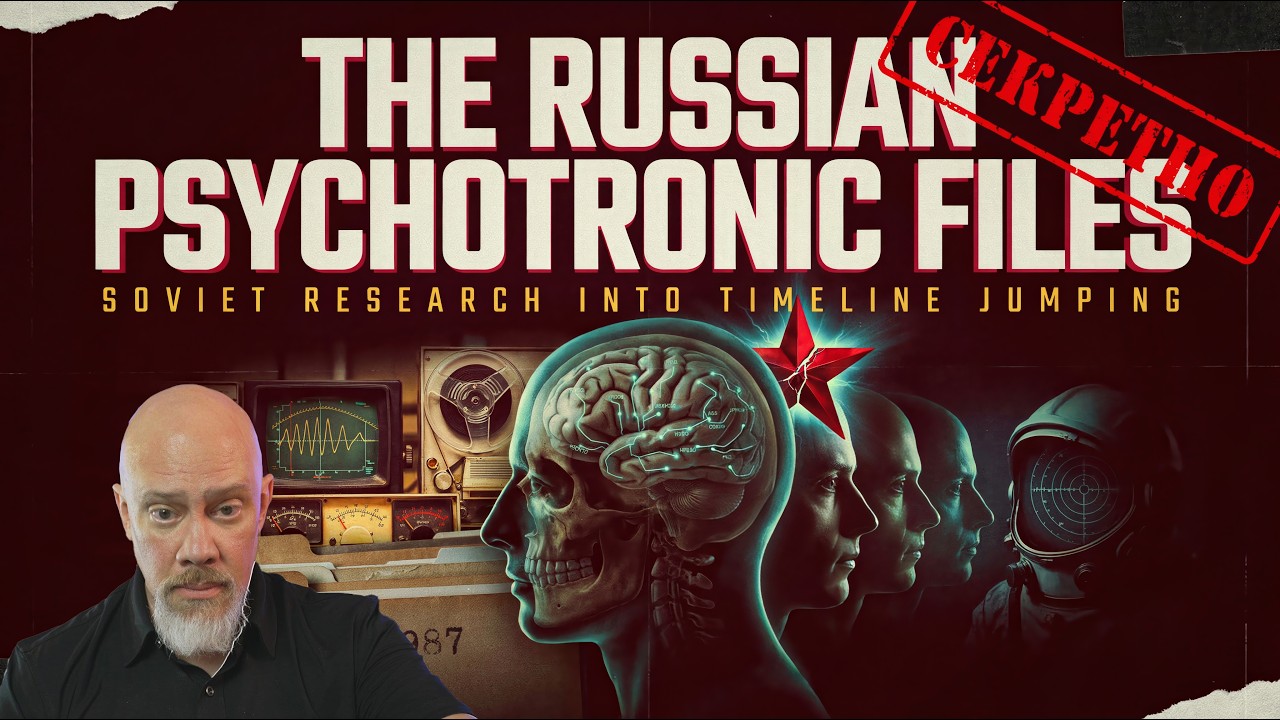
Brian Scott examines the Soviet Union's state-funded psychotronics program, which operated across twenty institutions under KGB oversight and aimed to weaponize telepathy and remote viewing. The research centered on Nikolai Kozyrev's theory of time as a physical substance, tested in an Arctic village using a spiral aluminum chamber called the Kozyrev mirror, where participants reportedly drew symbols hours before a computer generated them.
Chapters
By the 1970s, the Soviet Union had built something the West only had in fragments. They had a coordinated, state-funded, university-embedded psychotronics program operating across more than 20 research institutions with KGB oversight and military application as the explicit goal. Welcome to the Reality Revolution. I'm your host, Brian Scott, and I'm beyond excited to finally do a deep dive on the Russian psychotronics files. This is Soviet research into timeline hopping. December 1990. The polar village of Dykson, Russia. Latitude 73 degrees north. The kind of cold that cracks the lenses on your cameras. The sun has been gone for weeks, and it stays gone for weeks more. Inside a cylindrical chamber made of curved aluminum sheets, a man is lying on a thin mattress. The chamber is roughly 7 feet tall, spiraled like the inside of a seashell. He's wearing a heavy coat. He has a thermos of water beside him, and he is being asked to receive a signal, a signal that has yet to be sent. Hundreds of miles away on the Russian mainland, a computer is running a random number generator. In a few hours, it will pick a symbol— a circle, a wavy line, a triangle, a cross. Until that moment arrives, the symbol does exist anywhere. It has been generated, it has been chosen, it has been transmitted to anyone. The man inside the cylinder closes his eyes. He starts drawing a wavy line, then a triangle, than a circle. 5 hours later, the computer chooses its symbols: a wavy line, a triangle, a circle. The receiver had pulled the symbols out of the future before the future had decided what they would be. The lead scientist, a man named Alexander Trafimov, would later write a single sentence to summarize what happened in that polar chamber. I've been chewing on it ever since I first read it because the implications scramble everything we think we know about the direction of time. In the far north, the future is present in the present. Today we are going somewhere most of the consciousness world has barely touched. Most of you have heard about the CIA's Stargate Project. Most of you have heard about remote viewing. Most of you have even heard about the Gateway Process. Those are things I've recently discussed on the channel, but almost everything we know about the psychic research from the Cold War come from the American side. The other side of the curtain ran a parallel program. It had a different name, a different vocabulary, a different scientific philosophy, and by some estimates, a budget over a billion dollars. They called it psychotronics. They built devices to bend time. They placed thousands of subjects inside spiral aluminum chambers above the Arctic Circle, and the documents they have released so far suggest they discovered something The Americans only dreamed of a working method for receiving information from the future and possibly for influencing the past. Today we open the Russian psychotronics files. We talk about how we know any of this exists. We meet the woman who stopped a frog's heart with her mind on a black and white film that ended up in the Pentagon. We meet the prisoner who developed a theory of time inside a Soviet gulag. We walk into the spiral mirrors at the top of the world. By the end, I'm going to show you why all of this connects directly to the work that you and I have been doing in our own future self meditations. Because the Russians may have built with steel and aluminum and Arctic latitude the same thing we are doing with breath and intention and visualization. Before I go further, I want to address the question you should be asking. You should be asking it about every episode I've ever made. The question is, how do I actually know any of this happened? Because here is the trap with the Cold War mystery content. It's very easy to spin a story. It's very easy to say the Soviets had a secret program and let the words secret program do all the work. So before we walk into the spiral mirrors and the frog hearts and the time energy chambers, I owe you a clear pipeline of evidence. The first source is a book in 1970 2 journalists named Sheila Ostrander and Lyn Schroeder published a book called Psychic Discoveries Behind the Iron Curtain. They had spent several years traveling through the Soviet bloc interviewing scientists at official laboratories from Prague to Moscow. The book hit American shelves like a bomb. It described state-funded psychic research at a scale the West could barely imagine— telepathy experiments inside electromagnetic shielding Psychokinesis demonstrations under controlled conditions, photographic techniques for capturing the human energy field, and a whole vocabulary the Soviets had developed for talking about consciousness as a physical force. The book is still in print. You can buy it. You can read it. It is the foundation document of everything we're about to discuss. The second source is a defector. In 1967, a Czech biochemist named Milan Rizal walked across the line and brought with him direct testimony about Soviet bloc psychic laboratories, including their interest in something he openly described as thought control. He wasn't the first. A KGB officer named Nikolai Kolkov had defected back in 1954 and reported that Soviet research into psychic warfare had been underway long before the Sputnik era. These were trained intelligence personnel. They had reasons to be credible. The third source is the United States government itself. In 1972, the Defense Intelligence Agency produced a report titled Controlled Offensive Behavior, USSR. The report has since been declassified. It described Soviet parapsychology as a fully institutionalized scientific field Supported by a network of laboratories, universities, and KGB-controlled research centers. It estimated more than 20 active research institutions inside the USSR with an annual budget around $21 million in 1970s money. That single report is the document most often cited in serious histories of the program. The 4th source arrived in 2017. The CIA released roughly 12 million pages of formally classified material, much of it concerning the Stargate Project, but a substantial portion concerning what the Americans were monitoring on the Soviet side. Many of these documents are sitting on the CIA Reading Room website at this moment. Anyone with an internet connection can read them. The fifth source is recent academic work. In 2013, a German researcher named Serge Kernbach published a paper in ArXiv Physics Archive titled Unconventional Research in USSR and Russia: Short Overview. Kernbach is a roboticist at the Research Center of Advanced Robotics in Stuttgart. His paper is the most comprehensive English-language summary of Soviet psychotronics ever produced, drawing on Russian-language journals, declassified KGB material, and interviews with researchers are still active. Kernbach estimated that as of the time of writing, around 500 scientists in Russia were still active in the field. He also noted that documents from OGPU and NKVD, the predecessors of the KGB, remain classified 80 years after the fact. The 6th source is the testimony of 2 American historians. Annie Jacobson, the Pulitzer Prize finalist, published a book in 2017 called Phenomena: which devotes substantial chapters to Soviet psychic research using American intelligence files. Jim Schnabel's earlier book Remote Viewers did the same. Both are journalistic works built on declassified material and direct interviews. So when I tell you what comes next, I want you to know I am working from declassified intelligence reports, peer-reviewed papers, defector testimony, journalist investigation, and published research of the Russian scientists themselves. The Russian psychotronics program existed. It was massive. It was well-funded. And the question of how successful it was— that question has more interesting answers than you've been told. The story of Russian psychic research starts before the Soviet Union existed. It starts with a man named Vladimir Bekhterev. Bekhterev was a neurologist, a psychiatrist, and one of the most influential brain scientists of the early 20th century. He founded the Brain Institute in St. Petersburg in 1907. He was a contemporary of Pavlov and in some ways a rival, and in 1919 he conducted a series of experiments that are still discussed in the Russian psi literature today— experiments on telepathic communication between humans And animals. Bekhterev's protégé was a man named Leonid Vasilev. Vasilev was a serious physiologist working at Leningrad University from the 1920s through the 1960s. Vasilev ran a long, methodical research program into what he called mental suggestion at a distance. His most famous experiments involved sending hypnotic suggestions across rooms and across cities. And timing the moment when the receiver entered a hypnotic trance. He was meticulous. He used Faraday cages to rule out conventional electromagnetic transmission. He published his results in April of 1960. Vasilev stood in front of a group of senior Soviet scientists at Bekhterev Brain Institute and declared on the record that he had scientific proof of telepathic communication. He said the next task was to identify the energy that carried it. The Soviet government heard this declaration, and the Soviet government did something the American government would never have done in that decade. They listened. They funded him. They built him laboratories. They told him to figure out what kind of energy a thought was made of. Now here's where the story becomes uniquely Russian. The communist worldview was officially materialist. Everything in the universe had to have a physical explanation. There was room for spirits. There was room for souls. There was room for the supernatural. So when a Soviet scientist demonstrated something that looked like telepathy, the Communist Party did refuse to investigate it. Instead, they declared that the phenomenon must be explainable through ordinary physics, and they handed it to their best scientists with instructions to find the mechanism. This is the philosophical inversion that made Soviet psychotronics so different and interesting compared to Western parapsychology. In America, psychic research lived on the fringe, dismissed by mainstream science, scrambling for funding from private foundations. In the USSR, psychic research lived inside the universities, the academies of science, the brain institutes, and eventually the KGB. It was treated as a branch of physics that simply had to figure itself out. The treatment made it dangerous in two directions. It was dangerous for the scientists because the moment the work touched on anything that looked spiritual or mystical, the ideological police would shut it down, accuse them of fraud, and sometimes have them arrested. One of Vasiliev's collaborators, a parapsychologist named Edward Naumov, was arrested by the KGB. and sent to work at a camp for a year. His crime was meeting too often with Western parapsychologists, and it was dangerous for the West because the work progressed and the reports filtered out. The American intelligence community started to take it very seriously. The DIA's 1972 report quotes Vasilev directly and asks the obvious question: if the Soviets are decades ahead of us in this field, And if they figure out how to weaponize it, how do we defend against an attack we cannot see, hear, or measure? The question is what kicked off the American Stargate program. But before Stargate, before remote viewing, before the Monroe Institute and the Gateway Process, there was a housewife in Leningrad who could move objects with her mind. And in 1970, In front of a room full of Soviet doctors, she did something that arrived on the desk of the United States Department of Defense within weeks. Her name was Ninel Sergeyevna Kulagina. The West knew her as Nina. Her birth name was a Soviet-era invention. Ninel is Lenin spelled backwards. She was born in Leningrad in 1926. At age 14, she joined the Red Army and served as a radio operator in a tank regiment during the German siege of her city. She was wounded in the abdomen at age 17. After the war, she became a housewife. She was unremarkable in every way— short, plump, dark-haired, quiet. She had no theatrical training, no obvious showmanship, no apparent desire for attention. And starting in the 1960s, she became the most studied human being in the entire history of Soviet parapsychology. It started with small things. She could move matchsticks across a table without touching them. She could rotate a compass needle. She could separate the yolk and white of a broken egg suspended in salt water without disturbing the water. The Soviet scientists who studied her, at least 40 of them including 2 Nobel laureates, placed her inside Faraday cages. Removed all metal from her clothing, monitored her heart rate, monitored her brain waves, and watched her physiology spike during every successful demonstration. Her heart would race, her brain wave patterns would shift dramatically, her blood sugar would change. After a long session, she would sometimes lose 2 pounds of body weight and need to spend days recovering. Whatever she was doing, It was costing her something. And then, on March 10th, 1970, in a laboratory in Leningrad, she did something that the Soviet government immediately classified. She was asked to extend her abilities from inanimate objects to living tissue. A frog's heart had been removed from a frog and placed in a saline solution that would keep it beating for about an hour. Electrodes monitored its rhythm. Kulagina was asked. to slow it down using only her concentration. It took 20 minutes to prepare. Her own heart rate climbed dangerously. After 7 minutes of focus, the frog's heart began to slow. She accelerated it. She decelerated it. And then, with what the Soviet doctors described as extreme intent of thought, she stopped it. Then they asked her to do something even more disturbing. There was a physician in the room, a skeptic. They hooked him up to an EKG. They asked her to elevate his heart rate. Within minutes, the physician's heart rate had climbed to what the technicians called a dangerous level, and the experiment was terminated to protect his life. A film of these experiments, silent, black and white, with no narration, was distributed by the Soviet academic community and reached the American Defense Department In a matter of weeks, American intelligence analysts watched it. They watched a woman with no obvious means of cheating in a controlled laboratory setting apparently kill a frog's heart with her mind and then nearly stop the heart of a skeptical doctor. That film and the broader phenomenon of what the Americans began calling the Soviet psychoenergetic threat is what triggered the joint intelligence assessment that led directly to the founding of Project Stargate in 1978. I'm going to say something about the Kulagina that the skeptical literature often skips. The skeptics are real. There's good scholarship arguing that some of her demonstrations involved hidden magnets and threads. She was accused of fraud. She sued for defamation in 1986 and won partial victory. Her case will probably never be fully resolved. But here's the thing: the skeptical literature on Kulagina Even her sharpest critics acknowledge that the Soviet government took her seriously, the American government took her seriously, the Pentagon took her seriously, and the scientific instrumentation hooked up to her body was registering real, measurable physiological extremes during her sessions. Whatever was happening, something was happening. Whether she could truly stop a frog's heart remains debated, but the Cold War psychic arms race that followed her demonstration was very real, and it changed the trajectory of consciousness research in 2 superpowers. She died in 1990 of a heart attack. She was 63. By the 1970s, the Soviet Union had built something the West only had in fragments. They had a coordinated, state-funded, university-embedded psychotronics program operating across more than 20 research institutions, with KGB to be oversight and military application as the explicit goal. The vocabulary alone tells you how seriously they took it. In 1963, the Soviet Academy of Sciences issued an official directive rewriting the entire terminology of the field to make it sound like ordinary physics. Telepathy became long-distance biological systems transmissions. Psychokinesis became non-ionizing electromagnetic emissions from humans. Psychics were renamed extrasensors— people with extra senses. The Russian word for the entire field, psychotronics, fused the Greek root for mind with the engineering suffix used in electronics and bionics. It was a deliberate linguistic move designed to drag the field out of the realm of mysticism and into the realm of state-funded science. Inside that vocabulary, the Soviets pursued several research lines simultaneously. The first line was telepathic transmission. Karl Nikolaev and Yuri Kaminsky became the most famous research subjects in this branch. Nikolaev was placed inside a Faraday cage in Novosibirsk. Kaminsky sat in Moscow, more than 1,000 miles away. At appointed times, Kaminsky would attempt to send mental impressions of objects, words, or images. Nikolaev would record What he received, the results were strong enough, often enough that the Soviet Academy of Sciences continued funding the research for over a decade. The second line was bio-information detection, the use of trained subjects to gather information about distant locations, people, or future events. This is the Soviet equivalent of what the Americans would later call remote viewing. The lead figure here was a man named Tofik Dadashev. An Azerbaijani extrasensor who, according to declassified KGB testimony released in 2014, was used in actual field operations. He helped resolve an attempted aircraft hijacking for which he received an official award. The KGB officers involved have since publicly acknowledged his contribution. The third line was direct mental influence, the attempt to use psychic energy to affect physical systems, biological organisms, and human behavior at a distance. This is the Kulagina line of research, and it also is the line that produced the most paranoid Western intelligence reports about psychic weapons and zombification. The 4th line was the one we're going to spend the rest of this episode on. It was the most ambitious, it was the most physically strange, and it produced experimental results that, if true, would rewrite our understanding of time itself. This was the work on time energy and consciousness. The man whose theories drove this entire research line had spent 10 years in a Soviet gulag, and during those years of imprisonment, he developed a theory of time that no Western physicist has ever taken seriously. His name was Nikolai Alexandrovich Kozyrev. Kozarev was born in 1908 in Saint Petersburg. By his early 20s, he'd become one of the most promising young astrophysicists in the Soviet Union. He worked at the Pulkovo Observatory. He published technical papers on stellar atmosphere and radiative properties of planetary surfaces. He was on the standard track to a long, quiet career observing the heavens. In 1936, he was arrested. The charge was the standard Stalinist boilerplate: counter-revolutionary activity. The reality was that the Stalinist purges were sweeping through Soviet science, and the Pulkovo Observatory was hit especially hard. Many of his colleagues were executed. Kozyrev was sentenced to 10 years in the Gulag system. He spent those 10 years in a series of camps in the Russian north, including a stretch in Norilsk above the Arctic circle. He had no laboratory. He had no instruments. He had no books. He had nothing but his own mind, the Arctic sky, an enormous amount of time to think. What he thought about year after year was the nature of time itself. He came out of the Gulag in 1946 with a theory. He spent the next 37 years of his life until his death in 1983 developing it, defending it, And trying to convince Soviet physics that he had discovered something fundamental. His theory had a name. He called it causal mechanics. The central claim was breathtaking. Kozyrev proposed that time is a physical substance. Time has density. Time has a direction of flow. Time has a measurable energy. And the flow of time can be amplified focused, reflected, and redirected using ordinary physical materials. This is a long way from the Western understanding of time as a passive coordinate on the Einstein-Minkowski spacetime grid. In Kozyrev's model, time is an active force. It moves through matter, it carries information from cause to effect, and under specific physical conditions— the right geometry, the right materials, the right latitude on Earth— that flow can be slowed, sped up, or even reversed. Mainstream Soviet physics rejected him. Igor Tam, a Nobel laureate, dismissed Kozyrev's causal mechanics as unscientific in 1959. But Kozyrev kept working. He designed experiments to detect the flow of time using torsion balances, gyroscopes, and asymmetrical mechanical systems. He published his results in Soviet journals. He kept his job at Pulkovo, and in 1969, the International Academy of Astronautics awarded him a gold medal for his observational work on the moon, where he claimed to have detected outgassing from the lunar crater Alphonsus, a finding that was later confirmed. So here was the situation by the late '70s. You had a serious astrophysicist with Nobel-adjacent reputation in lunar studies Who had spent a decade in Gulag developing a fringe theory of time as energy, and who was now publishing papers claiming that this energy could be focused with the right equipment, and that focused time energy could affect biological organisms, including human consciousness. He died in 1983, but he had the chance to build the equipment he was describing in his papers. His students built it for him. 2 men picked up Kozyrev's work after his death. The first was Valery Petrovich Kozachev, a Siberian medical scientist and full member of the Russian Academy of Medical Sciences. The second was Alexander Vasiliev Trofimov, a medical doctor and consciousness researcher. Together, beginning in the late 1980s, they built the laboratory that Kozyrev had described in his papers. They built it at a place called the International Scientific Research Institute for Cosmic Anthropoecology, ISRIKA, in Novosibirsk, and they centered their work on a device they called the Kozyrev mirror. Here's what a Kozyrev mirror actually is in physical terms. It is a sheet of polished aluminum rolled into a spiral cylinder roughly 2 meters tall and 1 meter in diameter. The spiral coils inward with the open end facing the subject, who lies on a thin mattress inside the chamber. The geometry is the central feature. According to Kozyrev's theory, the spiral focuses the time energy emitted by the subject's own body back onto the subject, intensifying both the subject's consciousness and the subject's interaction with the surrounding time-energy field. Patent number 212446, filed by Kozachev and Trofimov in 1996 and granted in 1998, describes the device as an apparatus for the correction of human psychosomatic disease. The patent application carefully avoids any mention of telepathy, ESP, or psychic enhancement. Inside the Russian-language literature of Of course, those are exactly what the device was being studied for. In December of 1990, Trofimov's team transported a set of these mirrors to the polar village of Dixon, located on Dixon Island in the Kara Sea. Dixon is one of the northernmost permanently inhabited places on Earth. The Soviet scientists chose it for 2 reasons. First, its extreme latitude was close to 73 degrees north, a number that comes from Kozyrev's theoretical predictions about the latitude at which time-energy forces approach zero, allowing easier penetration of consciousness across normal time barriers. Second, the local geomagnetic environment of the High Arctic produces unusual electromagnetic conditions that, according to the team, weaken the planet's normal time-filtering mechanism. Their working hypothesis was specific and testable. They believed that under certain ordinary conditions The Earth's electromagnetic field acts as a filter, restricting human consciousness to the present moment and screening out perceptions of past and future. Above the Arctic Circle, that filter weakens. Inside a Kozyrev mirror, the subject's own time energy is reflected back and amplified. The combination should allow consciousness to access information from outside the present moment. Here's what they reported. Between 1990 and 1999, 3 large research programs were conducted at the Dixon site. The names were poetic: Banner of Peace, Arctic Circle, Northern Lights. More than 5,000 volunteers from 12 countries participated in coordinated experiments timed by synchronized astronomical observation. In one of the most consistently cited protocols, 2 groups of subjects were paired across great distances. One group sat inside the Kozyrev mirror at Dixon. The other group, on the mainland, attempted to receive geometric symbols mentally transmitted by the mirror group. The symbols were generated by a random number generator on a computer. The receivers got about a third of the symbols correctly during the transmission window. That alone is statistically significant. But Trofimov reported something else, something that, if the data is reliable, is the most important experimental finding in the entire history of consciousness research. The receivers were getting the symbols before they were generated— 1 hour before, 5 hours before, 7 hours before— multiple times across multiple experimental runs. Receivers on the mainland were drawing the symbol hours before the computer at Dixon selected them. The signal was traveling backwards In time. I want to be clear about what is being claimed here. Trafimov is reporting that information was being received from a future event. The computer had yet to select the symbol when the receiver wrote it down. The symbol existed only as a probability inside the algorithm awaiting its random draw. Hours later, the algorithm collapsed the probability into a specific output, and the output matched what the receiver had drawn earlier. That is precognition. That is retrocausality. That is a measurable demonstration that consciousness, under the right physical conditions, can access future information before the future has decided what it is. This is the experimental finding that anchors my entire future self framework. And it is my belief, as we shift into the New Earth, that the filter that is around the planet that filters time into the present moment is slowly dissolving away, and more and more we're naturally able to access future self-experiences. The reports from inside the Dixon mirrors got stranger from there. Subjects reported visions of past historical events they had no knowledge of, in some cases involving symbols later traced to Sumerian or pre-Sumerian civilizations. Subjects reported encounters with non-human observers. Multiple UFO sightings were logged in the area during the experimental periods. Some subjects reported seeing the Northern Lights respond to their thoughts, brightening and shifting color in apparent correlation with shifts in attention. The local environment around the mirrors registered measurable temperature anomalies and unexplained electromagnetic fluctuations. I'll be honest with you, some of these reports rest on stronger evidence than others. The UFO sightings and the responsive aurora, those live in the looser end of the literature. The temperature anomalies and the electromagnetic readings have instrumental support. The precognition data is one that has been published, replicated within the program over a decade, and discussed in peer-reviewed Russian scientific journals. The institutional infrastructure that supported this research largely collapsed with the Soviet Union. Funding evaporated. Many of the original documents remain inaccessible to Western researchers because the language barriers and the post-Soviet classification of related materials. Most of this material will never be accessed by the West. Kozachev died in 2014. Trofimov continues to work at Isrika in Novosibirsk, where the original mirrors are still operational and. Where, according to the institute's own publications, research continues to this day. The end of the Cold War was supposed to end the psychic arms race. It didn't. In 2014, senior officers of the post-Soviet security services, the FSB and its sister agencies, publicly acknowledged for the first time that selected and trained extrasensors had been used in military operations as recently as the Chechnya campaigns of the 1990s and 2000s. Tofik Dadyshev's hijacking case was the headline example. Other cases involved battlefield intelligence, hostage location, and the screening of— for recruits of psychic abilities. In 2025, a review in Scientific American, generally a skeptical publication, confirmed that Russian scientific and military interest in psychotronic effects has continued And connected it to ongoing speculation about the so-called Havana Syndrome incidents affecting American diplomatic personnel. You might have heard about this in the news, where people suddenly had blood coming from their ears and hearing a certain noise. The Russian government has at various points openly boasted about possessing weapons that operate on a directed energy or psychotronic principle. Whether those weapons exist as advertised is a separate question. The fact that the rhetoric persists suggests the underlying research never actually shut down. Serge Kernbach's 2013 paper estimated 500 active researchers still working in Russian psychotronics as of the time of the writing. Conferences continue, patents continue to be filed. Documents from the OGPU and NKVD eras covering psychic research from the '20s and '30s remain classified more than 90 years after the fact. Whatever's in those files, the modern Russian state has decided that the public can wait a while longer to see it. A few things are worth noting about the Russian program from the perspective of consciousness research. The Russian model treated psychic phenomenon as ordinary physics awaiting a mechanism. The American model treated them as anomalies to be exploited. The Russian model produced a unified theoretical framework Kozyrev's causal mechanics, the time-energy hypothesis, the cosmophile-cosmophobe distinction Kaznacheev developed for classifying human sensitivity to cosmic time fields. The American model produced a collection of operational techniques without a unifying theory. Stargate viewers learned to do remote viewing. They never developed a coherent account of why it worked. Kozyrev's school developed an entire physics of consciousness, even if much of that physics remains controversial. Now, I wonder— some people say Vadim Zeland, who developed Reality Transurfing— many people say that he was a physicist working for the government. He has never explicitly said what he was doing when he worked in physics for the government, but it's my contention that he most likely was working with Russian positronics, or he would not have developed a theory and technology as elaborate as Reality Transurfing. The Russian model also took seriously something American programs completely ignored. The American program studied how to receive information from elsewhere. The Russian program studied how the human being is embedded in a larger time field and how that embedding can be enhanced or restricted by environmental conditions. They studied psychic transmission as well as the entire ecology of consciousness in time. I've spent 8 years on this channel taking you into states of consciousness that connect you to versions of yourself across time and in different realities. I've watched thousands of people in person and hundreds of thousands more through this channel report experiences that by the standards of mainstream Western science should be impossible. They receive information from their future selves. They access memories that have yet to occur. They walk into events 3 months later they are already lived inside a meditation. For most of my career, the only theoretical support for what we have been doing has come from the edges of quantum physics and experience. Wheeler's delayed choice, the 2-state vector formalism, retrocausal interpretation of quantum mechanics, the work of Daryl Bem on precognition, All of those are real. All of these are useful. All of those have been contested, debated, and partially absorbed into the mainstream over the past decade. What the Russian psychotronics files give us is something different. They give us a parallel research lineage conducted by serious scientists at state-funded institutions that arrived at conclusions remarkably similar to ours by an entirely different route. The Soviets discovered that time has the properties of an energy. They discovered that consciousness is embedded in that energy. They discovered that under specific conditions, specific geometries, latitudes, and states of attention, that consciousness can access information from the past and the future. The implications are enormous. Consciousness has the capacity to perceive across time. The capacity exists in everyone. The Russian program studied how to amplify it through external technology— the spiral mirrors, latitudes, and geomagnetic anomalies. The work that you do, that I do, amplifies it through internal technologies— breath, intention, emotional state, sustained attention, and the deliberate cultivation of high-frequency feeling, especially when done in groups as we do in my events. Both methods are working with the same underlying phenomenon. Both methods produce similar reports: visions of the future, contact with past or future versions of self, encounters with non-physical intelligences, the dissolution of ordinary time perception. The Russians built their version with aluminum and Arctic ice. I'm building this with breath and silence. The substrate is the same. When I take you through a future self meditation, when I ask you to receive a download from the version of you at the end of your life, what we are doing has a legitimate scientific lineage that goes back through Kozyrev and Vasilev and Bechtel, through a chain of state-funded research that spent over 50 years and over a billion dollars trying to understand exactly The territory we are walking into together in the Reality Revolution. This is real. Your experiences are real. We are using a faculty of human consciousness that the Soviet Union spent decades and untold resources to try to engineer at scale. The difference is that you don't need a spiral aluminum chamber. You don't need The Arctic Circle. You don't need a research institute or a state grant. You just need your breath, your attention. You need the willingness to sit with a feeling long enough for the field to respond, especially in this environment, in an awakened state, in a fourth density world. This is what's happening now. The future is present in the present. This is what Trofimov wrote. What Kozyrev predicted. This is what I have watched happen in living rooms and hotel ballrooms and school sessions for the last 8 years. The future of you is here. The information is available and you can download it. I want to leave you with one image. Picture a man lying inside a spiral of polished aluminum on a polar island in 1990. The Arctic wind is howling outside. The aurora is moving across the sky above him. His eyes are closed. He is breathing slowly, and his hand is moving, drawing symbols he has yet to be sent by a machine that is yet to choose them in a future that is yet to arrive. You and I have access to the same room. The room is inside us. The mirrors are inside us. The polar latitude is a state of attention. The signal has already been sent. The work is to listen. Before I go, I want to invite you to join the Reality Revolution community. You can find the link in the description. It's at skool.com, skool.com/realityrevolution, where you can find exclusive training modules, content you can't find anywhere else, weekly group coaching sessions where I go deep on topics I'm unable to cover On YouTube. If you want to take this and go deeper, if you want to join a group of people that are amazing, that work together to create and manifest, then join me there. I'd also like you to come to one of my future events. We have one in, in Anaheim coming up soon. We have another in Austin in September and in Sedona in November. You can find all updates on events at my website at therealityrevolution.com. And welcome to the Reality Revolution. 3 days, 9 sessions. You're invited to a complete timeline shift this July. The Reality Revolution comes home to Anaheim for the most immersive 3-day experience I have ever built. Activate your pineal gland, meet your higher self, quantum jump into your greatest timeline, enter the bliss body healing state, step into the flow of large sums of money, open fully to love, and shift into the higher density New Earth. Every session combines deep teaching with guided activation, the same techniques that have produced extraordinary transformations at every Reality Revolution event. Friday night, the community celebrates together. Saturday evening, we have a special appearance from Darryl Anka. Sunday, you walk out as a new version of yourself. July 24th through the 26th at the Hilton Anaheim. Early bird pricing available now at
More from Brian

The Man Who Mapped The Other Side-The Story Of Robert Monroe, Hemi Sync And The What He Found There


The Woman Who Spoke Her Life Into Existence - Florence Scovel Shinn And The Power Of The Word



4 Hour Deep Sleep Meditation - The Operators Reprogram Your Reality While You Sleep


