The Secret Of The Golden Flower - The Lost Method For Forming The Body That Survives Death
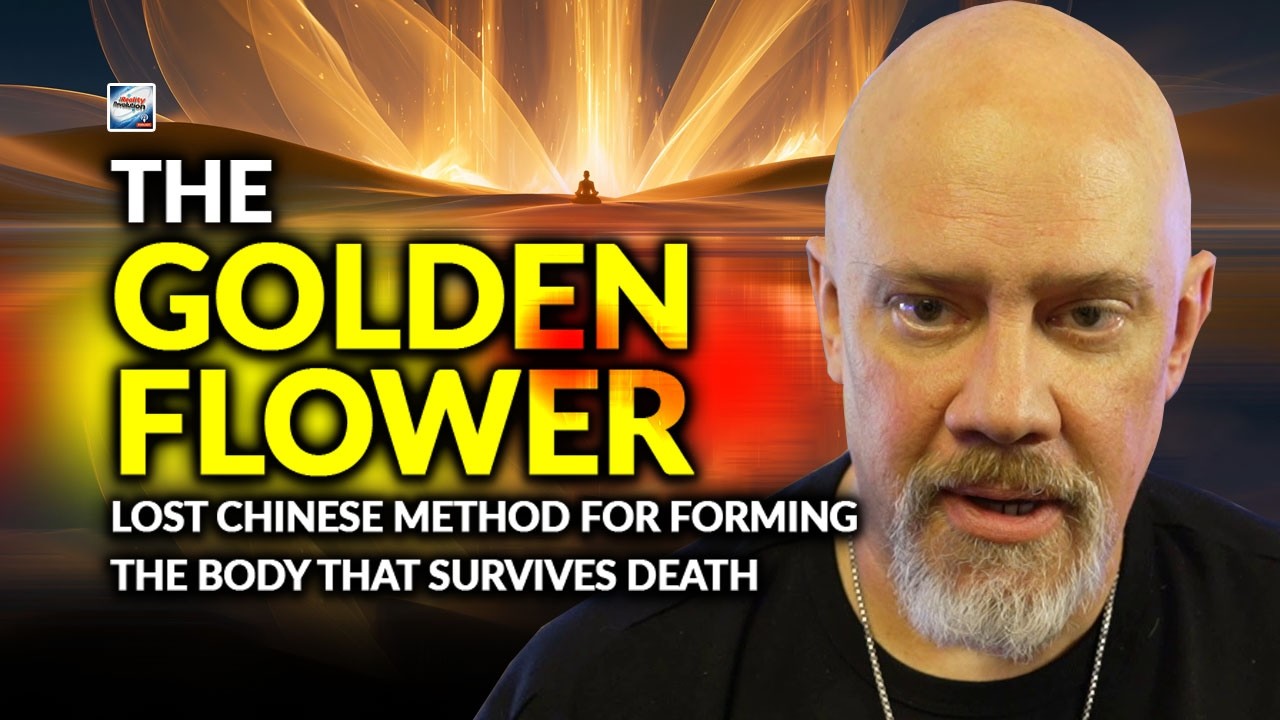
The video presents a comprehensive narrative about the Chinese inner‑alchemy tradition known as The Secret of the Golden Flower (Taiyi Jinwa Zhongji). It describes the phenomenology of the “golden flower” – a luminous inner vision that signals the formation of a second, immortal body (the holy embryo) capable of surviving physical death. The talk traces the text’s lineage from the Tang‑era immortal Lu Dongbin, through centuries of secret transmission, to its 17th‑century codification, its translation by German missionary Richard Wilhelm, and its impact on Swiss psychiatrist Carl Jung, who recognized the text as a validation of his own private visions and later incorporated its concepts into analytical psychology. The speaker outlines the six core operations of the alchemical system – reversal, turning of the light, circulation (micro‑cosmic orbit), gathering at the cauldron, formation of the holy embryo, and birth – and links them to anatomical sites such as the “heavenly heart” (pineal gland). The narrative continues with the modern dissemination of the practice by teachers like Mantak Chia, the challenges of contemporary patience, and recent scientific interest in the neural correlates of such practices. The video concludes with a promotional invitation to join the “Reality Revolution” community and attend an in‑person event in Austin, positioning the ancient method as accessible to anyone willing to undertake sustained daily practice.
Chapters
He saw himself approaching what he described as a temple suspended in the dark, surrounded by a glow he had no Western vocabulary to describe. The form he saw himself approaching, he wrote, was a flower. He described it explicitly using the Chinese term he had learned from Wilhelm's translation. The form was the golden flower. He was, in his report, on the verge of entering the form when his physician, working to revive him, called him back to the physical embodiment. Welcome to the Reality Revolution. Today we are going to do a deep dive on the Golden Flower, the lost Chinese method for forming the body that survives death. In the predawn dark of a small wooden room high in the Wudang Mountains, Of central China. An old man sits cross-legged on a thin cushion, his eyes closed, his breathing slow. The room is bare. A single oil lamp burns low on the table beside him. The mountain wind moves against the wooden shutters. No other sound enters the room from the villages below. He has been sitting in this position in this room At this hour, every morning, for 55 years. What is forming behind his closed eyes is something he has been training towards since he was 19 years old. He is now 74. The shape sits in a region of awareness ordinary perception fails to reach. It opens slowly into focus, the way a developing photograph resolves under chemical wash. The shape has petals. The petals are luminous. At the center of the shape, an intensity of light the old man recognizes from his master's descriptions but is encountering in his own awareness for the first time after a lifetime of training. The flower is the golden flower. Within the lineage the old man belongs to, the golden flower carries a specific meaning. The flower is the visible sign That the inner alchemical practice has crossed the threshold inside the practitioner's body. In the region the Chinese tradition calls cauldron, a second body has begun to form. The second body bears multiple names across the centuries of the literature. Some texts call it the holy embryo, others call it the diamond body, others use the term immortal body or pure yang body. Or simply the body of light. What every text agrees on is the function of the second body. The second body, once formed to sufficient density, maintains its coherence independently of the physical body. When the physical body dies, the second body persists. The practitioner who has succeeded in forming the holy embryo through the disciplined practice of inner alchemy survives in the tradition's framing. The death that ends ordinary human existence. He carries his individuated consciousness into the realms the tradition calls the immortal plane, retaining the capacities and memories of his current life while shedding the physical vehicle that has carried him through it. This is what the Chinese alchemical tradition claims to do. This is what the old man in the wooden room has been training 55 years to achieve. The golden flower appearing this morning behind his closed eyes for the first time is confirmation that the work has succeeded. The threshold has been crossed. The holy embryo has begun to form. What follows for the remainder of his life will be the careful nurturing of the second body, the slow increase of its density, the preparation for the moment of physical death when the flower will open fully and the practitioner will pass through it into the form of consciousness the tradition has been promising him since his initiation at 19. The practice that produced this morning's flower is documented in detail in a Chinese alchemical text composed in the early 17th century, attributed traditionally to a Taoist immortal of the Tang Dynasty named Lu Dongbin, transmitted privately for 300 years within small mountain lineages, eventually compiled and printed in a slim volume that bears the title in classical Chinese, Taiyi Jinwa Zhongji. The English title is The Secret of the Golden Flower. The text describes with technical precision the inner operations a practitioner must perform to produce the phenomenon the old man in the wooden room is experiencing. The text identifies the specific energy channels that must be opened The breathing patterns that must be sustained, the redirection of consciousness from outward to inward focus, the formation of what the text calls the light, the circulation of the light along specific pathways, the gathering of the light at the cauldron, the moment the light begins to organize itself into the form of the flower, and the eventual maturation of the second body within the petals. The text remained for 3 centuries Almost entirely unknown outside the small Taoist lineages that preserved it. Then in the late '20s, the text reached Europe. A Swiss psychiatrist named Carl Gustav Jung, then in his early 50s, then the founder of the school of analytical psychology that bore his name, then in the final years of a 15-year private crisis he had referred to in his journals as the confrontation with the unconscious, received a German translation of the Chinese text in Zurich in the autumn of 1928. He read the manuscript through the night. He read it again the following day. He understood by the second reading that the text in his hands described in 17th-century Chinese language the precise process he had been independently undergoing, alone and in fear, of his own sanity for the entire 15 years of his crisis. What the Chinese had codified, Jung had been spontaneously experiencing. What the Chinese had been calmly teaching for 3 centuries, Jung had feared was the beginning of his own descent into psychosis. Jung sat down and wrote a long commentary on the text. The commentary was published alongside Wilhelm's translation in Germany in 1929. The book entered the small circle of European intellectuals who would, across the following decades, build the entire field of depth psychology, transpersonal psychology, and the modern Western understanding of consciousness on the foundation the Chinese had laid centuries earlier and Jung had independently rediscovered. This is the story of the book that confirmed Carl Jung's madness was authentic transmission. The 17th century Chinese alchemical system the book transmits, and the technique the Chinese tradition has been quietly producing the golden flower inside human nervous systems with for over 2,000 years. Begin in Zurich in the autumn of 1913. Carl Jung is 38 years old. He has until this autumn occupied one of the most enviable positions in European psychiatric medicine. As the chosen successor of Sigmund Freud, the heir apparent to the entire psychoanalytic movement, he has spent the past 7 years building his career on the foundation Freud established. He has been the editor of the major psychoanalytic journal. He has been the president of the International Psychoanalytic Association. His name has been linked to Freud's in the European press as the natural continuation of the new science of the mind. In the spring of this year, Jung published a book breaking with Freud's framework. The break was sharp. Freud read the book, considered it a betrayal, and severed personal relations with his former protégé. The psychoanalytic establishment, taking Freud's side, has begun to withdraw its support from Jung's career. Jung is now alone. He is 48 years from the publication of his collected works. He is over 50 years from the major shift in Western consciousness that his ideas will eventually catalyze. At the moment, in the autumn of 1913, he is a Swiss psychiatrist whose career has just collapsed, whose intellectual community has just ostracized him, and who is sitting in his consulting room in Küsnacht facing the immediate prospect of professional irrelevance. Something then happens. Jung has been pondering across recent months the question of what the unconscious actually is. Freud had treated the unconscious as a repository of repressed personal memory, primarily sexual and developmental in nature. Jung has come to suspect that the unconscious extends much farther than Freud allowed. Beneath the personal layer, Jung suspects, lies a deeper layer that operates by different rules, that is shared across all humans regardless of biography, and that produces material the personal unconscious would have no capacity to generate. Sitting at his desk one October afternoon, Jung decides to deliberately invite this deeper unconscious to communicate with him. He closes his eyes. He releases his ordinary directed thought. He waits. Images begin to arise. The images carry an intensity Jung has never previously encountered in his own mental life. He sees himself descending through layers of consciousness, dropping into regions of awareness he had failed to suspect existed. Figures appeared to him, addressing him by name, conducting conversations of theological and philosophical depth. The figures introduced themselves. One is an old man named Philemon with the wings of a kingfisher. Another is a woman named Salome. Another is a serpent. Figures behave with autonomy. Jung lacks the capacity to direct what they say. Jung lacks the capacity to dismiss them at will. They arrive, deliver their material, and depart on their own schedule. Across the following 15 years, the visions continue. Jung records them carefully in a series of leather-bound volumes that will eventually be published almost a century later under the title Liber Novus, The New Book, also called The Red Book. The recordings include detailed instructions Jung produces by hand, He paints elaborate circular images of extraordinary complexity with petals, geometric patterns, and figures arranged around a central point. He has, before this period in his life, no training in formal painting. The images emerge from his hand as if drawn by another agency working through him. He produces hundreds of them across the 15 years of the experience. He has no idea at the time what the circular paintings are. He has no idea what is happening to him. He spends much of his period in genuine terror that he is losing his mind permanently. He builds at the village of Bollingen on Lake Zurich a stone tower where he can carry out the work in solitude. He carves stone reliefs with his own hands. He paints the walls. He writes the conversations with Philemon and Salome and the others in his ornate calligraphic script. across the pages of the Red Book. His wife Emma Jung sustains the household and the practice of analytical psychology during these years. His patients continue to consult him. The work continues. The visions continue. Jung suspects by the early '20s that he is experiencing the manifestation of the deeper layer of unconscious he had been theorizing about in 1913. The figures, the conversations, the circular paintings. The descent through layers of awareness— all of it seems to be directed experientially, direct experiential encounters with what he is by then calling the collective unconscious. He has yet to find any external confirmation that anyone else has ever undergone the same process. He continues to fear that he is mistaken, that he is hallucinating, that the framework he is building is a private construction with no objective referent in the world beyond his own nervous system. For 15 years, Jung undergoes this alone. Then, in the autumn of 1928, a manuscript arrives from a colleague in Frankfurt. The colleague is Richard Wilhelm. Born in Stuttgart in 1873, Wilhelm has spent the past 2 decades in China as a Lutheran missionary who, across the course of his stay, was gradually converted by the culture he had been sent to convert. He arrived in Qingdao in 1899 intending to bring Christianity to the Chinese. He stayed for more than 20 years and brought instead Chinese mysticism back to Europe. During his years in Qingdao, Wilhelm came under the instruction of a Chinese scholar named Lao Najuan, an aging Confucian who had served as a high official under the Qing Dynasty before the dynasty's collapse in 1912. Lao taught the German missionary classical Chinese language, the Confucian canon, and gradually, after years of careful evaluation, the deeper esoteric literature most Chinese teachers refused to transmit to Westerners. Lao initiated Wilhelm into a small Taoist circle operating in Beijing in the early '20s. The circle had inherited through generations of private transmission copies of texts that had circulated only within inner lineages of the Chinese alchemical traditions. The text now known in English as The Secret of the Golden Flower was one of these. Lau decided after extensive deliberation that Wilhelm was the appropriate vehicle for bringing the text westward. Wilhelm spent several years translating the Chinese into German. The work was difficult. The 17th century classical Chinese carries technical terms with no direct German equivalents. Many of the terms refer to inner psychological, physiological structures and energetic operations that the Western medical tradition lacks the vocabulary to describe. Wilhelm spent months on individual passages working back and forth with Lao, attempting to render in German the precise meaning the Chinese was conveying. By 1928, the German translation was complete. Wilhelm wrote to Jung, whom he had met several years earlier at a conference, and asked him to write a psychological commentary on the text. Wilhelm believed Jung's framework of the unconscious, with its emphasis on archetypal material arising from a deep stratum below personal biography, would be the appropriate Western correlate for what the Chinese tradition was describing in its own vocabulary. The manuscript reached Jung in Zurich in October of 1928. He opened the package. He sat and read. Within the first chapter, Jung recognized what he was holding. The text described in 17th-century language the precise process he had been independently undergoing for the past 15 years: the descent through layers of unconscious, the encounter with autonomous figures from the deeper psyche, the emergence of circular images carrying a specific structure and meaning. The gradual differentiation of the practitioner's awareness from the surface mind toward a deeper center the Chinese called the original spirit. The text laid out as a systematic technical method what Jung had been experiencing as a terrifying private revelation. Most decisively, the text described the circular images. The text identified the circular form with petals arranged around a central luminous point as the natural symbol that emerges in the consciousness of any practitioner who has begun to differentiate his awareness from its ordinary scattered state. The Chinese called this form the Golden Flower. The form arises spontaneously. It carries a specific meaning within the alchemical tradition. It indicates that the practice has begun to produce its intended result. Jung had been painting this form for 15 years. been producing it without knowing what it was. He had been afraid across the entire 15 years that the images were evidence of his own psychological disintegration. He had no framework within which to interpret them. The Western psychiatric tradition of his era considered such autonomous imagery a sign of pathology. Jung had suspected, against the consensus of his profession, that the images were carrying something legitimate. But he had failed to find any external confirmation of his suspicion. The Chinese text confirmed everything. The circular images were the golden flower. The golden flower was the natural manifestation of the name and a tradition and a 300-year-old technical literature describing exactly what he had been independently rediscovering. Jung wrote in his commentary, completed across the following months, that the encounter with the Wilhelm translation had been one of the most important intellectual experiences of his life. He acknowledged Wilhelm publicly as the bringer of the confirmation he had been seeking for 15 years. The book containing the translation and his commentary was published in Germany in 1929. What the text actually transmits is a specific operational method. The Chinese language of the 17th century carries a precision that the English translations have often softened. The actual instructions, when read in their original technical form, describe a sequence of inner operations the practitioner is meant to perform in specific order across the years of his training. The first operation is the gathering of attention. The text states that the ordinary human consciousness operates in a scattered condition. Attention runs outward through the senses, dispersing across the objects of perception. The contents of thought, the demands of the body, the activities of the external world. The practitioner who wishes to begin the inner alchemical work must first reverse this outward dispersion. He must learn to gather his scattered attention into a single focused beam, sustained at will, capable of being directed by deliberate intention. The text calls this the reversal. The reversal is the foundational operation of the entire system. Without the gathered attention, no subsequent operation will function. With the gathered attention, the practitioner becomes capable of the operations that follow. The second operation is the turning of the light. Having gathered his attention into a focused beam, the practitioner now turns the beam inward upon itself. The attention ordinarily directed at objects of perception is redirected back toward the source from which the attention itself arises. The text describes this with a striking phrase: the light of consciousness ordinarily flowing outward is made to flow backward toward its own origin. The Chinese expression is hui guang, the turning back of the light, sometimes translated as the backward flowing method. What occurs when the light is turned in this manner is the central phenomenon the text seeks to produce. Ordinary outward-directed attention illuminates the contents of perception. Inward-turned attention illuminates the source of perception itself. The practitioner who succeeds in sustaining the inward turn for sufficient duration begins to perceive behind the contents of his ordinary mind the deeper substratum from which the contents arise. The Chinese tradition calls this substratum the original spirit, the wan-shen. It is distinguished from the surface consciousness, the shi-shen, which manages the practitioner's daily activities but operates only within a narrow band of the wider awareness the inner work eventually reveals. Across years of sustained practice, the original spirit becomes increasingly available to direct perception. The 3rd operation is the circulation. Having turned the light inward and perceived the original spirit, the practitioner now begins to circulate the gathered light along specific pathways within the body. The pathways correspond to the major channels Chinese medicine had been mapping for 2 millennia. The text emphasizes the microcosmic orbit, a circuit running up the spine From the perineum to the crown and back down the front of the body to the perineum again. The light circulates along this circuit, gathering density with each rotation, building the inner pressure the next operations will require. The 4th operation is the gathering at the cauldron. After repeated circulation, the practitioner draws the accumulated light into the lower abdomen, into the region the tradition calls the cauldron. Located approximately 3 inches below the navel. The cauldron is the alchemical vessel within which the actual transmission occurs. The light gathered in a sufficient density begins to organize itself into a concentrated form the tradition calls the pearl. The 5th operation is the formation of the holy embryo. Within the cauldron, the pearl begins to undergo a process the text describes through extensive alchemical imagery. The yang energy and the yin energy separated in ordinary embodied existence merge inside the cauldron under the heat of the circulated light. From this merging arises what the tradition calls the holy embryo, the second body, the immortal form that will eventually develop into the diamond body. The holy embryo requires years of careful gestation The practitioner must continue his daily practice, must continue the circulation of light, must continue the gathering at the cauldron, must maintain the inner heat through which the embryo matures. The tradition compares the process to the gestation of a child in the womb, requiring the same patience, the same consistency, the same daily attention across an extended duration of time. The 6th And final operation is the birth. When the holy embryo has reached sufficient density and coherence, the practitioner performs the final operation of the system. He projects the matured second body outward through the crown of the head, the point the tradition calls the Heavenly Gate. The second body emerges into the space above the physical body, capable now of independent operation. The practitioner, while remaining attached to his physical form, has now formed the vehicle that will carry his individuated consciousness beyond physical death. The golden flower appearing in the practitioner's awareness during the maturation process is the signal the consciousness gives that the work has reached this threshold, and it has been witnessed by multiple different people. Several details of the system deserve a specific elaboration. The Chinese text identifies a particular location within the head where the light is meant to gather during the inward turn. The location lies between the eyes, slightly behind the surface of the forehead, in the region the tradition calls the heavenly heart. The heavenly heart corresponds in modern anatomical terms approximately to the pineal gland, the small endocrine structure deep within the brain that the Western mystical tradition has independently associated with subtle perception across the past 2 millennia. The Chinese were precise about the location centuries before Western anatomy had even identified the pineal as a discrete organ. The text instructs the practitioner to direct the gathered light specifically toward this point during the inward turn. The instruction is technical rather than Poetic. The light has a place. The place can be felt with sufficient training as a specific region of sensation within the skull. The light gathered at this location begins to operate on the surrounding tissue in a manner the text describes as the awakening of the original spirit. Across the duration of sustained practice, the heavenly heart becomes increasingly luminous. The practitioner begins to perceive a steady glow at the location, present even when the eyes are closed and no external light source illuminates the room. The glow gradually intensifies. The glow eventually organizes itself into the form of the flower that the tradition has named the work after. This is the Golden Flower. In its phenomenological description, the form arises in the heavenly heart. The petals open outward from the central point. The light intensifies. The practitioner perceives the form as clearly as he would perceive an external object, despite the form existing in a region of perception ordinary vision lacks the capacity to access. Once the form has stabilized, the second body, the Holy Embryo, has been born within the practitioner. The remaining decades of practice mature What the formation has begun. The flower deepens, expands, becomes increasingly bright. The body it represents becomes increasingly dense and increasingly capable of operating independently. When the moment of physical death arrives, the second body separates cleanly from the failing physical vehicle and carries the practitioner's individuated consciousness forward into the realms the tradition has been describing for the duration of his training. The text Wilhelm translated and Jung commented upon belongs to a much wider Chinese tradition. The body of literature is called Neidan, meaning inner alchemy or internal alchemy. The tradition extends back at least 2,000 years in continuous documented form. The foundational text, the Kang Tong Qi, or Qi, dates from the 2nd century of the Common Era. Attributed to the Han Dynasty alchemist Wei Boyang. The text systematized practices that had been circulating in oral and fragmentary form since at least the Warring States period of the 5th century before the Common Era. Across 2 millennia, the Neidan tradition produced an extensive technical literature. The texts describe in increasing detail the operations required to form the immortal body. Their literature names hundreds of specific energy channels, dozens of inner organs and glands the body's external anatomy fails to disclose, multiple cauldrons at different levels of the body, the relationships between the planets and the operations of the inner alchemy, the connections to the broader Taoist cosmology, the timing of the practices in relation to solar and lunar cycles, the dietary requirements, the breathing methods, the postures, the visualizations. The literature is vast and fascinating. The literature was guarded. Most of the texts circulated only within a small initiated lineage. The practitioners who carried the lineages forward across the centuries were typically mountain hermits, members of small Taoist monasteries, or itinerant teachers who would accept a small number of disciples and transmit the methods directly. Public versions of the practices were always partial, simplified for general consumption, withholding the operational details that produced the actual results. The Golden Flower Text Wilhelm translated was one of the more accessible texts of the tradition. The full operational manual remained, and largely remains, the property of the inner lineages. In the 20th century, several teachers chose to release more of the material to the general public. Montauk Chia, a Thai-born Chinese teacher who studied with several of the surviving lineage holders in the '60s and '70s, began publishing detailed manuals of the inner alchemical practices in the late '80s and '90s. His Universal Tao system codifies in written form, available to any reader, the operations the Chinese tradition had previously transmitted only through direct master-disciple lineage. Chia's books document the fusion of the 5 elements, The microcosmic orbit, the 8 psychic channels including the 4 ordinarily hidden extraordinary channels, the formation of the pearl, the projection of the energy body, and the preparatory practices for what Chia calls the practice of the immortal Tao. Chia released this material against considerable resistance from the inner lineages. His position has been that the era requires the wide availability of the practices. The previous policy of closed transmission, appropriate for early centuries, has become unsuited to the conditions of the contemporary world. The collapse of the traditional cultures that protected the lineages has placed the entire body of teaching at risk of disappearance. Chia chose to print what others would have kept private, accepting the cost of the decision in exchange for the wider survival of the methods. The full library of accessible Needham Material now extends to dozens of volumes in English translation, with Chia's working manuals supplementing the older translations of the Kang Tong Ki, the Wu Zen Pian, and other classical texts. The practices remain in the strict sense as available now as they ever have been. What has remained difficult is the patience required for the work. 2,000 years of tradition concur that the formation of the holy embryo requires sustained daily practice across years, often decades, before the central phenomenon begins to manifest. The contemporary culture has been organized around shorter and shorter time horizons. The patience the work requires runs against the grain of nearly every habit modern existence cultivates. I believe that we've reached a point where we can reach the golden flower faster, but you got to start From the beginning. Return to Jung in Zurich in the year following his encounter with Wilhelm. He has written the commentary, the book has been published. He has, for the first time in 15 years, an external framework that confirms that he had been experiencing something beyond just insanity. The fear of madness had receded. The work he's been doing has been recognized. Jung will spend the remaining 32 years of his life building on this foundation the body of work that becomes analytical psychology. He will develop the concept of the self, distinguishing it from the ego, identifying it as the deeper center of the psyche that Chinese tradition called the original spirit. He will articulate the concept of individuation, naming the process by which the practitioner's center of identity shifts from the surface ego to the deeper self, describing in Western psychological vocabulary what the Chinese had been describing in alchemical vocabulary for centuries. He will document the universal recurrence of the mandala symbol across cultures, recognizing it as the natural visual expression of the inner work the Chinese had isolated as the golden flower. His students will carry the framework forward. Marie-Louise von Franz, his closest disciple, will continue the integration of alchemical material into depth psychology across her own long career. Eric Newman will trace the evolutionary development of consciousness in his major work on the history of psychic structure. James Hillman will extend the framework into archetypal psychology. The transpersonal psychology movement of the '60s with Stanislav Grof and Abraham Maslow and the early consciousness researchers will build on the foundation that Jung had laid. The wider cultural impact is harder to measure but more pervasive. Aldous Huxley draws on the Golden Flower material in The Perennial Philosophy. Joseph Campbell incorporates it into his comparative mythology. Alan Watts disseminates the broader Taoist framework to the post-war American counterculture. The mandalas Jung had painted privately for 15 years become by the '70s a common element of the wider spiritual landscape. Books on Eastern meditation traditions written for Western audiences presuppose Jung's framework as the bridge that makes the Eastern material intelligible to the modern Western mind. Across the late 20th century and into the present, the integration continues. Contemporary neuroscience has begun to document the brain states associated with sustained inner practice. The default mode network, the patterns of neural activity associated with self-referential thought can be measurably altered through the disciplines the Chinese tradition was describing 600 years ago. The phenomena classical mystics reported, dismissed for most of the 20th century as superstition or pathology, has been gradually returning to the legitimate study as the instruments capable of measuring them have been improved. What Jung suspected, what Wilhelm translation confirmed, has been progressively vindicated across the centuries since the original encounter. The inner work codified the process— repeatable, documented effects on the consciousness of the practitioner who undertakes it. The golden flower is the symbol the tradition chose to represent these effects. The further detail belongs in this account. Richard Wilhelm, the German sinologist who brought the text to Europe, died in May of 1930, only months after the publication of the German edition. He was 56 years old. The cause was a complicated illness contracted during his final years in China. Jung, attending the funeral, wrote afterward that Wilhelm had been so deeply penetrated by the Chinese tradition he had transmitted that the transmission itself had carried a cost his body had been unable to sustain. Jung used the term to refer to Wilhelm as a vessel that had been emptied through the transfer. The image was Jung's, but the underlying claim that The idea that the carrier of a deep transmission may pay a physical price for the transmission has surfaced repeatedly in the literature of wider mystical traditions across multiple cultures. Jung himself experienced confirmation of the Golden Flower material in a more direct form 14 years after writing the commentary. In February of 1944, at 68, Jung suffered a heart attack of significant severity. During the period of clinical near-death that followed, he reported a series of experiences He documented carefully after his recovery and published in his autobiography Memories, Dreams, Reflections decades later. He described leaving his physical body, perceiving himself from above the hospital bed, then ascending into a region of space where the Earth appeared below him as a luminous sphere. He saw himself approaching what he described as a temple suspended in the dark, surrounded by a glow he had no Western vocabulary to describe. The form he saw himself approaching, he wrote, was a flower. He described it explicitly using the Chinese term he had learned from Wilhelm's translation. The form was the golden flower. He was, in his report, on the verge of entering the form when his physician, working to revive him, called him back to the physical embodiment. He returned reluctantly. He resumed his life. He continued writing for another 17 years completing the major late works that constituted the core of his published legacy. But he wrote in the documentation of the experience that he had perceived during the near-death state precisely the phenomenon the Chinese text had been describing in its own 300-year-old vocabulary when the text first reached him in 1928. The framework had been confirmed once through textual encounter in 1928 and was again confirmed through direct experiential encounter in 1944. Jung lived another 17 years following the second confirmation. He died in June of 1961 at the age of 85 at his home in Küsnacht. His final words have been recorded by his attending physician as a comment on the beauty of the day within the framework he had spent the second half of his career articulating The form he had perceived during the 1944 near-death experience would, in the moments after his physical death, have opened to receive him. Return finally to the wooden room in Wudang Mountains. The old man sits on his cushion in the predawn dark. The golden flower is formed behind his closed eyes. 55 years of training have produced their result. Across the coming years of his remaining physical life, the holy embryo will continue to mature The second body will continue to develop its independent coherence, and when the time arrives for the physical body to release its hold on consciousness, the transition will occur according to the architecture his lineage has been describing for 2,000 years. What the old man has done is available to any practitioner willing to undertake the work. It's documented? It's in print? The lineage holders who survived the cultural disruption of the 20th century have in many cases opened their teachings to Western students. The barriers to access that protected the tradition for centuries have largely fallen. The material that Lao Najuan transmitted to Wilhelm in the '20s, that Wilhelm transmitted to Jung, that Jung transmitted to the broader Western intellectual world, has been continued by teachers such as Mantak Chia and others working in his lineage and in adjacent lineages of the broader Nadon tradition. The question is whether contemporary readers will undertake the practice. The work demands what most contemporary life refuses to grant: daily sustained attention, years of patience, willingness to operate without measurable results across long stretches of time, trust in a tradition whose claims exceed what modern materialism considers possible. Confidence in one's own inner experience as a legitimate source of knowledge against the implicit dismissal the surrounding culture maintains toward all such experience. Carl Jung found himself capable of the work because the work had begun without his consent. The visions had come, the mandalas had emerged, the deep stratum of consciousness had opened beneath him And he had spent 15 years descending into it without any framework to organize what he was discovering. The Chinese text reached him at the moment when his own private experience had carried him to the threshold the text describes as the entry point of the inner alchemical work. Your own opening into the same material may arrive through a less dramatic mechanism. The deep work in the framing Jung and Chinese tradition both confirmed is available to anyone Who will sit down and begin it. The reversal can be practiced this morning. The turning of the light requires only sustained attention. The circulation builds across weeks and months. The gathering at the cauldron continues across years. The holy embryo forms in those who continue the practice long enough to allow the formation. The golden flower appears eventually in the awareness of the practitioner who has crossed the threshold. The threshold the old man in the wooden room crossed this morning after 55 years of training. The phenomenon arrives on its own schedule. The practitioner who has done the work consistently across sufficient time will at some point perceive the form behind his closed eyes. The methods remain operational. What Jung wrote in his commentary in 1929 after 15 years of fearing his own private experience was the beginning of madness was simple in its final claim. The inner work the Chinese had been doing for 2,000 years was the same inner work he had been undergoing alone in his tower at Bollingen. The Chinese had a name for it. The Chinese had a literature for it. The Chinese had been quietly producing the golden flower inside the consciousness of trained practitioners for over 600 years. before he had been born. The work continues, the flower continues to form, and the door the old man in the wooden room walked through this morning after 55 years of training remains open to whoever will undertake the discipline through which the door becomes accessible. Now, before I go, I want to invite you to join the Reality Revolution community. You can find the link in the description. We have weekly group coaching sessions and content that you cannot find anywhere else with workbooks and training manuals designed around my content so we can take it to the next step. So if you're interested, click the link and join me in my community. You can find all episodes of The Reality Revolution at therealityrevolution.com. I would love it if you checked out my art. You can find it at www.newearth.art. And welcome to the Reality Revolution. Hey, welcome to the Reality Revolution. I'm Brian Scott. You know, over the last year, I have had the honor of hosting some amazing live in-person events, something I never thought that I would do. And I have grown and changed so much in these experiences. The opportunity to meet so many of you, to shake your hand, to hug you, to hear your stories, To watch the way that you grow, to see your changes, to get to know you. So many of you have followed my channel. It's been such an exciting experience. So when we were thinking about our next event, we decided we wanted to do something a little different. So many of you have found me through my teachings on money, on large sums of money, on the affirmations that I use. And so we brainstormed and came together with an amazing event. Over three days, we've planned out some of the most incredible. incredible meditative techniques, exercises, and teachings that I have ever done. 9 immersive meditations, all designed to shift you into the reality where large sums of money come to you easily and quickly. There is nothing I want more than for you to experience absolute prosperity. I want you to live a life where you are free to do what you want when you want. I want you to be able to choose when you wake up, when you go to sleep, I want you to lead a business that empowers you, that fulfills you. I want you to live a life where you choose where you live. You live in your dream home. You travel the world. I want all of this for you, and it's available to you. I believe when we come together at these events, magic happens. And so I want to have the opportunity to become a catalyst for you to join me for 3 days so that we can manifest the most incredible life for you, one that makes you incredibly prosperous, where you tune into infinite streams of money. You walk through storms of money all around you. You experience it in every way, shape, and form. Large sums of money are coming to you. Join me in Austin on September 18th through the 20th at the Hyatt Regency. You can find the link in the description at www.brianscottlive.com/austin- 2026.
More from Brian

The Man Who Mapped The Other Side-The Story Of Robert Monroe, Hemi Sync And The What He Found There


The Woman Who Spoke Her Life Into Existence - Florence Scovel Shinn And The Power Of The Word



4 Hour Deep Sleep Meditation - The Operators Reprogram Your Reality While You Sleep


