Stacey Kass, editor-in-chief of Equal Access Public Media, had a traumatic brain injury in 2017 that made her realize news sites were inaccessible. The average news page has 58 accessibility errors. She explains what actually works: alt text, captions, plain language, and hiring disabled journalists.
Chapters
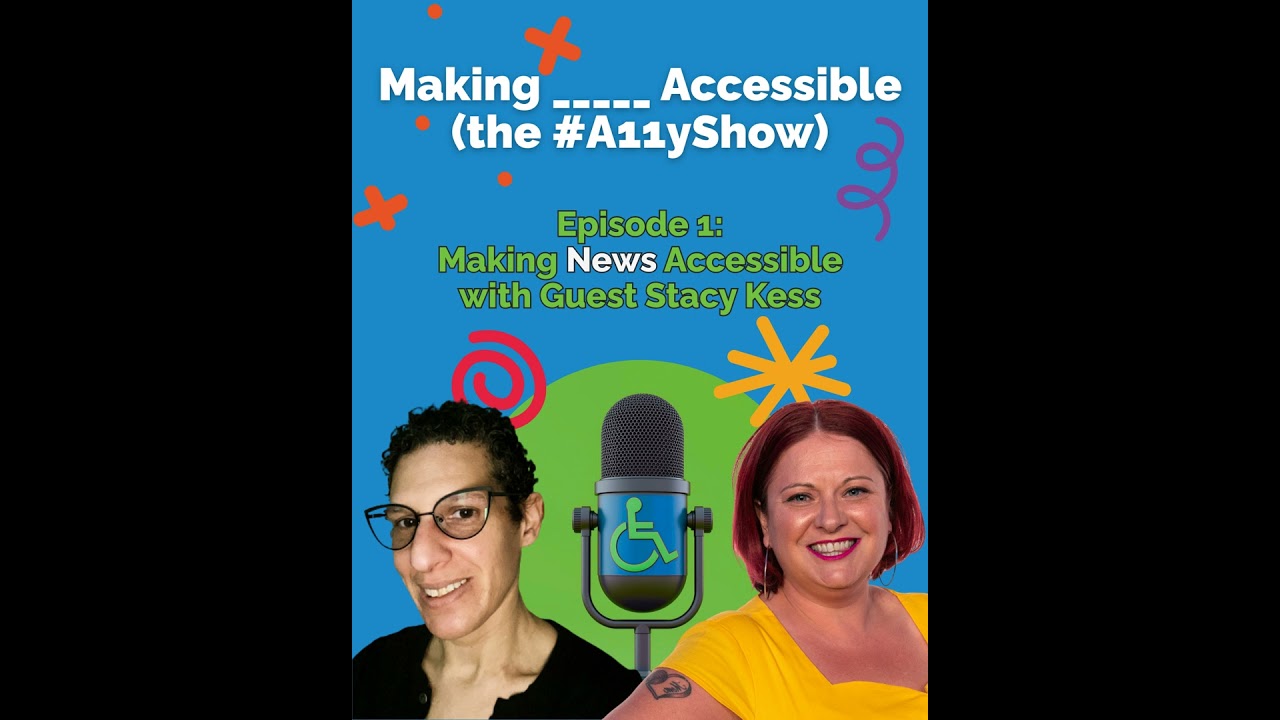
Episode 1: Stacy Kess, Making News Accessible.
Welcome to Making Blank Accessible. Today we are making sure everyone is informed, equipped, and included by making news accessible. Our guest is tackling the core mission of public media with an accessibility-first approach. Joining me today is Stacey Kass, editor-in-chief of Equal Access Public Media. Stacey is a pioneer ensuring that critical news and public information is designed from the start to reach everyone regardless of their ability or platform. Stacey, welcome to The Accessibility Show.
Thank you.
Stacey, let's jump in with a question about how you got started in the world of accessible journalism, what was that moment or experience that first made you realize accessibility really needed to be the core focus of your work?
Well, I would say it was a car crash in 2017. That's sort of my superhero origin story. I had been a journalist for years prior to— oh, this is Bodhi, everyone. Britne Jenke: I had been a journalist for years prior to this car crash, and I was hit head-on in late August 2017. That left me with a severe traumatic brain injury, some other physical injuries, and I spent 2 years going through physical therapy, occupational therapy, and speech therapy. One of the toughest things for me was aphasia. I had trouble word finding. I had trouble taking in information. I couldn't read due to some eye injury, injury to the muscles in my eyes. And I had trouble concentrating from the brain injury. So it was a lot going on and I spent a lot of time in recovery from that crash. Um, when I sort of came out of recovery, um, I realized that during those, that time in recovery, I wasn't able to access news the way I previously had. And I certainly couldn't write or edit the way I had. Now, prior to the crash, I had spent years hiding chronic illness from myself, but also from my editors, which meant that, um, I worked through illness. I worked through, uh, a lot of strain on my body. I worked to the point where I ignored symptoms. When I finished recovering, or I should say, as, as recovery brought me back to a new normal in 2019, my previous symptoms were much more pronounced. And I became pretty much a much, I would say about a, what they call an ambulatory wheelchair user where most of the time I used a wheelchair to get around though I could stand up for short periods of time and I could transfer myself and walk short distances. My heart had significant problems. My muscles had, were still strong, but my joints had very significant problems. So there were no answers and we started pursuing answers with the help of my primary care physician at the time. I became a medical mystery because I had recovered from this crash in very significant ways that were very surprising to the medical team, but I couldn't yet go back to work. And so I'm still unable to go back to the field I love. And so again, the field is inaccessible to me. And so during recovery, the news, which I'm a news junkie by, you know, by job, by just who I am, was inaccessible to me. And now after recovery, the field is inaccessible to me. And that brought us right into the pandemic. In fact, Prior to the pandemic, I was in the hospital just before the pandemic hit. I was hospitalized for 2 weeks while they were still working on this mystery illness. So I had the first 2 years of the pandemic while most doctors were, um, I was seeing these specialists who were like, I don't have any patients. What's going on? Hey, you wanna come see me? So I'm seeing genetics and I'm seeing, you know, all these really rare specialists, but I became, you know, I actually got my diagnoses and so on and so forth. '22 comes around and I'm ready to rejoin the field and I start applying for managing editor jobs. And I'm told point blank to my face, you know, it's not your disability that worries us, the time you had off for your disability. And I said, wow, why don't you just say it? You know, it's, So that's my villain origin story or my superhero origin story, however you wanna put it. And I thought, I can't even remember exactly the moment because I was still in physical therapy at this point 'cause my joints had gotten so bad that, and my heart had so many issues. I was doing physical therapy, I was in water physical therapy, and I can remember being in the pool and my physical therapist, Greg, was there and he— and I'm telling him this idea I had. I'm like, okay, an organization and we support making the field of journalism more accessible and we make the news more accessible. And one of our projects is, is that we make a national newspaper or national news outlet that's so accessible and it makes news accessible in more ways. And he's like, Are you gonna do it? Yeah, I should do it. So yeah, I mean, literally the moment Equal Access Public Media was born was during physical therapy on a January morning in warm water physical therapy.
All right. The, the birth of Equal Access Public Media, literally from—
Yeah, that's a long story.
That— no, it's a great story. It's a great origin story. And thank you for sharing your personal journey and how much the accessibility matters to you personally, because I'm sure other people listening have similar experiences where they have been faced with news or information that is inaccessible in some way, and they're struggling to be informed or to get access. And your work, your ideas are making that possible for so many people. When you look at, let's say, just a typical breaking news story today, what is maybe the single most overlooked inaccessible barrier that people outside of journalism may not realize?
Sorry about that.
That's okay.
Well, I actually have statistics, um, to—
She brings data.
I always bring data. Sorry, I'm a data journalist by nature. It's how I started. I started as a healthcare journalist and then quickly moved into editing. So healthcare journalists also tend to have a a data background, usually started in science, or we have a science degree, which means we bring the data. Um, when you look at a news site, and most people are getting their news on the internet, in fact, slightly over 50% of people get their news at least some of the time from social media. Um, that is 2025 Pew, uh, research, which has remained steady over the last couple of years, but at least some of the time most people, most U.S. adults are getting their news from social media. But when you go to a news website, there is an average of 58 accessibility errors on a news website page. 58 accessibility errors. Those errors tend to be missing alt text, color contrast problems, and then my personal pet peeve is language. Okay, so we tend to not use plain language. And I wanna break down plain language for people.
Yeah, please.
We tend to use, even when we think we're using plain language, we're not using plain language. And so what is plain language? This is, this is a really hard concept for people. Plain language is not something that you can put a number to, like the Fletch Kincaid people are gonna tell you. It is not a score, even though the Fletch Kincaid people are probably gonna write me and sue me on this. Maybe, maybe not. Don't, please don't. Nobody me or whatever the saying is. And there isn't, there is an international group of plain language and they're gonna back me on this. Plain language is context. It is using language people broadly understand. Now here's the thing, more than 50% of Americans read at or below a 6th grade reading level. So when we're using language people broadly understand, we shouldn't be using those 25-cent words. And I love that saying. Those are the big dictionary definition, multisyllabic words that are just, you know, like there to show I'm smarter than you. Don't use. Most people are gonna get lost. You know, I sit here with a dictionary and a thesaurus and Actually, I have a medical— two medical dictionaries, two dictionaries, one of which is from 1956 because it's been handed down to me. Three different style guides. So, you know, so on and so on. Drug dictionaries. And, you know, again, nursing, you know, old health editor here next to me on my bookshelf. But that's not everyone. Not everyone is sitting there with Merriam-Webster open, though I love Merriam-Webster and I love their social media, they are hilarious, but not everyone is sitting with Merriam-Webster open. So you shouldn't write using words that someone has to look up. And if you do use a word that needs to be defined, you have to define it. The same thing is when you put out, um, political information that isn't something that everyone uses. You know, broadly understood terms. You shouldn't assume that your followers, your readership, your watchers, your viewers, your listeners are following an issue so closely that they know all the information. You have to give them a little context and background, right? That's plain language. Plain language is context. It's using broadly understood terms. It's, you know, It's really connecting language-wise with your readers, your viewers, your listeners, you know, the people that your audience is. And so, but we, we have, you know, our SEO programs and our, you know, you know, all our websites now come with all these, you know, and even our, um, uh, Google Doc and our Word and our whatever all come with the thing that tells us our reading score. You know, now they're all built in, and if you use one of those language checkers, it gives you a reading score, right? Those are all Fletch Kincaid and all of those things, and they're not— they're giving you a formula. That's a formulaic thing, and it takes out the nuance, okay? It takes out the nuance of what is plain language. So what I get when I tell it, when I teach people about plain language, is pushback. Plain language is quote unquote, dumbing it down. Plain language isn't dumbing it down. It's connecting with your community, your audience. So that's, so I get, I get two extremes. I get either people thinking it's easy English, which is a whole different thing. And shout out to Easy English Australia. Hello, my friends. Um, and, or I get people who want to be The Atlantic and no shade to The Atlantic. You, you're the New Yorker, you know, you guys are You know, not meant for, you know, your average reader. You guys are in your own category of like highfalutin, you know, PhD readers. So, you know, we're, we're not, we're talking about average news, breaking news. You can't be using, you know, those words. And again, the other thing is your color contrast, your alt text. And I love to say alt text is the gateway drug to accessibility. And I'd like to get everybody hooked.
Love that. Love that. So obviously accessible news is so much more than just putting captions or transcripts along with what we're producing. It is how those words come across in plain language. It's so important to be able to make those topics like, like you said, health information, political information, making those those topics accessible to the public is so very important. So maybe, maybe for those listening, walk us through the method a little bit. When you are creating a brand new news story, what is the first step that you're taking to make sure that this story is born accessible? What principles or what guidelines do you follow?
Well, we, we aren't necessarily a news outlet. We create, we have created one news outlet and our big project is to create a big news outlet, national news outlet. But we do training for journalists. We offer paid training to newsrooms and news organizations. We have a style guide out there. And what we like to say is, you know, accessibility starts with interviewing. So, you know, who are you interviewing? Are you offering interviews that are accessible? And we get pushback again from journalists and editors because, you know, when you're offering accessible interviews, you need to sometimes make accommodations for your— if your source is neurodivergent, you may need to offer sort of a range of questions or like what you might be asking in an interview ahead of time. Editors don't love that you might be sort of giving even a loose idea of what you're asking ahead of time. I'm an editor. I've been an editor for 25 years. You know what? Like, let that go. Let that go. Like, you want to be accommodating. If your source is deaf or hard of hearing, if you can't have a translator available or an interpreter available, or, you know, might that interview be easy— best done over email or some other written sort, you know? Because, you know, are you putting the onus on them to do something like lip reading, which is not okay. We don't— you know, we need to be more accommodating. And that's getting a range of, you know, different sources. We know that there are experts out there who have a range of expertise who also happen to be disabled, but we don't hear from them. Hmm. We also don't— we need to be aware that when we're interviewing people with disabilities, we need to be speaking to them, not their caregivers, their assistants, so on and so forth. So a lot of times when you hear or when you see articles about disability issues or accessibility issues, mostly disability issues, you see interviews with non-disabled people about the disability issue. One of the greatest examples was when 2 months ago, just before the government shutdown, the— 2, 3 months ago, 2 months ago, time is a little wibbly wobbly— the government cut funding for DeafBlind programs in Oregon. Wisconsin, going to leave off a state here, I'm so sorry, the New England Consortium, and one other state, and I am so sorry to that other state that I'm leaving off.
We'll grab an article and we'll—
Anyway, articles by ProPublica, by Education Week, they interviewed parents, they interviewed non-deafblind educators, they interviewed state, uh, you know, superintendents. Who didn't they interview? DeafBlind activists, DeafBlind children, DeafBlind students. Nobody. I had— so we, we run a magazine called The Word. It's about issues in journalism, style in media, and accessibility in media. I had one of our reporters go out and talk to DeafBlind activists because that was something I noticed, that media left out DeafBlind activists from the story, DeafBlind children, you know, students. And so we talked to them and we said, what does it mean when DeafBlind people are left out of the story? You know, people who are DeafBlind need to have a voice in the story. And that's the thing is they had a voice. They raised their voices verbally and sometimes actually in getting the Helen Keller Institute, which funds the National DeafBlind Group, to then offered grants where the federal government had pulled the funding, but no one talked to actual Deaf, you know, people who are DeafBlind to get their perspective. Those voices are there, are professionals, they are lawyers, they are, you know, teachers, they are parents. So why aren't we talking to them? And so this is an issue that I had our reporter cover, that they weren't covered, that they weren't sources, that they weren't talked to.
Sure.
So accessibility in news actually starts right from the source, from the sources we use. Then it goes to how we're doing our stories. Are we, you know, in articles, are we using the right words? As I said, language. When we lay it out on the page, are we, you know, using the best way to link? Are we doing our HTML correctly? Are we following rules of ARIA? Are our photos, do they have alt text? Do they have image descriptions? And we like to suggest that your image description be combined with your cutline. Do your videos have transcripts and closed captioning if possible? American Sign Language, or if you're not in America, British Sign Language, or so on and so forth. Do they have, you know, video descriptions, which I know that, you know, to get all of this in, you might need to find a better video player. We're working on building one. We're not happy with, you know, the options out there. So we're working on building a new video player that can allow us to do all the things. We just haven't found one yet. So we're working on building a new video player. So, you know, the— this is, you know, when you have audio, when your interviews or your news is by audio, do you have a transcript available of the audio? Do you maybe have a quick fact that people can, you know, just pull instead of like needing to read through the whole audio? Does your audio player allow for slowing it down, speeding it up? And, you know, the biggest thing that I need to see from people is, Is your website able to be run through by a screen reader? I use a screen reader regularly to check through websites, and I use it— I mean, I use a screen reader regularly, so I understand how it sounds, how it works, how it feels. But I think most people just do their accessibility checks using an accessibility checker. It is actually different. Those accessibility checkers do not necessarily capture or feel, and it sometimes is different than what the screen reader actually says.
Sure.
So all of this matters. And there just aren't enough of us in journalism who actually know accessibility, who actually do accessibility. There's sort of a joke that all of us could fit in my apartment in Boston, specifically my living room, for dinner. So, you know, we need more of us. For sure.
Yeah. Let's fill Stacy's full apartment and not just the living room. Yeah.
Exactly. Let's have so many of us that, you know, let's make all of journalism accessible. I would love to quit and close down tomorrow and then just go like have a regular job editing where I could just sit in my office all day and like be like worried about commas, you know? And that would be great. Like if I could do nothing but tomorrow be like the most pedantic editor and worry about commas and you know, what's going on in the news and make news choices all day and go back to being like the best managing editor in the world. I would love it. Help me close down. But until then, we need donations and we need to keep going. So yeah.
Yes. No, that would be, that would be the dream if all the news were just accessible and we didn't need an organization to specifically work on this.
Exactly.
But since we do need the organization to work on this, we have Equal Access Public Media and let's— Stacy said always taking donations towards nonprofit work. So let's talk about maybe the impact of accessibility in the news.
Mm-hmm.
How is it that we measure success when it comes to making news accessible? So what may be tangible benefits, outcomes, um, increase increased comprehension rates from that, those plain English articles? Is that something that we can measure? How is this making journalism better?
You know, we'd love to see more journalists in the newsroom who identify as disabled. We don't have a specific measure, or we don't track, I should say, in the US journalists who, we don't have an organization that does that. If we had the funding for equal access with media, I think that is something that we would love to do. You know, track that, you know, how many journalists identify as disabled, how many journalists identify as neurodivergent, how many journalists identify as so on. Military veterans in journalism estimate they're about 2%, that about 2% of journalists are veterans. We did some math using Department of Labor,, you know, their data from the, you know, Bureau of Labor Statistics, um, statistics. And we were able to, being data wonks, come up with that about 7% of journalists are likely disabled. And then using further data, extrapolate that most of those who openly, you know, who are disabled are likely either unemployed or are, unemployed, likely also, you know, maybe freelance. And that was a lot of math, a lot of statistical analysis, so on and so forth. They track in, there's an organization that tracks in the UK how many disabled journalists, and they've come up with about 15% in the UK, but we don't have that here. So we had to sort of extrapolate from some some, you know, government data, and that was last year using Bureau of Labor Statistics.
Uh, it was—
the data was about like a year, 2 years old. So we just don't know. The thing is, is that we also would like to see more journalists who are aware of accessibility, using accessibility. We would love to see that number. The number I gave earlier about this the accessibility errors, that's from WebAIM, news websites ranks among the worst. And it's been consistent. Like it improved from last year. They do the, the Web 1 Million every year. Journalism is like news sites are always at the bottom. We need to start being at the top, but there's not enough of us working journalists or people working in journalism who are also accessibility people. People who are often leave because journalism says, "Well, we don't have the funding. We don't do that." But so much of it is free. You don't have to pay anything to do Alt-Pac. We have a budget of used duct tape and chewed up chewing gum and pieces of lint at Equal Access Public Media. I have built our websites with, you know, the accessibility in mind from the start. That's not to say things don't go wrong. You know, links don't break. You know, web gremlins exist. I am 100% sure of it. Don't feed them after midnight. But, you know, you, you start from the beginning and you take accessibility courses or you, you know, they're, they're They're all over the place, or you read accessibility information, you join accessibility groups, and you constantly learn, and you just work from the beginning. Don't use overlays, just start from the beginning. And then you come to my courses. I am constantly doing free trainings. I am at conferences talking about how to do accessibility, talking about how to work it in, doing accessibility basics trainings, trying to inspire people to make their websites just a little bit more. So if, if If we could reduce that number of errors on the WebAIM, Web 1 Million, and stop being at the bottom in journalism on the news sites and stop being an embarrassment. If we could have more web accessibility people or just, you know, journalists, you know, like advocating, like, hey, I did the alt text, you know, throw it in there. I recently had to teach a college newspaper photography editor, the, the, the you know, photo editor at a college newspaper, how to do alt text of his photos. Just didn't even know. Their newspaper just doesn't do it. We need to like make this secondhand. It just should be second nature. If, you know, we just feel like everyone in journalism should be learning it, should be doing it, and that would be a measure of, you know, success. More, more disabled people in the newsroom, more veterans, more caregivers, because caregivers always get left out, even though they have high rates of back injury, depression, anxiety. Maybe they don't call themselves disabled or chronically ill, but they show all the same. People call themselves different things. They're disabled. And so if we put those people at the table, we're gonna see different results. We're gonna see more accessibility in the newsroom. Journalism.
Absolutely. And like you said, those voices need to be at the table. We need to be hearing from all of those voices. I think you've, you've maybe already kind of answered my last question here, but think of maybe a journalist or an editor that's listening to this episode and you've just told them all the things they can do to make their website more accessible with alt text and ARIA and HTML. And maybe what's the one thing to start with? Is it the alt text? Is it the ARIA in HTML? Where's the first place that we start to do?
Start with the alt text.
Start with the alt text.
Start with the alt text. And then call me.
Alt text and then call Stacy. All right. I love that. So that is our call to action for this episode is if you are listening and you are interested in making the news more accessible, start with alt text and then call Stacy or how—
Start with the gateway drug to accessibility, alt text. I will get you hooked and then we'll go from there.
All right, Stacy, before we wrap this up, where can our listeners find Equal Access Public Media and support all of the work that you're doing?
Go to equalaccesspublicmedia.com. Great.
We'll have that link for you. Yes, that simple. We'll have that link for you in the episode description as well. A huge heartfelt thank you to Stacy for being our guest joining us today, helping us make news more accessible. Your insights into the power of accessibility in journalism are truly invaluable, and thank you so much for the work that you are doing in this space.
Thank you, Britne. It's been fun.
All right. Thank you. If you enjoyed this content and you'd like to learn more about people who are making our world more accessible, please take a moment right now to hit follow or subscribe in your podcast app. Following the show is the best way to support our mission and ensures you never miss an episode where we fill in the blank. As always, an accessible transcript of today's entire conversation, along with all of our guests' resources, can be found along with the episode and on our website. If there's someone you think would be a great guest on our show, let us know. Thank you for tuning in to Making Blank Accessible, the accessibility show. We'll be back soon to discuss making another part of our world accessible. Stay tuned!