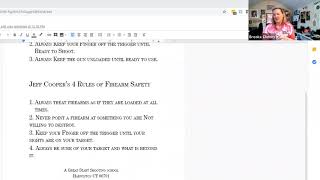
Jeff Cooper's four rules of gun safety: treat every gun as loaded, never point at anything you won't destroy, keep your finger off the trigger until sights are on target, and know what's beyond your target. The speaker demonstrates how each rule builds muscle memory and applies to shooting, cleaning, and teaching.
Chapters
Alright, so another set of rules that is very prevalent in the gun industry are Jeff Cooper's 4 firearms— 4 rules of firearm safety. So always treat the gun, firearms, as if they are loaded at all times. So this is where the NRA and Cooper's Rules, to me, go together. Because what does it mean to always treat the firearm as if it is— as if it's loaded at all times? Well, that makes sure that you have your gun pointed in a safe direction at all times. It also makes sure that your finger's off your trigger until your sights are on your target. So Yeah, so they go together. This is why I'm giving both of them to you guys. Number 2: Never point a firearm at something you are not willing to destroy. Again, this is why when we go with safe direction, it is at the target, at a safe backstop, not at the ground, not at the ceiling, always just nice and flat. And remember, you do have a firearm and you are to treat it always as if it is loaded. Because they're not ever called on purposes, they're always called accidents. I do have a lovely story, but I'm not going to tell it on recorded video. So y'all have to ask me about that later, of when things should always be— why things should always be pointed. Because there are negligent discharges. People do pull the trigger when they are not on target. But as long as the gun is in a safe direction, bad things do not happen. Keep your finger off the trigger until your sights are on your target. And this gets into actual marksmanship skills because, again, if you guys ever come here for lessons, one of the things I will teach is finger off the trigger is actually making contact with your frame at all times. Once you are on your target, then you can put your finger because now you're going to be settling your sights. So, however, once you are done shooting, make sure your finger comes all the way off the trigger before you bring it back down. So finger off trigger is until you're up on your sights onto your target, and then before your sights come off your target, you want to make sure your finger is back up here as well. Now here's a funny thing, or like I think it's funny, is when I'm cleaning my firearms and they are all apart, when I'm, you know, rubbing them down and everything, this is still where my finger is. So this is probably, as a gun owner, The second most important thing for you to really, really, you know, every time you pick the gun up, make sure your finger is here. When I am teaching my students, I'll pretend— so pretend this is the table. I always teach them, have your index finger, that is your trigger finger, touch the frame of the gun is the first thing that you do, and then you're going to build your grip. Around that. But if you create that muscle memory where your, your trigger finger, your index finger, is always touching the frame first, it will really help build that muscle memory for you. Okey-dokey, so where are we? 3 finger off trigger until sights are on target, and then always be, be sure of your target and what is beyond it. This is part of what we were talking about in the very beginning, understanding what a safe direction is. So as I explained about the targets here, I know that if a bullet were to go through it, it goes through the woods, over the valley, literally into a hill. So this also sort of gets more into tactical thinking. However, it's also very useful at the range because, for example, one of the gun clubs I belong to, you get to choose where you set your, your target. So you want to make sure that your target is set at the right angle and at the right height for you, because I am like around 5'7" and I have some students who are shorter than me, and so they actually have to have their targets lower because we don't want them aiming up at stuff and we don't want them aiming down at stuff. So knowing your target and what is beyond it is also useful just at the range.