In this live‑recorded session Brooke Cheney walks viewers through her first IDPA classifier run as a baseline for a 30‑day Dry Fire Challenge. She demonstrates the live‑fire sequence, explains IDPA scoring rules, safety procedures (unload and show‑clear), and how penalties are applied. Brooke shares her raw performance numbers – draw time (2.81 s), split times, total raw time (5 s) and the 10‑second penalty for missed shots – and shows how the timer displays shot count, draws, and splits. She offers practical advice for safety officers on counting shots (start from the outside) and emphasizes proper technique for every dry‑fire repetition. The video outlines her training goal: reduce draw and split times while eliminating penalties over the next month, and hints at future gear discussions. Community interaction is encouraged, with invitations for questions about IDPA or dry‑fire practice.
Chapters
All right everybody, I am trying something new. I don't know how it's gonna work, but I'm gonna try this, so bear with me as I learn how to try to be fancy. All right, so I wish I could get rid of this because I don't know how to get rid of that, but that's okay. Um, hey DJ, uh, I probably need help on this whole thing. But anyway, here's the deal. Yesterday we started off the IDPA— or sorry, we started off the Dry Fire Challenge. And so what I did yesterday was I shot my IDPA classifier. And as this slide here, right here, says, to find your way you must have a starting point and an end point. So the reason I did my classifier— awesome, thank you for the 5x5.
Because I—
when I play the video, I really need to know that it's still 5x5. Um, yeah, so I did the class for her to have a starting point. So I'm just gonna play the video and get rid of myself, I think, and I'll stop here and there. So this is kind of live, kind of recorded. So I don't know, we don't have a plan for this, we're just gonna see what happens.
So here we go.
And maybe there'll be silence. All right, so I did take out the sound, I remember now. All right, string 1, draw and fire 5 shots freestyle. Same thing for everybody, every single time. Let's stop here for a second. Again, we're looking for a starting point. So my starting point for my first set of shooting was my draw was 2.24. Definitely not the best I can do. But it gives me a place to know that I need to get better. Um, yeah, you think I know how to toss you a link.
Oh, but if I put it up here, then you're just gonna get it everywhere.
All right, so there is that.
Um, we're gonna go on, but the next one will have sounds.
You guys know what that all means now because I explained to you in the first one. Like I warned everyone, this could be about as exciting as watching paint dry some of the times. And that's it. That's all it really is. Unload and show clear, just so you know. Dry fire— you never get enough dry fire. So when you're at the end of a, um, whatever that's called, whenever you're at the end of a course of fire. They will say unload and show clear, or they're— depending on which sport you're doing, they will say different things. But the idea is your magazine is out, your, uh, chamber is empty, and you drop the hammer to verify that the chamber is empty. Now, I have seen people actually get disqualified at this point in time because they weren't actually all the way empty. However, because we're talking about Dry Fire Challenge, I want you to know every single time you touch your gun, you really do want to actually have that sight picture, press that trigger one more time. Because even though I'm about to do dry fire for the entire month, the reality of it is we can always do more, no matter how much you do. Um, proper technique. All right, here we go, onwards. Oh wait, I gotta, I gotta share this here, and then I'll put that there. So it's all about safety right there. All right, IDPA targets.
All right, let's talk about the IDPA target. Is 25 shots. So as a person who's going to score this, the first thing we're going to do is count all of them. So there's 1.
I'm not going to bring you through I could go through all 25, but you're about to find out that I didn't do math right the first time because I counted 8, but I really had 10.
So I would actually put numbers by all of them: 2, 3, 4, 5, 6, 7, 8, 9, 10, all the way up to 25.
So that means at the very— also, if you are a safety officer for IDPA, um, the first thing you do when you're storing classifiers is verifying that you have all the shots there. Because it's easy to not see them because like obviously you're going to score all the shots that you see. However, you want to make sure all of them are there so there are no 5s that you don't see. And what happened was I counted the number of holes, which is where I got 8 because there's 8 holes that I had to score. So 1, 2, 3, 4, 5, 6, 7, 8. But when I added them up, I forgot to give this the lovely 0.3 seconds that it actually needed.
Very least, we don't have any 5-point misses because all of the target— all of the shots are on target. Now that one over there, right there, that, that, that one, I knew that I did that in the second string of fire, which was one-handed.
One of the things you also want to learn as a competitor is how to call your shots and know which shots went where. To be fair, I knew that my first shots and my first string were all in down zero. I then saw this, uh, in 3-pointer and a couple of these 1-pointers with my one-handed. And then for the last 2 strings, honestly, I was not paying that much attention.
The rest of the 1s I don't really have an excuse for. I know that the first 4 that are down there were one-handed. After that, I'm not sure which string it was. So I have a total of -8 points. If you don't understand that. This is 3, 4, 5, 6, 7, 8.
Oh yeah, and to you budding SO safety officers for IDPA, I will tell you, um, always start from the outside and go in, because if you have 5, then you have 8, then counting the ones makes it a lot easier to do the math. So that is why I always start from the outside in, because I need simple math when I'm figuring out scores.
Oh wait, 9, 10. I did the math wrong. So a total of -10 points. So what that means is we take my raw time, which I haven't added up yet, I'm going to add 10 seconds to that entire score.
And I just realized I still haven't added it up, which is going to make this, um, I'm going to put it in the comments what the total score actually ended up being, which sucks because it would not have taken me 10 seconds to slow down and get better shots than that.
So in IDPA, you definitely want to be more accurate as quickly as you can, but that 3 seconds right there and the 10 seconds that came up for the whole thing, that is going to hurt a lot.
All right, let's talk about what I am actually looking at real quick.
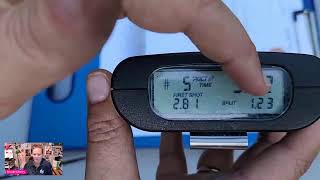
This is my starter classifier. So here's the— here are the things that my timer will show me. So I can show you for the last one with—
and the one thing I forgot to put in here when I'm talking about this, because I'll go through this, but that number 5 tells you how many shots were fired. And an IDPA, they want to make sure when you're shooting the classifier that you have the correct amount of shots, that you did not do additional shoot, um, any additional shooting, because it is a limited— you can only shoot as many shots as they tell you to.
Was draw and fire 5 shots for the body, 1 to the head. What the timer tells me is that my draw was 2.81 because it tells me my first shot. It says my split, which is the amount of time in between shots for that particular last shot, which was the head shot.
So, and I see that G-Webs has joined us to make sure that yes, if you only shoot the inside part, You do not have to count as much. So generally when you're at a competition, however, you're not doing the counting, but when you're doing your own stuff, then yeah, you have to count more. But it is always better to hear a down zero, which means they're not adding time to your, um, to your score.
Actually, that is the largest split there. So if I know what my draw time is and I know what my splits are, I now know what I can make better or what I need to work on. So go back to the bidding, that shows my draw at 2.81, and for me, even out of practice, that's like a super slow draw. I'm usually much closer to 3 or 2 seconds. All right, so the 1 or 0.69 is how much my split, then 0.58, then 0.61, And then like I said, that last shot, it's a precision shot, and it was pretty. I'm not gonna lie, that's like right in the center of that circle. So, but again, so totally, it really was pretty.
It was like not exactly in the zero of the zero, but it was really pretty. I was proud of that shot. That made me smile. So that was the last shot I took of the day.
For shooting, drawing and shooting, I came out with 592. As we already discussed, I've got 10 points against me. So now my time is 15 seconds, um, versus 5 seconds. So here's the thing, back to accuracy. So now that I've done this for the first time, I have the ability— oh, so on here, back to that whole thing is I'm looking at what was my raw time, what was my draw, what was my raw time, my draw. On this one we have a reload, so I'm looking at my reload time as well. So this is day 1. We're gonna see if we can make these numbers go down and the points go down to 0. It's not 18, it's really supposed to be 10. It was 8 because I added wrong. But, so let's see what happens 30 days from now.
And that's it. That was my practice yesterday. And yes, I started with live fire because we have to start and measure to see where we're going so we can see all the hard work we're putting in and what that means.. And yes, Mike White, good evening. I suppose I didn't actually officially say good evening to Gun Websites, but hi, G-Webs. So yeah, so start with dry fire, figure out where you're at. This is one of those things when I teach my NRA classes, there's a book that has a bunch of different courses of fire. So you try this at this distance, at this speed, with these many shots, and it gives you something to measure. So tonight, because I have to still do my dry fire for tonight, it will probably be draws because my draws— my lap— my final draw yesterday was 2.81, which is, like I said, it's slow for me. So I know that I can get better. The other part of this is that for real, I certainly did not have official IDPA gear on, so when I do this at the end, I will still use the same gear that I was using for this. So maybe tomorrow or next week we'll start talking about the gear stuff. If you guys have specific questions about IDPA, uh, dry fire in general, let me know down below.
It doesn't matter if you're on YouTube or Facebook, it's all down below.
And that's what I got for you guys, and I promise tomorrow's gonna be much shorter because And someone also asked, am I going to do this on a regular basis at a regular time? And the answer is no. My life is crazy. Tomorrow you might get a 1-minute short up, but it'll show something of my dry fire. So thank you all for checking in. Do the like subscribe thing because apparently that's what YouTube likes so we can show more people. Thanks again, everybody. I will talk to you