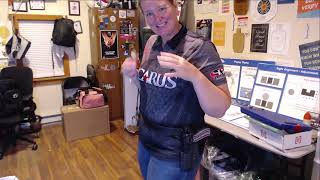
Brooke Cheney teaches pistol handling for competition: how to pick up a gun from a table, draw from a holster with the "up, out, and straight out" motion, and practice dry fire while keeping your finger off the trigger until sights are on target. She warns against the "up-and-down" style that can get you disqualified.
Chapters
Okay, so. One of the things you might have to do in a competition is what we call a table start, and what that means is your gun is in some configuration. Honestly, more often than not, it's actually closed. I just generally don't ever put my guns down closed except if I'm being told to do so in a course of fire. So, um, anyway, So here's the thing. When I teach my students basic pistol skills, I'm actually teaching them a table start. So for those of you who are my students, this looks familiar. If you're a right-handed shooter, we're always looking at the open chamber of the firearm when it's down, and we always have our magazine to the left of the gun and with the bullets facing up. Most magazine bottoms have a flat part, so it's easy to tell which way to put it on the table. Now, that being said, how do we pick up a gun from the table? Rule number 2: Always keep your finger off your trigger until your sights are on target. So we're starting with our index finger. Index finger goes on the frame. Our left hand scoops it up just a tiny bit and then we wrap our fingers around. We want to make sure our hand's all the way high at the top of the gun, and we're going to pick it up. Then our index finger goes on the front of this magazine pickup. We tilt— see a little smiley face right there? We look at the smiley face, we put the magazine in like so, and then when I'm tilting it back up. I'm going to do this sideways so you can see it. My thumb goes here to drop the slide lock. My slide— my finger slides forward so that if you're looking over the top of the gun— come on, back into focus— my thumb and my forefingers are— this is thumb over thumb, and my thumb and forefinger are somewhere close to the same distance on the frame. So from a distance, what this looks like is index finger, wrap around, pick up, index finger, tilt the gun, magazine, straight back up, thumb forward, present the gun. And yes, I'm a headless horseman today because I can't quite figure out how to do these things so you can see the table and the rest of me. And I'm still close enough to the, um, audio stuff. So there's that. All right, so that was a table start, but what are most of our starts? Most of our starts are from the holster. So when we're practicing starts, here it is: up to the gun, clear the holster, press out to your eye level, back in, all done, put it back. That's it. However, as I was telling a student today, it takes a lot to get to that point. Here are the things we're looking for. One, hands relax at sides. Usually we pick somewhere on our thighs that we're touching, or maybe we're touching the bottom of our holster. Two, when we're practicing learning how to do this, it's a little bit up, a little bit down. So again, just like we just did on the table start, I really want to make sure I'm high on my grip. I want to make sure there's no possibility of me not having what I want— oh, hold on— of me doing something like this. So I'm keeping my hand close to my body to push out so that I never do something like that. So both hands relaxed at the side, they come up at the same time. The difference is my support hand is closer to my body. Alright, so on the signal, up, out, and straight out. Now, one of the things I was really looking at with one of my students today is we really want to keep this flat all the time. The most common thing is, "Let's go fishing," and so that student was out of the holster, but then went up and then came back down. Now, there is a group of people who are taught to do that. They're taught to look at the target and then come back down onto it. And I had that earlier last week as well, where they go up and then come back down. And that's a style. However, when we are being timed and trying to be as accurate as possible. Because of the timing portion, we want to be as efficient as possible. And you know that triangle thing, straight line, fastest place to get somewhere. So up and this going directly to on target is faster and more efficient than letting it go past the target and then coming back down. So also safety-wise, There is one, one, whatever that's called, one range you go to up at State Academy. If you go up, you're disqualified because the berms that they have, if you go over the berm, because just this little, this little tilt here is really far once you get away from the gun. So that little tilt up there, DQ on some of the ranges specifically. So As I was telling a student today, just video yourself doing this and then see what happens when you're out. And make sure you're looking into your holster when you're going to put it there, because there's nothing more that a safety officer dislikes is this with a gun. Doesn't matter that it's empty. It's up, out, bam, bam, bam, shoot your course of fire, Unload, show clear. You get one last dry fire at the end, and then look into your holster and put it in there. Now, again, my hand is up here. Why? Well, so many people put their hand here, and so now when I'm going to put my gun into my holster, I have just swept my hand. That is also a DQ. Look, Hawkeye has joined us. Just so you know. He's a pretty dog. Yes, he is. So anyway, so this is why we don't put our hands here. We put our hands here. Now, ladies, those of you who have larger upper bodies than I do, one of the things the hand can be used for, same thing if we have gentlemen or ladies who have larger midsections, sometimes you may need to scoop up and lean away and hold those extra amounts of body parts this way, which is okay. Just make sure your gun is out here, grab whatever you need to get out of the way, lean away, and then put your, your gun into your holster. Because we all have unique body types, right? Right. All right, so dry fire practice. Let's just go and see that. I didn't actually see it, but I think I saw a little of that. Did you see that? Maybe I'll cut this and rewind and see. Maybe, maybe not, but it seemed like this. This is the other part. Focus on what you want, not on what you don't want. Because my challenge right now is because I just showed you all of those wrong ones. Now I have to be like, okay, stay flat, stay flat, stay flat. Okay, that's a little bit better. That would have been a sucky shot, but I think it was flatter. Although that also was a sucky shot because my sight picture was not pretty. And what am I missing? Oh yeah, that timing element. If I'm not timing it, I'm not measuring it. I have no idea what my speed is. So that's what I got for you guys today. Um, to me this is way longer than I meant to because now I have to go back and edit it. So, um, but it's up and I will see y'all later.