Dry Fire Practice - Day 2
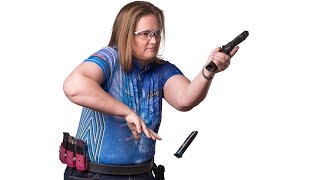
Brooke Cheney from Great Start Shooting School runs through her Day 2 dry-fire routine before an IDPA competition. She identifies three weaknesses from her last live-fire: eye focus, arm fatigue, and slow reloads. Her ten-day plan focuses on sight picture, breathing, and reload drills.
Chapters
Hello all, welcome to day 2. Of dry fire. For those of you joining me for the first time, my name is Brooke Cheney. I own a Great Start Shooting School and I'm the owner instructor here, and we are going over the next week of just doing dry fire practice in little itty-bitty bites. So yesterday, for quick review, we did what's called the bump drill and we did the whitewall drill. Both of these things are focusing on trigger pull. And why am I doing this? Because I finally scheduled a competition, which is a week from Saturday. So I've got 10 days left, and I just did my IDPA classifier like I said I would. Um, totally under the gun. I've been running around like crazy, but thankfully I told you all that I was going to do it, so I had to do it before I jumped on tonight. Um, let's see. DJ, remember to share, subscribe, comment, thumbs up today's live. Oh wait, here, I should at least like, you know, for those watching on Facebook, y'all can do the same. All right, so let's see, dry fire. I left you guys, I did my dry fire practice of at least 10 reps of the white wall drill and at least 10 reps of the Bump drill and part of dry fire. Oh my goodness, sorry. Um, yeah, that qualifier target looked like garbage, but that's okay, it's all right because you have to start somewhere. Um, I brought my son down with me. Uh, he is, um, he's, he's 15, he's in competition, and he and I came this close to tying as novices with our targets. 'Cause this is one of those things like people think, oh, look at my target, look at my target, right? And those are all my good shots. Well, down there, those are my bad shots. So bump drill and whitewall drill. One of the things I realized when you go with anybody's book, whether it's Sieglander or Ben's, they tell you the whole point is to pay attention to what you're learning. So what I learned yesterday as I'm doing my bump drill and my whitewall drill is that my eyeballs are significantly out of focus. So when you are writing in your logbook, you're supposed to not only write what you did, but what did you learn from what you did. So at the beginning— at the end of your dry fire practice Write down what you learned and what you need to know for next time. So my notes from last night are: eyes need help, strength needs help. Here's the other part that I realized: I have not stood like this with a firearm in my hand for over almost 8 months now. Um, it's not that I don't ever shoot, but I don't shoot for competition currently because June was appendix surgery. December was knee surgery, so I'm significantly out of practice. With a good dry fire drill set mindset of, okay, I've got this competition coming up, which is just a club match, I'm not running around, I'm not going to try to win it, I just want to shoot it so I can get some practice. However, I want to be as good as I can between now and then. Physically, all dry fire practice, if you're getting ready for competitions, is gonna have that health aspect to it. Can I run? Am I out of breath? All those sort of things. So that's another piece that maybe I'll save for another, um, another segment here. So dry fire, what did I learn? My eyeballs are tired, my arms get tired easily. I was only doing like 3 and 4 reps. I would come down, go up, 3 and 4 reps. It's better than not doing them at all, but it's also understanding what you need to work on next. So for today, a couple things I've learned. One, I did a live fire session so that we have my baseline before we get through a full 10 days of dry fire practice. I am currently an IDPA novice by 0.28 of a second. I missed it by this much, and I can tell you I can shave that off because I know The reload that I had in there totally sucked, right? So I know that's one thing I'm going to work on over the next 10 days is my reload. And I can bump from a novice to a marksman relatively quickly because all I have to do is practice reloads a little bit. I'm not going to do that tonight. We're still working on eyeballs and sight picture and trigger control. So the other thing that I learned from going to the range and shooting my target Right on a high— oh, there we go. So this is my, my zero, right? This is my down zero in here. So these are all good shots. Then I sort of started walking down my target, and so now this is into the -1 and this is the -3 for each of those two shots. So if all I do is work on my trigger control and my sight picture to pull these up, not to down zero, but at least up here, that goes from 6 points down to 2 points down. So you have to evaluate what you're doing and figure out where you want to go. And this will help, help you create your dry fire practice for what you need to do. I was getting my oil changed today, happened to talk to a lovely lady there, and we were talking about shooting, and she's like, I really need to overcome my flinch. I'm like, watch yesterday's video. Because that bump drill and just that white wall drill will give you so much to help you not have that flinch response. Because I know I've talked to other instructors like, oh, but the gun's not loaded, people will know. And for those of you never tried it, I promise you, if you sit there and you watch your sights as you're pulling the trigger, you will find even when you're doing dry fire, sometimes you're gonna do that. And that's all your flinch is. All right, let's see what Clover— gotta remember to breathe. Just a few seconds of not breathing will absolutely affect your vision. Yes. And one of the things I can tell you with Mike's book, and I put the comments in yesterday's description, I'll put them in there again tonight when I'm done and I'll update this. There's actual specific breathing drills you do before practicing. There's actual specific visualization that you do before practicing. Again, part of this is understanding what your program is going to be for you. As far as the walk down, yes, it absolutely can be fatigue because it's only 5 shots at a time and then a reholster and then a reset and then 5 more and then a reholster and a reset. As far as the walk down across my thing, absolutely could be fatigue because again, I know I'm out of shape. If you don't know, like even though I'm talking to you right now, I'm like I'm still out of shape because I only did this like 15 minutes ago and came in and threw the studio together. So you must evaluate, you must start somewhere, and this is why if you can shoot a target— and what we'll do is next Friday, a week from Friday, I will shoot another target and I will let you know what my actual score is the day before that I am going to be in the competition. All right, so that's kind of the overview, right? Evaluate what happens. So pick, pick something to dry fire last night— bump drill, whitewall drill. Realize what's happening during those things. Do you really need to work on them more, or what did you learn from doing those drills? And then, okay, what's the next day that we're going to be— because I'm going to do at least 4 of these each week, I'm going to give you a different drill each day. When you're actually doing this for yourself, often you will maybe have, all right, on Monday we're doing the white wall drill, on Tuesday we're going to work on reloads, on Thursday, and that sort of thing. That's the other thing I like about Ben's book, because in the back he has suggested, um, uh, what do you call it Schedules. There we go. When to practice what, based on what your, your goals actually are. For me, it's go from where I am to where I am actually classified, because I am classified as a marksman in IDPA. So at the very least, I want to do that. Not necessarily is going to happen in the next 2 weeks. However, we will see some improvement, is the idea, between now and a week from Friday. All right, so knowing what I learned, because I'm tracking it by writing it down today, the first thing it says is, what is today's goal statement? Where do I want to go? So my next practice is on my eyeballs, right? I want to make sure that When I put that sight out in front of me, my eyes are focusing on that sight. So believe it or not, this is actually very, very simple. And yet something that most people won't take the time to do because they don't realize how important it is. And it, again, maybe it's not— oh, sorry, I forgot I left that up there. Maybe it's not that is what you have to work on, but for me, it absolutely is. So literally all I'm going to do is press out. Now you can do this with a white wall drill or anything like that, but the idea is each thing you practice in your dry fire practice is a single thing, just one thing, because if you try to do everything, you're not going to measure what you're doing. So for me I'm going to look at a target and all I'm going to do is put the gun out in front of me. And right now I have to close one eye. Sorry, I just realized apparently while I was shooting I lost my front sight, just the fiber. I still have the, uh, I still have the iron sight. So all I'm doing, looking at my target, pushing out, and if I can see the sight right away I'm then closing my eye to verify that I'm seeing the correct sight. For those of you who haven't learned how to shoot with both eyes open, here is a handy-dandy tool you can use. And guess what? You don't actually need any tools. So, hi Vanessa Kitty. Just so Facebook people don't think I'm crazy, that's Vanessa Kitty. So if you want to shoot with both eyes open, So I'm going to choose the, uh, whatever that's called, the camera. So if I'm used to closing one eye and that's how I see my front sight, right? I'm using my finger as my front sight and I cover the camera. Now when I open my other eye, what happens for most people is now you see a split. You see two fingers or two front sights, right? So by closing your one eye, seeing your sight picture, which for me right now is my finger over the camera, when I open my eye, the finger splits, and I close it to verify that I'm still where I left off, and I open it. And what I am doing is I am training these muscles, because your eyeballs are just another set of muscles in your body. I'm training them so that I'm training my, my eyeballs and my brain to see the sight picture that I want to see. So some people never learn to shoot with both eyes open, that's okay, but for me that's how I like to shoot. So, um, I've also taught my students how to like that, and I originally learned that from Jay Hershberg, who I don't even know if he shoots USPSA anymore, but anyway, I think he does. So, um, It's a very simple eye exercise. And this is the other thing about dry fire practice. Look, just hands. I don't need to find my gun. I don't need my ammo. I don't need a belt. I don't need a holster. I don't need magazines. Super simple. I can just sit there. You can sit there in your cubicle at work and pick something and like, all right, I'm going to go for this. And all you're doing is going this and this until you get to the point where you only see one finger. Now there is no actual, um, substitution for actually just putting the gun out in front of you and verifying that you're seeing what you're seeing. Now I got a couple different things while I'm doing this. I still want to check in: is my stance good? Am I gripping the gun well, right? So am I gripping it like I'm about to shoot it?. So as I push out, I need to know, and then I'm closing my eye again just for verification purposes because I need that practice because I haven't had that kind of reps. So, um, so Vanessa Kitty says always shoot with both eyes open, and that's true except when there's an exception. Um, I don't know who we all know in the shooting world But one of the people I've trained with is Lena Michalik. Michalik. Yeah, there we go. I can say her name really. And we talked about this. And for easy shots, you know, 20 yards, you know, closer, that sort of thing. Sometimes on those really far long distance shots when you're going for super precision, even Lena closes one eye. So I'm just saying, and she's won a couple of world championships and all that kind of stuff.. So there is no one size fits all. You have to decide what your skill level is gonna be and what you wanna do. So today, as soon as I sign off with you guys, all I'm gonna do is probably like, I don't know, 10, 15, maybe 20 of these where I just see my site picture, probably not check in every single time. So I don't wanna get in the habit of doing this. Because one of the handy-dandy little things I have in my classroom— practice makes perfect, so be careful what you practice. You want to be very knowledgeable and aware of what you're practicing, partially, well, because you want to know what you're learning and what you are teaching yourself. So I'm going to be doing— I don't know how many reps I'll fill you out, fill you up, fill you in tomorrow. No, I'm not filling in tomorrow. Tomorrow night is Wednesday. Uh, Wednesday night I teach pistol permit classes online, so I will not be doing this on Wednesday, but I will be back on Thursday at 6 o'clock. So, um, let's see. So I'm just going to work on my eyesight, and in that I'm concurrently verifying my grip. I'm really stepping into my stance and making sure that is correct. And that's all I'm going to work on tonight because I want to make this easy, small, and bite-sized. Whether you're going to do this at work and start practicing seeing one finger versus the split, um, whether or not you're going to work on draws or something else like that. Thursday, maybe we'll get into belt work since I found out by doing my classifier that I need help on my reloads, so we might work on that on Thursday. All right, let's see. Gun website says video game like almost all the time, so I feel like I'm probably really good at shooting IRL, but don't need to waste all that money on ammo and guns. Well, so this is kind of like the beauty of dry fire, right? You still get all that stuff and you're not wasting a ton of time on ammo. And some of the drills you don't need to have a gun for. 'Cause honestly, even working on my strength, I can use a can of soup. These are the things I offer to my brand new students who haven't figured out what they're gonna buy for a gun or they haven't invested yet. So there's a lot of the things that we're gonna do in dry fire you don't have to have a gun for. The eye exercises, obviously an obvious one. Strengthening, yes, I went to the gym yesterday. Do I need to go more? Yeah. Do I need to up my weights? Yeah. Will it happen overnight? Absolutely not. So, all right everybody. So like I said, I want to kind of keep these short and whatever that's called, short and sweet. Hope this was helpful and I will not be here tomorrow, but I will be back on Thursday. So that is all. Bye MK Joe, bye Vanessa Kitty, bye Gun Websites, bye DJ, bye CloverTac. Who else? I think that's everybody. All right. See you all on Thursday, 6 PM Eastern, and have a great night.










