Dry Fire Practice doesn't have to be complicated.
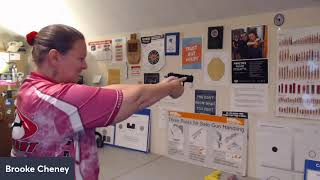
Firearms instructor Brooke Cheney explains why dry-fire practice builds confidence without ammunition. She covers three safety rules, then walks through grip, sight picture, and trigger control. A few minutes of practice yields the most improvement for the effort.
Chapters
Ta-da! It says I am live, so I'm going to assume that I am actually live. So, imperfect progress. Uh, what is today? It's Tuesday, November 16th, and a month from now I'll be returning from my training at SIG Academy. So one of the things I realized I should be doing before I go to training because I need to get better, is I'm going to work on my marksmanship skills. Now the title of this is "Dry Fire Doesn't Have to Be Complicated," right? If you are a new gun owner, or even if you're an established gun owner, the truth of the matter for me was going to the range is not how I learned to be confident with a firearm. Doing this, working in the classroom, working at home without ammunition, is actually how I got confident handling my firearm. Most of my students take classes, and I ask, what's the purpose of the class? And the class is generally so they feel more confident handling their firearms. Unfortunately, in the gun community, a lot of people assume that that means you have to go to the range and put thousands and thousands of rounds downrange, which is actually not the case. Handling the firearm without any ammunition in it is the most important thing. So let's talk about safety real quick. Prior to starting any dry fire routine, you want to make sure, like this, you're in a room where there is no ammo. This is my classroom. There is never live ammunition in this room. That's one of the NRA rules for teaching a gun class is the classroom has no live ammo. Unfortunately, not all instructors follow this rule, and if you're curious about it, go ahead on YouTube and look at— look for instructors who have shot themselves. The videos are out there. So in this room, there is no ammunition. So in your home, you want to make sure that if you're going to do this, you do this in a room that has no ammunition. So that's rule number 1 for safety for dry fire. Second, what is your safe direction? Here you see targets on the wall. This is my safe direction. Why is it my safe direction? Because I know if somehow I was wrong and there was ammo in here somehow, that if something went through my wall, it then goes into the woods and then goes into the mountain. So as safe as possible, this is my safe direction. Now, if you're in a condo or an apartment, a corner is usually where we suggest a safe direction is, because corners are usually where the biggest beams are. So your safe direction, if you have a house with a basement, is in the basement, because generally your basement is cement followed by dirt. So the bullet will not go any further than that. So number 1, no ammo in the room. Number 2, make sure you know what your safe direction is. 3, if someone's around to verify that the firearm you're using is empty, go ahead and do that. So the fact that you can see through here— that's my little finger right there, right? That means there is no magazine in here, so there's no ammo in here. If I had a flashlight, I would show you there's also no ammunition in here, but unfortunately I can't quite get the angle right. But the way that a lot of people will check is sticking their finger in there. I hate doing that because I'm always afraid I'm going to pinch my finger. I'm just a baby that way. All right, so 1, no ammo in the room. 2, what is your safe direction and why? Because they're just going to stop the bullet, or if the bullet goes through there will not be any more— sorry, there is an unlikely chance of something bad happening. So now that you've got a room full of no ammo, a safe direction, now let's talk about actual dry fire. Your gun has been verified it's empty, so I guess that's number 3 for the safety stuff. Today all I'm gonna do is work on my trigger pull. So, well, so I'm working on two things while I'm working on my trigger pull. I'm looking at my sight picture and verifying that my front sight stays in the middle of my rear sight while I am moving the trigger. Sounds relatively simple, right? So I build my grip, and I'm actually going to build it with the other hand because I'm a left-handed shooter So I should actually practice with my left hand. I'm going to build my grip, so fingers on the frame, all my fingers are wrapped around, my thumb is going to get out of the way. I'm going to put my thumb on the frame, palm fills up as much of the grip as possible, all my fingers wrap around. When I am standing here, now granted I have a wall full of targets and stuff. Ideally, I want to do this on an empty, what's called the white wall drill, where I'm looking at my target— I'm sorry, I'm looking at my sights through the— I'm looking at my front sight through the rear sight. When I squeeze the trigger, I want to make sure that I'm not moving my front sight, and that's what I'm paying attention to. So that's it. That's my dry fire for tonight. Is I'm going to do— that was just single action because the hammer was back. I'm going to do double action where I pull the trigger trying not to move the front sight. I'm going to do single action again. And so this is just a single skill that you can work on. Take 5 minutes, take 10 minutes, take 2 minutes, whatever works for you. Dry fire practice is where you're going to get the biggest bang for your buck, and it's inexpensive because you're not spending anything other than your time. Just make sure that you're aware of what you're practicing and why you're practicing it. So my trigger pull is all about watching where my sights are. Any questions? Drop questions below or to the side, side, because this is on YouTube and Facebook, whatever works for you. Also, dry fire practice. I believe in December I'm going to come out with Monday night, 7 to 7:30 or 7:30 to 8, depending on how people vote for this. And we're going to do a half an hour chunk of you and me dry firing at the same time. We're going to start with basic handling skills such as locking the slide back and how to drop it and what the proper technique for just that one piece is. Monday night, Monday night, Monday night, Monday night. We're gonna do 4 Mondays in December, 7 to 7:30 or 7:30 to 8, depending on how y'all vote. And that's Coming up. So that's kind of it for tonight. I just want to do something short and quick and easy that is breaking it into— hey, Guns and Barbecue, how are you, hon? Um, so yeah, that's kind of it. Dry fire is simple. It's where you get the biggest bang for your buck. It's how you get comfortable with your firearm quickly. And like I said, ideally we are going to be doing this every Monday night from 7 to 7:30. And I— yes, I realize today is Tuesday, but I'm just kind of trying out, figure out how we're going to do the angles and stuff on this with my single camera. So we'll see how that all goes. Like I said, comment below to the side, however it works. Let me know if 7:00 to 7:30 works for you or 7:30 to 8:00 is better on a Monday night, and I will send y'all links. Um, I am doing well. I've been teaching all day today, just got done. Uh, gonna go have dinner in about 10 minutes. And then I got another class at 7 o'clock, so hopped on real quick, using my StreamYard to make things all really cool. We're gonna go live everywhere, and that's kind of it. So I will see y'all later. Have a good night.










