Dry Fire Practice - Let's get started
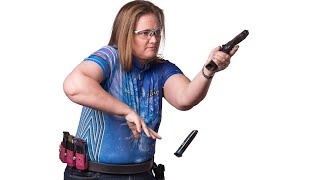
A shooter outlines a dry-fire training plan for IDPA competition, covering safety rules and two core drills: the bump drill for trigger control and the white-wall drill for sight stability. Daily practice over 11-12 days, with classifier scores tracked before and after.
Chapters
All right, here I am. Like that, it says there's 5 people. Hold on, I want to see comments if there are comments. First comment I would love to see is, can you hear me okay? Normally I've got my headset on and I'm plugged in, so I know you can, but now I'm just using the little tiny speakers. So if you would be so kind, um, give me a thumbs up— not a thumbs up because I can't see that on StreamYard, but put in the chat if you can hear me okay. Although as I'm talking, I realize I probably need another cough drop. All right, I am hoping and praying that y'all can hear me. 5x5. Love you, DJ. Thank you for that. Um, so tonight is the first night of my dry fire, and I have not done dry fire in a long time. Um, however, I went and signed up for my first competition, uh, that's gonna be in 2 weeks, and I figured I should actually practice. And why not bring you all with me? Because what you say is one thing, what you do is what people will actually emulate. So my plan for the next 11 or 12 days before competition is to hop on here at least once a day and give y'all a little tiny dry fire tip. So first things first, safety is always number one. Down below the scroll thing here, make sure there is no live ammo in the room that you are practicing in. Rule number 1 when it comes to setting up for dry fire: before you even touch your firearm, verify there's no ammo in the room. The regular rules all still apply— gun in safe direction, finger off the trigger until your sight's on the target, all of those good things. The other part would be there is no keep— well, there is keep your gun unloaded. Don't load your gun while you're dry firing. That would be bad for your walls And we don't want that to happen. So, hey PN Woods, hi G Webs. All right, so yeah, so PN Woods, sorry, I'm limited with my, I'm not, like I said, normally at my desk when I'm doing this. Dry fire practice for those of you who are new to firearms is literally just picking up your gun and doing stuff with it. It's not just pulling the trigger. It is learning how to have the proper grip for your firearm. It's learning how to drop a slide or lock a slide back. This is my— let's see, there you go, now you can see through it. No, this is empty. You know, it's everything that you didn't realize you could learn while you're not at the range. Because here's the truth, Most of us, most of you have to go to a range and you pay money for your time on the range. And you only have usually about an hour and you want to spend that time shooting. So dry fire is about learning about your firearm and getting more proficient with your firearm before you go to the range or after you go home, come home from the range and you decide you have a problem. So I'm gonna make this, I'm gonna try to make this short. Again, my target's always like 10, 15 minutes because I have a short attention span. All right, so where are we gonna start? All right, number one, I started by booking a competition. So my first competition for this year is gonna be an IDPA match. Now, does that matter? Not really, not for tonight's practice because the first thing I'm gonna focus on is my trigger skills. If you want to be fast and accurate, your number one skill set is your trigger skill. So tonight's practice, I'm going to show you all the white wall drill and show you the bump drill. And I've learned these from other instructors, and they've learned them from other instructors. So for those of you who want me to quote who I learned them from, I'm not gonna because I don't remember off the top of my head. Well, that's not entirely true. I just got a refresher from Steve McGough from Opspec training, uh, last year when I had him here as a guest instructor. So, bump drill. This is what y'all usually look like when you're holding a gun— finger on off the trigger, actually touching the frame. Problem is, I'm not like you, I'm left-handed, so my hand is going to go on the other side. Bump drill, ready? It's really quite simple. Once you've built your grip You're going to put the gun out in front of you, and you're going to put your finger on the trigger, and you're going to apply a little bit of pressure while paying attention to the sights, and you're going to release that tension. Then you're going to put a little more tension, and you're going to release that tension. Then you're going to put a little more tension and release that tension. And a little more until at some point the gun goes click. At that point, you've completed your first rep of bump drills. My goal is to do probably 10 or 15 of those tonight. I am not going to make you sit here and watch me do those because that would be really boring, or at least as far as I'm considering it, it's really boring. Um, let's see. So bump drill, the whole purpose— well, not the whole purpose, main purpose is you're looking at your sights. You're being very aware of where your sights are. You want that perfect sight picture, equal height, equal light. And as you're moving your finger, you want to make sure that that is not moving. Now, once you've done 5 or 10 reps of that bump drill, next you may as well just do the white wall drill. White wall drill is very similar. Now, because I shoot a CZ and it's double action, I shoot production in IDPA, which means my first shot when I draw from my holster is always going to be double action. So when I do the white wall drill, it's going to look kind of similar, but it's a smooth motion all the way through the pulling of the trigger. So build my grip and over— I know you're seeing all these targets over here, but there's actually not a target over there where I'm gonna go. Get my stance, put my hands out, finger on trigger. Um, sorry, looking for the white wall. And then gently pull without disturbing my sights. One smooth run. Finger back off. Come back down, take a breath, and that is your white wall drill. So DJ, I used to dry fire in anticipation of going to the range rather than by a regular schedule, but I'm rusty as hell. Yeah, so this is the other nice thing about dry fire is that you can do it whenever you want because all you need is your empty gun. Disclaimer, this is a centerfire gun. It's okay for me to pull the trigger as many times as I like. If you have a rimfire, a.22 is the most common rimfire, don't pull the trigger. Most rimfire guns do not like being dry fired. Can you? Yes. Have I broken guns doing that? Yes. So it's your stuff, so you're welcome to do what you want, but centerfire, dry fire all day long, pull the trigger as much as you want. Alright, so those are my 2 drills that I'm going to do today. I'm going to do the bump drill because that really works on just getting that really smooth trigger pull. Do 5 or 10 reps of that. Then I'm going to do 5 or 10 reps of the dry fire, um, just white wall drill, just really watching my sights because I'm not on a target when I'm focused over there. The idea is to get this to move while these are not moving. Sorry, trying to get everybody's little comments here. Um, dry fire. Okay, I want a Mantis dry fire so become a regular thing, and dry fire should be something to do frequently. Yes, I was actually just interviewing Carrie-Anne Auclair, who is our DC project director in Massachusetts today. She's actually a Mantis, um, rep, and so she gets them for her girls. So, revolvers guy. Oh well, if you really want to know, PN, Hold on, I will show you. We have— oh wait, no, I don't. My husband took his revolver back. I got nothing for you, dude. But no, it's the same thing, you know. Revolver guys actually, um, tend to be even more accurate than semi-automatic hooks. I'm not just saying that because I'm married to one. Um, I do love my husband and he is awesome with a firearm. And, but I've watched, uh, some of the really good— oh, sorry, it would help if, uh, people know what I'm talking about because on Facebook y'all don't see the same comments that I'm seeing. So revolver guys, absolutely same sort of thing. Ideally, I'm assuming that you are shooting a double-action revolver, not just doing single-action, unless you're doing cowboy action shooting, at which point you might be doing single-action. But that bump drill and your white wall drill still will give you great results when you get to the range. My goal is tomorrow I'm going to go do an IDPA classifier. I was hoping to get it in today, but, uh, didn't work out that way because I wanted to show you guys where I started cold before doing any dry fire at all, and then where I'm going to be a week from now so that I do another a classifier next Monday and then do another classifier the following, because one of the things I love is documentation. If you don't know what you are doing or why you're doing it, you're much less likely to do it. Um, I have two different books here. One is Ben's— whoops, backwards. Wow, I can do this. Yeah, this is why I'm not Vanna. Um, so I've got Michael Sieglander's book, which I don't even know if he still has this competition handgun training logbook or not, but I love it because in the beginning of it, it's— it shows you kind of how to set up some goals, like what are you doing and why are you doing it. Most of us are much more motivated if we have a why, because like, uh, who else said here Um, who was— I gotta scroll up. But anyway, somebody said how they have— they're rusty, they haven't done it in a while. I think DJ said that as well. Um, but it's like, if you have a reason why you're gonna do it, it helps if you kind of write it out. This is Mike Zieglander's example, and he's like, January, working on physical stuff. February, USPSA skills because there's a floor to open, that sort of thing. So I started my calendar, and that's why I'm doing— getting into the dry fire. And then if you have a plan of what you're going to do and when you're going to do it, then the next thing is to actually record it. Now obviously you don't have to get a competition handgun training logbook. I like it because I'm lazy. Ben Stoger— Stager— I always screw this up. Same thing, uh, he has a lovely outline in the back of his book that says, let's say if you're a new shooter, he's suggesting week 1, week 2, week 3, week 4, what to do throughout the skills and drills that are in this book. I just know that I'm starting with trigger because I know for sure I need help with that because it's been a while since I've done any actual any shooting at all. So there you have it. Bump drill, bite wall drill. Two things. Do a couple reps. I'm going to start with 10. I'm not ready for calluses and blisters quite yet. And something is better than nothing. Hey, Fiona. Yes, I am. I responded to your text. I really did. So, um, what else? Revolver competition is fast, cylinder swaps versus magazines look wicked hard. Well, like everything else, every other skill set we've got when it comes to handling guns, it just takes practice, and that's what you need. So in closing, if y'all have enough, I'm gonna just review. So pump drill, get a good safe picture. Put your finger on the trigger, apply a little pressure. I'm sorry, I'm gonna try— I'm gonna hold it one-handed so you can actually see a little better. Apply a little pressure, release. Apply a little more pressure, release. Apply a little more pressure, release. The idea is to try to do this at least 3 or 4 times before you get that click. And just to give you a little incentive why you want to practice this, is when I had Steve McGowan here as a, uh, a guest instructor. At the end of the day, he took training cards and he had his students split the training cards in half along the skinny edge. And that's what the bump drill can give for you. Now, as far as just the white wall drill, looking at my target verifying that my sights are good and I am not moving them as I move myself through my trigger pull. And that is what I will be practicing tonight. What happens tomorrow? I don't know. It's probably going to be more of the same. Oh, surprise! Hey, how are you doing? Um, I can't— Sunshino, Connecticut. Yeah. Okay, I don't know if it's me or Rick. I'm assuming it's Rick, but I don't know. Um, so anyway, that's it. White wall drill, bump drill. Pick one or two things. Don't get stuck in the details. Um, it's the other reason why I love having a book to follow versus making it up on my own, because I get to just go, oh, what did Ben say to do? I'm gonna do what Ben did because, you know,. He just happens to be a world-class shooter. Same with Mike. Awesome trainers, love the new pieces. Nothing is original. All right, so David likes going fast. Well, and here's the thing, yeah, because David said this, slowly speeding up. One of the things I've heard in the gun community is Slow is smooth, smooth is fast. And people like Ben will be like, no, fast is fast. But for some of us mere mortals who are not necessarily going to do 5 million dry fires a week, um, slow is a good way to get that consistency and really build that muscle memory. And you want to know what you're looking at. And, uh, yeah, we'll see tomorrow's installment, and I'll let you all know. Oh, I know, I will By 6 o'clock tomorrow, I will have shot a classifier. I will give you all my raw score from my first run through, not after warming up or anything else. And, uh, oh yeah, well, to be fair, David cheats. He's got that red dot thingy on the top of his gun, but, um, I won't hold it against you. Um, oh cool, very cool. All right, MK Joe, enjoy Maryland. I will see you all later. I will see you tomorrow. Grab something, follow the first rule: no live ammo in the room you're practicing with. Then follow all the rest of the rules. I will see you all tomorrow.










