Dry Fire - Week 2 - Mon
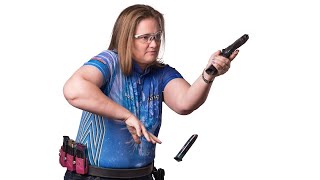
Brooke Cheney of A Great Start Shooting School demonstrates Week 2 dry-fire drills for USPSA/IDPA competition while recovering from surgery. She covers reload technique with dummy rounds, magazine color-coding, state capacity laws, and how to log practice consistently. No live ammo allowed in the room.
Chapters
Ta-da! Here we are. Um, hi. All right, let me say hi to MK Joe. Hey, yo, hola. Uh, G Webs, thank you, second thumbs up. I'm guessing MK Joe might have missed you, got you on the first one. Um, but you know, everybody's got a different way to go, and you are welcome for this series. Uh, once I was explained that you can't have real guns live on YouTube, it's changed how the series was originally going to go a little bit. So anyway, for those of you brand new and not have seen any of this yet so far, here's the deal. My name is Brooke Cheney. I am the owner instructor here at A Great Start Shooting School. Of course, if you want to look up in the corner there— wait, ready? There you go. There's my logo too. Um, probably I'm gonna get to links because I've been told I need to I'll drop links for you all in the description for all the books I'm going to talk about and show you. So anyway, this is week 2. Week 2 of what? When I started this, I had 2 weeks to go until I was going to my first competition of the year, and I am in recovery since June of last year. June I had my appendix out, and then December I had my knee operated on, so I am very rusty and I have not been practicing with my firearm at all. So, um, uh, all right, well, hold guns in my wrist. Okay, well, we'll see. I prefer to be safe than sorry so that I don't get banned because I'm just starting to get you all to visit and all that fun stuff. Oddly enough, I've been told if I pre-record it and then put it up, I can handle as many guns as I like, so So I don't know, I'll work on that, but that wasn't for this series. All right, so I haven't handled my gun easily 6, 7, 8 months at this point. So the best and easiest way for me to get back into preparing for competition is dry fire practice. It is one of those things that I did not know about until I became a competitive shooter, and that's where I met the world-class competitors who— this is how they do what they do and get really, really good. One of the books, if you watched any of the other of these, uh, Dry Fire Reloaded by Ben— he to me is the perfect example of someone who really, really, really got good by doing dry fire. Um, I may or may not be interviewing him later this year about that, but here's what dry fire is. It is handling— wrong hand— handling your firearm without any ammo in the room. See a little ticker below? Make sure there is no live ammo in the room that you are practicing in. And this means no live ammo in the room that you're practicing in, no matter what, because I've had students ask me that, like, oh, can I just have some regular ammo in the room? I'm like, no. Um, Sorry, I'm laughing at G-Web's comment of people who have their organs removed just to shoot faster might be taking things a little too far. Well, and the worst part about that actually was that I was on my way to Aiming for Zero in New Hampshire. I was supposed to staff that event and I felt absolutely horrible picking up the phone while I'm sitting there in the emergency room calling Chris Tessier, be like, I'm sorry, man, I can't make it. I'm in the hospital having my appendix removed. And of course his response is, are you okay? And I'm just like, I'm sorry, you're down a person. So yeah, unfortunately the appendix removal thing was definitely not timed well in any way, shape, or form. So, all right. Again, generally one of the biggest things we talk about is review, right? So week 1, we just got started with here's what we're doing. First thing I need to work on is my eyes and being able to see my sight picture. So that was Monday of last week. Thursday was reloading, and Friday we worked on draw and all the pieces of the draw, from hands relaxed at side to bringing up to clearing your holster to creating your grip and getting your sight picture. There you go. So that was the draw on Friday. And yes, obviously I forgot what we did on Tuesday because I didn't write that down, focusing on what we're doing today. So let's talk about the reloads because I know I did not get a chance to go over them the way I really wanted to. In both course— both types of firearm shooting that I do, USPSA and IDPA, my magazine needs— my magazine holder needs to be behind the front of my hip bone. So generally we want it as close to the front of our hip bone as possible.. So we don't have to go very far. So with that, see this, guess what we're really good at? Humans in general, we're really good at pointing. So I can point right there, right? So when we are reloading, we're going to assume I have already dropped my magazine, just like in that picture. That's the thumbnail for this. I'm taking my index finger and I am bringing my hand down to the front of my magazine. Now I put in specifically orange dummy bullets because, like I said, you all know this is not a real bullet. Orange dummy, so you can see the front of the, of the cartridge, right? So I'm pointing in, and now I'm going to be looking at my gun while I'm doing this. I'm going to look into the base and be able to just slide that in there. Um, when I go to When I'm all done shooting, I need to drop it. I'm just going to make that same effort to put my index finger on the front and tilt into my gun, load it, and create my, my grip again. This is my reload. It's really funny because a lot of the times if you take your index finger— get back here— and I put my whatever it is, magazine, into my mag pouch. I want to make sure, just like we did the draw, how we went forwards and backwards, you want to make sure you know where that is. You're up here with the gun, then you come down, pull up. And this is also where you're checking the tension of your magazine holder as well, because if it's too tight and you have to yank it out, that's going to cost you time.. And yet you don't want it too loose because when you're running, if you run, I will not be running on Saturday cuz my knee is still in recovery. You don't want anything to fall out of your magazine pouch. So just this part again, break it down into the little piece where you're just pulling this up and verifying that it has enough tension, like it's snug in there, right? But I don't have to rip it out of there. Oh yeah, and yes, you get to bend over a lot while you're doing, um, reloading practice. Oh yeah, what I, what I started to tell you about, honestly, was when you put this back in, I always load from the back forward because when you're putting this in here and you go to reload, you want to come to the front. So once I've reloaded this one, next time I have to reload, I'm just making that same motion I'm just getting to my second one, and if I'm in USPSA, my third and fourth and fifth. Um, but Saturday is IDPA, so I only have my IDPA gear on for that. When I see people with their magazines facing the wrong way, I literally am like, hey dude, do you know your magazines are in backwards? Like, nope. And I don't know how they reload. It's just not how I reload. So, uh, where is it? Oh, that, that— wait, that orange sign there says one size never fits all. So I'm not making fun of you if you have your bullets backwards. I just don't know how you reload. So, um, and if you're ever— if you ever don't know, just the same thing happens when I'm doing an on-the-table reload, because that is, um how we do some starts is they'll just be on the table. So if it's on the table, I have it flat side down, pick up and load. So it's just the same if it's on the table versus if it's in my mag pouch. Now hold on, um, somebody, MK Joe, apparently lives somewhere where there's a free state and you can have 33-rounders. And I am not in a free state, nor is production, which is what I shoot, uh, anything more than a 10-round mag. Uh, when you start, you start with 11— one in the pipe, one in the chamber, and your 10. So 11's as high as I go. And I'm trying to think, there are classes where you could have a 33-rounder if you're in a state that that is legal. Unfortunately, there's a lot of actual misinformation out there that competitors think if you go to somewhere like Massachusetts that has a 10-round mag ban that they could bring their 33-rounders because they think there's a competition clause. There is not. We've actually checked with the Attorney General in Mass. So be careful where you bring your 33-rounders is basically what I'm saying. Do I use old bad mags for practice which might not drop well? Do you practice with top-notch gear even though training will abuse it? Um, competition in general abuses all your crap to death. Uh, so no, I, I, you know that run, run what you brung thing? Um, all my competition gear is the same stuff that I, I practice with. Um, I have two identical guns. I tend to use the same one in practice and in competition. Some people are not like that and they have a practice gun and a comp gun. My guns are almost twins. I really have the second gun as a backup if I go somewhere and my gun breaks and I need to replace it and it's not something I can fix quickly. So yeah, no, everything that— oops, sorry, let me do that. Um, actually I do, you're just, you just can't see. I'm a girl, so they're in colors. So this is my blue one, that's my pink one. I got my Barney mag, and that's green sparkles. So I, I don't memorize things really well, so if you told me, oh, mag number 3 was the one that busted, I wouldn't necessarily remember. But if I know it's my blue one, because actually I have one This is my pink one, and this is the bad mag. So this is the mag that I always use for my Barney mag. And for those of you don't know what the heck I'm talking about, um, when, uh, G-Webs was asking the previous question about which don't drop well, this guy is the one that does not drop well. So I know that I want to use this for my extra round when I am loading, uh, at the beginning of the stage during the make ready thing, which I think that might be Thursday's or maybe it's going to be Friday's dry fire practice. We're going to go over commands and that sort of thing. Oh, I'm in the free state but we're not really free. Yeah, well, it's all relative. You're a girl. Wait, what? Yes, because I have pink things. Um, but anyway, I don't know. Um, so yeah, so that's how I know. Um, for those of you who have not been in competition and you don't know why it's important for me to be able to differentiate my mags, it's simple. Like this one, if I notice over and over again that when I go to drop it and it's not coming out, when I've got my finger on the mag release and I do my flick and it doesn't come out, then I know and I noticed that and I'm like, okay, take this guy out of rotation because anything that's not running properly will slow you down. You just can't do it as well. So yes, when you get into it, um, most guys, they just number them. Um, like I said, I just am afraid that my 3 will look like an 8, and I don't know, I have nail polish, so this was just easier. So you want to know if your stuff is working. So that'd be the other reason why, yeah, I wouldn't use garbage for practice, because as it is, um, competition just beats the crap out of your stuff in general. All right, so where are we? That's kind of it. We're almost at 15 minutes. We're at 13 minutes. Um, want to show you reloading as far as what the positioning of your mags are, because I realized last Thursday when I did it I don't think I had put my mag carrier on here. Pointing is number one. Again, get as many reps as you can. So when you are putting your stuff away, make sure that you're doing the same thing that you do when you're going to be taking it out. Every rep can be done forwards and backwards. One of the other things I did want to mention, since I brought— I have Ben's book out on front is that you don't have to figure out what you're doing, uh, because people like Ben have it figured out. So I highlighted the table of contents to be what the elements, standards, scenarios, and practice stages are. In the back of his book, he says if you're a beginner, which is what I am practicing like, here's where you're going to practice on each day of the week. And week 1, 2, 3, and 4. So for the next 4 weeks, if I were going to follow Ben's program, every Monday would be elements, every Tuesday would be practice stages, every Wednesday would be elements again, Thursday are scenarios, and Friday would be standards. And then that's taking 2 days off. Um, uh, Mike's book, which I've also been showing you guys as well he has specific drills actually listed out. And for this one, it's a stationary draw, all the different types— pivoting draw, stepping draw, table draw, that sort of stuff. Um, then the next day, stationary reload, stepping reload, swinging reload, table reload. And again, all how to do all of these things are in the books. So, um, I'm gonna read stuff. Thanks for the info. I also mark my mags for the same reason, for when it's time to rent maintenance and replace springs before they break. Yeah, I've not ever had to replace springs, ever. Um, not saying that I shoot enough to, but that is definitely another advantage of knowing what mags are doing what. Because the other thing, other than having to do that reload and having them not come out, the other part is if they don't go in well that would be the other time that you want to take them out of rotation. Um, yeah, I've never replaced springs, so. All right, good practice breaks gear. So good training costs you money if you're willing to gain the experience breaking their gear and practice. In my experience over the years, well, good news is for me at least, I have not really broken any gear. Generally what happens is what actually happened on Tuesday when I ran my classifier and I just lost my fiber. So I would much prefer to practice in my gear and have it break during practice versus when it breaks during the competition. So, um, but yeah, it's— this stuff does break, um, but that's all part of the cost. Your time investment is huge when it comes to dry fire, or it can be. I have not been practicing a ton. Like I said, I did Tuesday, Monday, Tuesday, Thursday, Friday. I also took the weekend off. I didn't do anything. When I leave you guys, I have to actually go find my gear because this is for, um, my M&P, not even for my CZ. So anyway, um, oh, so yes, this is actually a very valid point. Dropping mags— people will hold their guns over the couch to keep their two mags perfect. The couch— the bed is actually easier because most people's beds are higher than the couch, at least in my house. So there are those. I actually have a basket that I got that I can put around my waist to catch my mags for when I'm— when I am practicing a ton and I just don't feel like dropping picking stuff up off the floor all the time. So I don't know if the baskets are available to people anymore or not. So, all right, well, do you have— you kept me talking again, but that's all right. Um, I think that is everything. Write down everything. If you're not tracking it, you don't know what you've done. It's just like dieting. We tend to underestimate what we've eaten and we overestimate how much we've been practicing. So, um, write down your goal, know why you're doing what you want to do. And it could be something as simple as, I am doing Ben's plan because Ben said so and he's a world-class champion, so I'm just going to do what he did. Um, and know that the knowledge will come. So with that, I bid you all adieu. I'm going out to dinner with my husband. I will see you all tomorrow. I already set the links. I will be here 6 o'clock Tuesday, 6 o'clock Thursday, and on Friday will be the big reveal of whether or not these 2 weeks of just dry fire practice will improve my, um, classifier score. Oh, and DJ comes in at the last minute. Clutch move. Um, yeah, sorry dude, I never put the link up. I apologize. Um, So anyway, come visit me at A Great Start Shooting School. We're about to roll out a whole brand new website, so prepare for everything to crash. Anyway, love y'all, have a great day, stay safe, finger off the trigger, sights on target, smooth trigger pull. All right, talk to y'all later.










