Keep your gun unloaded, and how to do that...
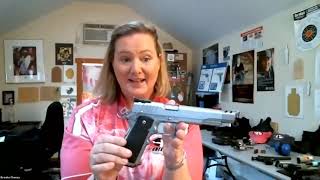
NRA Rule #3 requires keeping firearms unloaded until ready to fire. Learn how to verify a revolver is empty by opening the cylinder and checking each chamber, and how to clear a semi-automatic by removing the magazine and pulling the slide back to inspect the chamber.
Chapters
Alright, number 3: Always keep the gun unloaded until ready to use. What does that mean? That means your gun is always unloaded. It's very simple. Again, these are the NRA rules for safe gun handling at the range. We are not talking self-defense. What does that mean, you say? Do you have a gun? I don't know. I know Peter has a gun. I mean, I know some people here have a gun. You're never supposed to tell who has firearms and who does not. So how do you know? Thank you, Peter. I'm like, oh. So yeah, so it's nobody's business if you own a gun, by the way. You don't have to tell anyone ever. As a woman, I generally My students will say, "How many guns do you have?" I'm like, "More than one," is my answer, because as an instructor I need to have at least one. So keeping your firearm unloaded. Let me show you. We'll start with a revolver. How do we know that this is unloaded? Well, most revolvers you're going to find in a drawer or in your box or wherever it is that they are currently stored, that it will be in this closed position. Now this is where I have some challenges. I don't have like fancy cameras or anything, but most revolvers are pretty much the same. This is your cylinder and this is your cylinder release, release latch. And so when I push this forward— oh gosh, sorry— so this here pushes forward and then this will pop out. We do what's called the rock star. Looks like this. See, that backwards, got it. So that your hand is nice and comfy in there and you've got a good grip. Now to verify if it's empty or not, you wanna look and see if there's anything in your cylinder. And oh, look, there is. But the good news is, like we told you at the beginning of class, that is a dummy round. But I wanted you guys to be able to see these are all empties. And then, oh, there's one there. So you open it up, you realize, "Oh, I have ammo in there. What do I do?" Well, with a revolver, because you're already a rock star, notice how easy my thumb goes on this long little thing here. That pushes down. So when I push down, now there is nothing in there. So that is how you empty your revolver. Super simple, super easy. When people are beginning to shoot, and they want super simple and super easy, revolvers are absolutely the way that I teach them to go. Even people who have arthritis, that sort of stuff, because pushing this little button forward and pushing that out is relatively simple. Now, but Brooke, I don't have that revolver. I'm like, okay, I have more. So to give you an idea, Here is another revolver. Oh wait, I'll put another dummy in so you know. So here's a little tiny revolver. This is from Charter Arms. Yay, Connecticut! Because Charter Arms is made right here in Connecticut. I've been to their factory. They're very sweet people. So anyway, so here's another revolver. It's smaller, but look, it's exactly the same thing. You have your cylinder release latch. You put your thumb there, and again, you're pushing it towards the cylinder, and then you're just pushing your fingers up. And it's empty. Oh, it— yeah, the orange one was easier to see. But nope, there's something there. So, well, that just falls out, but it's the same thing. You push on that lovely little thing here. I'm not going to get into technical stuff just because this is just basic safety, so you can verify it is empty. All right, that's revolvers. And the nice thing about revolvers and guns in general is most of them are going to fit the same, um, what I want to say, they're sort of the same pattern basically. All right, so now we've emptied out revolvers, if that's what you happen to have, and we verified that that is unloaded. So now Let's talk about a semi-automatic. Oh, but wait, silver shows up better, so hold please. Ta-da! It's not that I can't get up, it's just this is more fun to just slide around. So this is a magazine. This is where the cartridges go. And we're not going to get into loading and stuff. I just want you guys to be able to see what it looks like loaded versus unloaded. So if I come home or I'm finding a firearm or I'm working with a firearm, I do not know for sure if this gun is empty or loaded. For those of you who know Schrödinger's cat, same idea. We do not know what is in here until we visually and physically look and verify. So with a semi-automatic gun, The first thing you're going to do is take the magazine out. And if only I brought my left-handed magazine or left-handed gun, this would be so much easier. So on a semi-automatic, basically to get the magazine out, most guns have some form of release in this area around the trigger guard. So in order to get the magazine out, You're going to— hold on, I'm going to do this all left-handed so you actually see what it looks like— or right-handed. So while holding on to the firearm, and you can let gravity be your friend, you push the button in towards the grip. It's going towards the grip because sometimes when I say in, people don't know which way I'm going. And that takes the loading device out. So see, now the ammo is here. We're good, right? No, no, we are not. We still need to verify that there's nothing inside here. So in order to do that, I have to open this. But wait, it won't go anywhere. Why won't it go anywhere? Well, because my safety is still on. Some guns have a safety, so I need to take the safety off and push that down. Now So when I open this, it's going to show me— there's my other bullet that was in there. So I can drop that. Okay, so now there should not be anything in there. I took the magazine out first, so it wasn't able to load the next bullet. I have racked this back is what it's called when you open it up so you can see in the chamber. Apparently I need a flashlight for you guys in the distance. But I really want to really verify. So somewhere along here is what's called the slide lock, and it's a little button that is going to be a lever that's going to be able to go up. So you want to be able to rack your slide back and push that button up so you can actually look in there and verify that it is empty. And that is how you are verifying your gun is actually empty. So that being said, I wish that I knew how to get you guys to chat because I would say, any questions now? Or what are your questions? Because right now we have a slight— oh wait, all right, so that was one gun, right? What do I do? But Brooke, I don't have that gun. Let me show you another one because semi-automatics are similar yet different. So this is cute little Walther 22. And when the magazine is in there, you can see my fake bullet, right? So when the slide closes, it goes into the chamber. So now remember on this one— oh boy, this is gonna be fun— this one had a magazine release right here, and I would push it in to get the magazine release to come down. Now for the Walther, Again, it's similar where it's right near the edge, but this one is different. This has a little lever. So I don't know how well you guys can see that, but that actually goes down. So even if you don't have the same guns that I'm showing you, the mechanisms are still basically in the same area. Now, both the guns I just showed you have hammers right here. So in order to move your slide back, you want to make sure— to make it easiest on you, if your hammer is back, it makes it easier for you to move your slide. It's not that you can't move it when the slide is forward. However, it does make it a little bit more challenging. So when I am done with my guns, then I put them away.










