Legislative alert! Violence is a verb, an action verb...
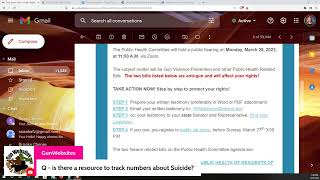
Firearms instructor Brooke Cheney walks Connecticut gun owners through two upcoming bills: one creating a 21-member Gun Violence Commission and another declaring gun violence a public health crisis. She opposes both, argues existing programs work, and provides step-by-step instructions to submit testimony and contact legislators.
Chapters
And I am live. Welcome, replay viewers, because you all are the only ones who get to see the beginning of this. All right then, you know that sound effect that they make at the beginning of newscasting, or at least they used to? That's what I was trying to imitate. Um, I am not Adrienne Cronauer, however. Although maybe this will be interesting, maybe it will not be. So for those of you just checking in, hi, my name is Brooke Cheney and I am here at a, in Connecticut at a Great Start Shooting School. Why I am online talking to you guys, because see that and that, these are new bills that are going up before the public health Wait, what is it? Public Health Committee. Yeah, Public Health required. Oh yeah, Committee of Public Health is actually what it says on here. So what are these handy-dandy bills here? What are they about? Public health, of course. Why am I, Brooke Cheney, a firearms instructor and owner, talking about public health bills? What do guns and public health have to do with one another? Well, here's the deal. Depending on who you are, they kind of really shouldn't, but they kind of really do. So let me tell you what's going on here in Connecticut right now. Just a mere few hours ago, CCDL has sent out the Connecticut Citizens Defense League action alert because on Monday nary 3 days, 2 and a half days from now. They are going to have a hearing starting at 11:00 AM via Zoom. And what's it going to be about? Well, let me tell you, the subject matter will be gun violence prevention and other public health related bills. The 2 bills below are anti-gun and will affect your rights. So what is CCDL asking us to do? Number 1, please, by all means, write a testimony. And ideally, at the end of this video, you will have a better idea of what perhaps might want to be in your testimony. 2, email your written testimony to publichealthtestimony@cga.ct.gov. And obviously, sorry, if you're only listening to this, it's PH testimony, but that stands for public health. Hey, PN Woods. Uh, yeah, hold on, wait a second, I gotta grab you. So yes, I feel like I should have a cape. Yeah, well, I'm running, I'm not gonna lie. This is a lot of a lot of stuff. I am trying to be a 2A superhero, but really and truly, I just want people to address violence as a problem and stop talking about guns. So, um, because lots of us have guns that have nothing to do with violence. So once you've written your testimony, then you're gonna email it to not only the public health testimony email, but please, please, please reach out and send it directly to your state senator and representative. If you don't know who your state senator is, we're not talking about Blumenthal and Murphy, we're talking about your district senator. Um, click on the link that says find your legislator. And I realized I forgot to pre-do that for you all. So I'm going to pop that link right in the chat. Chat right now. So give me just a moment. Ta-da! There you go. And if that doesn't work, when I am done, I shall cut and paste these things in the descriptions both on YouTube and Facebook. All right. And then if by some miracle on Monday you have time to sit in a Zoom meeting starting any at 11 AM and going till we don't know when, because I don't know how long they run their hearings. You must click on this testify via Zoom link, which I will also drop this in. Is this gives you the opportunity to go ahead and let them know what you feel. What your opinions are. You have 3 minutes to testify if you happen to do this testify via Zoom thing. So, uh, let's see, besides DC Project, you have a preferred gun rights org. So here's the thing, Domo, is that here in Connecticut, uh, CCDL is absolutely my preferred gun rights organization. And as far as nationally, I don't, other than DC Project. So because I know DC Project the most, so that is the answer to that. So yes, NCT. Sorry, that was your next part, right? Um, so yeah, it is Connecticut Citizens Defense League whose stuff I am showing, sharing with everybody. All right, so step 1, prepare your testimony. Like I said, at the end of this video you will have an idea of what that's going to look like. Email it to your senators— excuse me— and state reps, as well as to the public health testimony email. And if you have an opportunity, and here's the thing, even if you don't know if you can make it, some of these meetings go on crazy late. So if you can sign up before 3 PM tomorrow, Sunday, March 27th, and if you make it, great, and you have an opportunity to jump in. If you don't make it, that's okay, at least you tried. So let's get into the bills. Ready? All right, SB number 477. SB means Senate bill. An act concerning the public health of residents of the state. Now here's an interesting thing. When you go to this bill, the part that we are not liking is section 7 of SB number 477. The rest of the bill has to do with dementia and special care units. So we are only against Section 7 because Section 7 is talking about creating a 21-member commission on gun violence intervention and prevention. So who will be in the commission? Members of organizations that spent hundreds of thousands of dollars lobbying for gun control here in Connecticut. Representatives for organizations like Connecticut Against Gun Violence, Mothers Against United, United Against Gun Violence. So if you want to know more, when we click on this link, it will bring you to the actual General Assembly page, at which point, if you want to see what's in the bill, you click on where it says Raised Bill Doc. Okay, and, um, so, Domo, just so you know, Tech DC Project is national. So when you donate to DC Project and you're in Texas, it will go to the Texas girls because we do have folks there. So I appreciate that, and so do the girls in DC. We also have national stuff that does go out to everyone. All right, try to stay back on track and not get sucked into the things. So here we are in the actual bill. Like I said initially, if you start reading it, you're like, wait a second, why would I be against this bill? We're talking about dementia and special care unit or program. We're obviously not against any of that. However, If we continue on to Section 7— whoa, hold on, I have it highlighted. Wait, I should just go to my written one so you all don't have to wait for me to get to this. All right, so on page 9— what page are we on now? All right, oh my goodness, I went past it. All right, Section 7 starts on line 229. So when you are chatting, or when you are chatting, when you're writing your testimony, you can say, dear representatives and senators of the public health, um, committee, please vote no, or please remove lines 229, section 7. And then it goes all the way to, I got to cheat on my notes, through line 339. To be removed from the bill. Why do we want this removed? Well, I got my Cliff Notes here, so we're going to go to those instead versus reading through the entire bill. Oh, but the whole reason I went to the bill is so I could drop that link for y'all. Hi DJ, and yes, tonight you're welcome to, uh, drop links for me, but for right now, because I'm winging this, we're just going to go there. So if you want to look at this bill, click on the link I just dropped. So Section 7. Now I'm going to go back to my Cliff Notes of the bill. So violence in our society is absolutely something that every gun owner and every person is against. However, uh, we do want to reduce it. The problem with this bill and Section 7 is that it's focusing on guns and not on violence prevention alone. So there are already programs that have been proven to work, right? Our government body gets slower in responding to our needs as it grows bigger and requires money to keep it going. The bill does not serve people who have to deal with violence on a daily basis. All they're doing is making it harder to actually get anything done. And as much as I wish I hadn't just closed the bill Sorry about that, everybody. Um, the thing about this bill, and I can run through it relatively quickly because it's not horribly long, uh, I mean, it's horrible, but it's not horribly wrong— long. Oops, not 200, that's too hard to read. So if I go to page 9, I'm almost getting better at this, right? Oops. That's not what I want to do. I have a mouse that I'm playing with and it's not working the way I want it to. Sorry about the delays, folks. All right, so page 9. This is what we go through trying to figure stuff out, right? So first thing they're trying to do is create a new, uh, a whole new thing. Right? Mental health— what the heck? What number am I on? I gotta— I'm looking at the wrong screen. Oh, where'd it go? All right, bear with me. I know it's here somewhere. Page 8. Ah, that was my bad. I went too far. All right, Section 7. There we go. Because I'm going to explain to you what some of this stuff says because I've been doing this stuff for over a decade, and honestly, it's a pain in the neck, and I'm starting to sort of understand this. So, couple of things for you to notice. See where it says new? That means this is new language. It's being added to the legislative process within our bills and our laws. So, some of the stuff you look at. So, establish a commission on gun violence intervention and prevention. Okay. So we're creating more government. We certainly do not need more government. We already have enough problems funding the existing government that we have and getting them to implement things on a regular basis. So community-centric gun programs and strategies— how about we just get to violence prevention? Let's stop wasting time and money. Now here's what it tells you how this is going to happen. The commission shall be composed of the following members. They're going to be folks that are handpicked. Whenever you see the words to appointed or appointed, they're talking about someone's going to be able to say, oh, I like you and I like your point of view. So I'm going to appoint you to this new commission. And then it goes on and all the different people that are being appointed to do this. And I promise you, someone like me is not going to get appointed to one of these positions. So that's what a big chunk of this is, is talking about who is getting appointed, right? And who's appointing them. Once they get through who's going to create, uh, be part of this, then they start talking about, oh well, initial appointments will be to the commission shall be made no later than 60 days after the effective date. Effective date is at the end of this thing, which isn't until next year. One of my arguments about this is stop putting off helping people now by saying, oh, we have to do this first. Um, and it continues on about who's going to get appointed, who's getting the positions. So, uh, now this sounds good, right? The members of the commission shall serve without compensation but shall, within the limits of available funds, be reimbursed for expenses. Well, We don't know what their performance of their duties may or may not include. So this is just our government spending more money that we don't need to spend due to the fact we already have the ability to implement violence prevention strategies under public health without creating a new commission. All right. So now here's the next. The commissioner, by majority vote, shall hire an executive director. Oh, wait, what's this? Oh, this is so someone else can make money. The executive director is gonna get paid, and the executive director can then also have two administrative assistants. Hey, Vanessa Kitty! Oh wait, see, my mouse is on two places and I just don't even know. So more money, more money, more money. If we're trying to save lives, prevent violence, we need the money to go directly to violence prevention strategies, not to an executive director and assistants. So they're gonna implement all of this stuff, which, you know, evidence-based, evidence-informed, community-centric programs. Here's the truth: violence prevention is always community-centric programs. The DOJ, Department of Education— oh gosh, there's a couple more— CDC community-centric programs are the way to prevent violence. We do not need an entire new commission to go look up this stuff again. It's already out there, which I'm going to talk about more in the second bill. So, I mean, the idea behind this is lovely. Let's prevent violence. The need to wait until January 1st, 2023. To, uh, get reports from them and find out what's working and what's not. Also not spectacular. And why wait if we already have the money? Hold on, uh, I gotta put this up. So yes, yes, we are always. And the fact that Vanessa Kitty has her CCDL sticker, um, that's totally— oh, um, what does it say? Can only get that one in person. Oh, gotcha. Um, All right, so there we have it. That is the first one we're talking about. So I'm going to go back to what I'm writing in at this point in time. This is my rough draft. So Section 7, lines 229 through 339, are to remove from this bill. The bill does not serve the people who have to deal with violence on a daily basis. You are taking money away from them versus funding the programs that we already know work. There is no need for another legislative branch. Please remove Section 7 of this bill and actually fund the programs that help prevent violence. Like after-school programs and the like. Like I said, this is my rough draft. So now we're going to go on to our next bill that CCDFL has put out there for— all right, HB number 5397, an act declaring gun violence a public health crisis and establishing the Office of Gun Violence Prevention and Advisory Council on Gun Violence Prevention. And intervention. The bill will declare that gun violence constitutes a public health crisis and will continue to be a public health crisis until their goals are attained. It will establish an Office of Gun Violence Prevention. Oh yes, that concise request for action. Absolutely, without a doubt. So what are they really looking for? Well, I'm going to close this one so I don't get confused of which things I have open. Let's go here again, raised bill number 5397. And just so y'all know, I'll show you this link as well if you haven't had a chance to get here. What this page tells you is how long this has been in the works. They're color-coded, so if it just been popped up today when we got notice of this hearing and the fact this bill was being heard, you would see it new today. However, it's a Saturday, so probably not. If it was blue like the other one, it'd be 2 to 4 days old, and then 5 days or older is what this bill is. So when you want to read what it says, you click on the link and it brings you to the actual documentation. I keep clicking on the wrong thing. Uh, actual documentation of what the bill actually says, which, like I said, it can be painful to read these. Um, However, it's a necessary evil. Let me throw the link if you just want to go directly here because you don't care about the other stuff. Um, so Vanessa, yeah, uh, all my doctors now ask about guns and if I have them. When I had Jake on here a couple weeks ago and we were talking about that, he was saying it is absolutely ridiculous. They have no right to ask you this. It's really quite wrong. So let's talk about an act of declaring gun violence a public health crisis. Oh, there's so much in this lovely bill, and I say lovely with about as much sarcasm as I possibly can muster currently. So I just have a hard time with this. Let's just talk about Section 1. It is hereby declared that gun violence constitutes a public health crisis in this state and will continue to constitute a public health crisis until the goal set forth in the subsection of Section 2 of this act is attained. What are they talking about? What is their goal? To reduce gun violence? Well, of course we want to reduce gun violence because we want to reduce all violence. So the established— there's an established Office of Gun Violence Prevention, which shall be within the Department of Public Health. Here's the truth, folks. We do not need to spend time and money creating another department within a department. Um, and, uh, yeah, so all the mental health care and health care through the years. One best understates how to chat about firearms to other mild docs. So, um, I don't think I have read that right. All the mental health care and health care through the years. One best understood how to chat about firearms to their medical docs, right? So that was actually one of the things we talked about with Jake, is how in psychology, in psychologists, therapists, we're really working on— they're really working on Walk the Talk America of how to, uh, get better medical care for people with firearms, as far as firearms people not feeling like they're being attacked for being firearms. So All right, onwards. The Office of Gun Violence Prevention shall work towards the goal of substantially decreasing the level of gun violence in the state. Now, here's something I really want you to pay attention to. They're saying that the Office of Gun Violence will work towards the goal of substantially decreasing the level of gun violence in the state. However, The first thing they have to do is collect the data on gun violence in the state, because if you were here for BBQ's long day of legislation, they don't have the numbers. So they're trying to do something that there is already not necessarily a problem for. So gun violence data public available, it already is. The CDC has it, the FBI has it, um, there is plenty of gun violence data publicly available. As you all know— or not all of you, but, um, you know, tonight is Saturday, so at 9 PM tonight I'll be doing Suicide Friends on Saturday. Uh, one of the things about gun violence data is they rarely tell you that 60% of that number— over 60% of the number of gun violence— are suicides. So They are trying to create something that already exists. They want to make recommendations to decrease effects of gun violence on public health, but they already don't have anything according to them, uh, to talk about what is, what is a reduction? What does that look like? Implementing evidence-informed community-based programs. Again, we already have evidence-based community-based programs that actually reduce violence, not only in the state but in our nation. So we don't need one more thing that's going to tell us about what will work, because there's so many programs that are already out there that have been proven to work, whether it's gang for— gang violence task force, reducing crime on the streets, reducing violence on the streets. They're all available already. So again, waiting until January 1st, 2023 to make sure this is all in place. We already have the public health department, and you can implement these things under public health. We don't need an office of gun violence prevention. So I will I will deal with the comments when I'm done because otherwise this will be a forever long thing. All right, so Office of Gun Violence prevention shall establish administrative grant award programs. So what is this again? What are we talking about? Oh, money, money, money, money, money, money, money, money. One of the things that I really have issue with is the money is going to go for intervention and wait, ready? Mental health aftercare for gun violence survivors. Hello folks, why are we being so myopic? Why would it only be gun violence survivors? Again, we can help so many more people if they took the money that they want to do and the time to help people. I am 100% for mental health aftercare for violence across the board. Uh, my notes are, why are we so myopic? About this. So violence is important. Mental health aftercare after violence is important. Gun violence is the smallest portion of violence according to CDC, FBI, DOJ. So again, we're taking this little tiny sliver, um, little tiny sliver, and, uh, it's just like, are you kidding? All right, so yes, for survivors it's a bit late. Well, it is and it's not, because one of the reasons why you want that mental health aftercare is because after the violence, it doesn't end. And I can tell you this because, as we've discussed in the past, I am a victim of sexual assault. And not 10 years ago, I came across one of my attackers while sitting at a restaurant with my family. So that mental health aftercare is necessary for goodness knows how long, because that was a really hard day, and I had no idea how hard it was going to hit me that I saw this guy across the room. He looked at me, he smiled at me, and I about lost my stuff. Not that day, not with my family, but thereafter. So mental health aftercare is super important. So, but yes, no real prevention. But the— what I was going to say, as far as the mental health aftercare is prevention, in that so many live with violence and assume it's the way that it's supposed to be. And especially if we're talking about gun violence, uh, really I'm thinking gang violence, right? And so if you get taught how to deal with violence in a way that you're not going to repeat it, then that makes a huge difference. So it can be preventative. All right, I will get off my soapbox and continue on this lovely bill. So, um, all right, what else is in here? I'm looking at my notes, so I'm gonna go to my other notes because I have the links with this. So health crisis, that's what this is supposed to be addressing. Let's talk about health crisis. The CDC already has decided that our suicide rate is 30% higher than it was in 2020 than it was since 2000, and it's been on the rise since 2013. Our teens and preteen population and veterans are at the highest risk. I'm bringing this up because the numbers that are used to calculate gun violence are made up of over 60% coming from deaths by suicide. So we don't need more offices. Uh, line 9, we already talked about the level of gun violence because they're talking about not knowing it because they need to collect it. Um, then evidence-based informed. Oh, so here's something that I found. CDC has plenty of violence prevention, and I gave them the link in here so they can just click on it and go. I will share this with you all. So that you too can click on it and go. Um, the other part is they're looking for programs that have been proven to work. Well, the Department of Justice, they just spent over $44 million on programs that they believe already work. So I would say we don't need to create a whole brand new arm of our government to create, to look for these things. It's already existing. So, um, they can already use the public health department. They don't need us to— they don't need to create a new thing. Violence is violence. It does not matter what tool a violent person uses. And to get back to the end of the bill, the Department of Public Health— oh, ready? Here was my word of the day: promulgate. Yeah, I don't even know what that word actually— how to pronounce it. However, because they used it, I had to look it up. So to put into effect by formal public announcement. Here is one of those things why reading the bill can be helpful. This tells you that the Department of Public Health may just decide what rules are necessary for the administration of the grant program. So open-ended wording within here allows them all sorts of leeway if this bill were to pass. And what else is in here? Well, it's already been half an hour. I'm not even going to go into all the rest of this. So, um, and there's a lot. I just wanna get to the end. And in the end, what is it? Oh, we're gonna take $5 million from our general fund to put this in here. And my question that I put in my notes is, if we're taking $5 million from the general fund, what department— and I can never spell lose. Who's going to lose that $5 million? What programs could that have gone to if it just went straight to programs and not to a whole brand new arm of government? The bigger the government gets, the slower it moves. The slower it moves, the less people are getting helped. So all in all, that's kind of the summary of what I got for everybody. If you haven't seen the CCDL Action Alert, I ask you to do so. I think I put all the links in here, but I'm going to get off here momentarily and I will double-check to make sure I've got the links. Any questions, anything you need, let me know. Direct message me, go to my Facebook page, leave me a message, any of that, and I will happily help you with testimony. If you need help writing it, I will help you find your senator and representative. You have the links. But, and if you're considering testifying live and in person and you want some coaching, I will help, happily help you after, uh, 2, 2 o'clock or 3 o'clock tomorrow, because I'm actually getting to talk to someone tomorrow about the first bill we talked about Number 477, because the beginning of it being about dementia and special care units, I have someone who's going to take part that part as well. All right, let me go— oh, sorry, I said I'd get back to the comments. Let me see if I can scroll. All right. Oh shucks, I don't know where I lost them, where the last one was. Um, I'm gonna do this real quick. Anyone else? Let's see. Speaking. All right, so just switched primary care, made sure she does have my care license and I'm stored securely. Newest gun laws, only I have access, secured if they are not, right? And to me, I'm one of those people that honestly, I, uh, I don't think it's anyone's business how I do anything. I know there's laws out there but, uh, I try not to talk about stuff. So nobody mentions the suicide numbers, and when they do, as of late, they've actually been, um, trying to downplay them in that the— oh, it's not 60% anymore, it's less than that— which is total garbage because suicide has currently been going up over the last 10 years, not down. And as CDC says, it's been going up over the last 20 years, but I've just been paying attention to the last 10. Um, so I mean, this is what suicide— about the pleasure using a firearm to do it is so small. Well, that's not actually true, hun. Suicide, uh, the, the gun— suicide by gun is actually the largest percentage of how commits— people commit suicide. So I wish that it was smaller, but it is currently not. But it is getting smaller because again, our preteens and our teens are becoming part of the suicide number, and many of them do not have access to suicide or, um, to guns. Uh, let's see, let's see. Oh, all right, Vanessa, give me a link for the 3 bridges that have, uh, go-to spots for suicide. Um, I'm not sure I'd put it up anywhere, but I would just like to have that for what my um, just for my own personal thing. All right, I think that's everything. I think I got caught up on all of this. Oh wait, no, there's more. Um, and yeah, state— in this state, Connecticut, each legislative session keeps pushing to pass even more arms restrictive legislation. And yeah, they're trying to ban everything And again, this is why when I'm talking about these things, it's totally— let's actually focus on preventing violence, and everyone can get behind that. This whole banning gun stuff doesn't work. The countries— the countries— the cities that have the most, uh, stringent gun laws are the ones who also have the highest gun crime. So, all right, have I gotten anywhere? Oh my gosh, wait, do you guys keep talking after I As I reply to these, oh, let's see. Um, I think you guys are just talking to each other. And oh, G-Webs finally, uh, joined us. Uh, thank you, sir. I just want to let you know that, um, I gave away another pair, another deck of your cards today and sent people to you. Okie dokie. And hey, CNT, I will see you tonight, I hope. At an actual 9 o'clock suicide prevention, uh, resource to track numbers about suicide. So not really. Um, I actually end up going to lots of different places. I start with the CDC, I then go to wherever they got their numbers from, and then try to, um, look up you know, what studies they pulled their information from. So, um, that's kind of how that goes. It's same with violence prevention stuff, uh, is that I generally go to the crime, uh, FBI database, Department of Justice. They do a lot of violence prevention stuff. But, um, CDC has the best numbers, but then I usually try to dig down. So, all righty. Um, and that's it. I think I got caught up with everybody. So anybody watching the replay, have fun. Um, and yeah, I, I'm not going to disagree with you, G-Webs, but for sure I've gotten better at it. Um, and there are other places you can go. Um, but I'll talk about that tonight. I'll put that on a chat of how to find about, uh, suicide prevention or suicide numbers for real, as far as guns versus everything else and that sort of stuff. All right, all. MK Joe, thank you, sir, and I will talk to you at 9. All right, goodbye all.










