Let's talk Gun Shopping
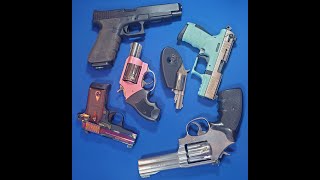
Brooke Cheney walks beginners through choosing a first handgun, starting with defining your purpose. She covers caliber costs, revolver versus semi-automatic tradeoffs, sight options, and budget ranges, then describes her class that teaches grip and trigger evaluation before helping students shop in stores.
Chapters
Ta-da! It says you're live, and so hopefully I actually am. Welcome replay viewers, because you guys are the only ones who ever see the very beginning, because I did not have this planned, as so many of my lives actually are. So let's talk about gun shopping. I have a class, it's called Find Your Perfect Gun, and it really doesn't teach you what gun you're gonna buy. What we really do is we take all of the different aspects of firearms. Of course, DJ is the first one in the room. Hello, DJ. So we're talking about buying guns, and so many people think— well, let me, let me go backwards in time. I remember my first time buying my first gun, and I go into a store. I've been shooting other people's guns.. And I'd been to the range a fair amount and I shot a lot of guns. And I went to the shop and I'm walking around and I'm picking up guns and I'm putting them in my hands and I'm looking at them. And quite honestly, I didn't really notice any difference between one versus the next. I didn't know what to look like, look for any of those things. So I finally, I'm like, all right, this one. And I bought it., and I got a conversion kit for it, which is— it was a 9mm and I converted it to.22. And unfortunately, it was the first gun that I ever sold. And why is that? Well, it wasn't actually what I needed. So this short little live video here, we're going to talk a little bit about that Find Your Perfect Gun class, because even if you've never taken a class from me, at least you'll have some ideas of some are some of the things you might want to pay attention to before you buy your first gun, because, you know, guns are not inexpensive. Your time is valuable. You want to make sure that when you walk into a gun store, you actually already know what you're looking for prior to getting your first gun. Now, number one question you have to ask yourself is, what is your goal? What are you using this gun for? I gotta tell you, I think the number one mistake that most everybody makes when they are shopping is they see an itty-bitty gun, they're like, "Oh, it's cute, it's little, I'm gonna conceal carry it, so the smaller the better." That would be incorrect. The smaller the gun, the higher skill level you need to have to wield that thing effectively. Also, the smaller the gun, the easier it is to have accidents with it because there's less to hold on to. So literally, it's just easier to drop. So first goal of gun— first gun is most likely to learn on, get comfortable with. And one of my favorite instructors, Tatiana Whitelock, you can look her up, she's pretty awesome. She's based out of Maine, but she travels and trains the entire United States and then some. Says really and truly, if you're looking for a carry gun, you want to use the largest gun you're willing to carry. Now, that being said, not all of us are here in order to do self-defense with firearms. Some of us are just want to have a new hobby, want to go to the range with our friends. That's why I started shooting. My husband, my boyfriend at the time, had a gun, and I got my permit because he had a permit. And so we could go to the range together. So that might be it. And then there's others that might get into competition. Well, the best thing about competition is there's other people already doing what you're doing. So you go to them and be like, oh, what guns do you like? And ask to shoot theirs to see if you like their gun. Don't just say that, oh, well, my friend who's XYZ, been doing this forever, likes this gun, so I'm gonna like this gun. Not true at all. So shoot as many guns as you can prior to buying your own gun. If you're like, how do you do that? Well, I will tell you, if you already have friends who have guns, most of us will be super excited you want to go shooting with us and try our guns because we like our guns. So we're hoping you will like our guns. All right, so what else? You want to enjoy practicing with your firearm. If you don't enjoy shooting it, you're probably not going to practice with it. If you're not going to practice with it, you're not going to get good with it, and you're not going to build that comfort that you should have prior to going to the range with friends or carrying or getting into the shooting sports. Cost of ammo. I have lots of students who come in and they've been reading this and reading that because here on the internet we have 5 million things that we can read and it will bring us down 5 million rabbit holes and all that sort of thing. So most common calibers. The most common caliber we have altogether is.22LR because you can shoot that out of a handgun and a rifle. Then for handgun calibers, we have 9mm and.45. Those are the most common. Are there others? Yes,.380 is a caliber that is gaining in some popularity. It's still about as expensive as a 9mm, and people have all sorts of opinions over what you should get. And please, For those of you who are in here for self-defense, understand this: anyone who tells you you can't use a.22 for self-defense, just ask them if you can shoot them with your.22, and the answer is always going to be no. There are other things that go into this. Oh, it's our C&T! How are you doing, Coop? Um, and I'm not saying that.22 is the ultimate self-defense round, .380, but I'm just saying you need to use whatever caliber you shoot well. Because if you are in the self-defense world, you need to make sure you're hitting what you're shooting at. And just because.45 has more stopping power, if you can't handle the gun and you don't like shooting it and you don't want to spend 50 cents a round every time you pull the trigger, this is why a.22 or a 9 or even a.380 will be helpful.. But shoot as many calibers as you can prior to buying your first gun. What else? Importance of cleaning the gun. Oh yes, for those of you who are revolver shooters, God bless, because revolvers are the easiest gun in the world to shoot. They are the easiest gun in the world to clean because they're all one piece and you never have to take them apart unless you're going to get into gunsmithing, and that's a whole nother animal. So there is that. So ease of cleaning, revolvers win 100%. For those of you say, oh, not enough ammo in your revolver, revolvers come anywhere from 3 to 10 rounds depending on the revolver you buy. And when you live in a state like Connecticut where you have a limit of 10 rounds in your magazine anyway, that whole discussion over, you know, mag changes and ability to have more ammo kind of dwindles. So we've got Connecticut, Massachusetts, New York, California where you can only have 10. In your gun to begin with, yes, reloading a semi-automatic is faster if you practice it and you know how. So, and then you can look at FBI stats and we can start talking about how it's the 6. It's 6 seconds, 6 feet, 6 shots are the average thing that occur in a self-defense, per, you know, national averages. The other part of that is 80% of self-defense situations that involve a firearm actually stop, are de-escalated before a single shot is fired. So just some little stuff to chew on. Let's see what else. Oh yes, I know some people love the looks of things, so if your priority is the look of your gun, then that's okay, and there's lots of pretty guns. Just know the prettier the gun, usually the more expensive it is. So part of this will also depend on whatever your actual budget is. I tell everyone, imagine here in Connecticut, basically $400 to $600 is a good price range to figure out where your first semi-automatic is going to come from. $600 to $900 is probably a better price range to figure if you're going to get a revolver. And obviously you can always spend more money on all of these things. And, uh, sorry, I'm laughing at Coop over here because he's like, I'm gonna belt-fed machine gun for EDC. And EDC, for those of you who don't is everyday carry, and a belt-fed machine gun only helps if Coop just happens to be mounted on the top of a Jeep that has a belt-fed machine gun, and that's the only way you can really do everyday carry with that. But, um, there is that. So how it looks is up to you. And when I say $400 to $600 for a semi-automatic, I'm talking about a polymer gun, which means we have plastic on the top or bottom end metal for the parts that need to be metal. That's your $400-$600 range. If you're looking at a full metal gun, which a lot of my students do enjoy, now we're talking $800-$1,200 because it's full metal, so it costs more. The higher end ones, you can think of like Colt 1911 is kind of the classic that people would hear about and read about. SIG, Glock, Smith Wesson are the polymers that are sort of a lot around some of the more popular stuff. It just it depends on what circles you travel in as far as what is what you hear. But Smith Wesson is definitely one of those things. They're big in the competition world. Glock is huge in the competition world. Ruger is also big in the competition world because they sponsor tons of competitive shooting. And then we're just talking handguns here, we're not getting into rifles and shotguns. Glock, SIG, Sig Sauer,. They're having a little bit of a challenge right now. C&T says he's gonna fit that belt-fed machine gun in his really big pants. So, oh yeah, so back to the ease of cleaning the gun. Revolvers win every time because it's all one piece. Second is when we get into semi-automatics, we have really simple ones. Like my favorite to clean is something like a Smith Wesson M&P Pro. Because it's got one takedown lever. I pop the top off, I end up with 3 more pieces: the recoil spring, the chamber and barrel, and the slide. And so all together I end up with 5 pieces because you start with the frame, slide, recoil spring— oh yeah, I guess that's 4 pieces. I don't know, I can't count. I guess I think of 5 because you've taken your magazine out before you start doing any of that. So you have 5 pieces, uh, when you take a basic semi-automatic apart.. Now, Glocks, you end up with the same pieces. I just don't like the way you have to squeeze these little things on the side. So YouTube is your friend if you want to. Yeah, that's it exactly. Sorry. So C&T, when I said SIGs having some challenges, currently SIG's P320 has an image issue, shall we say, because it's had some randomness occurring where it literally can go off in a holster without anyone touching it. Now, that problem with SIG P23, you can go down the rabbit hole and go look that up. I would look at Ben Steger's YouTube site because he's got a whole bunch of stuff on that. So go on YouTube, if you find a gun you like, look and see what it takes to take it apart, decide if you want to love the color or the look and you don't care how hard it is to clean, and if you need a NASA engineering degree to put stuff back together, like my Ruger Mark IIIs, old school. If you get a Ruger Mark III now, it's almost too easy to take together because it's single button. But those of you who've been around for a bit, you know there are just some things that are ridiculous. So, um, Yeah, and C&T says always remove the source of ammunition before starting to take down or clean your gun. And I do tell my students all the time, when you read that headline of so-and-so shot themselves while cleaning their gun, they were not following the proper safety rules of no ammunition should be present when you are cleaning your firearm. So the first thing is your gun is empty before you start handling it in order to clean your gun. So that is essentially the Reader's Digest version of the questions that I ask when you come to Find Your Perfect Gun class. Then when you are here, we actually look at sights, we talk about triggers, um, let's see, all sorts of stuff. Because again, when you don't know anything, you pick up a gun, you pull the trigger, you're like, or it fits in your hand or whatever. And this is why I don't suggest this class for your first class, because your first class. We want to normalize your grip so you're doing the exact same thing every time you're touching the gun. So when you pick up the gun, you're assessing it equally to the next gun that you pick up. Then sighting systems, you know, we got to understand what our sights need to look like. If we're using iron sights, we got to decide if we want to have batteries in our bag. So we have things that have electronics like red dots, and red dots and lasers are two separate things. Lasers are what you see on action movies where everyone all of a sudden has red dot, red dots on them. That's where a laser goes onto your target. Red dots are an optic where they sit on top of your gun and you just see literally a red dot on a piece of glass, and that's a whole nother animal to go down. So that's just talking triggers, grips, and sights. Then we can talk controls and that sort of thing. So this is why you want to shoot as much as you can prior to ever buying your own gun. The amount of students I have that come in here and say, "I'm gonna go get my own gun and then learn how to use it," and I'm like, Come to me, shoot as much as you can. Go to your friends, shoot as much as their stuff as you can. Start learning, like, what grips do you like? Do you like finger grooves? Don't you like finger grooves? You like wood? You like plastic? You like rubber? There's so many options, and there's lots of things to enjoy and love, and there's things that I don't want you to have buyer's remorse over. So with that, that was kind of my point, because I've been doing a lot of Find Your Perfect Gun classes. I've been doing a lot of concierge shopping for my students these days. Once you've come here for at least 2 or 3 lessons, I will offer you the concierge gun shopping where I will— you hire me and we just literally drive to whatever store you want to go shopping in and we go shopping together and maybe you get your first gun, maybe we just talk and explore and understand what it's like to go to a gun store for your first time. Just like any other type of store, you've got your itty-bitty boutique types, you've got your Walmart style, like Cabela's and Bass Pro, that sort of thing. So that is kind of that. Yeah, so the concierge gun shopping is only available to existing students because I know you know your grip, I know you know how to handle firearms safely, I've already taught you all the basics of shooting. So when you're picking up that gun, you have a better idea of, ooh, do I like this, don't I like this, that sort of thing. So there you have it. Find your perfect gun. Basically shoot as much as you can, shoot as many calibers as you can, shoot as many styles as you can, and go with what feels best to you, not what somebody else tells you. All right, my friends. DJ C&T, thanks for popping in here on the live. For those of you watching the replay, feel free, drop comments, questions, anything you want to know down below. In the description, I do have a link to the Find Your Perfect Gun class. And for those of you who are far, far away and you'd like to do something like this online, I do offer that in the evenings. However, it is not something you get on my website, so you would just click on the Contact Me on my website. So with all of that, have a lovely rest of your day, whatever time of day it is, and hopefully I'll be doing a little more of these more often. So have a great day. Bye, guys.










