NRA Basic Pistol Lesson 4
Learn to score targets, understand pistol types from air guns to centerfire models, and get a framework for choosing one based on your purpose and budget. The lesson covers field-stripping, cleaning, and safe storage, emphasizing test-firing before you buy.
Chapters
All right, Lesson 4: Scoring Targets and Selecting and Maintaining Your Pistol.
Learning objectives: properly score a pistol target, explain the basic guidelines for selecting and purchase—
purchasing a pistol, identify the materials needed to clean a pistol, and demonstrate how to safely clean a pistol.
I will happily let you all come over and clean my pistols.
Okey-dokey, here we go. Scoring targets.
Hits outside the scoring rings have a 0 value.
If you miss the target, you get nothing.
Hits completely or partially inside a scoring ring, like this one and this one and this one, uh, get that ring's value. So these 2 are 9s and this is an X.
Hits that touch or actually break the scoring ring receive that ring's value. So these guys are 10. So this is one of the cool things about competition, is that the benefit goes to the shooter. Types of pistols. Air pistols provide practice at home because you can shoot them in your basement, and the same safety rules apply, although I will say the stuff bounces all over the place. Rimfire pistols— those are the things we're going to shoot here today in class because low recoil is awesome.
It makes it so much easier to learn when you're not having to fight with the firearm— lots of recoil and lots of noise. And then we have centerfire pistols, available in many calibers, suitable for personal protection, hunting, competition, and more.
And rimfire pistols are also good for competition, and you could even get air pistols as well for competition. So Factors in selecting a pistol. Oh, what is this? We have another test question. So if you would go to question number 37, it says the single most important selection criterion revolves around the purpose of the firearm. They had to use a whole lot of 10-cent words to say the intended use of the pistol in question number 37. That one is true.
Why are you buying a pistol right now? Because you're brand new.
It's so you can learn how to handle a firearm, because you cannot save your life with something you are not comfortable and confident with. Price and budget. I would guess generally a brand new gun currently—
can get a decent one between $400 and $600.
You can get stuff less expensive.
I just rarely have that kind of taste. However, I I have gotten some good guns under $300. So, uh, availability, price of ammunition. The more common calibers are.22LR, which is what we shot today.
Then there is.380, which is seeming to be very popular these days.
9mm is still more common, as well as.45 and.38 Special are kind of the ones you probably have heard of before.
Pistol fit and ergonomics. This is the joy of always creating the grip exactly the same way, because when you go gun shopping, you can, um, create the same grip so you can evaluate the guns the same way.
Because if every time you pick up a gun and you grab it differently, you're going to have a heck of a time deciding if you like how it fits your hand.
Pistol size and weight— bigger is better. The larger the gun, the the easier it is to control.
Obviously, there are times when bigger is not always better, but generally the pistol size and weight is a matter of your preference.
But it's easier to handle and maneuver and find magazine releases and that sort of thing the larger— on a larger gun.
Also recoil.
The heavier the gun is, the easier it is for you to control the recoil. Simplicity and ease of operation of— or sorry, simplicity of operation, ease of cleaning. Revolvers win every time. Revolvers are the easiest thing in the world. They are one piece.
You don't take them out, you don't field strip them. They are ready to clean right now, or they are ready to go to the range. They are ready to be loaded or unloaded.
Um, yeah, there's nothing simpler than a revolver.
Reputation, manufacturer reliability, record of make and model, warranty or guarantee, and availability of aftermarket parts. All of those are up to you. If you're a Consumer Reports kind of person, then you care about all that stuff. But I'm going to just say most guns, if you've heard about them— Ruger, Colt, Smith Wesson, Glock— there's just so many that just, you know, if you've heard of them, they're probably pretty decent. And there's amazing new up-and-comers. All right, so selecting a pistol.
When considering purchasing a pistol, consult knowledgeable shooters, research, and if possible, test-fire various makes and models, and purchase the pistol from a reputable dealer. I say nay, you must shoot before you go buy a gun.
So many people come to me and take this class and then are like, oh, I'm gonna go get my permit to come back and learn from you. I'm like, no, for, for, for peanut, the sake of peanut butter and jelly.
If you want to buy a gun, shoot as many guns as possible before you buy one.
Because what happens is buyer's remorse. You go to the gun store, you ask the poor guy behind the counter, what should you get? They have no idea of what you should get.
You need to understand what calibers you like to shoot. Shoot?
What size of gun do you like to shoot? What are you proficient with? And that is why I have my Find Your Perfect Gun class, is so that we can try different guns and you can learn how to evaluate guns based on size, trigger pull, sighting system, all of those things. And, um, so yeah, so shoot as much as humanly possible prior to.
You can still take lessons without your pistol permit.
Before you actually get it. And my suggestion for my students is come and take the 5 or 10 lessons, because if you can come for the next 2 or 3 weeks, 1 lesson a week, you're going to be amazed at how much you learn and really feel like you know what you're doing before your pistol permit gets here. And then by the time it gets here, you'll actually know what kind of gun you're really looking for. So it makes it way more exciting and you're much less likely to have buyer's remorse if you just go and grab a gun. And then purchase the pistol from a reputable dealer. I do like smaller shops more than big shops. I like my gun stores to know my name. So, um, there are lots of little gun stores all over the place.
All right, caring for the pistol.
Proper care of the pistol involves preventative maintenance.
The pistol should be cleaned and lubricated after every shooting session.
The pistol should always be checked to ensure it is unloaded before cleaning or other maintenance. No ammunition should be present when a pistol is cleaned or maintained.
Just like this classroom where there is no live ammunition in this classroom, you should pick a place in your home where no ammunition is ever allowed, and that is where your, your dry fire practice and your gun cleaning should occur.
So all the stuff we did in class today, you can do at home so you can learn how to properly handle your firearm. And you want to have a place that is safe with no ammunition. The pistol should always be checked to ensure it is unloaded before cleaning or other maintenance. The number of headlines that say, ah, so-and-so is cleaning their gun prior to, you know, they were— they shot themselves while cleaning their gun.
I'm like, no.
No, no, no, you can't clean a gun without field stripping it. Well, I suppose you can clean a revolver without field stripping it. However, you must have an empty gun in order to take it apart. And as far as people always ask me, the pistol should be cleaned and lubricated after every shooting session. People ask if I do that.
I'm like, when I used to go shooting once a year or once every other year, yes, I absolutely cleaned and lubricated my gun after every shooting session.
Now that I have multiple guns that get shot on a weekly basis, I actually clean my guns when they stop working. So, uh, that is not proper care of the pistol, and, um, I would not do that. I'm not suggesting that, but I'm just being honest with you as far as how that goes. I know people that absolutely 100% every single time they clean and lubricate before they put it away. And if you're like I used to be, where you go shooting once a year or once every other year, you You absolutely must clean and lubricate it because otherwise it's going to sit in there and it was going to rust, and you don't want a rusty pistol.
All right, here is the gun cleaning equipment that you want.
Eye protection for when you're using the brush on all the little small parts after you put bore cleaner on it. That's what that's for.
Have I ever used that?
No, but it really is a great idea.
The other thing, soft cloth.
You can buy one of the fancy ones in the store.
I use my old towels and sheets and I chop them up. That's just easier.
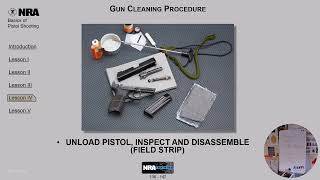
I love my protective gloves. I think that's just the best thing ever. I don't look like a mechanic when I'm all done with all the oil and cleaners all over my hands. Your boar brush and jags and your patches are going to be bought in the caliber of the gun that you are cleaning. Your cleaning rod is generally generic and will fit any of the bore brush and jacks. All right, the only other thing they didn't have on there that I like is the bore snake, which is this little guy over here in the corner. It takes the place of the brush in the patches, so I just find it because it's 2-in-1, so I definitely prefer that. And this is what your gun looks like, or your semi-automatic looks like, when it's field stripped. Your slide comes off, your barrel that has your chamber on it, and then this is your recoil spring.
This is your frame, and this is your magazine. So you unload it, inspect it, and disassemble.
And we, like I said, we call it field stripping.
And this one always cracks me up: gun cleaning procedure: apply cleaning solvent to bore brush, do not dip brush in solvent.
What they meant to say is don't leave the solvent in the original can and dip that into the original can.
However, most cleaners these days come in a spray bottle, so you just take the brush, put it over your garbage, and then you spray the brush with the solvent.
Gun cleaning procedure: run brush completely through bore 10 to 15 times. The NRA is not great about updating their stuff sometimes, so most ammunition is much cleaner than it used to be. So I would say I don't go more than 3 or 4 times if I go that much. So 10 to 15 is probably excessive unless you had really dirty old ammo is the only reason why I could think that you would go that long.
All right, run brush through each chamber of a revolver cylinder. Notice how his hands are wrapped around the gun.
He is actually holding the cylinder open and there's a little arm here that that swings out on, and you want to hold it because there's actually a fair amount of force when you're pushing that brush through there, and you don't want to bend the arm. Now, guns are over— they are, they're very sturdy, so it's not like it's going to happen all at once, but it's still a good way to take care of your revolver while you're cleaning it. With a semi-automatic pistol barrel, Yes, just clean it with the solvent.
This is my favorite one: put jag on rod and patch on jag.
I feel like I should start a Dr. Seuss cleaning kit. So I just think that's fun. So your patch, like I said, is going to be in the caliber of your gun. The jag is just universal.
This is your white glove treatment for your gun to make sure you really got it clean, because if this still comes out clean, then you are all done. And run patches through the bore chambers until they come out clean, which could be a lot or a little. This is why I love the Bore Snake, because it really does a great job.
So you're using the brush for the crevices that you can't get with your fingers and a rag.
And when you clean and lightly oil exterior of the pistol with a soft cloth, it keeps it from rusting.
That's why you're lightly oiling your exterior. You can't over-oil your guns. The only thing that happens if you put too much oil on it is that the next time you go shooting, you just get dirty because the oil goes everywhere.
But other than that, you're pretty much set.
And as far as lubrication goes, the owner's manual you have with your firearm will show you where and how much oil to put. Now, this is also where YouTube is your friend. You can actually look for pretty much any gun and someone will have done a video on it.
Um, when you're lubricating, uh, semi-automatic, something like this, this is metal and these rails right here are metal.
I also put a little oil on my barrel and that's it. Like, I literally, on the end of the slide, I put a drop on either side before I put it back on top. And these are the rails that it slides up against, and that makes the oil go all the way from front to end.
Okey-dokey. Pistol storage. Store guns and ammunition so they are not accessible to unauthorized persons.
Again, here in Connecticut, basically all your guns per law are— all guns must be locked up at all times. Again, I am not a lawyer.
I'm not offering—
I am not offering legal advice, but it looks like we're going that way.
All right, store guns and ammunition separately and store guns and ammunition in a cool, dry place. All right, ready?
Everyone say this together: always keep the gun pointed in a safe direction, always keep your finger off the trigger until ready to shoot, and always keep the gun unloaded until ready to use.
As a result of your participation in this lesson, you are now able to properly score a pistol target, explain the basic guidelines for selecting and purchasing a pistol, identify the materials needed to clean a pistol, and demonstrate how to safely clean a pistol. All right, what are your questions?
Yes, the kits come all together, but you really don't have to buy that much. Just remember to buy it in the correct caliber of your firearm.










