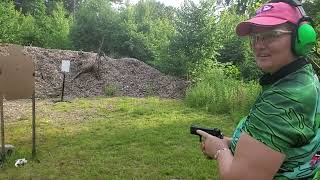
Brooke practices with a CZ 75 P-01 ahead of the Massachusetts IDPA Championships, working through accuracy drills at 5 and 10 yards. He struggles with a paster drill, identifies a possible left-hand pull, and refines his draw technique before painting targets to confirm shot placement.
Chapters
All right, so I have a match, uh, 6 days from now on Sunday. I'm going to the Massachusetts IDPA Championships. I'm like, yeah, what class am I going to? Anyway, I have to practice because I have a gun that I'm planning on using in competition that I don't normally shoot in competition. This is my CZ 75 P-01. Normally I'm shooting a Shadow. Which is way bigger than this one. This one has a much different trigger than my competition. So the first thing I'm going to do is assess how accurate I am with this gun. So when I start my, um, practice, first thing I'm doing, I put a paster up, and then my job is to put 5 rounds into this paster. And the point The point of this drill is as slow as I need to be accurate to be able to hit this paste target. And that's it. Let's see how it goes. Alright, so I've chosen 5 yards as my starting point with my firearm. We'll see how it goes. Eyes and ears. I missed. I know, but I'm trying to figure out my sight picture with this too. So let's see if adjustments will work. I did a center hold on that one, so let's see how a 6 o'clock hold goes. Still a little bit off. Closer. All right, now I've got consistency going for sure.
Mhm.
All right, so that's a fail, uh, because not all 5 bullets hit the paster. So now we'll paste and start over again. All right, so repasted. What did I learn from my first 5 shots? When you are practicing, these are the questions you'd ask after every shot. What is your purpose for doing the thing that you're doing, and what did you learn when you did it? So for me, I now know this gun is more of a 6 o'clock hold versus center hold, at least for when I'm looking at it. For some reason, I'm I'm pulling a little bit off to the left, so that's something I need to pay attention to. Could be my sight alignment, could be my trigger finger. I'm not sure what yet, but I have more bullets in the gun, so we're gonna try that again and see what happens. So that counts because I hit the target and I hit the black thing. I still hit the edge of the black. I think it still counts. Oh, that's much better. I can see through the black thing now. See, that's what happens when you get cocky. You then fail. It's pretty much always what happens in shooting. You see what you want to do, and then like, yay, let's do that again, and then it doesn't work out so well. All right, last one. All right, well, almost 4 out of 5. 1, 2, 3. All right, so here's the deal. Probably the hardest part when I was learning this drill is to go slow enough. Um, you know, 5 yards is not a ton of distance. However, it's not as close as you might think to be able to hit that. When I started this drill, I used to start at like 3 yards, sometimes 2 depending on the day, but it was still the going slow and really working on that trigger pull. It was kind of the thing. All right, next round, last one hopefully. Let's make sure I don't get cocky this time and actually get all 5, cuz I can't move on from this drill until I get all 5 successfully, cuz that's what my coach told me. And I could just give up now. I could. Oh, not gonna. Let's see if I get 5 consecutive on there. I don't know, cameraman, can you zoom in? Did I hit it? Did I not hit it?
We can count it if we really want to, but I don't think— I don't think it would hold up in court.
No, no, all it has to do is grease reading has to be touching. That's it.
That's better.
Mhm. All right, we'll start counting from there. So that's 1, that's 2. I think that's 3. 4. Hey! Alright, so now I'm done with my warm-up drill. So now I can do the next thing, which is going to be drawing and shooting one shot. And the reason I'm going to be drawing and shooting one shot is like I said, this is a new gun for me in that this is a different trigger than I'm used to. With production in IDPA, I have to have this decocked, which I already did before I put it in the holster, in order to shoot the Production Division. So my first trigger pull when I'm drawing is a lot longer than when I am shooting the rest of the shots. So I know one of the things I have to get more comfortable with is that longer trigger pull. So we're gonna go see if we have a timer or not, because measuring your speed and accuracy together is what helps you learn how to advance. So let's go see if we can find a timer with us. All right, so we didn't bring a timer with us, but I have a plan anyway. So now I'm at 10 yards from a plate rack, and I'm still going to do the same drill. I'm just not going to have the feedback of the time, but I will have the instantaneous feedback of whether or not I hit what I'm aiming at. So without the time, it's not as good, but it just shows that next time I'll actually use my checklist before I come down to practice. I think I have 3 or 4 shots left in this from that last magazine, so my cameraman here is just going to tell me to go at some point, and then I will draw. Um, IDPA rules though, right? So it's make ready, done that. Are you ready? Done that. And then standby. And once after he says standby, he can then say beep and I will go.
All right, standby.
Beep. Oh, that's a seriously long trigger pull.
Stand by, go.
All right, so that was crappy on two parts. One, that I missed. Two, I missed going into my holster. I like hit this part instead of getting a clean grip. So I'm gonna have to practice with these pants and work on just the movement from here. To here without looking.
Stand by. Go.
All right, that's all I have for that.
Are you ready? Stand by. Go!
Hold on, I'm gonna give myself a little advantage.
Are you ready? Stand by. Go. Are you ready? Ready. Standby. Go.
Oh, that would not have been a zero. You can tell by the sound that the, uh, bullet hit the tray and then ricocheted off. So we painted those just before we went. Oh hey, let's just do one more.
Are you ready? Ready. Standby. Go.
You know, sometimes you just got to do that anyway. All right, so what I started to say was that we painted all these just before. So come on up. The one that I said is definitely not going to be a hero is this one because I hit probably here, but I probably also nicked just right there because it had a different sound to it. This one also I hit crazy low. It would have been in the zero if it was an IDPA target, but look, ta-da! This is why we paint, so we can have fun and say, look, that was a perfect shot. Now the first time I drew to this one, I missed it, so the second one I made up for it by being totally awesome. These ones aren't bad hits.
And then that was the last one, which was a perfect hit on the first try, as you all know.
It was so not, because I was high and I finally came down to it. All right, that's that.