Q&A Session Part 6
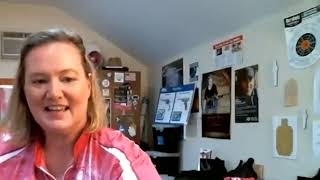
Brooke Cheney answers student questions about firearm storage, pandemic class formats, and dry-fire training. She recommends separate safes for guns and ammunition, kept unloaded. Dry-fire practice with dummy rounds builds confidence and technique without live ammo, especially for new shooters with limited range access.
Chapters
Now you guys can all unmute yourselves and tell me, what do you want to do in the last 10 minutes? What questions you guys have for me that I did not already answer for you that you're hoping to find out about today? Maryann gave me that she has a safe. Awesome. Safe and cable lock. But so should you have a completely separate safe for your ammo? Your choice if you want to spend the money. Some people do. Other people, it's just a matter of literally having it somewhere else. Some people do have an ammo safe and a gun safe. I guess part of it depends on how much ammo you have. As long as they're just— the idea is not to be— not to store loaded guns. And so that's part of why the safe and ammo is separate. So Danielle, does that answer your question?
So Brooke, um, are you currently holding classes? Because I looked up the, um, what do you call it, on the website, state website. So at the very bottom it says if you are like a sole owner Pretty much no, you're like self-employed, pretty much. Then you don't, you're, then you're exempt. But then it doesn't really state, you know, can you have any clients? So I contacted the contact person, the contact person responded back pretty much referring me back to that and then to apply for exemption. But it says do not apply for exemption if you are like self-employed at the same time. So that, that's why I was like You're supposed to know. That's why they put you as a contact person.
Correct.
And you happen to get any sort of, um, from anyone?
So I have not. And the way that I'm holding classes is like this. I'm doing online stuff because like, um, basically I can show people how to do things here online. However, with the actual class— so like, let's say Jess, who who I haven't seen in forever, needed to do gun handling skills. I've added to my website the ability for her to book an hour online class where we work on just what she needs. Now, it's hard if A, Jess doesn't have her own firearm, so on and so forth, because here at a Great Start Shooter School, it's all about getting started. But the idea is my family and I are are staying encapsulated for at least a week or two to see what is next. And as far as having people come to my house, when I talked to my friend who is a lawyer, but not an employment lawyer, because you have to have the right kind, she's like, well, you know, the stay home, stay safe thing is the idea that we stop touching other people, period, or having interaction. So Next week, I may go to my original plan, which is to see 4 students a day. And what happens in between each class is I take out my Clorox wipes, I wipe everything down. I've got an hour in between classes, so I have time to do that. So then it's up to my students if they want to come and see me. So, and the stay safe in your home— stay home, stay safe— is still up to you. So, all right, and I'm going to pick on everybody individually. Jess, do you have any questions, yes or no?
I don't think so.
Okay, is there anything that I didn't cover that you were hoping to learn today?
No.
Okay.
I didn't really have any specific ideas, I just kind of wanted to see what it was about.
Okay, well, what did you think of it then? Interesting. Yeah. So where is your level of comfort with firearms right now? Pretty comfortable.
I carry on a regular basis. I would look for opportunities to shoot, but I haven't really so far. I mean, it's just hard to find time.
All right. Well, have a very flexible schedule, especially right now.
I know.
Well, I guess tell Peter. The idea is, because I mean, and plus the other thing about being here is that you can actually shoot from concealment versus one of the things you can't really do when you're at the range. So that is definitely one of the bonuses of coming here, is that we get to literally run around. So, all right, thank you, Jas.
Welcome.
All right, Marianne, your turn. I'm just picking on random people. I think, Marianne, you said you're in Torrington. Yeah. All right. So, Marianne, do you have any questions? Or was it what you expected, I guess, should be the question that I ask you. No questions at this time. All right, you're just gonna be quiet. You're so not saying anything.
Got it.
You are awesome. I just want you to know that.
What? Who? What? Marianne is?
You. You.
You. Me. Okay, well, thank you. Peter, one of my big fans from my Suicide Prevention Saturday. Hi, Yvette. How are you? I'm good.
I'm so sorry I'm late. I kind of— it slipped my mind and Jess reminded me and I was having problems logging in. But I'm catching like the end of it.
Okay. So just to give you the quick recap, it was— we went over making sure everybody writes to the governor to thank him for keeping gun and ammo stores open. We did safe storage, how to unload a firearm to verify it's unloaded. And we did revolver and semi-automatic, so that was it. But I'm recording this, so in theory I should be able to give you the recording at the end.
Oh cool, okay.
So then what is your current situation with firearms? Are you new? Are you old? Have you been around them a lot?
Yeah, no, I am pretty new. My husband really is into them, so he insisted that I get my license as well, just because he wants me to be comfortable in any case that anything happens. He wants to be— make sure that, um, I know how to handle it and I know how to take care of myself as well as the kids. So I'm fairly new. We've— I've had it for about a year now.
Yeah.
Um, but I have a.45.
Oh gosh.
And so, so yeah, so that's always the joke. Because he has.
I know there are girls that do it, but I'm like, oh my gosh.
Yeah, yeah. And I actually feel— so I have a.45 and a 9, and I feel more comfortable with my.45 than with the 9. And actually, my shooting, it's more accurate with the.45 than with the 9. But, um, so—
go with what works, man. Go with what works. It just gets more expensive to practice, that's all.
It really does. Yeah, it does.
And that's totally what I forgot to talk about today. So the name of this course was Dry Fire. And so the idea is, is that while we're all cooped up and we're not going somewhere, is like all the stuff that I showed today— see, here's my.45— so all the stuff I showed you today is really part of what Dry Fire is. It is using and utilizing and working on your grip. It in your trigger pull and all of that with an empty firearm. So just like in this classroom where there's no live ammunition, the idea is simply that you find a place in your home that is safe for you to put your gun somewhere, because we talked about what a safe direction was, and you do all the things you do at the range because one of the things you can really, really work on that you can't see when you're live firing is your trigger pull. Because being able to pull the trigger smoothly without moving the sights is one of the biggest ways that you can actually get really, really good. And the other part is for people who are new and have problems like racking the slide or anything like that, while you're home with an empty firearm is the best way to practice. Because most of us, when we go to the range, we're paying for the time that we're at the range. And if you're spending most of the time figuring out how to load and unload your firearm, you're kind of annoyed and you're kind of rushing. Whereas if you do it at home with like dummy rounds— and you don't even have to have dummy rounds, but just to get so that you understand how to do everything at home. So that— thank you for bringing that up. See, even though you're late, you're so valuable to the class.
Actually have those dummy rounds. We have those.
Yeah, well, and I mean, it's, it's like depending on where you get them, it's a $10 or $15 investment. Yeah, if not less. And so it helps because it gives you an idea, because one of the things people have a hard time with learning is like how to load and that sort of stuff. Because I remember watching people when I started, I'm like, oh, how did they do that? I was so excited when I could do that. Yeah. All right, do you have any other questions? I know you came at the tail end, but if there's anything you're dying to learn?
No, I just want to be more comfortable with it, just handling it better without being— I've always been raised with fear of guns, so to be able to have one in my hand and be, you know, responsible with it without being afraid of it, that it's going to, you know, spiral off or anything. So that's, that's what I have to overcome. So pretty much, you know, it's just that like handling it better where I'm totally comfortable with it.
Okay, and so what we just went through today is exactly that. It's, you know, handling it now, figuring out where your safe space, where your safe direction is in your home, and then doing all of those things, loading, unloading, cocking, decocking, all of those things are things, like I said, you can do now without ammunition anywhere around you. Because then when you get to the range, all of a sudden you have more confidence because you're not like, "Huh, where's that, that slide lock thing? How do I get the magazine out?" And the other thing I find with my students is we do a lot of this in the classroom without ammo around it. And your stress level is much lower that way because nothing is going to go bang. You're not rushing to get to be able to shoot right now, right? You're just working on the mechanics. And so by handling it empty and/or with your dummy rounds, you get to see how everything works, but you're not rushing to try to get to the point where you're shooting. Because a lot of people will just try to rush because you're paying for your time at the range again. So at home is one of the best places Oh wait, there's more. It's like ShamWow. I almost forgot. Where is it? So there's lots and lots of different books that you can utilize, but this was the picture you guys all saw on the Facebook group, and it's Dry Fire Reloaded. And it's really mainly for competitive shooters, but what we're doing by doing dry fire and managing firearms empty really helps you. Like this guy here, Ben, he got— he became a world champion by spending time at home just simply pulling the trigger on an empty firearm. That's kind of his story. And that's what I, I was never taught when I first started shooting. And so that whole handling of firearms empty. So, all right, did I talk to everyone? Oh, Danielle. Danielle's the only one I haven't bugged yet. So, um, wait, no, Danielle did tell me she's all done. All right, Marianne. I don't know, I'm awful. I'm not doing good at, you know, managing my class because normally you guys are all here. And, um, I teach a self-defense class. So, Marianne, I do not really teach a self-defense class. What I do teach is I teach you to be safe and accurate and fast with your firearm. I have, like, back here you can actually see there's a ton of— well, I don't know if you can see or not, but I've got a boatload of different, um, holsters and that sort of thing at my range. We can draw from a holster and you can shoot from a holster, which is one of the advantages of here versus most ranges, because most ranges you never get to practice that. I do not teach self-defense tactically. I just teach you how to do the mechanics of everything. I tend to like to send you to my other friends that are SEALs, and all they do is study tactics. And, you know, they're the ones who are going to teach you to hold the gun like this, where I'm just like, I hate doing that. So, um, I will teach you the safety stuff and I will make you fast and I will make you accurate and I will help you clean up your draw and stuff like that. So I hope that answers your question, Marianne. Anything else? So I don't know, I would say I have to actually give her time to type, right? So let's see. Let's take classes. I'm in the same boat as having a decent amount of exposure. Okay. Yeah, so, and yeah, give you enough time to type. So here's the thing, you guys can absolutely sign up for classes. Like I said, I'm planning, I think, on next week opening back up. So it's going to be one person, it's going to be 4 people a day max for me, and there's going to be an hour in between each one. The challenge that I have is that we're going to just— it's going to be unique for me to try to teach you guys without being being able to touch you. So you have to understand that chances are I have to touch or adjust or move things because most people have a really funky grip when they get here. And that's probably one of the first things that I tend to fix because we work on recoil control a lot. But it is up to you when you guys are comfortable to come out of your homes. All right, ladies and gentlemen. I am losing my voice. So if everybody's happy and content, I'm gonna go. Do you have any last questions? You got like a minute and I will ask— answer any more. Uh, you are welcome.
See you.
Welcome, Charlie. And any questions or anything, let me know. What? Wait, I don't know, I just talked over someone. I don't know who I did. All right, so I will get you the recording, and I'll probably look at it first to see if there's anything I want to edit out, and then I will get you guys the recording. All right, thank you for being patient and, you know, working through all this, and I will see you all at the range sometime, hopefully. And now I don't know how to stop this thing. I think if I close it, it'll end. Goodbye, everybody.
Thanks.










