Scott W March 11th 2019
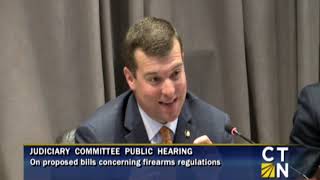
Scott Wilson of the Connecticut Citizens Defense League testified before the state Judiciary Committee on firearms bills. He opposed four bills while supporting three others, arguing that safe-storage laws need clear education components and that the state's 169 municipal pistol-permit systems create inconsistent rules and delays up to 2.5 years. He also warned that requiring serial numbers for home-built firearms would infringe on Second Amendment rights.
Chapters
Hi, good evening, honorable co-chairs and ranking members of the Judiciary Committee. My name is Scott Wilson, president of the Connecticut Citizens Defense League. We're a grassroots Second Amendment organization founded just over 10 years ago. And for the record, I oppose and/or support the following bills today on today's agenda. Senate Bill 60, I oppose. Senate Bill— or House Bill 7218, oppose. 7219, oppose. 7223, oppose. And we support SB 940, HB 5227, and HB 5870. And You have my written testimony. I just want to say that today has been an interesting day to see some of the decorum, or lack thereof, that's going on during the course of today's events. It was, you know, we've had somebody that texted what could be perceived as, you know, a threat against a state legislator here and against others who are members of the National Rifle Association. We've had people circumvent rules as far as bringing in partially completed firearms or not completed firearms or a hunk of metal that could be manufactured into a firearm, depending on what the mood of the moment is. So I just want to say it's a privilege to be here and testify before the committee. I want to say that, you know, right now we've tried to come to terms. As you all know, we spoke outside Chairperson Staatsstrom with regarding the Safe Storage Act. We have presented a bill to Sean Scanlon, Representative Scanlon, and as of now, that language that we had recommended never made it into what's before the Judiciary Committee today. I would like to see education implemented in schools. It had already passed back in 1990 under the Public Act 90-144. You know, I— we are, are sick over what happened to the Song's child, and it's not falling on deaf ears. And as I've testified to this committee before in the past, and I believe the Public Safety Committee, you could have a law today called Scott's Law, just about, because back in 1979, a friend of a relative brought a gun over and I was shot with that gun. The bullet hit the artery in my neck and lodged against my spine, so I nearly lost my life too. And I can understand and empathize with, with, uh, you know, the family's grief. So that's it. You've got my written testimony, and if anybody has any questions, feel free to ask.
Thank you, uh, Mr. Wilson. And I just, um, you know, I want you to know on the decorum piece, obviously there were several issues this morning. Committee leadership met and dealt with those. I'd like to contain, you know, the remainder of this hearing to the testimony, the bills before us, and the questioning to the bills before us and language before us. There was several decorum issues, including outbursts this morning and the like. Yes, I'm, I'm glad that everybody has calmed down as the day has gone on and appreciate the fact that we can get back to talking about the language of the bills. Sure. So on the safe storage bills, safe storage in the home, the 7218, so there's a couple pieces to that bill, and I understand you'd like to see some additional language in that bill, but I want to understand what you— what language in that bill you agree with and what language you may not agree with. So on that bill, do you agree that the age at which the safe storage law kicks in should be raised from the age of 16 18?
That's the component that we discussed as an active committee, and we looked at that language and we said that's okay provided we get the education in there.
So you can live with that piece? How about the piece about that an unloaded gun that would need to be held in a safe the same way as a loaded gun would? You can live with that language?
Well, we do believe it should be a loaded firearm, not necessarily an unloaded firearm. However, if the language of the bill comes out with the education, what we intend to do is go back as a committee and discuss whether or not we could support and live with that language. Right now, we don't see that.
That's not how a negotiation works. Well, I mean, agree or do you not agree?
I, right now, I would say that we would need to discuss it as a committee if the language of the education gets put in there, then we go back and reassess. Right now—
I'm sorry, go ahead, go ahead.
No, right now, you know, we agreed with the 16 to 18. We have no problem with that. We have— we would prefer manner as opposed to location. And, you know, beyond that, I do think that— well, I'm Okay, I do think that, you know, turning this from a may type of piece of public act that was passed back in 1990, I do believe that it should be a shall. So you and I discussed out in the lobby that, you know, you're concerned about it bouncing from one committee to another committee. I'm here to say that if we're going to enact some legislation, let's make it meaningful and let's do it the right way.
And I'll talk about the education piece in one second. But I want to follow on the safe storage piece for a second. So you're okay with a gun in a— so the current state of law, the loaded firearm needs to be kept in a safe where there is someone under the age of 16. Or let's actually do this, because you're okay with that number going to 18. So you can—
well, that's not entirely true either, because it is discretionary to a point where if a parent feels that the 16-year-old is okay, or a 15-year-old is okay with the firearm, any of the components of the law don't trigger, don't kick in, better word, until something, if somebody is harmed or killed as a result of that. You see what I'm saying? So, it's not, I do believe that parents, sure.
And we heard testifiers that this is a reactive law, it's a secondary violation. Right.
Okay.
Um, nobody's— we can all agree that even if this law goes into place, there's not going to be a SWAT team that goes around and checks every gun owner's house to see whether they're locking their guns up, correct?
Correct.
Okay, because that's not the law now, right? And that wouldn't change under the proposed bill. Understood. Okay, so, um, if you're okay with being a secondary violation that someone has to retain a loaded firearm with someone under a certain age in a home. Are you okay with that same requirement for a loaded firearm left unattended in a vehicle to have to be safely stored in a safe?
I do think that people need to be responsible with their guns wherever they are. And if it's— what the problem with that with the motor vehicle is that we don't really have a clear definition of what a safe is.
You don't know what a safe is?
No, I know what a safe is, but what is a safe by definition as far as safely stored in a motor vehicle? Are we talking mounting a safe into the well of the automobile to where it's immovable? Are we talking about just a basic trigger lock that goes through the trigger lock and around the frame of the seat? Are you—
I think the language right now just says it needs to be kept in a safe, correct? It doesn't say it has to be mounted.
Sure.
Okay.
I mean, you know, if folks would advocate and say the safe had to be mounted, I guess we could craft the bill that way, but that's not what the bill currently says. The bill just says it has to be left in the safe.
Right. Okay, so does a glove box count as a safe?
No.
With a key?
No, it's not safe. It's a glove box.
Okay.
All right. I mean, the— I don't— I mean, you've been around this building for quite some time. Have you ever encountered Connecticut General Statute 1-2Z?
I'm not familiar off the top of my head with it, no.
It's the plain meaning rule of— it's actually in the statute, and it specifically requires that statutes be given their plain meaning, and unless they would yield absurd results, you shouldn't basically read more into the language than what is actually written in the language.
Okay, fine.
So I think when we use the term safe, something like a term safe that has a plain meaning in English parlance doesn't need to be defined in statute because most Americans know what a safe is. Sure.
Okay.
All right. On the education piece specifically, Can I ask, has— have you or anybody from your organization, to your knowledge, reached out to the Department of Education and asked why they've not promulgated a curriculum within the last 30 or so years?
Yeah, I know, I know our legislative coordinator, who will be up here later, did do it— did on our behalf a FOIA request to find out what happened beyond when the statute passed. And essentially, I don't think any of the people there really know what's going on. So it essentially dead-ended right there.
But what about over the last 30 years? I mean, we've had Republican governors during that time, probably more Republican than Democratic governors. We've had many different education commissioners. Has anybody wrote to the Department of Ed, or has anybody called them up and said, hey, there's this law on the books, this that you may promulgate this. Can you please get around to doing that?
To my knowledge, as far as anybody in our organization, no, because we're now just sort of starting to be enlightened with some of this. But I can tell you that when the information came back that the act had passed in 1990 and that nothing was done about it and it just simply dead-ended between the Police Chiefs Association and the State Board of Education, You know, it's a little troublesome, you know, even to somebody like me who also had a shooting accident as a kid and have seen the news reports. You know, we saw the National Shooting Sports Foundation testify earlier that right now accidental shootings are at the lowest they have been in probably forever, but you'd never know that based on the, you know, nonstop news media coverage through I understand.
My question was sort of a simple one. Is there a way other than changing state statute to address the concern you have, which is that the Department of Education already has the authority to promulgate a curriculum? Maybe, you know, just over the last 30 years nobody's brought it to their attention that they haven't done it, and the current commissioner and the current Board of Education may be willing to do that.
You know, that's something that we would probably explore if the, if the language that we're seeking to have put in there right now does not make it into the, into this bill during the judiciary.
Further questions? Representative Fishbein.
Thank you, Mr. Chairman. Good evening, Mr. Wilson. You testified earlier on in support of HB 5227.
Yes, that's correct.
And in your doings with the CCDL, have— has there been problems indicated or brought to your attention with different municipalities and having their own rules, let's say, with pistol permits and that kind of stuff?
Well, pistol permits is certainly one of those issues as far as the issuing process, but we also see You know, what happened in Southbury just over probably about a year and 4 months ago where they tried to, you know, pass a whole bunch of bans on town property and town events and things of that nature. There's been a number of these issues going on. There's still some issues down in, I think, Madison right now, or Branford, where they're trying to institute some language down there in the municipal code. But yes, as far as You know, the pistol permit process— we did it, we did a, we had filed a declaratory petition years ago with the state, the Board of Firearms Permit Examiners, and we found that a lot of towns were putting in all kinds of different things into, in addition to the state pistol permit process, where they wanted to count the teeth in your mouth, they wanted background checks, they wanted, you notar— they want the, the main cover sheet of what they hand you notarized on top of other things being notarized, which the, the board came back with their ruling and said that nothing beyond the what's required by state statute, uh, is necessary to, to have a pistol permit issued in the state of Connecticut. We see cities like New Haven, Bridgeport, Hartford, Waterbury, uh, to some extent Middletown, although I've met with the police chief there, and they have improved somewhat on their issuing, but it's still not within the statutory time frame. You know, this is a right delayed is a right denied, and we're seeing people constantly living in certain locations being denied their due process to have a pistol permit issued.
I'm sure you're being facetious with the number of teeth in their mouth, but no, I'm not.
Really?
Yes.
Okay. How many?
Yes.
Are you missing any teeth? That was in I don't know if Jonathan's here, but I believe it might have been Waterbury asking that.
And in your experience, what happens when the municipalities— you don't comply with their local rule with regard to pistol permit process?
They're not going to issue you the permit.
And so that's a denial?
That's a constructive denial, yes.
Was it a constructive denial? Because constructive denial is—
Oh, constructive denial, right. Just when they—
No response. Right. Yes, so that's a straight denial. Sure. And then if you have a— if you still want your pistol permit, what do you do then?
You have to appeal to the Board of Firearms Permit Examiners.
So that takes about 2.5 years, I think there was—
That's correct, yes. You know, a law-abiding citizen in the state of Connecticut that, you know, has paid for the background checks, has paid— has done everything by the letter of the law,, you know, is subject to a 2.5-year, up to a 2.5-year wait or more, depending on how many different cases they have at any given time. You know, and the comparison was made last year with Kevin Kane that, you know, he compared the town of Goshen to the town of Bridgeport, purely for the profiling bill, I'll call it. He compared those two, and in towns like Goshen, it's relatively easier to get a pistol permit than it is in a town like Hartford or in a town like Bridgeport. You know, so I just have to wonder what the, what the thinking is in those towns and in those cities where they don't trust their own citizens who apply for permit, and they make them wait and wait and wait. And oftentimes people move during that time frame, so if they do move, they can't just move the permit over to whatever town they move to. So if they have a 2-year wait, they have to apply again for the pistol permit.
So these are people that are lawfully trying to follow the system that is taking them years, in some cases, especially in the cities, to, to exercise their right? That's correct. Okay, thank you.
Thank you, Mr. Chairman. Thank you. Further questions?
Representative Dubitsky.
Thank you, Mr. Chairman. Thank you for coming in.
How many members in your organization? 31,000 and up.
Okay.
Are you, are you able to speak about the, about what your members would go through if there were 169 different, different sets of firearms laws, or is there somebody else from your organization who be coming up later who would be better able to—
I'm sure people may be able to augment what I want to say, but I mean, I will— I can state definitively that we— and I know the term law-abiding citizen has been, you know, sort of, you know, a rhetorical kind of statement made here often and repeatedly year after year— but we go through local background checks, we go through state background checks, we go through the federal background checks, We do everything we can. We pay hefty money for our pistol permits, the training, all the things that, that go along with being a legal, law-abiding gun owner in the state of Connecticut. And if you're going to drive from one town and pass an imaginary line that you can't see, and you're one minute you're in a town like, you know, Wolcott, and the next minute you're in a town like Woodbridge where they actually have language that says that you really can't drive on a town road in in Woodbridge. What are you going to do? You know, you do your best to follow the laws. Years ago, we had ordinances in London and New Britain that banned concealed carry of weapons in general, just a general term for banning weapons. So there was, there was some hoopla about people saying, well, just open carry in those towns. And a lot of people were stating that they didn't want to open carry in those towns. So we appeal to the senses of— it was, they were both very old ordinances. We appealed to New London, which is the town I live in, and then we appealed to New Britain, which is a town another executive member at the time of our organization lived in. And they did the right thing and they changed those ordinances. But that's not the same case in every town. You know, we often meet resistance. And, and I really do think that there are unfortunately some politicians that do use gun control and gun restrictions and all the difficulties that go with that as sort of a platform, you know, to make a name for themselves or, you know, to make their mark politically? One of my concerns— and can I just say, and there are other legislators who may swing one way or the other on any given day who,, you know, can be swayed by an argument and who really do sit on the fence, and they just, they want people safer. So let me say that. Okay.
Um, and I thank you for that answer. One of my concerns is that the combination of having 169 different sets of regulations along with the possibility that a police officer in any one of these municipalities could now detain somebody simply by seeing a firearm, that the combination of that would make the firearms laws in this state so onerous that nobody would even understand them wherever they went, and that they could be, they could be detained their firearm could be seized, their permit could be seized, because they happened to be driving down a road that went through 2, 3, 4, 12 different towns without any indication that the means of carry was changing from one traffic light to the next.
Yeah, and even if ultimately whoever, a judge decides to just say this is not worth it, you know, they've got a permit, a person may not beat the ride, okay? They're gonna probably have issues with the police and they could be taken into custody and detained. They could face all kinds of, if there's a criminal charge attached to it, they could face all kinds of humiliation merely simply because they have a permit to carry and they are trying to follow the law. I mean, I would hope that the legislative body here would understand that, you know, we are doing our best to follow the laws as written and as best we have them interpreted, because sometimes there are a lot of gray areas. I would certainly hope that given that, that there is an understanding that we really don't want to end up becoming a criminal as a result of any of this stuff. So I think this would— this, if anything, here today Whether you're opposed to ghost guns or not, or whether or not you agree with safe storage to whatever capacity the language says right now, this is something that actually would be fair to those who have a permit to carry a firearm issued by the state of Connecticut, not by the town of Bridgeport or the town of New London or the town of Wolcott or Goshen or anywhere. This would be a very fair measure, I think.
Thank you.
Thank you, Mr. Chairman. Further questions?
Vice Chairman Blumenthal. Sir, thank you for your testimony. Thank you, Mr.
Chair.
So I just want to clarify a couple things. It sounded like before, when you were testifying on HB 7218, the safe storage in the home, that your primary issue with that was— I guess your issue with that was you thought education should be implemented as well? I do. But you don't, you don't have any opposition to the bill otherwise?
Well, the language we presented, I don't know if Representative Staffstrom has the language we have. I'd be happy to send you the bill as we had handed it over to Sean Scanlon.
But the only difference is that it has education as well, right?
No, it's okay. So location, we would prefer that the manner of the firearm— or that's, yeah, that's, that's in the bill. Yes, right, as opposed to location. So that is the main issue. I think, I think if some common sense education component is either developed or adopted from the National Rifle Association's Eddie Eagle program, or the National Shooting Sports Foundation, or we would be happy to sit down with the Board of Education or whoever and help develop that program.
But you don't have any other— because it's the actual proposed bill does have manner instead of location, right, as you desired. You don't have any other problems with the bill besides that you want education as well, right? That's correct. And, uh, so you don't— it's not your position that there's any Second Amendment problems with HB 721?
Our biggest concern is that this is all punitive as opposed to preventative, and I think that right now, I think somebody that does store their firearm in an irresponsible manner— and yes, there are, there are definitely people that are irresponsible with guns, otherwise we wouldn't be sitting in here today, okay? So I do think that there's room for talk about that. But I also think that it probably, at the end of the day, for somebody to go through the grief and trauma of having either their child killed or a friend of a child killed with their gun, that their friend was over the house and got killed with their gun that somebody took from me as a parent and let them play with it, I'm not so sure that the punitive and the civil liability and all the things that go along with that are really going to stop somebody if the common sense isn't there in the first place. So that's what I'm saying is— what I'm trying to say is you can have all the penalties in the world, people are going to find a way to hurt themselves, unfortunately. And that's been proven with, you know, with guns, with swimming pools, with skateboards, with automobiles and texting, and all kinds of things.
But okay, so I see what you're saying, but there's no— 7218 wouldn't infringe on the Second Amendment.
Infringe on the Second Amendment as far as you're concerned? I think that if the language does turn into something where somebody cannot access a firearm in the middle of the night to stop a, you know, a home invader or something like that, then yes, that would definitely infringe on the Second Amendment right. But right now, the way that the language is worded, I don't see it.
Okay. All right. And so I just wanted to go to 7223, which is in a motor vehicle, safe storage. You don't see any Second Amendment problem with that bill, do you? No.
Okay.
And so the 7219 ghost guns, I, you know, I understand that there's some doubts as to its effectiveness on your part, but you don't see any Second Amendment problems with that bill, do you?
Well, what I see a problem with that is the very fact that if I, I as an individual, as a sovereign being, as a sovereign individual, if I have the time, the wherewithal, the ability to acquire the tools and manifest and design something that I can conceive of as a firearm out of a hunk of aluminum or a hunk of some type of steel, if I want to do that and I'm not a prohibited person, otherwise prohibited person, neither adjudicated mentally deficient, or a convicted felon, I would think that yes. I mean, I'm not even talking about buying the ghost gun kit. I'm talking about being able to just use my own skills to be able to manufacture a firearm.
So that's the only part of that bill that you think poses a Second Amendment issue?
No, I think the fact that the kits do require a lot of machining, I do think that they're not a firearm, that there's— you know, we go back to the block of aluminum argument where if it's not a firearm, if it's not over the 80%, if it's within the federal guidelines, the federal government said you can buy these kits, I don't see what the problem is. We all know that the criminals, the majority of the guns they're getting are stolen on the streets or they're straw purchased in stores, straw sold. So maybe if we tried a little more punitive measures for the criminals to act as a deterrent, we might have a little better success with some of the violent crime that's going on.
I understand again that you think that other methods might be more effective, but you don't think that if you, as a hobbyist, build a gun in your house, you don't think it violates the Second Amendment for you to have to go within 30 days of completing its manufacture or assembly to DSPP and notify them and put a serial number on that weapon that you built, do you?— Can you repeat that?— Yeah, sure. You don't think it violates the Second Amendment that within 30 days after you complete the manufacture or assembly of your home-built weapon, that you should have to put a serial number on it and notify DSPP?
I think if that's my gun that I manufacture, I shouldn't have to do that. Would I want to do that? I might want to do that. I don't know. I'm not at the level where I would manufacture a firearm myself. I know that some probably have testified here today that they wouldn't want to put the number on there. I know if I did build it, I would not want to put it on there, probably, but I might.
But you don't think it violates the Second Amendment to have to put that?
Sure it does. Yeah, I, again, yes, I do. I don't think that it's the state's place to tell somebody if they build something out of the fruits of their labor that essentially it's, it's a quasi de facto registration once you put the number on it.
Do you think it violates the Second Amendment to have to—
if you're purchasing a weapon, that that weapon has to have a serial number on it? I have a gun right now that was built probably somewhere— we can't even track it down right now— between 1955 and 1958. It's a shotgun. It was my grandfather's shotgun. I have never once thought of taking that gun and putting a serial number on it and going down to the state and registering it.
Okay, but this law wouldn't make you do that? It's only if you are building a gun, if you're completing the manufacture, so you're building your own gun, or you're seeking to transfer a weapon.
It has to have a serial number. Yeah, I don't think if you legally purchase the gun and you own the gun, we already know, it's already been stated here today that you can't transfer it without the serial number, but you can own it without the serial number. Right. You can't build a gun and hand it off to somebody else. Without serial number.
At that point, you're a manufacturer. Okay, so we're not talking about your guns, which we've—
so I'm talking about my gun. I'm just saying if I bought the kit and I built the gun, yeah, and I wanted to own the gun, I shouldn't have to put the serial number on there. I should if I want to legally transfer it through an authorization process and hand it off to somebody else.
Okay, so, all right, I see what you're saying. So The only thing you think could potentially infringe on your Second Amendment rights in the ghost guns bill is if you build your own weapon from scratch and you do not transfer it to anyone else, and you don't want to put a serial number on it. If you were forced to put a serial number on it, that's the one element of that bill that would create—
Exactly right. And the fact that the AR-15s and the, you know, the so-called assault weapons that are, you know, now already banned in Connecticut can't be manufactured into those types of firearms either. So— I'm sorry, say that again. Well, the AR-15, the lower receiver for the AR-15 cannot be built into an AR-15. So yes, those are already illegal. We're talking, we had an AR-15 lower that was in here earlier today that somebody, that the, you know, the CAGV had brought in and was showing. It would be illegal to manufacture that into a firearm. So we already have laws for all these things in one way, shape, or form. The only concern is the criminals that are doing whatever, committing crimes with guns, violent crimes, is the chief issue that I see.
And okay, I see what you're saying. It was— but you know, so since you're saying since those things are already illegal, doing them just one step earlier wouldn't be—
wouldn't violate the Second Amendment? Yeah, what I'm saying— well, I will say that we have over, what, 20-something-plus thousand laws on the books across the country in one way, shape, or form, and growing, because every year at the local, federal, state, and federal level, we keep adding more and more laws, you know, and it's just we're always looking for a problem for a solution, it would seem to me. Okay.
All right, thank you, sir. Thank you. Thank you for the questions.
Seeing none, thank you very much, Scott. Appreciate it.
Thank you very much.
Appreciate it.










