Suicide Prevention Sat - Let's talk about addiction
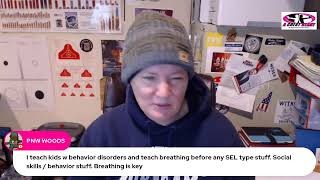
Brooke Cheney, owner of A Great Start Shooting School, argues that addiction fuels suicide and that we treat the problem too late. Two-thirds of gun deaths are suicides. She says most programs focus on treatment instead of prevention, and that breathing and meditation can reduce reliance on harmful substances.
Chapters
Okay, here we are. I am trying to get my notes and stuff for today. I got 1 minute. 1 minute. Well, actually, there's a countdown thing somewhere and, uh, it— I don't know where it went, so I don't know if I have a minute, but it says 8:59, so I'm gonna go with a minute. All right, so Here we are tonight. I just, I was about to say it's Friday. Yeah. Okay. It's been one of those weeks for sure. Um, let's see, on Thursday my daughter told me it was Friday and I was very distraught because I had certain classes on Friday that I did not have on Thursday. And so, um, just freaked me out a little bit, but it's okay. 'Cause you know, why should you listen to your 14-year-old when it comes to, uh, whatever you call it, what day it is. So 9:00 PM Eastern Standard Time here in Connecticut. My name is Brooke Cheney. I am the owner instructor here at A Great Start Shooting School. Hey, can I— this is really hard to do because everything is all backwards. There it is. Ta-da. I come on every Saturday for 15, 20 minutes unless I've got a guest to talk about suicide. Because as a gun owner— see targets and stuff behind me— um, 2 out of every 3 gun deaths you hear about when you're talking about gun violence are suicides. And I find it very insincere for people to want to lock away guns because guns are bad when in actuality we have a mental health crisis here in America. Uh, not only are adults who have access to guns causing suicide, uh, our teens, our preteens, are— those numbers are rising like crazy. So 50 minutes once a week on Saturday for Suicide Prevention Saturday. Um, so yes, Carrie Ann says I look cold. Yes, it's cold here. It started at like 2 degrees, it got up to a whole like 27 degrees today,. And I actually just came in from the hot tub, so my hair is all wet. So I'm actually nice and toasty warm. I just look cold. All right, let's see. Hold on. Ready? PN Woods. PNW Woods. I can't really read. Thank you, sir or ma'am. I should never assume anything, especially online. It's all very scary. And thanks for— I appreciate Guns and Barbecue as well. So I know it's rough having a hot tub, right, Carrie Anne? She, she's very distraught over the fact that it's very sad having a hot tub. My hair is all wet, so I am warm now. All right. Ah, this weekend, this evening, uh, I have had a request since about mid-December. December was just a little bit crazy with surgery, holidays, all of that. So tonight, uh, we are talking about addiction, combination of addiction and how it leads to suicide. And really all of it is the mental health crisis that we are currently having in America. I'm not saying the rest of the world is free from mental addiction. I am just saying I can only deal with what's in my own backyard. So with that, let's talk about addiction. I'll start with me. Uh, I found out at like 19 I was desperately addicted to TV. I know, sounds weird, right? However, here's the deal. My husband, who was my boyfriend at the time, I was at his house on a Friday night. We were watching The X-Files on Friday night, as we do. His mom started talking when it wasn't a commercial. I remember getting angry. I was like super mad. I'm like, how could she interrupt my TV show? She doesn't know. She doesn't understand what she's doing. And I remember that anger in that— I'm not going to go as far as saying rage, but I remember that anger and realizing like, wow, I have a problem because I can't handle someone trying to talk to me while I'm trying to pay attention to something else. And it was very odd. Now, there are 5— there's tons of different types of addiction. Uh, some of y'all out there have like the most pristine houses ever, um, addicted to cleanliness. And for the most part, um— hello, Sarah's Kitchen, Tara's Kitchen, Tara Smith's Kitchen. Wow, I can't read tonight. I'm just gonna put them up there. Y'all can read them, I'll be quiet. So there's tons of types of addiction. One of the articles I'm going to share with you guys today talks about how we do not pay attention to preventing addiction. We're really focusing on the poor person who is already down in the throes of maybe losing their job, maybe losing their wife, their sibling, whatever. Um, so types of addiction. Most common that we hear about, right? Drugs, alcohol. Now, however, we have this, right? Screen time, another type of addiction we're dealing with. There's sexual addiction. There's, there's tons of different types of addiction. Like I said, I started out with the TV thing because really and truly, I did not, I didn't handle stuff well because I was so wanting my TV show, which sounds lame, but it was just, it was an emotional imbalance that I noticed. All right, so Guy That Comments, because, you know, guys that comment should comment. Anything that gives a dopamine is addicting. Addiction runs in my family. You name it, we got it. And knowing you're predisposed is super important. I have a 14-year-old and a 15-year-old. My Mom was an alcoholic, high-functioning, loving, wonderful woman. And my dad was a drug addict, also high-functioning, wonderful man. Um, but like, for the longest time, I just thought my dad was moody. I had no idea that he had a drug problem. So because of these two things, I do tell my kids, like, here's the thing, we already have this in our family, and we already know that it can take people down the dark roads. My father had the drug addiction and he was also suicidal, as I've shared with you guys in the past. And which came first, the chicken or the egg? The mental health problem, right? Because whether you're looking at alcohol addiction, drug addiction are the most well-known, so we're going to try to stick there, uh, versus stamp collecting addictions and stuff like that. Um, Drug addiction can start out one of two ways, right? One of the things that's getting a lot of headlines, which I'm not sure how, how it works, I haven't looked into it a lot, but if I break my leg and the doc gives me painkillers and I get hooked on them because I love the feeling that the painkillers give me, my pain goes away. But I still want the feeling that the drugs give me. So that's one kind of addiction, right? And I'm addicted to the feeling. Now there's others like my dad, a total adrenaline junkie, and he loved the feeling of whether he wanted to be up or down. He could just pick something out of his, out of his bag and decide to go one place or another. So the feeling is what we're talking about when we're talking about addiction— alcohol, drugs, sex, any of it. And well, like a guy in the comments said, um, anything gives you a dopamine response. So what do all of those addictions break down to? Feelings, right? How do we feel? How can we make ourselves feel? Well, as someone who's been in self-help, counseling, all of these things, it really boils down to you being responsible for how you feel, right? So the addiction is trying to fill or change something within us. So I take a pill, makes me feel better, that's easy. Doing the actual emotional work, the work that has to happen up here, for me to feel good is a lot harder. And we like that instantaneous, oh, I'm gonna have a glass of wine, oh, I feel better now. When in actuality— or smoking, oh, I know some of you out there have that problem, right? So smoking, uh, Tony Robbins does a great job. It's like, all right, ready? Shoulders back, sit up, take a big breath in. What are you doing when you're smoking? You're actually Taking that big breath in, unfortunately, you're throwing a bunch of chemicals in there, which enhances that big breath in. But imagine for a moment, instead of picking up that cigarette, someone said, hey Brooke, put your shoulders back, take a big breath, notice how you feel, versus, oh, well, we need to have something, whether it's a cigarette, a pill, a drink, whatever it is to change your state. Tony Robbins does a ton of this stuff. It's like jump up and down movement, right? If you jump up and down, you can't be depressed. You can try to fake it if you want. You have to work really hard if you jump up and down and stay depressed. So we're not taught how to manage our mental skills and our emotional skills. We're dumped on like crazy, right? Whether you are here Facebook, YouTube, wherever you're watching this from, above me and below me there's more information. Some of it might be cute panda pictures or kitties or dogs, but some of it's going to be people pissed off and angry and arguing. And we are taught so many things in passing in that Brooke better not say something that pisses me off. And we aren't taught that your happiness is your job. No matter what I say or do, you get to choose how you react to it. And we're very much in this, right? You did this to me. I love the fact that if I'm pointing at you, I've got 3 fingers pointing back at me. That's one of my favorite little things that people remind me is like, when you're pointing at somebody else, you're pointing 3 back at you for the 1 you're pointing at someone else. So addiction, trying to feel stuff that again, like Guy in the comments said, dopamine, dopamine, dopamine. We are little dopamine addicts regardless of which way we take it. Oh, ready? Some of my girls are gonna hate me for this, but some of us love essential oils. We just go like, okay, And it makes us happy. Now, is that a good addiction or a bad addiction? I'm not sure, but it changes how we feel. All right, so that's a long bit of— it's been 10 minutes. I'll try to get this wrapped up quick. Um, Piano Ed talks about kids are literally addicted to their phones now. Too much dopamine, right? So you and me— well, me, I'll talk about me because I don't know about you. But I will go to Facebook, I will click on what my stuff is in the corner. If anyone mentioned me or shared one of my posts, I'm like, yay! And then I go click on it and there's this thing, it's like this click, ooh, a little dopamine, someone paid attention to me, which means, ooh, I have significance. If I have significance, then I must be worthy. If I'm worthy, I need to get more. Uh, cocaine, speed, business guys, uh, doctors, people who are high-performance athletes, right? They perform, perform, perform, perform. Well, that cocaine helps them a little bit faster, a little bit better. Testosterone, all of these things. But ultimately, we need to pay attention to how we're feeling about ourselves. So let me get to one of the, um, one of the articles I want to share with you tonight. Of course, if it will actually go to the article I want to share with you tonight. So this is called Heroes in Recovery, and let me share it with you. I'm going to disappear here for a moment if I can get this to do this properly. Um, ta-da! The Heron Project, uh, Project Purple. So one of my favorite quotes from this article— and yes, I will put the whole link up here so you all can just grab it— um, when it comes to addiction, I think we've really focused our energy and resources on the wrong— oh, sorry, I'm showing you the wrong thing. We really focus on the wrong thing. It's when people are in the toilet, right about— gosh, never mind. All right, I'm going to stop sharing screen because I'm not doing a good job of showing you where it all is. But he talks about how we talk about the addiction and the end of it. So when I can't talk anymore, when I can't hold a job anymore, that's when we send me to rehab. We do not talk about enough of the mental health that's going to prevent me from needing the drugs in the first place, because it's very hard to prove something that didn't happen. So if I'm going for a grant and I want to fund the Brooke Cheney Prevent uh, suicide stuff, then if I prevent suicide, how can I prove it? Because no one killed themselves. And this is one of the challenges we have with doing this preventative stuff. Um, I am a big proponent of what they say in this about looking upstream to the prevention. The challenge is, again, when we try to get funding for preventive measures, it's super hard to prove that we stop something from happening. There we go. I can speak today a little bit. So looking upstream, not just looking at, ooh, they're addicted, now what do we do? Because that's where most of the research is. It's, oh, how do we healthfully get our dopamine? How do we healthfully figure out that we are worth something and that we should be doing something good for ourselves. So that's kind of the big thing, is looking upstream, realizing that meditation, number one thing that has been proven time and time again to actually change lives, and it takes this much information to actually sit there and just go I'm breathing. I am still breathing. Count my breaths up to 10, 100, 50. Something as simple as that, that a teacher, a parent, a kid, a friend could talk to someone about. We're here on YouTube. 5 million places that you can find how to meditate. It's very simple. It's like, should we just say Pledge of Allegiance and then 5 minutes of quiet time? Gratitude. We know that one too. So here we go. Addiction sucks. We need to prevent it. And yes, we still need to figure out good ways to help someone break the cycle. It's just, once they've gotten into the cycle, it's super hard. Anyone who smokes cigarettes, That's one of the hardest ones. And that's kind of that. Questions, comments, ideas? I'm trying to get to— what did I miss? Let's see, Guy that Comments says, gotta have them quit cold turkey. And he's talking about the comment that he said before about kids are addicted to phones, right? And here's the thing, if— oh wait, there's even better. Um, currently I'm in quarantine, what should I do than getting high all day? Huh, meditate. Ha, I already got to that even without seeing the, uh, the comment. So what do we have to do? We have to work on mental health. We have to realize that everybody needs a coach. We all need to figure out better ways to satisfy our dopamine needs. We need to communicate better with ourselves. We have to retake responsibility for ourselves as well. So let's see. Hold on, I got more. So, Guy in the Comments, if they're addicted, stigmatize them. That always helps. Absolutely. So this is where it gets weird, right? Is that, oh, you're an addict. Like, yeah, I was a TB addict. Not quite the same stigma as when you say, oh yeah, my dad was a heroin addict. You know, all of a sudden you expect all his teeth to be rotten out. Or wait, no, that's meth. But anyway, his teeth weren't rotten out. Like I said, there are so many high-functioning addicts out there that usually when people talk about addicts, whether regardless of what it is, they see the bum on the street drinking Mad Dog out of a paper bag. And the truth of the matter is addicts are all around us. There's one in your neighborhood right now, maybe your next door neighbor, maybe not, but it's so pervasive. And again, it goes back to going upstream. Who's throwing them in? Who's getting them there? Oh wait, what did Mike say? Great quote. Are you okay? Ask a friend, talk to your friends and ask them. And here's another really important thing is honestly, if you're having a bad day and you reach out to somebody else and find out how they're doing, it helps pick you up because you're doing something to serve someone else. Uh, we talk about self-help on here as well, and it's one of those things that's super hard because a lot of us are strong and I can take care of anything and I'm whoever I am. Um, it's, it's always good to reach out and try to help others, and it usually helps you as well. I don't know if that makes sense. So what was my last one? I'll try to get out here. I do try to keep these shorter, and we're already at 20 minutes. Um, all right. I teach with kids with behavior disorders and teach breathing before any SEL type of stuff, social skills, behavior stuff. Breathing is key. Yeah, oxygen is super important for your brain. When we get tense— because I teach shooting, right? One of the things I teach all of my students is they took a shot, make sure they take a breath. And like, I'm breathing. I'm like, no, take a breath. Give your body oxygen. As soon as you lower your oxygen, your body starts to stress. And freak out. And if you're breathing really shallowly, you're actually increasing your anxiety. So breathing, a meditation— there's two things that you do every day. You're like, but Brooke, I don't meditate. Like, yeah, you do. Every so often you're spacing out and you don't even realize you were meditating. If you do it consciously, you help chill your body allow some of that anxiety, frustration, anger to go, and you don't need to reach for that cigarette or whatever is your— what's the thing? I'm on crutches right now, so a crutch, for example. So there we have it. Addiction sucks. Yes, we need to go upstream, try to help people not get addicted in the first place, come up with better ways to help break addiction once it's there. But really, if we just go back to the prevention side of things, uh, we will get a lot farther a lot faster. So that's it for tonight. I swear I'm horrible at saying goodbye. I apologize. Uh, kind of excited. I don't know what week this is. I believe in 2 weeks I have Mike Sodini from Walk the Talk America. If you guys have not been to Walk the Talk America, it's usually abbreviated WTTA. I don't know what it's got, if it's a com or a dot org. Nope, it is not a dot com. And they are also trying to help have a reasonable conversation. NSSF does that as well. So Mike Savini is coming on on the 5th. Good night, Miss Carrie Anne. And then I'm going to get his partner Jake probably sometime that weekend. So we're actually going to have a, what do you call it? Bonus. It's not going to be Suicide Prevention Saturday. It's going to be some, some day that week and talk to Jake more about what they're doing to help bridge the gap between gun owners and healthcare workers and counselors. So that gun owners are not as afraid to seek help as they currently are. And then March— January, February, March— I've got April. I have more guests lined up for April. Apparently no one for March yet, but my hope is I will start seeing you guys once a month with someone here with me or another thing. So did I already say that? I think so. All right, good night all. Have a good night. See you next










