Suicide Prevention Sat - Let's talk about Pattern interrupts.
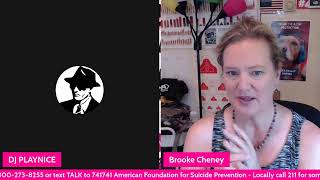
Brooke Cheney explains pattern interrupts, unexpected questions that shift someone away from escalating emotions. Two-thirds of gun deaths are suicides. She shows how asking about a first kiss or a childhood street can calm anger and create space for real conversation.
Chapters
Gotta go like this. I gotta go like this. I gotta go like this.
All right. It's official. I have too much stuff in my little sidebar thing that I can click on because that's the intro for my Dry Fire stuff, not for Suicide Prevention Saturday. So with that, do we fix it? Do we go ahead and throw the actual intro? I say no. It's all about imperfect action in life in general. All right. So this— good morning, everybody. Yes, it's 9:00 AM Suicide Prevention Saturday versus A 9 PM. Yeah, see, that's how good my, my poor little brain is working right now, right? All right, so Suicide Prevention Saturday. Why? Because 2 out of every 3 gun deaths the CDC talks about, it's a moo. Um, I have a feeling that's not what I was trying to say. 2 out of every 3 gun deaths you hear about are indeed suicides. So when they give you this huge number of 30,000 deaths a year 20,000 of them roughly are suicides. So the next time you talk to someone and they want you to give up your guns to save lives, ask them what they've been doing to do suicide prevention. Ask them what they've been doing to work on mental health of our society. And they'll be like, what, what are you talking about? And that is what we call a pattern interrupt. Um, yeah, so 2 out of Moo said good morning. Um, so that's when I said 2 out of 3 Moo And thank you for the comic relief. All right, so, uh, today we are talking about pattern interrupts. Look, I even made notes, you know, because notes are good sometimes. They help me stay on track. DJ also helps me stay on track. So, um, am I going to hide the comments from myself for a moment? Because surprisingly enough, there's two of you out here who are actually live and awake right now. That are commenting because the little ticker says there's 3 actual people watching right now. But oh, if I didn't have to be, I'd probably still be in bed right now. All right, pattern interrupts. What are they and how do we use them? So it's basically a way to change focus, just like in the intro just there where 2 Live Move, uh, comment of good morning came up in the middle of me saying 2 out of 3 gun deaths. And it interrupted my pattern of finishing the thing that I was going to say. And that is a pattern interrupt. We have them all the time. Oh my goodness, this little beast here. This one is really good for pattern interrupts. So let's say we're talking about Second Amendment rights. And, you know, some of us get very emotional over Second Amendment rights. And it's getting really heated, really hot, right? And I simply say, hey, What was the name of the first person you ever kissed? What does that have to do with 2A? Absolutely nothing. Hence the reason it's a pattern interrupt. So what did I do by asking you that question that had nothing to do with what we're talking about? If you were getting upset or angry, it brings you back down to something you weren't thinking about. Most of us know who the name of the first person is that we ever kissed. So it's a question that you most likely can answer. Especially depending on your age, I suppose. But the idea is if we were getting excited— not excited, like, let's say we're getting angry. And here's the reality: anger— we do not make good decisions making decisions out of anger. So if I want to have a good conversation with you and we're getting to the anger portion of where we're feeling about this stuff, by interrupting that pattern, saying, "Hmm, who is that first person you ever kissed?" You're like, huh, what? So it takes you immediately out of the anger that you were just feeling, and now we can come back to our conversation after you tell me who it was, because I want to know. I'm guessing that might be in the comments right now, actually, because I see them popping up. I'm not reading them yet, so DJ, you'll have to keep tabs. Um, and now we've both taken a breath, we can come back to a calmer point of frame of reference for the things that we're trying to talk about, and we're both more useful. So pattern interrupts are very, very helpful. One of the things we talk about here is suicide prevention. Well, what does that look like? Well, let's see. How do we know someone is suicidal? We don't always, but what do we do when we see someone who's upset? We go up to them like, oh honey, what's the matter? And the problem is she will then grab that shovel you just gave her and she will dig a hole as she tells you all the things that are the matter. And this may seem odd, but it's very, very useful. If you see someone who is distressed, and we all show distress a different way. Sometimes I'm laughing hysterically when I am distressed. Other times I'm crying. And if I am crying and you walk up to me and you ask me, what's the matter? I tell you, and I will cry even more. Or you can walk up to me and say, hey Brooke, what was the name of the first street you ever lived on? I will stop crying because I will have to think about what is the first street that I ever lived on, and that will immediately take me out of that pain and suffering that's making me cry and focus on something that's kind of benign, but I have to think about, because just like when we're shooting and our eyes can focus on one thing at a time, usually it's the front sight for the way most of us get taught. Our brains are kind of the same. As much stuff is bouncing around in our heads all the time, just randomly. And yes, DJ, I'm talking about you a little bit. No, just kidding. We are always, we are definitely always having random stuff going around in our head. But when you ask a specific question, we have to go search for that specific answer. So while I'm looking, I'm in my brain, you know, like, you know, where is it? What was the name of the first street I ever lived on? And I don't know because I was born in Massachusetts. No, I was born in Connecticut, but my mom and dad lived in Massachusetts, but I don't know that address. But that's what a pattern interrupt can do. And as with helping anyone regardless of what you're, what you're meaning to do. Understanding how pattern interrupts work really, really can help you help someone else. Now here's the good news, 'cause you know we are here to give you resources like 211, for example. And just so we're clear, 211 is for any kind of crisis. You can't pay your heating bill, you can't get food on the table, you're dealing with anxiety, depression, 211 gives you resources to everything that is out there. I think it's probably one of the most underused resources we have as Americans. So pattern interrupts, how to help someone else, help, don't give them the shovel. Don't ask them what's wrong. Ask them a different question that you're actually curious about. Maybe you need them to help you. Like, hey, do you know where the closest CVS is? And they're like, oh, Okay, here I am crying and you want to know where the closest CVS is? So here's the thing, they might go from all upset to what is your problem? But I would prefer to not get stuck into that depression, sadness. So back to 211 resources here, right? So now you understand a little bit on how a pattern nerve works. Here is the beautiful thing of this: the person you can help the most with this is going to be yourself. You know, from time to time we talk about the words that we use and how important those are. So the words you use, if you remember about the pattern interrupt, they can help you as well. So there was someone commenting here a week or two ago, and they were having a horrible week. And I private messaged them, and I'm like, you probably had some moments that were kind of sucky, but the reality is the whole week didn't suck. You woke up every day, you had put clothes on, you're probably able to take a shower, um, things like that that we can easily be grateful for. So When we say, "Oh, my day sucked," it's like, wait, pattern interrupt. Did it really? No, it probably had some things that I wish didn't happen, but the reality of it is it was probably okay most of the time. So asking ourselves questions is how we can do pattern interrupts on ourselves. And it's the hardest to do on ourselves, honestly, because we like being in in our little wallow of depression, anxiety, and everything else. And it's just like, no, you can't. Like, that is horrible. I'm like, yes, it is horrible. But some of us are comfortable there. And our pattern interrupt is to realize that, oh, I've been here in the anxiety area for a little too long. I need a timeout. What was the name of that first person I kissed and what color were their eyes? All right, that's what I got for you today. DJ, Please tell me who is here.
Well, I want to bring this to your screen first, and that is that 2 out of 3 Moos agree it's early in the morning, especially for this program. But joining us this morning, joining us this morning, not only do we have 2 live Moo out there, but we also have Crabby Turtle, who is a hand pink waving. We picked up on what that is, right? Yeah, yeah, yeah, we got it.
I still don't know. I really don't know. I just say hand pink waving. Okay, hi, it's a pink waving hand. That's what I got, man. I really don't know.
Hand pink waving, I'll show you after show.
Okay, thank you, you're so kind. Do I want to know?
Right on. And it is, it is good to— and I am out there as well, but like, if there weren't any other, uh, answers in the text chat as to who the first person was— oh no, that was Deb, that was Debbie Beam. What was the street? It was Whitney Street. And yeah, I was a wee babe, I don't really remember it, but it's in my baby book, right? And, uh, the other one was— what, where is it? Uh, brown eyes. I had not yet finished typing in the color of her eyes.
I could tell you it was our team, and it was third grade, and it was a truth or dare third grade thing, and it was I had to French kiss our team as a third grader. Oh, it was horrible, and he was sloppy. It was not— so yeah, it was memorable, but I can't tell you what color his eyes were because I probably had my eyes closed for all of that.
No doubt, they're probably well advised for that kind of situation. Drooling like a puppy, was he? Well, kind of. No wonder.
Even— yeah, yeah. Um, um, but yeah, and also the fact that he had an interesting name because I've never met anyone else named Artine, so there's that. Um, and then the first street I know that I lived on was Coe Street, followed by Maple Street. Um, And there was another one, but I don't remember the name of it. So yeah, there's lots of firsts. And the closest CVS is probably 6 miles away. So, but yeah, but so DJ, what, what, what do you think? Do you understand how they work? Do you understand what they are and how they can be used?
Oh, absolutely. And when you were using, you offered a couple of examples, but I was thinking of when a kid falls down, goes boom, and they will look before they will respond. And you have personal, you have firsthand experience with that. So like, that's the example I thought of. And maybe even that, you know, that kind of an example when, when you're with, say, certain friends, you can't do this certainly with everybody, but if you happen to know one little comic thing, like, remember Uncle Ted? And that just will make them stop and go, yeah, I remember Uncle Ted. Remember what he did with his teeth at the dinner table? And you're like thinking about a guy dropping his dentures, right? So it's just like, that's going to be a real pattern interrupt.
Oh yeah, kids for sure. It's like, I was a nanny for a while and yeah, I was like, I was going to bring that up, but I'm like, yeah, Julie Hart, where her dog bit you, but that was before or after she kissed you? I just, you know, or did she kiss you because she felt bad for you because her dog bit her, bit you? Oh my goodness. But yeah, so with kids, it's super important. Like you said, if they fall down, and you do, oh honey, how you doing? And like, you're up, or are you okay? You know, they learn that. They— we all learn that like instantaneously. Oh, if I cry, I get more, you know, versus, oh, here, let me help you up, let's go. And no blood, no broken bones, awesome, let's go. That was definitely how my dad dealt with stuff. Duct tape.
Well, I have it. You could tell that I don't have children because one of the examples I thought of in my head is, well, what can you do as a substitute like do something exciting, like be excited by that, you know, like encourage them to not cry, but like encouraging them, you know, be saying good job. They'd just be falling down all over the place.
Yeah, absolutely. Well, and I'm like, I was thinking of, you know, how they hold up the 10s and 8s, and I'm like, dude, that was a solid 8. Let's see if you can do tuck and roll next time, you know, that kind of thing.
Yeah, yeah, the jungle gym, wicked dismount.
Exactly. As they're going through their lips and stuff like that. But, you know, well, crying, crying.
Yeah, no doubt. Crying on the way to the emergency room or whatever it might be, that, you know, be the time when you want to be able to distract them for sure.
So, oh yeah. Well, I mean, and that just is like, um, if you watch kids specifically, kids are usually pretty chill. Um, it's the adults that freak out, um, trying to figure out 'Oh my God, what happened?' And it's just like, nope, you need to stay calm. And it is one of the things my students tell me all the time. She's like, they're like, 'Oh, you're very calm.' I'm like, 'You have a loaded gun and we're on a range. I don't think yelling and screaming is going to help me much.' So I would, I would always want to be calm. So To Live Moo, I want to know, since you are here, and Crabby, do you guys normally get up this early and watch YouTube?
We have an East Coaster for sure in the Krabby Turtle, and poor Moo, he's stuck on EST. I wish that Michigan would, would like kind of move towards the center of the country. I do consider him to be an Upper Midwest brother though, but yeah, Michigan's Eastern Time as well.
Okay, yeah, it is the funniest thing. It's like going— being on YouTube is a little bit like being at a, um, a competition. I see all my friends here, I have no idea where they live. So, uh, it is one of the funny things about the gun community to me and the YouTube community because I'm like, I don't remember where people are. So it's sort of like seeing people without their eye and ears.
So, um, so like Moo and I have lots of things in common, and this is one of them.
Another DJ.
Yeah, so Moo out there saying my sleep patterns are all over the place. All right, I've known him to be— I've known him to be up to the wee hours, and often I know, and he won't mind me sharing this, when, when he's spending time with his dad, that can go until dawn. They are party hard up there.
Really? All right. Yeah, no, um, yeah. Oh my gosh, actually, that reminds me of another story, but, um, it's already been 16 minutes and I don't know if we want to go in for another story. But partying is really funny when you go to Alaska and you don't realize that the sun is never going to set and you have— you keep saying you're going to go to bed when the sun goes down. That is the short version of the story.
And like, I'll just put a short rejoinder on that. Did you just find my perfect place to live?
Oh, but that's the summertime. In the wintertime, it's just dark all the time. So it depends what perfection means to you.
So it's possible it might be a little chilly, but like the constant dark, I think we found it. I'm going to be looking into a cruise to maybe go check it out.
All right. Oh, I hear the cruises are amazing. So, all right, ladies and gentlemen, um, I'm possibly gonna just post this back up to do a replay at 9 PM for all of those folks that are on the East, West Coast and all of that. Um, ha, see, Moo's been to Alaska. Um, but, uh, yeah, I think I might do that so that someone has— so folks all have stuff to do. So if you're watching the replay, feel free to leave in the comments who was that first person you ever kissed. And bonus points if you actually remember what color their eyes were, because that was very impressive, DJ. All right, sir, I believe we are done. Say goodbye to everybody.
Have a great day, everyone.
All right, bye. You're welcome, Moo.










