Suicide PRevention Saturday
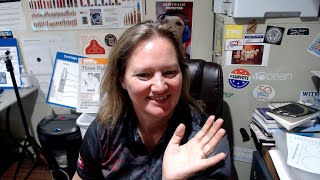
Brooke Cheney, a shooting instructor, discusses how physical activity and accomplishment combat feelings of uselessness. She shares body-based techniques like deep breathing and posture to regulate mood, addresses the caregiver paradox women face, and highlights resources like Aiming for Zero, a veteran suicide-prevention program.
Chapters
Ta-da! So I am live and, um, I'm on YouTube and I'm on— oh, that might be a little too bright. Hold on, let me adjust that. Um, that's better. What am I doing? All right, so I'm doing this whole thing where I've got YouTube here, I've got Facebook there, into is a little confusing. Um, my Facebook is being weird on my computer and won't let me log in, so Facebook's on my phone, YouTube's on my camera. Uh, hi all. Um, for those of you who haven't been here before, my name is Brooke Cheney. I am the owner and instructor here at Great Start Shooting School, and I come on every Friday night, Saturday night, whatever day it is. It is Saturday because it is Suicide Prevention Saturday. Hi Mike, I see your little tiny face. So, um, yeah, never mind when it comes on. So, oh my goodness, what have you done today? So on Facebook, that was my little tagline. On YouTube, it's nothing because I'm just new to doing the YouTube live thing. So what do we talk about on Suicide Prevention Saturday? Oh, well, we talk about how to prevent suicide. Or why do we talk about suicide prevention? Well, because every 2 out of 3 gun deaths you hear about in the media happen to be suicides. So today was a crazy day. I've been going since 9 o'clock this morning, finished at like 6-ish, 6:30 maybe. Yeah, 6:30. Um, got a Girl and a Gun event this morning. I also did, uh, finished up a pistol permit class and then Find Your Perfect Gun. And then a father-daughter team just came and got to shoot for 2 hours, so it's been a very productive day. So that's always a good day. And what does that have to do with suicide prevention? Well, let me tell you. When you do stuff, you feel better because you've accomplished something and you no longer feel useless. Now, as I've said in the past, I don't always know why people are upset or what's the matter or what causes that anxiety or what causes the depression or any of those things, but I do know do know— I can speak, I swear— holding your chin up, as simple as that, is taking a big breath in and letting it out. Something as simple as that can change your state. Emotions are something we do in our bodies. If I am tired and I'm just so done with the day, I slow myself down, I put my head down, I show push my shoulders forward, I'm getting rid of my chest's ability to take in that oxygen and feel what I need to feel. Head up. There's all sorts of— did you know that your eyeballs were part of your brain? It's the only exterior part of your brain. Um, I read that somewhere, heard it on some show, so I don't have any links to back it up or anything, but it kind of makes sense because your eyeballs are like the control center of your brain, in that if you look down, all of a sudden you get into your body, and if you're in pain, you can really feel it. If you look up, you can actually realize, like, huh, I feel lighter when I look up. It's one of those tricks. If you're ever at a funeral and you're giving a speech— because I've done lots of speeches at funerals— if you look up and take a breath, it allows you to stop crying, at least long enough to get the words out. It's not a permanent fix, but it is amazing what your eyeballs alone can do. Now, looking straight ahead, trying to look at the camera, the cameras, um, is a little bit harder for me to give you an example, but it's like when you look straight ahead, you're kind of in the middle. You're not disconnected from your body, but you're not fully attached either. So, um, so try it, play with it, uh, find different things that make you feel different. Doing something, serving others, taking care of people, taking care of yourself without feeling guilty. That is one of those things. It can be hard sometimes, but it's super important to do because that breath, that's one simple thing you can do to take care of yourself, right? And as women, I don't know if guys do this. I really don't. I've got lots of great guy friends. I don't have— I haven't had this conversation but it just seems to me like as women, so often we are caregivers and we are the taker care of people. We're moms and daughters and grandchildren. And somewhere in our society, we've seemed to kind of mess things up a little bit where it's like, well, if we're taking care of ourselves, then we're being selfish. But then there's the other extreme where it's like, all I do is take care of everyone else. No one loves me. No one takes care of me. And we have our own little pity parties. So balance is not real. It's realizing where the heck you are on the pendulum and trying to get a little bit closer to center and knowing that you're probably going to go the other way as well. So mental health, it's super important. There's so many resources out there. Wednesday— oh, next Suicide Prevention Saturday? Not sure when that's going to be. Just because I am volunteering at Aiming for Zero, which is a veteran suicide prevention program. And I don't know what time we'll be done, so hopefully I'll be here at 9 next Saturday. But doing something for others, I am volunteering my time and my money to go and assist the group Aiming for Zero to raise money to help support veterans in crisis and their families. So that gives me purpose and gives me something to do that I know I'm making a difference somewhere else. Uh, my daughter's coming, super excited. She decided she would come and play on the range with us for Wednesday, Thursday, Friday, Saturday, Sunday. It's gonna be fun and long days. But why am I telling you this? Because if you don't do stuff, if you don't serve others, if you don't take care of yourself and do things that make you feel better about you, like my my buddy Mike, who's almost here every Saturday. Um, he takes care of people all the time, but he knows the importance of taking care of himself. And when I was in my 20s and I went to a women's retreat, a Christian women's retreat, one of the most important lessons I learned was if I'm a caregiver, I must make sure that I fill myself up and overflow with love or God or whatever your belief system is before I can pass it out. Because if I— all I do is pass it out to you and I'm empty, then I can't help pass it out very well. So this is my thoughts for you tonight on Suicide Prevention Saturday, which is do something to take care of yourself. Do something that makes you feel better about taking care of someone else. And look and see at all the different places where there are suicide prevention programs, whether it's veterans, I don't know, teens. Rachel's Challenge is one of them. Walk the Talk America is another one where we're trying to have the conversation between the gun world and psychologists, because a lot of psychologists don't know how to handle people in the gun world. Um, what else is there? Just, just Google suicide prevention and see what comes up and see what makes sense to you to promote. Because one of the things we're talking about, suicide prevention for veterans, is there's so many resources and yet they don't reach out because everybody thinks it's the VA. So There are tons of free resources out there. Go look them up, find them, share them. All right. That's all I've got in for me to— for today. Holy moly. Um, cause it's been a long day and I am so very tired. So love y'all. Have a great day. Do something awesome because it makes you feel better when you get to do something awesome. And I will see you all next week.










