Suicide Prevention Saturday with Internationally Famous Guest Charlie Cook!!!
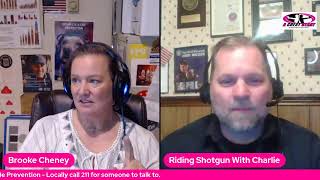
In this live‑stream episode, host Brooke Cheney teams up with Charlie Cook, the creator of the "GunGrams" YouTube series and host of "Riding Shotgun with Charlie," to discuss suicide prevention within the gun‑owning community. The conversation opens with light‑hearted banter before Brooke explains that two‑thirds of gun‑related deaths are suicides, making mental‑health outreach a priority for gun owners. They review four key resources: Sarah’s Hold My Guns program (which lets gun owners temporarily store firearms with FFLs during crises), Lieutenant Lou’s story of combat trauma and its impact on his mental health, the Walk the Talk America self‑assessment tool, and Mike Sardini’s work on addiction and suicide. Throughout, they highlight barriers gun owners face—fear of losing gun rights, stigma, and legal complexities around temporary transfers—while offering practical steps such as checking in with friends, using hotlines (211, American Suicide Prevention Foundation), maintaining gratitude lists, and fostering community support. The episode also touches on broader political debates, contrasting gun‑abstinence rhetoric with education‑based safety, and ends with a call to the gun community to prioritize suicide prevention as the most effective way to reduce gun deaths.
Chapters
So we'll see. It says we are live. Does it say that for you too, or does it not tell you?
It says I'm in the show. You can see, and everyone can see and hear you, so I better be careful.
Oh, you're pink. Do you mind being pink? So this is Riding Shotgun with Charlie.
I'm very in touch with my masculinity and my femininity.
Okay, well, I don't know if I've ever told you the story, but like, for me, I hated pink. Like, I was such a tomboy. Yes. Hate, hate, hate pink until I could handle one of these confidently. Then I decided I was manly enough that I could handle pink.
Nice. I, I try to wear black because black is slimming, and I cannot wear enough black.
Okay, I understand. I do, I do. All right, so, so much for starting early or giving us a little time to warm up, but we, we are highly trained professionals. We are highly professionals. All right, so hello replay viewers, because, well, although it does say there's already 2 people on, look, I'm making it double because there's 2, um, which is always amazing to me because people come back no matter what I say. Oh, we're up to 4 already.
You know, I bet just because of you, you know, they told 2 friends and they told 2 friends and so on and so on and so on.
That's how it all worked.
It's like a Perel commercial.
So I'm not as fancy as Paul Lathrop, but so here's my intro. It's Saturday night, so what time is it? It's time for Suicide Prevention Saturday. And why do I, Brooke Cheney, as a gun owner, want to talk about suicide prevention? Because 2 out of every 3 gun deaths you hear about in the media when they're talking about gun violence is a suicide. So if we're looking to save lives, we need to talk about suicide and mental health. So to help me with that tonight, I have Mr. Charlie Cook from Riding Shotgun with Charlie. Uh, I've been on his show— wait, which one was it? I don't even know, something. So I, I, wait, I have the link, but I— oh, number 75. Number 75. Yeah. So, uh, I had, like you said, I have, I have notes. Paul's teaching me a little bit here and there, so In the description, I said I have international star Charlie Cook here, and so I think we should tell the viewers here why you are an international star. Would you tell them why?
Because I'm a love machine. Yes, no, I— so there's a, um, I hate saying there's a couple things I do in the gun community. It seems like there's a lot that I do And then there's sometimes it seems like there's nothing that I do. But besides being an instructor, I started making videos playing the trumpet with one hand and shooting a gun with the other. I've wanted to be a musician my whole life, and my whole life was geared since, I don't know, 8 years old, 7 years old, my whole life was geared towards being a musician. And I think deep down I wanted to be a famous trumpet player. But I didn't play the trumpet. I ended up playing the trombone. And so I spent years being a trombone player and being a musician and whatever, playing in a band and all that sort of stuff. But at one point, ironically, I'll say this here 'cause we're, you know, we're in safe company. My therapist actually told me that when I talk about gun stuff, there's a light in my eye shines. And when I talk about music, a light, they're like, the same light comes up. So he said, why don't you put the two of those together? And why don't you make a video where you play bum bum bum bum bum? I said, that's ridiculous. So I went home and I worked on one-handed reloading. And I learned that from, it was the time, it was a Combat Focus shooting with Rob Pinkus. I worked on one-handed reloading and I made a video in 2014. Of me playing the Blue Danube Waltz and shooting a gun at the same time. And then in 2015, I made a video playing the Happy Birthday, and when kids sing it, sometimes they'll put in a cha-cha-cha at the end of every line, and I hate that. I hate it. Me too.
Oh my gosh, I can't stand that.
Oh my God, I hate it as a parent, I hate it as a musician, I hate it as everything. So, so I did a happy birthday video playing the trumpet with one hand and shooting my AR-15 with the other. And I shot the cha-cha-cha. And I put this on YouTube. I shared it on my Facebook page and I had a bunch of people like, oh my God, that's awesome. Can you make one for my birthday? So that spiraled. This is in 2015. That spiraled to happy birthday to TV themes and movie themes and all sorts of you know, other popular stuff.
So now Charlie has GunGrams on YouTube.
Yeah, I, I call—
and the reason that he's an international star is because— what, what, what country was that that they were asking you for your GunGrams?
I've had people ask them, uh, for them in, in Brazil, in Russia, in China, uh, Italy, um, Germany. I gotta— I gotta— the year that these took off was in, in 2016, and it was Christmas Eve 2016. I was at my girlfriend's house and I got an email from some guy that's like, dude, I'm, I'm in Germany, I'm totally drunk, and I love these videos with you playing the trumpet and shooting a gun.
And what does this have to do with suicide prevention? Absolutely nothing.
Absolutely nothing.
Absolutely nothing.
Right. I'm, I tell my students at school, I'm a band teacher during the day, I tell them I'm the world famous Mr. Cook, and they're like, yeah, um, you're not world famous. I'm like, yeah, I know.
He is actually internationally famous. And so that's why he's the international star that I have on here today, right? So normally our show is really short, 15 minutes or so, and we've already like 5 minutes into it. And so let you all know what we're going to talk about tonight. So what Charlie does also, because if you notice the little thing says Riding Shotgun with Charlie, is Charlie has another YouTube channel that he's not an international star at yet, but his job is to drive a stagecoach across all of America and he interviews gun people from all walks of life. So Charlie agreed to come on tonight because we're going to talk about some of the people he's, he's had in his stagecoach that are also gun people that are also doing, um, suicide prevention stuff. So we looked at a couple of his, and he's got a ton of them. What number are you up to now?
136 is what I put out this week.
Okay. And how often are you putting them out right now?
I hate saying this. In 2021, I put out 7 months worth of material, a show every week. But I'm back to doing every other week because I've run out of my, um, my stash or videos. Like, I'm still recording shows, but I'm doing shows every other week.
So like 2 a month generally sometimes, and then we get busy. Like, but you're leaving for SHOT Show. When are you leaving for SHOT Show?
I'm leaving for SHOT Show on Monday evening.
I hate you, but that's okay. Make sure you post stuff so I can live vicariously.
I, I have a whole ordeal with me getting a phone over the last day. Oh yes, a new phone. So yeah, I've got a new phone and it's primed and charged and ready to go. So all right, I am— yeah.
All right, so we're going to talk about 4 different things. Hey DJ, hey John. Um, 4 different people, I mean. So Sarah from Hold My Guns, who's episode 92. Then we're going to talk about Lieutenant Lou, episode number 136. Um, and I just want to drop a little thing about NSSF in there, even though you haven't, you know, driven around with anybody from NSF that we talked about. And then we're going to end up with Mike Sodini of episode 67. Um, so real quick, like short version, um So Sarah is from Hold My Guns, and if you want to learn a lot, we will drop the link to Sarah's talk down here. And I had just rewatched her interview and actually talked to Sarah tonight. So tease, you know, spoiler alert, I am gonna get Sarah on here in March.
I sent her a message and said I was going to be on. She gave me like 4 messages of things I need to plug.
Well, I, and I talked to her about it because she's going to be at SHOT Show too. So you and her can talk about whatever we didn't talk about tonight. There you go, you can do that. So Hold My Guns, the, the short version of it is, is that if I were in crisis as a gun owner, there are various FFLs around the country where you can just go, here, I'm having a bad day, take these and hold on to them so that I don't have access to them. Um, in that interview, I think, I think Charlie, I think you might have said it's a great idea for like when you're in the midst of a divorce and stuff so you you don't have to worry about anything like that.
Absolutely. I admit it, I rewatched the show with her. I, when I was going through my divorce, I gave my guns away 3 different times. I gave them to one friend to hold onto them. They were all in lock-secure containers. I kept the keys, he kept the guns. I eventually took them back. And then a month or so later, I gave them to another friend that held onto them. And it was the same sort of thing where he held onto the guns, I held onto the keys. And then the third time I did this, couple months later. I gave them to a friend who actually is an FFL, and he ended up logging them in his book. And then I had to go groveling back to him, and I'm like, hey man, I need, um, one handgun and one shotgun because I have a class coming up. And he's like, don't come back for 8 days. And then 8 days later, I'm like, okay, I need another handgun and a shotgun and a rifle this time. So I slowly acquired my guns back because he's a dealer. So I had to go through all of the, the, uh, 4473 to get them back the third time. And then I'm like, all right, this is ridiculous, right?
All right, so for those of you watching, the link to Charlie's interview with Sarah is now in the comments, or in the comments depending on you, you know, Facebook or YouTube. So, uh, let's see, she's always looking for more storage partners. So one of the things she said in your interview was If you're an FFL or you have a gun store, feel free to reach out to holdmyguns.org. What else did she tell you to plug since you talked to her too?
I can't read that much. So let's, let's talk about what she— what Hold My Guns does is it's, it's a nonprofit group, and what they do is they get gun stores around the country to hold on to firearms for people that are going through Sorry, John's always late, so I'm just pointing at him. Guns and Barbecue, awesome. He rocks, man. So Hold My Guns, what they do is they work with local FFLs and they hold on to firearms from people so that if they're going through a tough time, whether they're work, whether their job, whether it's a whatever, some sort of a mental health crisis, that someone else holds their guns so that they don't do something that their friends would regret. And that's kind of what they do. And it's also if you're, you know, going away for a while, you want to keep your guns secured someplace. It's kind of for that. But the important thing is to make sure that people don't do something that their friends would regret.
Right. And what else? I don't know, I want to try to get through everything because ideally I'm going to talk to all these people individually so we can go through more. Then you had Lieutenant Lou, uh, on episode number 136 of your show, and he's a badass kind of dude, kind of like crazy badass.
Yeah, he's done some wild things.
Oh wait, and DJ, thank you, I'm getting better with— because Charlie's talking so I can look and grab links and drop them.
You've got plenty of time for that. Lieutenant Lew was, was in the military for 4— 20, I think 28 or 29 years. I think 15 years in, 15 years in the Army, 7, I want to say 7 tours in the Middle East in the War on Terror. One of the things that Lieutenant Lew did is on April 1st, 2003, he was on the team that helped extract Jessica Lynch. From an Iraqi hospital. And that, uh, this— the thing, the thing that got me the most with, with him talking about that is, uh, there were 13 people that were killed, and not Jessica Lynch. They, they didn't know— the, uh, the terrorists didn't know that she, she lived together. There was a, uh, an incident with some vehicles in a crash, and, um, she ended up She ended up someplace where people didn't know she was, and they ended up killing all these other 13 military members. And the terrorists took her and tortured her and did some very bad things to her. And she ended up in a hospital. And when the military found out about it, they extracted her, and he was part of the team that extracted her. One of the things that he did is he ended up spending 3 hours in a helicopter with the the 13 bodies that were in shallow graves in Iraq, which is not a pretty sight, I'm sure, and not a— you know, it didn't smell good.
I know, I watched the interview again with you, like, oh, that's awful.
And he's like, you know, that's things you can't unsee, but it's also things you can't unsmell. And he spent 3 hours with rotting bodies in a helicopter to repatriate these, these, these heroes. And he had a tough time with it, a tough time dealing with this. And when he came back, he ended up with a drinking problem. And at one point, he wanted to, wanted to end his own life. And for some reason, he did. He was drunk, and he didn't have his firing pin in his gun. And he pulled his gun out and tried to shoot himself and did not shoot himself because the firing pin wasn't in there. So there's— when you talk with them, like, it's, it's a serious thing, you know? It's, it's a heavy issue. It really is.
And I mean, so the other thing I was watching— I mean, part of it is, um, uh, at around 29:29 in that interview, because these interviews are usually about an hour long, for those of you who haven't seen one of Riding with Shotguns—
what, people haven't seen it?
No, I'm sorry, I should never assume anything like that, but between 29 and 29 and like 32, 37, he kind of talks about a lot of the same stuff that Sarah talked about. And then our next person we're going to talk about, which is Mike, talks about is that people are afraid to go forward with the mental health issue because fear of losing clearance for him, for Lieutenant Lou, fear of losing their guns, fear of freedom, losing their jobs, losing their marriage. Because Lieutenant Lou does get into how much he lost And this is also where we talk about thanking your ex-wife because you wouldn't be where you are if you hadn't got divorced, Charlie. But, um, but it's just like, because like Sarah talked about it before, like I said, Mike will talk about it again, is that as a gun owner, we don't want to lose our guns. And in the, in the mental health world, like, mental health itself already has such a, oh my gosh, you're broken if you're going to get help. Um, And then for those of us with guns, it's like, well, not only that, but if we go to a therapist, they're going to take our guns away. So the fear behind even getting help, if you're willing to even think about getting help, and there's so many reasons why you don't want to. So, um, what did, what did John say? John wrote a whole bunch of stuff. Um, the compelling thing about—
I know, from Ammoland and who wrote the book Decoding Firearms, that John Petrolino.
It's because, you know, because Charlie knows everybody.
Um, I'm just keeping up.
Yeah, yeah, I'm not. That's why I have people like you so you can tell me about it. So anyway, so, um, the, the— when he's talking about the program, he's talking about the hold my guns thing, right? It's just, here you go, hold on to them. And there isn't a report that says, well, this person is unsafe, or un— or it's just before you're having the ambulance come take you away. Um, and one of the things he's talking about with the ATF also is, for you who are ungun people, is that one of the challenges, whether we're talking about Hold My Guns or Walk the Talk America, as we'll get to, is that there are so many laws that make it challenging. And like you talked about in most of your interviews as well, is like in New Jersey, right, I can't hand you a gun and then you can't hand it back to me because that's an illegal transfer.
Exactly. So if we're out hunting birds and we, we find a fence we need to climb over, if you hand me your shotgun so you can climb over a fence, that's a transfer. You have to do a background check on me to hand me your gun so you can climb over the fence. After you climb over the fence, I hand you your shotgun, I'd have to do a background check on you. Then I hand you my shotgun, I'd have to do a background check.
No, he has to— the one person receiving has to do the background check, right?
So it's, it's one of these things where I'm— we're climbing over a fence. The safe thing to do is for me to hand you my gun so I can climb over the fence. You hand me my gun, you hand me your gun so you can climb over the fence, and then I hand your gun back to you once we're both on the same side of the fence. These are transfers in, in the state of New Jersey. Yeah, and, and these would require background checks while we're out in the field, while we're out doing some hunting.
All right, and as we know from being in the gun community, one of the things we love about our gun community is people are really cool. We like each other. We love getting people into the sports. And I know as a competitive shooter, when I first got in, my husband and I didn't have any gear, didn't know anything, and people lend us stuff, and we took stuff because we didn't know any better. Because like, oh, you know, most of us think, well, you have a pistol permit, so it's like a driver's license. And so if I have one and you have one, I can hand you the keys to my car, ergo I could hand you my gun. It's not a big thing. Until a friend of ours found out from a lawyer that, oh no, in Connecticut, yeah, can't, because if it's not in my possession— it's not as extreme. But again, the whole problem is there are so many crazy laws around firearms and how things go. It is pretty brutal. All right, so that was Lou, um, and talking about the fear of going for, uh, any kind of mental health. And unfortunately, you have to lose a lot often before you will go and get help. However, um, let's just— I'm going to skip NSSF because I talk about them often enough. So let's go straight up to Mike Sodini. So Walk the Talk America, your episode number 67 with Mike. And oh, so another teaser or whatever is that Mike is going to be on here on February 5th. So there will be that. So I'll have Mike and then I'm gonna have Jake as a bonus session sometime that next week. Uh, I don't— I'm not even gonna try. I am just not gonna try.
I've heard a number— I think it's Wachowski.
So I—
okay, I know John's gonna tell us what it really is and he's gonna spell it out phonetically, but it's all right.
Is that what barbecue is good for? I don't know, right? Um, all right, so DJ says I've got a bot— whoops— which I just clicked on, but I don't know how to get rid of it. So one of these days, DJ— oh, you sniped him? Good for you. All right, so anyway, so, uh, yeah, episode number 67 of, uh, riding the stagecoach here across America. Mike Sardini, what is your favorite part of that whole mission statement and everything that's going on there?
What, what I like about Walk the Talk America is the, the, uh, so in, in the episode with me, what, what Michael Sardini goes through is that he had a friend that was in the firearms business that, uh, had a lot of, uh, a lot of depression, a lot of PTSD, and ended up taking his life with a firearm. And that is how Walk the Talk America started. One of the great things about their website, which— give me a second here.
Oh no, I got it. No, no, you keep talking. I got it.
I got it. I swear. What they have on there is they have— oh shoot, no, I got it.
An evaluation.
Thank you. They have an evaluation. So you answer, I don't know, 12 or 15 questions about yourself. And they— it's real informal. But you answer the questions and they give you a sort of an evaluation that says, hey, listen, you know what, you're in a good place, everything should be okay. Or they say, listen, you know what, you might want to talk to somebody and here's how, a way you can find people to talk to and people to help you out. And that really is the big thing with Walk the Talk America. They're trying to take this, the stigma, I think is the right word I'm looking for. They're trying to take the stigma away from having having issues with depression or PTSD or whatever, some sort of a mental health issue, and taking control of that and saying, hey, listen, you know what, I need some help. I need to talk to somebody. I love this. They have, I think there are 12 different tests on there that they have. So you can evaluate yourself. And one of them has to do with depression. One of them has to do with you know, uh, PTSD and, and all sorts of stuff. So that, that is a really an amazing thing about the, the Walk the Talk America website.
Yes, and I'm looking for if I can find it real fast, but because yes, you said if we need help, and then I'm like, oh yeah, I forgot to put my banner up. So if you're having a hard time, uh, if you're having challenges, uh, there is locally 211 Here in Connecticut, when you call 211, it's an information line, and you can actually talk to someone, and they may or may not be a counselor, but they'll talk to you. Um, I have had friends who've used this, and then the other part that's even better is then if you need it, they will hook you up with a counselor and they'll help you find resources in your area. So the other phone number that is here is the American Suicide Prevention Foundation, um, Crisis. And I actually just went there through their training, uh, volunteer training on Wednesday, this past Wednesday. And hi, James. I'm sorry, James said hi a couple minutes ago and I'm like, James, hello, hello. He's on. Yes, so James actually, uh, is a friend of mine and his brother committed suicide.
Oh man.
And his, his brother was a potter. And I actually have one of the goblets that his brother had made while he was still with us.
That's cool. So I wrote this as a note. I wrote this as a note that's something I wanted to say. Last, this past summer 2021, there was someone in the firearm industry. I don't think I knew this person, but he ended up taking his life with a firearm. And I remember talking to someone, one of my friends and saying, hey, listen, I don't know if you heard about this or if you knew this person, this guy ended up taking his life with a gun. And, and one of the things as a gun owner is my friend said, I'm really mad with this person because we spend all of our time fighting for our rights to have a gun, and then you use one to end your life, and that makes all of us look bad. And, uh, and I, I thought that was, uh, that was kind of a, kind of a big thing to me because we spend all this time fighting for our rights to have a gun and be able to protect ourselves and to go, to go shooting, to go hunting, to recreate recreational shooting, whatever, whatever the purpose is. But then when someone takes their life, um, these are, these are two-thirds of what the, the gun deaths are, are suicide. And to have one of our friends do this, it, it feels, it kind of feels like a betrayal, you know? It really does.
Yeah. No, here in Connecticut a couple years ago, we had a gun owner, a gun shop owner, take his life as well. With a gun in his shop. And it's just like one of those things where I think, again, what, every, every Saturday I come on, I'm like, 2 out of every 3 gun deaths, that gun violence you hear about. Yeah. And the truth of the matter is, just because you own a gun, you don't necessarily know that stat and you don't understand that stat. But I will tell you, someone who is formerly suicidal as a teen, is that when you're in that dark place where you're thinking that the world is a better place without you, the impact on you being gone doesn't seem like there's anything. Because for most of the people I've talked to, it's the idea is that if I am no longer here, life is better for everybody else. So we don't think of what the repercussions—
so I, uh, this is something I, uh, I was thinking about before the show tonight. One of the movies that, uh, it's probably one of the greatest movies ever, and it has an impact on me every year. The first time I made it to the end of the movie, I was, uh, single, I was drunk, I was in my apartment by myself. Was— my gosh, I'm feeling verklempt. Um, was It's a Wonderful Life. Yeah. And when I get to the end of the movie, I'm like, oh my gosh, the, the impact that George Bailey had on all of the people in his community is, is unbelievable. And I, I looked at my life and I'm like, I've been a teacher, I've been a scout leader, I've, I've done a lot of stuff in my community, I've got a lot of friends. If something like this ever happened, if, if these thoughts came across my mind and, and I ended up doing something like this, how, how would this affect all of these other lives? And, um, yeah, it's rough. I watch it, I watch it once a year, uh, usually around the Christmas time. Um, but it's one of those things that really gets you thinking. And what What I do is I've, you know, we've got friends that when they go through difficult times, check in with them. Check in with them once a week. Check in with them twice a week. Hey, man, how you— I've got a friend that's going through tough stuff. And he's been going through tough stuff for a while. I sent him a text message probably at least once, maybe twice a week. Hey, man, how you doing? How's things going? Let's get together. Let's go out and grab a beer. Let's, you know, whatever.
Well, that goes to John's, John's, uh, comment here. If Charlie's talking about what I think it is, it was alleged that person reached out to 3 friends prior to the act and none of them answered. Yeah. So, um, yeah, and to be fair, it is like, uh, to John's point, I'm like, I absolutely— if a phone number comes up in my phone and I don't know it, I don't answer it. I'm not gonna lie. But now that John said that, I'm like, do I have to talk to all the bots now?
Um, you know, your car warranty may have expired.
There is that. But on the flip side of that is that the opposite though, when people aren't going through crap, the people that are big and strong— um, I brought this up before, but it's like Robin Williams, loved by millions, successful by most everybody's standards, but he lost the fight in here. And who would have thought that Robin Williams needed help, right? Because obviously he's— he's— everything is great. And these are the shockers as well. And I mean, I think Mike also talked about this in his episode with you, which is any one of us can be struggling at any point in time. And I know from being with a lot of people that are high achievers. Like, we've got our stuff together, of course everything is fine. I don't need any help from anybody. I can't fail. I'm a girl. I can be a mom, be a wife, be a business owner. I can be the DC project lead. I can do it all. I don't need any help, and I have to look strong.
And it's bullshit.
It's like, all of us cry in the corner. All of us have bad days. It's just like, but we don't talk about it. And that's kind of the point of having Suicide Awareness Saturday, to know that you are not alone. People have crappy days all the time. Probably one of the people that you think is the strongest, most well-put-together person needs that quick pep talk of, hey, I just want to let you know I'm thinking of you. Because honestly, it doesn't have to be more than that. Because I know for me it was, I thought the world would be better off without me. And really it was my excuse of I just don't want to deal with everything anymore. And so it's that whole thing is you don't know what's going on in somebody else's head, right? And it's so often that the people— I don't know, to me the people that are strongest are usually the ones that need the reaching up to the most. So, and I mean, there's been a lot of that lately. Like, uh, I don't know if you know Ed Mylett or Dean Graziosi. These are kind of people that, like, pep talk people that I, I listen to. And, uh, my newest one is The High Five Habit from— oh, what the heck is her name? Mel Robbins.
Oh, Mel Robbins, she's awesome.
And she's talking about how she's a wreck. Like, she's like looking at herself in the mirror and one boob is higher than the other, and she goes down this whole thing, and she's like, and I got a Zoom meeting in 5 minutes. I didn't want to say that about her, but you know, Well, my dad taught me that when I was really young. He's like, yeah, 12 years old. I'm like, yeah, all girls are uneven. I'm like, okay, I don't need to know these things, Dad. But anyway, but it's like sharing. I know, but she talks about how it's like, here she is, one of the most booked female motivational speakers in the world, apparently. Yeah. And she's looking in the mirror and she's like, oh, I suck. You're right. And so it's like what we perceive of everyone who's got their stuff together, it's like, no, everybody needs help.
Everybody does need help.
Um, yeah, I'm with you. So, all right, we got through everything that was on the list.
Awesome, awesome. I thought we had more stuff, but that's, that's cool too.
I, I, I threw up the NSSF stuff just because Um, Sarah had talked about having a difficult conversation, and then, um, the other thing was Mike's thing that they've put in guns about asking the hard questions. And, um, so there's all sorts of like, I don't know, pamphlets and stuff you can download from any of the, uh, the websites that I put in the comments here.
You know what, something I wanted to say a few minutes ago is you were talking about, you were talking about when people— one of the business podcasts that I listened to actually talked about somebody that was going to, that was going to commit suicide. And they said to themselves, if any— I'm gonna go jump off the Golden Gate Bridge. If anyone smiles at me, I'm not jumping. It's that— I don't want to say that bad, but it's that desperate is not the right word. Bad is not the right word. But it's that wanting to connect with someone, which to me is, like I said, with my friend who's going through tough stuff. I reach out to him once or twice a week. Hey, man, how's it going? Just checking in. How's it going? How are things going? I just want to check in with you. That is, that is super, super important. And, and I know when I go through tough times, I reach out to somebody. I'm like, hey, hey, this person's not available. I'm going to message this person. All right, this person's unavailable. I'm going to give this person a call. Like, I've got— I don't, I don't have a formal list, but I have people that I can turn to. No, I have people I can turn to that will, will, you know, that I hope will answer my call at, you know, 11:45 at night. Right. And, and these are people you can just say, hey, listen, you know what, I just need someone to listen to me for 15 minutes. I gotta— I'm gonna rant, I'm gonna rave, I'm going to talk about how crappy things are. I just need someone to talk to. Right. Yeah, it's—
yeah, yeah. Now reaching out is super important. And that's why I like the little phone number down here below is so you can call someone totally random. Because the other part is, Like my family, we hope our family goes to counseling because for me that's the right thing to do. Because if I'm talking to a counselor, that is a third party that doesn't have anything invested in making me right or wrong. And the challenge when sometimes we talk to our friends and family is that they want to be right or wrong, or they want to fix it for you.
Not only do they want to be right or wrong, they want to talk about us at the next family gathering. That's it.
So, uh, but yeah, it's And everybody's reached differently. Like, uh, last week I was on the Weekly Bullet and, uh, yeah, you were like the social media butterfly last week. Yeah, last weekend was a little bit crazy.
Yeah, just a little bit.
So it's— hey, you know, comes and goes. It's my slow time. But like, so, but it could be something super simple because like, honest to goodness, uh, I blew out my knee the Thursday before Thanksgiving. I've been on and off crutches since then. I had knee surgery the week before Christmas, and various people just picked up the phone and called me. And I didn't realize how much that meant to me. Like, it made me feel so much better that someone just said, called to check in. And here I am telling people, oh, you should do this, you should do this, you should do this, and I do that for other people., but then to have it done for you, it's like, oh wait, this really is very sweet of people.
Exactly, exactly. So I, I've done, you know what, I've done the same thing when I, I've, I, I, I, again, I've been on both sides of the coin where I point, point, I put something on Vaguebook and I'm like, please reach out to me. I did yesterday, yesterday I did, um, because I had cell phone issues. But it felt like the end of the world just because I had cell phone issues. But I've seen some other friends that are just like, hey, listen, you know what, this and this and this and that and that and that and blah blah blah blah blah blah. And I just reached out. I'm like, hey man, I just want you to know I'm praying for you. I'm thinking about you. Just want to check and make sure you're okay, man. I just, I just want to let you know that, that somebody, somebody loves you and someone cares about you.
Yeah. And just to say hi.
I'm like, just want to reach out, man. Hey man, look, I know that things suck right now, just want to reach out.
And this is one of the things I don't talk about a lot on here, but having faith, as in God, the universe, you know, Yoda, whatever your, you know, your choice for faith is, like, if something crosses your mind, like, huh, I haven't seen Charlie in a while, pick up the phone and call Charlie. Whatever Charlie's in your life, of course, because, you know, I'm sure, um, right?
So it's not like me too, that's cool.
It's like, it's, it's been proven time and time again that those of us who have faith tend to be happier because we believe it's not all about us and there's more to life than just what we're seeing. And having that belief system in there's a plan or there's a possibility for for a plan. So I look at like dreams or thoughts or randomness and pick up the phone and call someone who I haven't talked to in forever. Although some of my friends are like, what do you want? It's like, no, for real, I'm just calling to say hi.
I swear. No, really, I just checking in, that's all.
But at the same time, I have really cool friends who if I call, they'll do whatever I need them to. So I've got that going for me. So there's that. So it could be worse. So Oh, let's see, hold on. What'd Mike say? Something about the worst day of his life. Let's get this up here. Uh, the worst day of my life is so small compared to the great days I had in my life and the ones to come.
Exactly. It, it's, it, it, it is. There's a lot of perspective. So I, um, I know people don't know this. I, uh, I had a friend of mine start a grateful list. Oh yeah, yeah. And she does 3 things she's grateful for every day. And she's like, hey, this changed my attitude. This changed— she was going through getting a master's degree, and it changed her attitude about a lot of things. She was getting out of a bad relationship and getting into a new relationship and working on the master's degree. And she's divorced and raising her kids and the whole thing. And she's like, you know, you should start a grateful list. I'm like, ah, that's dumb. That's stupid. But I started it. I've been doing it, I'm going to say, over 7 years. 3 things every day that I'm grateful for. It's small things. It's opening a brand new jar of peanut butter. It is getting all the green lights on the way to work. It, it, uh, it— I mean, it's, it's having both of my kids at my, my place for, for the night. It's going to dinner with my daughter. It's watching a movie with my son.
A movie? Are you sure it was a movie?
A movie, a move, whatever, whatever. I'm a band teacher, not a spelling teacher.
Okay, and for anybody who doubts this, I'm actually gonna— I'm gonna spam you now. Um, you can go to Charlie Cook's Facebook page, which I just dropped the link for y'all. Oh my God, every single day he, um, does his grateful list.
Every day. And it's, it's the small things. It's, it is a brand new jar of peanut butter.
Um, it's, it, it— John's being a smartass.
It's, it's putting things in perspective. And I will say this, I started the grateful list before I started doing the Gun Gramps, before I started doing Riding Shotgun. And when I started to, when these things started to happen, when more people started watching the videos on the Gun Gramps videos, when Riding Shotgun started to happen, it was, hey, I'm going to interview somebody in Jersey. I'm going to interview someone in DC. I'm going out to Minneapolis to interview someone. I'm gonna go to this event in Florida, and I'm gonna interview some people there and make some new connections. And then after that, I'm gonna interview some people in Florida, and then some people in Pennsylvania. And it was just one of these, like, it took time to happen. But once the ball started rolling, oh my God, it was, it's, it's been great.
Well, it's like we were talking about Mel Robbins a little bit earlier, and she started a new thing called the Hi-Fi Habit. And it's something super simple, and it's give yourself a high five in the mirror for 5 days. That's a high-five habit. 5 days, not forever. But stuff like your grateful list, your gratitude list, is something that people have been using forever. And like, for Mr. Ballinger, Mike there, I don't know the worst day of his life, but I know one of the worst days since I've known him was he went camping with his best friend and he woke up and his best friend was dead. So that's the kind of bad day that Mike had to be posting up, you know, the worst day of my life is so small compared to the great days. And I don't know that that's Mike's worst day of his life, but I think that's a pretty rough day.
Yeah, that's, uh, that's up there. I want to say the top 5.
Yeah, so it's the top 5 of bad days, probably. Um, but everybody that talks to me about these things, I mean Don't get me wrong, I've asked Mike before whether I'm allowed to share this, so I'm not letting any cats out of the bag that weren't allowed to go out. Um, and, uh, first thumb— I don't know what G Web's talking about, but good evening, sir. Um, oh, uh, first thumbs up. Oh, gotcha, gotcha. All right, I know they seem to have this competition of who was on time.
I know, right? I love it when G Web chimes in.
So, um, all right, so anyway, so yeah, so And the other thing that I've learned from other counselors is that you cannot take your pain and suffering and compare it to anybody else's. Yeah, in that Mike's got a pretty significant story of, yeah, I went camping with my best friend, which we've done forever, and I woke up one day and he's dead. Everyone's like, holy crap. And yet there's someone who's got it worse, and there's someone who's got it better. And that's kind of what got me through, because as a kid, I was sexually molested and raped and all of this other stuff. And people are like, oh my God, that's so horrible. And I'm like, yes, but there's people who've had it worse. Which is, I listened to an interview with Ed Mylett about this girl who talks about when she was 4 years old, the first memory she has of her sex slave life was 4 years old being sent into a hotel. And she knew to come out with the envelope and that that was her life. And that's how parent— her parents made money was off of trading her. And because we're in January and we're coming up on it, Super Bowl Sunday is like the Black Friday of sex trafficking. So as far as difficult challenges in life, we all have different grades and we're all gonna deal with it differently. So one size never fits all when it comes to mental health. And there's lots of things that we all need to work on. So how's that for getting all deep and cranky on you? But well, but it's just like we learn from the darkest. The darker we go, the brighter the light shines that has to pull us out of that darkness. And that's, to me, how I learn the lessons. And it's not that life is always sunshine and rainbows, but when you've been down in a pit of darkness the sunshines and rainbows. I think your gratitude list, you get your gratitude a little bit better.
It's— there are some days, uh, like legit, there are some days where I'm like, yesterday sucked butt.
I— an exploding iPhone. I don't understand why you care about your phone exploding, but other than that, I'm sure it was fine.
So here, here's what it is. When they told me the battery exploded and they could get me a replacement in 5 days to 2 weeks. Ah, you don't understand. I'm going to SHOT Show in 3 days. I'm going to be in Vegas. I'm going to need my phone. I need my phone to board the plane. I need my phone to make phone calls. I need my phone to send text messages. I need my phone for emails. I need my phone for everything. I don't think you understand. You can say you understand.
Yeah, not so much. All right, so G-Webs is also helping us. Well, no, it's just that he said he did the first thumbs up to let him know his other buddies were slacking because, uh, Barbecue and DJ apparently did not give me a thumbs up, you know. So G-Webs is helping me out on this, uh, the whole— how to get out there because he would— you and I wouldn't be here if it weren't for him because he's the one who taught me about this whole StreamYard thing.
He's— so, you know.
He does a lot of stuff, which is really cool. Yeah. So yeah, so the good news is you now have a phone that works. You're almost ready to go to SHOT Show.
Yeah, well, the bad news is I had to spend $800 on a new phone.
Uh, is this where I put your Donate Now button or buy some of your swag up so you can help Charlie stay in contact with people?
Right, shotgunwithcharlie.com/merch. I think it's runningshotcovercharlie.com/store, I think is where it is.
Okay, I don't know, anything's possible. Yes, buy more Charlie stuff, right? Um, wait, shop—
is it like a mug?
A gun gram mug? Or wait, wait, where is it? Oh wait, hold on, I got my sticker right there.
I got stickers, I got patches, I got coffee mugs, I got t-shirts, I got hoodies. John Petrovino is the only person to buy a hoodie, by the way. He bought one for him and he bought one for his wife, and he, he gave his, uh, his hoodie to his, his niece.
So, all right, Mark says great guy. I wonder if he's talking about you or John. I have no idea.
Mark's a good friend, man.
He's, he's a great guy. All right, so, all right, so I did actually put the link to your shop, so if anybody wants to buy from you— oh yeah, there you go. I don't care what they say about you. Okay, I know they talk about me. They do. I don't know why people talk about me, but you know, all good stuff. Yeah, no, we had fun on, uh, whatever that was, Weekly Bullet last week.
So yeah, yeah, you were, you were working it, girl.
Weekly Bullet on Saturday, another inner podcast on Sunday. Oh yeah, that was the guy who asked me to get you on your show. I'm like, dude, you don't do enough TV stuff.
All right, so you need to give me this guy's name so I can send him a check because you said he knew who I was and I'm like, yeah, there's no way, there's no way.
All right, so let's see, what time is it? I don't even know, 9:47.
Yeah, it's, it's— so the 15-minute show is 32 minutes over.
A little bit, a little bit, but you know, it is what it is. I, I did just come from a 50th birthday party. I told you we'd have 5 minutes, 10 minutes to warm up.
You've had One, one, one. Um, highly trained professional.
Yeah, yeah. So, but, ah, you get to be the very first guest I've had on StreamYard. You're number one, Charlie.
I'm honored. Usually I'm number two.
I know, I understand. But, uh, the exciting part for me is you're the beginning of this little tornado that's going on though.
This is great. Like, you're gonna have on Sarah, you're gonna have on Michael Cerdini, you're gonna have on Jake, however you say his last name.
Jake Wacharski. He's just Jake from Antarctica for me.
Jake from Antarctica. So, all right, so you got to talk to Jake. The only continent somebody hasn't watched a GunGraham on is Antarctica. Okay, so I need a video of, of Jake or someone he knows on Antarctica saying, hey, my name is Jake, and wearing a parka, hey, my name is Jake, I'm watching Charlie's Gun Grams on Antarctica, then people have watched all of my Gun Grams on every continent.
Well, Mike wants to say thank you for being on tonight, Charlie.
I'm honored, Mike. Thanks for, thanks for being here, man.
Thanks for tuning in and watching. Um, yeah, so Mike actually, uh, he's been asking for addiction services. So next week, Mike, I finally have time where I don't have other stuff planned So next week is going to be, uh, dealing with addiction and where the, the combination between addiction and suicide tend to come together. Because again, it's just back to mental health stuff is really what it comes to. So Mike has been asking for a couple weeks because he's got some challenging friends, friends with some challenges on how to deal with that sort of stuff. So that'll be next week. So let's see, so next week is addiction. Uh, I don't have my map up, but then February 5th is Mr. Sodini from Walk the Talk America, and he's a great guy. Then Sarah— I gotta look at my notes— is gonna be March 19th, because I'm just trying to do, like, unlike you who does every other week or so, I'm trying to do at least one guest a month.
Yeah, one guest a month, but you do shows every Saturday night. I do, I do. Like, I was telling— I was having some dinner with friends tonight. I'm like, so I've got to leave early because I've got a show. And she's like, they do a show every Saturday night? I'm like, every Saturday night.
I have no life. Well, it's like my girl's 50th birthday party tonight, and I'm just like, I'm gonna eat and run for your birthday party.
You'll chew and screw. I get it, that's, that's fine.
And everyone's like, you're only 9 AM tomorrow for an interview. I'm like, no, I'm having the interview at 9 o'clock tonight.
So yes, you know what, this is, this is the commitment that you've made. It is. And it's, it's commendable. I mean, really, it's, it's something to, to, to like. Every week you're on.
Every week. Yeah, well, except for those, those Sundays, because life doesn't always go according to plan, so sometimes it's Sunday instead.
Um, it still begins with an S.
It's still in the SPS, and it is weekly.
I, I—
there you go. Last year, I think I did miss maybe 3.
Um, 3 out of 52 is a low percentage.
Okay, all right. But yeah, and, and it was funny because when I was watching your interview with Mike Sardini from Walk the Talk America, I'm like, oh, I've been doing this longer than he has.
Haha, I do it across the country, girl.
Okay, I know, I know. All right, well, we still got a couple states to get you into. All right, so Charlie and I could talk forever, so we're not going to keep you all here for all of that. But thank you for tuning in tonight on Suicide Prevention Saturday, because all that gun violence you hear about— 2 out of every 3 gun deaths you hear about is a suicide— and that is what we need to start focusing on, and that is what we need to talk to our, um, our, uh, oh gosh, see, G Webb's got me all— he's, he's distracting me with his comments now. Um, 2 out of 3 gun deaths are suicides, and we really need to talk about the web, uh, the politicians, and talk— stop about gun grabbing and actually talk about solving problems, right?
So, um, so this is— I, this is something I wanted to say, and, and, you know, 52 minutes into it, we haven't had a chance yet. But you know, you said you wanted to talk about the MDA, the red shirts, the Moms for Manhood Action.
Oh no, I said, well, yes, I said we have to nicely talk about them.
Right. And we will. Okay, we won't, but we will. What I coined this phrase a few years ago, and I wish it would have picked up a little bit better, but they want, they talk about gun safety. They don't have any gun safety classes. They don't really want gun safety. What they want is gun abstinence. They don't want anyone to have a gun, correct? Which is very much like what, you know, some people don't want to teach, uh, teach about whatever, uh, Satanism. I don't know what, right? I mean, okay, they don't want to teach about safe sex, they want to teach abstinence. And what they want, what the, the anti-gun folks is they want gun abstinence. They don't want anyone to have a gun. And when I teach classes, I tell people, I say, hey, listen, the anti-gun folks, it's, it's not semi-autos, it's not ARs, it's a single-shot shotgun. Like, it's not a high on the list, but it's on the list. And when you get down to a double-barrel shotgun, when you get down to a 5-shot revolver, when you get down to a single-shot break-action shotgun, the anti-gun folks want to take those as well. As well. They're not high on the list, but they're still on the list. They don't want anyone to have any guns. And this is, this is what the Moms Demand Action, the Bloombergs, the Everytown for Gun Safety, the Giffords— they don't want anyone to have a gun. It's gun abstinence. It's not gun education.
It's gun abstinence, right? And this is where the ladies from the DC Project are all about. Education is the way to safety. Time and time again, it has been shown that kids who are raised around guns and taught gun safety are the ones who are safe. It's the kids that are never shown what a gun is are the ones that pick it up and point it at their heads and be like, oh, what does this do?
Um, so I, I completely off topic, I have 4— Sarah Joy's here. All right.
Oh, she rocks. I know, but she's, she's—
well, she did—
she'll have to go watch the replay to hear all the stuff we talked about, about her earlier. Because she was packing for SHOT Show last I talked to her. Oh wait, now we're— now we've really arrived. Gina has showed up! We must go for another hour because now Gina is here.
So—
oh my gosh. Oh my gosh, I have a project all over the place.
Mary Louise, she's, she's another Connecticut girl. Yeah. Um, I have 4 masks since the beginning of the pandemic. I have 4 masks. I have a Girl and a Gun mask, I have a Gun for Hire mask, I have a DC Project mask, and I have a Davenport Guns mask. These are the only masks that I have. I refuse to wear the paper masks. I keep these 4 masks in my car. I actually put one of them in one of my coat pockets the other day, and I had to call my daughter and say, hey, listen, girl, are you home? I think I left a mask at home. Put it on the wall where I keep my keys. I want to make sure I have this mask for tomorrow. These are the only masks that I wear. My 4 pro-gun masks.
T-Bo was ready for us to go for another, another hour. I'm like, I don't think I can handle that for real. It's a little late. It's been a long day, man. I am actually, uh, I got to, uh, what did I do? I taught today and I got a 16-year-old— no, a 15-year-old— to shoot his first shots and, you know, leave with a permanent grin. So that's a bonus. And then I got another one of my students who, um, is looking to figure out what gun she wants to buy, and so that was my other one.
You know, guns are like them— guns are like potato chips, you can't have just one.
All right, so since we're not talking about it, I'm gonna go back to it anyway. All right, Mom's Demand Action. I've actually gone to an MDA meeting and I've been there and they just want to skewer gun owners. From my firsthand experience in a Moms Demand Action meeting, they like, uh, oh yeah, so Gina's got another mask for you, by the way. Um, so the Moms Demand Action are just like they're happy to see gun owners turn into felons. And it's just like, if they were really excited about saving lives, that's to me what they would get excited about. And yeah, so Sarah's also been part of Moms Demand Action because they tend to be very angry. Now here's the thing, in the past when I didn't have to wear my DC Project shirt When I go to the Capitol, I would dress like I am now, and I look like a soccer mom, and I would talk to some of the anti-gun ladies, and then they'd say, oh, what do you do? I'm like, I'm a firearms instructor. And some of them would like literally lose— like they'd turn white and walk away like they saw a ghost. But some of them would like ask questions. And they're like, oh, I never realized that, or oh, I didn't know that. So this is why I don't write off the anti-gun people completely. I realize that they just don't have the information, like, because I was that person. I was a gun owner in 2005.
If you told— you were a shooter, not a loader, right?
No, no, no. So yeah, so I would be handed a gun and I would pull the trigger, and if you asked me if I was a shooter, I would say yes. Um, and I, I've been shooting, so I was a gun owner and I'd shot. But if you told me about a 10-round mag ban, my response is, well, they still have bullets in the gun, what does it matter? And, um, I've lost part of the conversations anyway. So I was that person who was uneducated, yet I was a gun owner. So someone like Mothers Demand Action could say Well, Brooke Cheney's a gun owner and she doesn't think there's a problem with 10-round mag bans. Because it wasn't until I got into competition shooting and I actually started buying guns and understanding that my M&P Pro comes with a 17-round mag, and that's just what it comes with. I didn't upgrade.
It comes with a 17-round mag in free America.
In free America, not in Massachusetts or Connecticut where you and I live. But it's, it's that I didn't know. I also used to think I was a Democrat because I thought they did the most good for the most amount of people, because I thought what Democrat meant. Um, and so it just changed. I found out I'm a Libertarian. I believe in freedom. Nice. And so it's like, as you learn things— and this is to me again where we get the education— is truly going to be where safety and freedom comes in, is a lot of those people that are being fed the MDA lines of buy one gun a month and it saves lives. I'm like, no, it makes it really annoying for competitive shooters who need to buy twins when they buy their gun, and it doesn't save lives.
So we've got two here with, with sequential serial numbers, and I like—
I love Sarah Joyce, right? Be mindful and create culture that's loving and welcoming and that makes us want to live for tomorrow. This is the 2A community difference. It's not bitter, not gloomy, not cancel culture.
Education is key.
Boom! Ta-da! There we go. So, and Sarah, I did already pimp the fact that you're coming in, uh, in March, so people are waiting for you and will come on to see you then.
All right, so for real, in the meantime, they can watch our Unwriting Shotgun with Charlie episode.
Yes, absolutely. 92. 92. Yes, Sarah is in episode 92. And she touches on the challenges with laws as well, and so does Mike talk about the challenge with laws because that transfer thing we talked about before. So there's lots of good stuff, um, and I don't know, that's what I got. I could go on all night. I won't though. So there's, there's Sarah's one again, just because she's on, so she knows we're really actually pimping her out. So, but yeah, so Bottom line, close out with the idea that the gun community does care. We do actually want to stop violence and suicide. It's just suicide is actually the bigger nut to crack, because if we can help address suicide in general— yeah, but 2 out of every 3 is just suicide with death, and I'm— suicide with death, there we go, suicide with a gun. Yeah, whereas if we're addressing suicide, imagine the other lives that we can save, not just the ones with guns. So we get to impact so many more lives by focusing on suicide prevention. All right, so that's what I got for the end. Is that a good place to end on?
I think it's a great place to end. I want to thank you so much for, for what you're doing. I want to thank you for having me on and, um, talking about all these great things that are going on in the gun community, because we do, we do care about people and We want everyone to live their, their best life.
Absolutely. All right, goodbye everyone. Have a lovely rest of your weekend.










