The Rev March 11th 2019
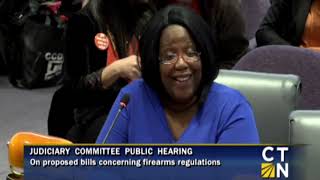
Reverend Ernestine Holloway testified before Connecticut's Judiciary Committee against three firearms bills, arguing HB 7219 would criminalize woodshop classes and DIY projects, SB 60 would increase racial profiling of Black gun owners, and the bills would fail to reduce crime while harming communities of color.
Chapters
You have the floor, ma'am.
Good evening, Chairperson, Co-Chairperson, this committee, Judiciary Committee. My name is Reverend Ernestine Holloway. I am a community advocate for Meriden, a member of CCDL, and I also represent CTRA, Connecticut Republican Assembly. I listened to you guys all day. Y'all gave me a headache. Y'all gave me a headache because you need to deal with reality. Reality is criminals— you are trying to play law to criminals, which hasn't worked in umpteen years, and it's not going to work now. I'm speaking because I come from a family that's on both sides of the law, the criminals versus the people that are legal. The legal people will abide by the law. The criminals will never do. So I just didn't understand, and I'm a little angry. If you pass HB number 7219, anybody that went to school and had woodshop know if you got a bar of soap, potatoes, wood, you can make a gun. So with this law, all those kids that experiment in shop will be in jail of a felony. I just thought that was very interesting. So let's get rid of— according what they said today, because I listen— let's get rid of all of that so we won't have no shop classes because kids won't be able to build nothing. And oh yeah, don't forget YouTube. 'Cause if you go to YouTube, I find you could build everything. 'Cause my daughter told me today, could you buy me some wood? I said, for what? I want to try to build this. I said, that's illegal and you better not build it. How long did it take you to put that together? Oh, it's very easy. I just listened to it for a couple of hours and I figured out how to make it. So you would have to get rid of YouTube. Now let's talk about SB Number 60, an act concerning the presentation of a carry permit. Here's what bothers me about that, being an African American woman and being pulled over by the state police just because I was running an election and needed a permit. Could you imagine if I had a license to carry a gun what they would have done to me? They wouldn't have asked me for no permit. They'd have locked my black behind up, put me in handcuffs, went to the precinct, I'd have been calling Doug and Craig Fishbein to come and get me. That's reality. When you make these laws, you have to take the different races in consideration. I know people don't want to deal with it, but it is what it is. I would love to say every police officer abides by the law. The fact that I got pulled over for doing the election thing and needing a permit, a peddler's license, excuse me. Shows me that everybody doesn't abide by the law. And I listened to the Mayor Gannon today. I just, I couldn't stop laughing at him, so that probably wasn't a good thing. But what I'm going to say to you is, if you just wrap up— when— yes, I am. I want to talk about 7223 and do it real quickly because like I said, there are criminals in my family. I've seen them go into a car from the window because I'm from New York, Brooklyn. Pop a lock, pop other things that they have in the trunk. 3 minutes and then the alarm goes off. What good would this do? Because locks are not made for thieves.
Thank you. Questions from the committee? Representative Jabitsky.
Thank you, Mr. Chairman.
Sorry, Doug.
Thank you for the confidence. I want to ask you about, you know, I knew you were going to bring up the issue of profiling, but you put a little twist on it that I want to ask you about. They, in one jurisdiction that you were in, required some type of solicitation permit.
Peddler's license.
Peddler's license. Did you have any idea that you needed a peddler's license in that town?
Well, I went and I looked at their books because I'm a reader. That's something that I learned from some of you guys. You gotta read it, know what you're talking about. When I looked in their book, they had so many laws that was so obscure, but they didn't have anything concerning politicians going door-to-door. What I found was had I collected $5 in donations like the state requires to do, I would have went to jail because it's illegal to solicit. So I said, so how does this apply to politicians? He said, I don't know. So you mean to tell me I could have got arrested? It was like, yes.
Okay, so you, so you, so two of the bills that are up tonight would affect you in that situation.— the profiling situation and local regulation. If that local municipality had firearms laws, for example, and you were lawfully carrying a firearm to protect yourself, you may not— even if you looked in their books, perhaps you may have seen it, perhaps not.
I'm gonna say this to you. I'm a victim of domestic violence, and I don't talk about it too often. And I was gonna take the class to get the permit, and I was getting ready to fill out the paperwork to get the permit. After the police pulled me over and racially profiled me and 16 other people, I didn't file the paperwork. I was too scared. I was scared that they were gonna see my skin and see an African American and pull me over and arrest me. Unfortunately, I like to say some of us don't live in the real world. African Americans with permits have gotten killed. So I want to know, how would this apply? And then I looked at that video of the guy in Bridgeport. It's something called racism and classism. And that's what I saw. And I don't think we understand the difference. They saw a Black man. He said he had a gun. He let them know when she asked them. They called the police. They sent 3 white police officers, and then they sent the big Black one that stood about 6 foot 4, 300 and something pounds. And I looked at the video. I said, oh yeah, that's racism. And yeah, that's classism. I said, I wonder if they know the difference. If that man would not have came, I promise you they'd have whipped his tail and put him in jail. And I'm not saying all cops are crooked, because I have some police officers friends who I adore. The ones that took care of me when we was kids and even grabbed me by my collar and took me home. I can respect them, but that's not the same police officer from yesterday and today. And they will profile us. I'm sorry. It's just real. A reality, and I'm trying not to cry. It's just a reality. You know how many Black people want to get permits that don't want to have a gun illegally? But they know if I live in Meriden, if they took their happy behinds down to the Meriden precinct and tried to get a permit, it will be sitting on somebody's desk because they judged them because the color of their skin. So if you pass this law, just know I'm going to be the first one to hire an attorney. To fight you on it because I think it's a little bit of racial profiling in there. And a lot of Latin peoples are gonna go to jail. And would you want to be responsible for some cop coming over to you, a police officer coming over to you and say, I want to see your permit, and I say, it's my right, I don't have to show you permit. Am I doing something? No. But your black behind is going to jail. They roughed me up and put me in handcuffs. Do you want that responsibility? Until you word this correctly and change the verbiage and some of this stuff that you guys are trying to pass, you're going to hurt people. You're going to hurt an industry of people that got guns with no serial numbers to it. I know a lot about guns, and I also know the ones that break the law. I had a father who broke the law, who saw things in half. He was a criminal. Should he have went to jail? Absolutely. So I think that to answer your question, yes, it is racial profiling. And I think that we're going to have a problem with some of this. And I also want to say, why invest in a lock that it will take me 6 minutes to break into because I'm not professional, but my daughter at 8 years old took tweezers and a pick and picked my father's lock. She was 6.
Did you hear Senator Looney's testimony?
I think he crazy.
Sorry. Folks. And ma'am, excuse me.
I said sorry. I said sorry.
Okay. Now his possible solution for getting around the Fourth Amendment violation would be for the police to stop every person that they saw with a firearm. How would that go over in your neighborhood?
Well, I think that's very interesting when they can't pull over cars at a DUI, pull over every car, so— and they don't have enough police officers to do it when they do a nose check. So how are they going to do that with guns? Everybody's walking down the street. You're going to say, hey, got a gun, that means you got to stop them, you got to seize them, you got to check them, because somebody may not admit that they got a gun. I think that's ludicrous, and I think the police got a lot of other things they'd rather do than search everybody coming down the block. And besides, didn't New York City get in trouble for that?
I believe they did. Okay, well, thank you very much.
Appreciate it. Further questions to the committee? Seeing none, thank you for being with us.
Uh,










