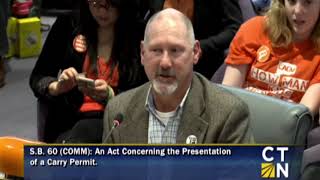
In a legislative hearing on March 11, 2019, Tom Maloney, a resident of North Stonington, Connecticut, presented his positions on several state firearms bills. He voiced support for SB 940 (allowing handgun carry in state parks and forests), SB 5227 (municipal regulation of firearms), and SB 5870 (transfer of assault weapons and large‑capacity magazines), arguing that these measures would recognize law‑abiding gun owners without compromising public safety. He opposed SB 60, the “Show Your Permit” bill, citing Fourth Amendment due‑process concerns and warning of a slippery‑slope erosion of rights. Maloney also criticized the patchwork of municipal firearm regulations, invoking the Connecticut Constitution’s clear guarantee of the right to keep and bear arms, and warned that varying local rules would create legal ambiguity for citizens traveling across towns. Throughout, he used personal anecdotes—such as carrying a sidearm while hunting in state forests—to illustrate inconsistencies in current law. The hearing concluded with brief questioning from committee members, focusing on his experience and the potential impact of municipal regulation.
Chapters
Hello, Representative Steffstrom, committee members. My name is Tom Maloney. I'm from North Stonington, Connecticut. I'm just going to run through the for and against stuff. I support SB 940, authorizing carry of handguns in state parks and state forests, 5227, regulation of firearms by municipality, and 5870, transfer of assault weapons and large capacity magazines. I am opposed to Senate Bill 60. I'm here every year for this one, an act concerning the presentation of a carry permit. HB 7218, as currently written. 7219, an act concerning ghost guns. 7223, storage of a pistol or revolver in a motor vehicle. I'm just going to finish on or focus on a couple bills here. Regarding the 3 bills I listed support for, I ask you to consider how many times you have heard those who oppose these bills decry the Second Amendment supporters' unwillingness to compromise. Compromise means give and take. And yet I don't have a single example where gun owners have seen anything, any beneficial bills come about. We have only had our rights taken with no compromise from the supporters of gun control. These bills being considered today represent an opportunity to recognize that one of the most law-abiding segments of our society deserves something out of this legislative process as well. None of these bills take anything away from someone else or have any conceivable negative impact on public safety. For instance, SB 940 regarding carrying in a state park or state forest, something I, I visit our state forests in Eastern Connecticut quite a bit. I'm perfectly legal carrying a sidearm on the roads leading to a park or forest, and yet because of an arbitrary and bureaucratic reasoning, I cross a line that suddenly makes the same activity illegal. No logical person can claim that we trust someone on one side of a property boundary and not on the other. Even more absurd, I'm a licensed hunter. I can drive to a state forest, park outside, secure my defensive handgun in my vehicle, remove a rimfire handgun and go hunting in the same forest that I can't carry the other gun in. I urge you to consider these three proposed bills favorably. Regarding my opposition to SB 60, again, as I mentioned, this bill's become a perennial favorite of the anti-gun groups, and every year we're forced to remind the committee that Fourth Amendment rights apply to all. The marginalization of any group The marginalization of any group by diminishing their rights hurts all Americans. If ever there was an example of the slippery slope principle, this bill exemplifies it. There is simply no justification for stopping someone who is obeying the law and demanding that they show papers to prove that they're obeying that law. As a society, we wouldn't stand for this in any other context. Due process is the cornerstone of American justice, and no segment of society deserves less. I urge you to oppose SB number 60, and I'm happy to take any questions.
Thank you very much. Questions from the committee? Seeing none, thanks so much for being with us. Oh, Representative Dvitsky.
Thank you, Mr. Chairman. Thank you for coming in. With regard to the Show Your Permit bill, do you have any experience or do you have any any anecdote that you know of that would be affected by this situation if that were passed?
I personally don't. I, you know, I just— I really— and honestly, where I live, I live in rural eastern Connecticut.
We tend to be more gun-friendly there.
Even if I did open carry, and I don't choose to, I probably, you know, would be happy to show my permit.
But there's I really object to the difference, and it hasn't been clarified here today.
There's a difference between showing your permit because you've been asked and being compelled. And I really think the Fourth Amendment rights are what's being overlooked here, that we're saying everybody deserves Fourth Amendment rights except for this group. Okay, we—
when you came here tonight,— or this morning, I don't know what time you got here. Very early. Can you identify all of the towns that you traveled through?
From North Stonington? I can't identify all of them, but it's more than a dozen, I'm sure. It's—
OK. How would your trip have been affected if there were a separate firearms law in each of those towns?
It would be terrible. Like so many of these bills, it's that ambiguity of we're— we are trying to obey the law, we're trying to be law-abiding, and it keeps getting harder and harder because of ambiguous language in some of these laws. And particularly the ability in this case, and we've heard about it, you know, another testimony, there's so much variety or diversity in how the different towns do the permitting process. Now if we extend that to I can drive on state roads but not town roads, in one town and not the other. And we've seen in the past where towns— and I don't remember the specifics— some cities it was you could only legally open carry, others you couldn't open carry. You know, it's— that's the wrong road, obviously, to go down. Let something that's guaranteed by not just the— we've talked a lot about the US Constitution, but also the Connecticut Constitution is very clear in our Second Amendment, or in that case, the 15th Amendment, Article 1, Section 15, you know, codifies that. And to let towns arbitrarily start to make up their own laws is just unfair.
Okay, well, I think the— tell me about the Connecticut constitutional provision, because it seems like that would be most applicable when it comes to having each of the towns create their own regulations?
Well, it states that every citizen has a right to keep and bear arms.
There's less—
there's no of the language that has been debated in the past around the militia. It's actually more clear than the federal Constitution. And so I don't see how towns could go the route that some of these towns would want to go without being in violation of of the Connecticut Constitution.
Thank you. I appreciate your time. Thank you, Mr. Chairman.
Thank you.
Thank you. Further questions from the Committee? Seeing none, thanks for being with us.