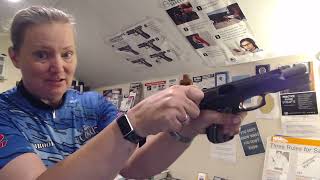
In this instructional dry‑fire video, the presenter walks through the sixth day of a structured shooting practice focused on trigger control. He reviews the day’s agenda—drawing, shooting, reloading—and then demonstrates how to align the front and rear sights, keep the sights centered on the target while squeezing the trigger, and minimize sight movement for better accuracy. He explains the importance of maintaining a steady sight picture, especially when aiming at a specific point (e.g., the “10” on a target). The session also covers training both eyes open, using a simple finger‑over‑lens exercise to ensure the non‑dominant eye stays engaged. Brief notes on striker‑fire pistols and a reference to a separate Glock‑specific video are included. The presenter emphasizes that some sight movement is inevitable due to heartbeat but encourages consistent practice. The video ends with a promise to continue the routine the next day.
Chapters
Okey-dokey. What is this, day 6? Day 6 of dry fire. So we did classifier and then qualifier, classifier. Yeah, sometimes I do that. What are the things we worked on? Well, we had to draw, we had to shoot, we had to reload. That's pretty much it. So how do we dry fire to do stuff? Well, one of the other things that I haven't worked on yet is trigger control. And why am I holding my front sight, rear sight here? So I can talk about what we're looking for with trigger control. We're going to look at our front sight and we're going to get our front sight down and try to get it center of the little black notch that's on the back of our gun. Ta-da! Right? Front sight, that's bump on the top. Rear sight, that notch on the back. Look familiar now? Because, you know, some people look at the bumps, some people do not. So anyway, I'm gonna line my sights up and I'm gonna squeeze the trigger. The goal is, when the gun is empty and this is dry, I'm moving my finger but keeping these in line. For those of you who are newer to shooting or don't know, if I use that target back there for my sighting in, let's say I want to hit that 10, that orange 10 in the middle, my sights kind of look like this as I'm trying to pull my trigger. And it's the front sight, rear sight is generally pretty much right on. Sometimes it'll go a little bit left and right, right, but the idea is We want to minimize the movement that's on the target. And while we're doing this, we're squeezing the trigger without moving these left, up, down, or over here, because then we don't hit our target. So what did I need to get better at with my shooting accuracy? Remember that down 3 and those 8 down or 7 down 1s? Those are seconds, people. If I can keep my sights smoothly on the target, right, while moving my trigger finger, this will make me more accurate. So tonight there's not a lot to see because my goal is— okay, oh, you want to be my safety check? Well, yeah, there's no way, there's no good light to show that. So for for my dry fire today. What it is, is simply, I'm out on target, see my sights, I'm having a hard day today, sorry, and then just try to squeeze my trigger without moving my sights. Now, my sights are always going to move a little bit, like there's, you know, as long as you have a heartbeat, your sights are always going to be moving. Let me pick a different target. All right, so I'm also, because I have to keep closing my eye, noticing the other thing I can do is work on shooting both eyes open. So how do we shoot both eyes open? How do we learn? I close my one eye, I put my finger over something like the lens of the camera, and then I open my eye and I make sure that I can still see the finger that is over the camera lens. For, you know, if you wanted to know. All right, so up on target, see your sight picture, squeeze. And now I'm just going to move my index finger because what I'm doing is trying to make sure I can move my finger without affecting the sight. So if you have a striker fire, which means one that does not have a hammer, You're gonna rack it once, as long as you don't have a Glock, then you gotta go look at the other Glock video I have for you all. Up on target, see your sights. The first time it's gonna click. After that, we're just moving our finger forward and back, making sure we're not affecting our sights. And that's it. So since it's not very exciting, I'm gonna turn this off, throw this up on YouTube. Then I'm going to continue on with doing those reps, and I will see you all tomorrow.