Trigger Control & Sight Picture - Dry Fire - Let's Go!
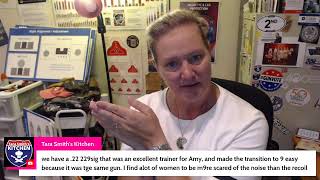
Brooke Cheney reviews her own dry-fire footage, breaking down trigger control, sight picture, and posture. She discusses why women should train on full-size guns first, demonstrates a prayer-hands drill to find your grip, and explains how shoulder tension kills accuracy.
Chapters
Poof, here we are live. Apparently I should have got something to drink before I started this. All right, day 8 of the dry fire challenge. Why am I on here live? Because I don't feel like editing and throw something up, so here we are. Um, I did some dry fire earlier and I don't know what it looks like. I recorded it and I'm hopping on here to throw it up here for you guys, um, so I can do a little bit of a play-by-play. Now, hey Gary, how are you? Um, yes, hopefully— you know how I always say I'm gonna make these short? That's my plan. I've got about 3 minutes of video to look at and talk about what some of my dry fire was this evening. So here we go. Um, I actually have to pull up the thing. That does the thing, and I gotta figure out how to mute the thing. There we go. Oh no, that says 100. We don't want that. All right, so hey, um, sorry, I'm like, I'm saying hi to 500 Magnum, but y'all don't— you on the Facebook side, you have no idea what I'm talking about, but now you do. All right, so here's what I got. Um, I, I failed with, um, my first camera angle. I just want to show you that it's not just what I'm going to show you. Um, so my first camera angle, I put away from me and so I couldn't see the screen, so I couldn't tell what you guys would be able to see. But the whole thing that I was doing here is I'm just working on getting to see my sight picture and I'm working on my trigger control. But I realized after watching this one, which I did do, you can't see the trigger control or any of that. So I really had to turn around. Now here's the thing about dry fire in my classroom. I have 3 safe directions, and in order to show you guys this other, um, hold on, make sure that's quiet, and that's quiet, um, direction, it's not exactly as, um, encouraging for me in that, like, I don't like pointing in this direction because it's towards the house. So do the best you can. Understand that sometimes you're not always going to do what you can. I shared the screen and then I made it go away. So again, bear with. All right, so after a long day of playing outside— oh, I'm like, I don't think that I, uh, you can see the end of the gun. 'Cause here's the thing, here's what I'm looking at, right? When I push the gun out in front of me, I want to see— oh, I wish I had pointers. Will this work? Can you see that? You can barely see that. I want to see my front sight perfectly between my rear sight. Now I'm actually focusing on the wall that is behind me. I'm not focusing on the wall. I'm actually focusing on my, on a dot on the wall. So here's the other thing, since I didn't watch this before I came on, I can tell you my head is way too far forward. So this is one of the kind of the cool things about, um, really watching yourself when you're looking at stuff. I look like I am a stork sticking my head out. We don't want to shoot like that. I want my head more erect on my shoulders. I think in a little bit, if I fast forward this, I realize that I I got my shoulders down a little bit or not. I'm just at a loss. So yeah, I don't know why I'm sticking my— my dog started barking at bears. Not quite sure why my head is forward so much, but now that I've watched this, but notice at least towards the end here I did. Oh yeah. All right. Don't watch that part. I was listening to music while I did this, but I'm trying to remember to get my shoulders down. And get my shoulders. And now that I'm watching this with you guys, I'm like, yeah, there was music going in the back. And so I hope you all are laughing currently because it's always fun. Oh dude, this is not my full size. I mean, this is not my carry gun. This is my competition gun, which is certainly not what I carry. I carry the smaller size of that gun. So the gun that you shoot the most is definitely the one that you want to carry. And this is one of the things I always suggest to my girls is like, learn on a full-size whatever. For me, it was Smith Wesson. And then you can go down to a compact. I, I don't like subcompacts. Depends. No, I like some subcompacts. There's a never and always. Never always happens, or always never happens. Depending on which way you want to look at this. Oh yeah, so sorry. For those of you on Facebook who can't see all of the YouTube chatting, 500 Magnum said, I think you are probably the only people that carry full size. No, Tatiana Whitlock, love her to pieces. She is the national training director for A Girl and a Gun. She carries a full size 1911, or at least that's one of her carries. It's like for her, guns are like purses. You have to get the right gun. For the right outfit. So there's also that. So I don't think anyone always carries the same one, or maybe they do. Hello, Miss Vanessa Kitty. Um, there you go. All mine are full-size Magnum. Um, although, yeah, okay, I'm like, wait, which Magnum? There's so many to choose from. And I don't know if we're spoiled with small lightweight guns. But, um, it is interesting because so many people haven't necessarily tried both and understand. I try to get people— so Gary, um, you may slump forward when you shoot a lot, or when— let me read this forwards versus backwards. Um, I slump forward a lot when I shoot. I guess I should be more conscious of that. So here's the thing, I know I can feel the tension in my shoulders when I start doing that. And let's pull up my last little reel here and see if I did any better. Oh, I don't know why I keep messing this up, man. Um, see if I did any better on the last couple reps, right? So my, my chin's still forward, but my shoulders are way back down. And the idea is if I can keep my shoulders down like that one It wasn't perfect, but what happens is when I pull my shoulders up and I can feel the tension. So whether you should or shouldn't do this is more a matter of what do you feel when you're doing it. Um, did I say hi, Vanessa Kitty? Um, Tara is saying something to us in a different language, which I don't remember what language she actually talks. So hi, Tara. Um, yeah, so yeah, so here's a fun thing that a lot of women don't know about heavier and larger firearms. Oh wait, I should pause that for a second. Um, is it the heavier something is, the tighter you naturally hold on to it? So when we are given something that's a little piece of plastic, we don't have to hold on very tight, so we generally don't. When we are given something a little heavier— this is glass and liquid, right— we will hold on to it a little bit tighter. So, ready? Polymer, metal gun. That's my girly example. So, um, I do get women to shoot full-size metal guns so that they can, um, understand what the difference— one of the biggest things on my Find Your Perfect Gun class is everyone looks at little tiny guns like, oh, that's so cute, it might be so easy, and I'm like, No, it's actually exactly the opposite. All right, so now Tara— oh, Tara, no, sorry. Ah, this is why I shouldn't do this without DJ. Anyway, uh,.329 PB and.44 Magnum for Miss Tara. Um, and you know, dude, carry what makes— what you're good at shooting. And the other part is carry what you're gonna carry, right? Um, a snub nose.357. If you can enjoy shooting that and you can shoot that well, awesome. I'm pretty sure I would not carry that because I don't think I would do any good at shooting it. And to tell you how much I don't think so, I've not shot a snub nose.357. I don't even— I have a— through— what is it—.38 Special snub nose, and I can shoot it. I'm not sure as I'm excited about saying that I would love to shoot it on a regular basis. So, oh nice. Sorry, pay attention. Let me get back to the dry fire portion of this. All right, so fingers on the trigger. I'm watching my sights very closely, and what I'm trying to watch is when I'm moving the trigger Am I moving the sights at all, or am I getting to, um— and that was the end of that one. So let me see if there was anything else that I want to show you guys. All right, so that's just me getting my sight picture again because I don't know, I've definitely been having challenges with that. I just want— all right, so here, so I see my sight picture, I'm watching my front sight, and I'm moving my finger and making sure that as my finger moves I am not moving the front sight. Now, Gizzard Gary, I don't know if you're watching or not, but in that little one right there, did you see my shoulders, right? So I'm doing this drill and there my shoulders are up. All right, so watch, my shoulders are up. Oh, if I hit play, that'll work so much better. And then I realize I've got that tension, I'm like, and I push my shoulders back down. So if you feel the tension, get rid of it. If you don't feel the tension and it's just how you shoot, uh, it's just another thing that you can experiment with. So Mike White, the only gun you own is a Beretta 92. I think you must be one of the only gun owners I know that only owns one gun. I'm sure there are others out there, but I think that makes you like a new type of person because I've warned all of my students, once you own one, you you end up owning more. All right. So Mario, yes, I can. I'm listening to Jocko to tell me just do it whether I want to or not. So that helps. And let's see what else, what else, what else, what else else? Do I say hi to everybody? I think. Yeah. So 500 Magnum agrees with me as far as the.357 painful to shoot in a small lightweight gun. Exactly. And I am not in for pain. I'm a big baby. It's why I will never play paintball, and I bruise easily. There's that. Um, so yeah, so Gizzard Gary, I was talking about if you lean forward a ton, like, like I said, I gotta work on— I don't understand why I'm sticking my head out like that. So I'm gonna bring that back and try to get lower. I was talking about my husband, talking to my husband about him watching him shoot because he's a really good shooter. And if you watch any of the shooting sports I do, whether— or my husband does— I-CORE, USPSA, IDPA, all of them, the people who are really, really good don't look like they're doing anything. And part of the reason that looks like that is because they minimally move, in that everything is relaxed. When everything is relaxed, they can move everything faster, and it doesn't look like they're doing anything. Because there's this, uh, shooter, Dave Alohasso. He's on some team, I forget which one. When I met him, he was on Smith Wesson. Then I think he's on Ruger now. But anyway, I'd watch Dave, and he's an amazing shooter, but he's, he's like so smooth it doesn't look like he's doing anything. So, um, when you're shooting, if you're trying to get faster and more accurate, try to see what you can do to relax your body as you are shooting. You still want that proper grip, you want your arms out in front of you, you want that little bend in your elbows. Oh, ready? I'm gonna give you all a tip tonight. If you've never tried this, this is a really kind of cool thing to figure out where your gun should go. So give me prayer hands like this. Sit up straight, shoulders back, butt down, right? Then you're going to put them out as far as you can, and you can't see them, but anyway, push your palms together as hard as you can. When you do this, you will feel the pressure in your elbows. Right, so now bring the hands in half an inch, maybe, and now push your palms together. You should feel your larger chest muscles engaging at this point in time. That is about where you want to hold your gun because that is where you will have more control of your recoil. Okie dokies, so there we have it. Tonight is day 8. We are going strong. And I will see you all tomorrow. Thanks for checking in. Oh, should I go up backwards? Um, I only own a pistol. I only— oh wait, okay, Michael, see, I'm wrong. Just because I can't imagine someone owning one, but that only one gun, or you only own one pistol. See, I know what that could mean, that you own one pistol, but doesn't mean you have one gun. Um, And who was it who told me they only have one? Oh, Mike. All right, so, and I realized now, oh yeah, just because you said you only own one pistol has nothing to do with whether or not you own a single firearm. So anyway, I will figure this out. All right, folks, thank you so much for popping in. Dude, I understand. However, we get more points down when we hit the white guys. So there is that, at least in USPSA, versus the guys with the hands in IDPA. Um, oh, okay, yeah, good to know. Magnum wants to know, he likes the pain of shooting a little tiny lightweight.357 snub nose, which, yes, I think that makes you crazy personally. I mean, glutton for punishment, whatever. There's lots of ways to skin that cat. So, uh, Gizzard Gary, I don't know what's good, but— oh, the, the hand thing. Yes. Uh, well, Kay Mikulik, you know, Jerry Mikulik's wife, when I went to my first Beige with Bullets camp with her, that's how she taught me this. And here's the real reality of it, right? Take what serves you, leave the rest behind. If this works for you, do it. Try it for a little while, see if it's a thing. My favorite book I ever read was very— in the very beginning, and it was Brian Enos, and I loved it because he talked about mindset. And getting better at shooting is, yeah, being fed stuff and information about how to shoot, but then it's noticing what you do and what makes a difference for you. So take what I can help you with. And, um, Mario, this is gonna make me cracking up all night long. So, um, because when we're shooting steel, we're shooting the white guys, so there's that. So at least most of them are white. Um, uh, let's see. Oh yeah, and I love this, Tara. Um, 22-229 and, um I love starting people on.22 and then just bringing them up to the 9 of the same frame of the.22 they were shooting. And so yeah, I might actually— huh, my very first gun that I got was my Sig P226 with a.22 conversion kit. And at the time, I never had any intention of being an instructor, and I sold it. And it's probably my saddest part of selling that. Um, yeah, and I know a lot of women also who hate being started on a 9 or a.45, which I, I explained to them, like, here's the deal: the dudes that are shooting these things have been shooting them all their lives, and they don't think about it, how much work they have to do to do it well, because they just do it because they've been doing it for so long. And they're so excited to have a woman on them on the range, and they're like, here, honey, you can do this. .22, and you can, but it doesn't mean you're going to enjoy it. So yeah, I definitely start all my, all my students, male and female, with.22 because also as an instructor it makes it so much easier for me to be able to see what they're doing versus the recoil of the gun. All right, with that, well, you know, early 1900s, early 2000s, whatever. All right, ladies and gentlemen, I appreciate you showing up. I appreciate you commenting, uh, like, subscribe, all that fun stuff. But I think most of you are subscribed because that's how you found me tonight. Oh, update, because some of you are Suicide Prevention Saturday watchers. I have a wedding on Saturday, so instead of pre-recording, I'm gonna do something even crazier. I'm changing the time. Saturday morning at 9 AM, we're gonna do Suicide Prevention Saturday. And I think my plan is to then do a replay of that for the 9:00 PM crew who won't see this or know. All right, everybody, thanks for the encouragement. I will see you tomorrow. And as soon as I find the Ed broadcast thing.










