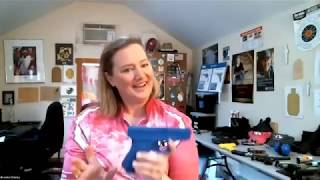
An NRA instructor explains the first safe-handling rule: always point a firearm in a safe direction. A safe direction means the bullet travels through open space like a field or woods, not toward people or buildings. Pointing down is unsafe because the bullet can ricochet back toward you.
Chapters
Let's get started. So let's first talk about the NRA rules for safe gun handling. Always keep the gun pointed in a safe direction. Sounds simple, right? Okay, it is, except for a lot of people don't know what a safe direction is. One of the things— oh shoot, hold on, of course the dog has to bark right now. Hold please. Come on, let's go. For those of you who've been here before, that's Brownie. He always finds the best times to, uh, um, do things. So let's talk about a safe direction. I'm going to stop my sharing so you can see me a little bit bigger now. Hopefully not too scary. I did put makeup on all for you guys. So safe direction. As you can see, and we'll try not to be too Blair Witchy, on the wall here, I have targets. Now this is my safe direction in my classroom because I know where those targets are is a safe direction. Now I almost forgot, number one thing in all classrooms across the country, across the world is there is no live ammunition anywhere here in, in this room. There just— you don't have live ammunition in a classroom ever, period, end of story. So that said, accidents are not called on purposes. So when I am handling a firearm, it is always pointed in that direction. I know there's a safe direction because if somehow someone snuck a piece of ammunition in here that could be loaded, and I close this, and then I go ahead and click on— hey Peter, we get to see your face now! So I gotta get on my phone. Ah, all right. So if for some reason this went off, and I know black is hard because it just fades into the back of everything, is that Oh, and Peter, do me a favor, turn off your video for right now, just because most people find it wicked distracting to watch other people moving around. But we'll do Q&A later. All right, so this gun is pointed flat, which is parallel to the ground, and it is perpendicular to the wall. Now, this is why I brought different color guns, because this is way easier for you guys to see, right? So a safe direction when you're at the range, and that's the other part of this. When we're talking about the safe gun handling rules, we are talking about in your— at your range, or when you are doing dry fire at home, because this is where we're all spending our time right now, is at home. So parallel to the ground and perpendicular to whatever your backstop is. So those are my, um, targets. And that's it. So a safe direction is where, you know, if a bullet were to leave here, where is that bullet going? I know if a bullet were to leave here, it will go through my wall and then it will travel over about roughly 60 acres of woods and then it will go into a— the side of a mountain because there are no buildings that way. Now, if I were to go that way, which is the other side of my classroom, I know that if a bullet goes through the wall, it goes over an acre of blueberry field, and then it goes over my driveway, my neighbor's driveway, and then it goes over a field, and then it goes over into some more woods. So a safe direction is a direction that you've thought about what happens if a bullet were to leave the firearm. One of the things that you will see very often, and do this so you can see a good one, is you will see people pointing down. Now, when we're talking about putting the gun in a safe direction, understand when people are doing this sort of thing, this is tactical. This is not at the range. This is, I'm SWAT or I'm military or I've got someone in front of me, someone behind me. It's like, oh, but you see people pointing down all the time. Think about with a safe direction that you want that projectile, the bullet, you know, wait, maybe Blue will be better against my pink. All right, so, um, you want that projectile as far away from you as possible. Most of us are going to be shooting at indoor ranges, so a little tilt to the down— the bottom towards the floor, you're going to shoot the floor. Maybe not immediately close to you, but the more it's tilted down, the closer that bullet is going to be to you. So again, safe direction, assuming we're in my classroom. Is always at the range at the targets that way. So what's the matter with this? Well, the problem with this is if this gun were to go off, which is just a piece of plastic, it will not go off, but if this piece were to go off, the bullet is now going to either go into someone's ceiling if you are in an indoor range, or chances are it will also go over the berm that you are shooting, shooting into. So with that, this is where y'all can unmute for a minute. Are there any questions?