Go Fast Alone or Go Far Together: The Winning Team - Episode 49 w/ Coach Bryn
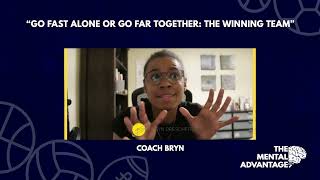
Coach Bryn Drescher argues that no elite athlete succeeds alone. Michael Jordan had the Bulls, Kobe had his team, Tom Brady had coaches and staff. The myth of the lone ranger ignores the network every high performer actually relies on: trainers, teammates, conditioning staff. Asking for help and leveraging your team's strengths prevents burnout and builds depth.
I know you're thinking like, well, yeah, but everything sometimes about sports is that I have to do the heavy lifting. I have to do— but you don't have to do it alone. In your ability to be a solo, you know, a one-man show, you may be robbing someone else of their victory moment to really truly support you.
I'm excited for you to see this week's episode, but before we get to that, I have a message for you. If you're a parent of an elite athlete or a coach of a high-performing team and you want— you're looking for some help or assistance with making them more mentally resilient, perform with more confidence, be more consistent, anything like that, then this is for you. I have an 8-week program all designed to address exactly that, to help your athlete be at their best on a more consistent basis and not get tripped up by those little voices in their head and getting down on themselves for mistakes performing like we know they can.
So what I want you to do is don't delay, schedule a—
just grab a time on my calendar through this link and let's set up a time to talk about your specific situation and how what I'm offering in my 8-week program can help.
Okay, so it's Bryndresher.com/freeconsultation.
So click this link, grab a time on my calendar. I look forward to talking to you. And now on to this week's episode.
Hey, hey, superstars! Welcome back to another episode of the Mental Advantage Podcast. You ever heard of the idea or concept of the Lone Ranger? Well, of course, I'm not talking about the old TV show, which most of you are probably not even old enough to remember. I mean, I'm not even sure I've seen an episode. But the interesting thing about the Lone Ranger the TV show is that even he wasn't really alone by himself in the sense that he had Tonto, a Native American. At the time, they would call him an Indian. And, you know, by his side, sort of like as a teammate, if you will. And since we are always talking about sports, we want to talk today about the idea that you can't go it alone. You can't go it alone. And so what I mean is a lot of us are sometimes the best on our team. We're the most talented. We are absolutely really, really good, and that is fantastic. But what that brings a lot of times is this idea that I have to do it by myself. I can win the game by myself. I can, you know, if I'm a Kobe Bryant, I can score 80 points in one game. Wilt Chamberlain, 100. So there's a lot of things that we just need to, you know, remind ourselves is that today's episode, we're going to be talking about you can't go it alone and you don't have to do it alone. Right. There's this old saying that says if you want to go fast, go alone. If you want to go far, do it together. And so we want to talk about the winning team because we want to go far in life. Everything's about speed, right? Success loves speed. You hear things like that. And that sounds fantastic. And of course, winning fast, great. The challenge is most victories are hard-fought. They take time, and you need a team around you. Now, whether you play a team sport or a solo sport, there's always a team, right? I mean, you look at somebody like Oh my gosh, why am I forgetting her name all of a sudden? Famous tennis player Naomi Osaka. You have to remember that you can't just go it alone. You're gonna have a team. You have somebody that works with you on your conditioning. Then you have somebody that comes in and helps you with your serve. You have somebody that helps you with lots of different aspects of your game, right? There's your strength and conditioning coach. Then there's your, the one that helps you with your technique. Then you maybe have a mental coach like myself. Then you have, you know, so many different aspects. You have a manager, but there's a team around you, whether you play a team sport or an individual sport. But many of us who are good, strong, high-performing people are used to doing it by ourselves. So we don't know how to operate in a team. And to do that, that is a skill. That is a skill. So I want to kill the myth of the Lone Ranger because no one ever got to the top by themselves, right? This concept of a self-made man. It sounds good, it really does, but ultimately it isn't true because no one did it by themselves. And so we have to learn the art of asking for help, building people around us that are strong where we may be weak, that can support us in areas that we are. Like, you think of, like, you know, back where I was growing up, you know, the Chicago Bulls having a really good run at the championships and things like that. And you got the team, right? What made the Bulls excellent was this team. Sure, Michael Jordan was an amazing guy, but the team they built around him and the way they supported one another and how they could each come in, John Paxson, you got Scottie Pippen, you got all of these gentlemen coming off the bench and just making sure that that team goes all the way to the championship. So the skill of being able to— one, you need to be able to ask for help. I can't do it by myself, right? Even though Kobe scored 80 points in that game, the rest of the team, you know, fills in the blanks. Somebody has to be able to come off the bench when they put Kobe on the bench to rest, right? So are you someone who is willing to ask for help? So that's number one. And sometimes you gotta ask for help even when you don't think you need it, right? I was thinking about this time where I used to be be a pretty independent woman, which is good. I mean, I'm still an independent woman. And I want to say, I used to think I could carry all the heavy things, but then I realized I don't have to carry the heavy things. And not that men were put on this planet to carry the heavy things, because lots of people can carry the heavy things. Just ask for help even when you don't think you need it. Like, hey, would you mind carrying that bag? Would you mind grabbing that? Is it okay if you, you kind of help me out with that. And I know you're thinking like, well, yeah, but everything sometimes about sports is that I have to do the heavy lifting. I have to do— but you don't have to do it alone. In your ability to be a solo, you know, uh, a one-man show, you may be robbing someone else of their victory moment to really truly support you, right? Sometimes the best players on the team have the highest number of assists in addition to their number of points. So being able to know when to dish it off— if all the attention's on you, being able to know when to get rid of the ball and give it to others is what makes your team a real threat and then has a championship run. You see what I'm saying? So being able to ask for help, right? Being able to also be able to lift and elevate the rest of your team to the next level. That was one thing that they talked about in The Last Dance, that Jordan was very interested in the way his teammates showed up. I have this whole thing I do with my athletes when I work with them on their mental game about, do you want to be an A player or a B player? And one of the components of an A player, my criteria, right, and I have my players come up with their own, but one of the things that I always say is that someone who, you know, has the team, they raise the level of everyone else on the team. They're not just playing at their level and being like, yeah, well, the rest of the team can just, you know, eat my dust or something like that. So really important that you ask for help and you're able to elevate those around you by seeing their strengths and then calling that out of them, calling them out of them. Like, hey, you know what, I, you know, I noticed on this side we're always getting double-teamed, so, you know, if we could open there, I could get the ball to you and then we could have more open shots, open looks, right? I'm speaking about basketball, but this is true in any sports, whether it be hockey, volleyball, basketball, um, football, those type of things, right? So Tom Brady is an amazing quarterback, but he can't win a championship alone. He needs a receiver to pass the ball to because we already know Tom Brady is not known for his runs or anything like that, right? He's just got a great— he's got a cannon of an arm, he's got great game presence, Most of the great quarterbacks today do have some runs and do have some amazing things, but again, they still can't win. They need an offensive lineman to block for them. They need somebody to pass the ball to, pitch the ball to if they're drawing coverage. There's so many different components of this idea that you need to be able to rely on others. So one, asking for help You need to, obviously, as we said, you can elevate the people around you. And also it's scalable. This is now your team can do better because like we know in many sporting events, games can be up to, you know, several hours long. And most people don't have the stamina for that. And not being able to have somebody to come off the bench is going to hurt your team in the long run because we get fatigued. We get to a place. Now, if you're playing an individual sport, then you may be saying, but there is nobody to come in. Like in tennis, Naomi Osaka or Roger Federer, they can't tag somebody and be like, all right, you go in, it's your turn, I'm tired. But their strength and conditioning coach, their coaches have prepared them for that endurance test. They needed to bring someone in to teach them that. They needed somebody to be able to train against So they could be ready for the world's best. So being— again, it's not about, you know, yes, having somebody come off the bench, but it's, it's also just knowing where your strengths are, playing to your strengths, but also knowing how to play to your team strengths. And then also knowing that having the depth, the depth of your abilities are going to be increased, enhanced, the more people you build around you. Because they can be strong where you are weak. So there's so many aspects to this idea. So if you're somebody who likes to do it by yourself, if you're an athlete, you know you can't do it by yourself. This is why you have a team, whether again solo sport or team sport. If you are a business person and you're attempting to do it by yourself, that's not scalable. Your team can't go as far because you have— are you doing everything? So you become the clog, right? Especially in an offense, if you're the only person that ever scores, you never pass the ball, you're easily defeated because the team knows, okay, well, they're going to pass it to that person, they're going to pass it to that person, they're going to pass it to that person. But when you have multiple threats, multiple areas where you are strong, now all of a sudden it's scalable because anyone can execute the right game plan. And then now you are a true force to go all the way to the championship, right? And so when you don't have a team that's working together— and that's what happens when you have too many— sometimes you can have— you've heard of the thing of like, um, too many chefs in the kitchen and not enough, uh, cooks, or whatever, like the whole thing of like— or too many, um, chiefs like if everyone is attempting to be the boss and give all the orders, then there is nobody to actually carry out the plan, the game plan, right? That's why there's one coach and then there's a team. So it's not that the coach has all the answers, because there was several people that would say like Michael Jordan was like a player coach even though Phil Jackson was the head coach. But I believe it was more a reflection of those amazing coaches, of the Phil Jacksons, the Pat Rileys Um, you know, the Doc Rivers, all these great coaches who know how to listen to their team and know what they need and know that they don't have to have all the answers. Even the coaches have a team. They have assistant coaches. They got, you know, in football you got an offensive line coach, you got a quarterback coach. One person is not coaching everybody. And that's the beauty of— again, you can't do it by yourself. Nobody ever has. No one ever will truly make it to the top by themselves. Someone has to lead the way, someone has to follow, and there's leadership in both of those opportunities. So I just want to remind you, so if you happen to be someone who's fiercely independent, you're really good at what you do, and you know that when you do it, it gets done, that's great. But you need to keep track of those things that you're doing. And you need to also know how to be able to teach others what you know, help them out so they can support you when you need it the most. Because this is why we have a lot of burnout, um, we have a lot of injury. Particularly, interestingly enough, a lot of my athletes that are really good, they get shoulder injuries or certain structures of the body that are known for like taking on weight because they are taking on too much. So you're more susceptible for injury operating this way. You obviously— your team is weak because if you're injured and you're the, you're the main thing to everything, then now they don't have the ability to pursue like the Golden State Warriors with Steph Curry, or when both Steph Curry and— oh my gosh, 3-point shooter starts with a K, I can't think of his name. Oh my gosh. But you know what I'm saying, the 3-point shooter that was out. Um, but in both of those instances, all of a sudden the Golden State Warriors aren't a threat anymore. And it's like, can you win with a team of no stars? I mean, it happens, it does happen. So it's really important to know that a team that works together, a well-oiled machine operating for the same goal together, and no significant one part that has to be best, that's typically when you're successful. So I just want to say that. So you please remember, you don't have to do it by yourself. No one ever really has, and you're not expected to do it by yourself. We don't want burnout, we don't want injuries, we don't want you to be somebody who was great once but didn't have a great— you know, wasn't known for having a great team about around them. Even Kobe Bryant figured it out later in his career how important it was to be, be a part of the team and not just be a part, you know, be the star. So anyway, that is today's episode. I hope you enjoyed it. I hope you got a good message from it. Please leave a comment below, let me know what was your favorite part, and we'll see you in the next episode.
More from Bryn


Who else hype for this upcoming season with Caitlin Clark and the Fever with all these great adds?







How to be nicer to yourself: Stop putting yourself down either out loud or in your head


Winning At The Net Game of Sports & Life No Matter The Score - Episode 60 w/ Jordanne Scott