Optimizing Your Performance : The Keys To Recovery and Rehab In Sports Episode 58 w/ Marco Nunez
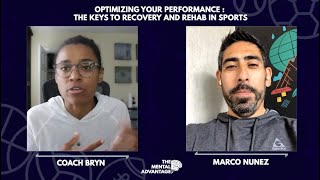
Athletic trainer Marco Nunez, who has worked with NBA stars like Kobe Bryant and LeBron James, explains why injury prevention gets overlooked and how sleep is the most cost-free recovery tool. He breaks down the non-linear nature of rehab and how mindset shapes recovery outcomes.
Chapters
you've worked with professional athletes, has it been easier because they're aware that injuries are more likely, or are they just as difficult to sell on injury prevention? Because I have found in my space of the mental performance space, people are very reactive, not necessarily, uh, big on proactivity. So is that the same you find in the physical space?
It is the exact same thing, you know, uh, and I think it's just because when they're young, it's ingrained in them, hey, you know what, you got to get the points, you you gotta get your HIITs, you gotta get your goals, you gotta run faster, that oftentimes, you know, in the back of their mind they're thinking, yeah, I need to recover. And oftentimes a recovery process is, okay, let me go stretch and let me go take my protein shake and that's it. We're done with recovery. It's not something that's part of the intervention. Maybe I'll do a little balancing type of thing. But yeah, it is still very common. One of the things that I kind of learned being in the professional setting that, like I said, being a professional athlete sometimes is difficult. But if I can somehow teach them and educate them and spin it in a way that, hey, if you do this injury prevention, one, it's going to help you stay on the court. By staying on the court means you're going to be able to move better. By moving better means you're going to get more points. By getting more points, meaning you're going to get a better career. By getting a better career, you're going to get more money in your contract. So it's how— it's always how you try to spin it with them and educate them.
I'm excited for you to see this week's episode. But before we get to that, I have a message for you. If you're a parent of an elite athlete or a coach of a high-performing team and you want— you're looking for some help or assistance with making them more mentally resilient, perform with more confidence, be more consistent, anything like that, then this is for you. I have an 8-week program all designed to address exactly that, to help your athlete be at their best on a more consistent basis and not get tripped up by those little voices in their head and getting down on themselves for mistakes, but performing like we know they can. So what I want you to do is don't delay, schedule a— just grab a time on my calendar through this link, and let's set up a time to talk about your specific situation and how what I'm offering in my 8-week program can help. Okay, so it's brindresher.com/freeconsultation. So click this link Grab a time on my calendar. I look forward to talking to you. And now on to this week's episode. Welcome, welcome, welcome back everybody to the Mental Advantage Podcast. As usual, we're back with another amazing guest. This week we're going to the world of athletic training and, uh, really sort of the rehab recovery side of things. As we know, athletics has its moments with injury and, you know, when you got your top people like the LeBron James and the Steph Currys and the Klay Thompsons who have these long drawn-out times away from the game, you know, you kind of wonder what's going on with those guys. And so I've got Marco here to tell us a little bit about that. Marco, how are you today? Marco Nunez.
I'm doing well. How are you guys doing?
Absolutely great. So tell the people a little bit about who you are and what you do.
So I am an athletic trainer by nature. An athletic trainer usually involves dealing with sports medicine and our Our job is to work specifically with athletes, either at the high school setting, collegiate setting, professional setting, young athletes, youth athletes, the Olympics, or something like that. So whenever you are watching a football game, an NFL game, an NBA game, and an athlete gets hurt, the individual, the young man or young lady that runs out to the field to do the initial injury assessment tend to be more likely going to be athletic trainers. Athletic trainers are oftentimes, like I said, employed by the teams or the high school or the colleges. And our job is to do injury assessments. We also do rehabilitation, but one of the main things that we also do is injury prevention. Our goal is to try to fix any issues, any injuries, any potential issues that athletes have, hopefully get them ahead of the game. And we cannot, you know, at the end of the day, we can't stop from injuries happening, but our goal is to try to reduce the risk of injuries from occurring. In addition, I'm also a certified strength and conditioning specialist. I also work in rehab. I'm a rehab therapist. As far as for rehabilitation and injuries and things like that. Okay.
So now when you talk about injuries, obviously, I really want to talk about that because I know that athletes, we know, you know from working with athletes, injuries are like really hard for athletes to go through and not just because the physical pain, but the emotional strain on the fact that they are now separated from the thing they love the most, which is and identify with the most is playing. So when you talk about prevention of injuries and we look at like, you know, there's— I read some something before that injuries are happening more, like we're actually putting too much strain on the body based on the fact that kids are starting to specialize earlier and earlier in their sports. Say something about that. Could you speak to that a little bit, what you think about that?
Yeah, so there's been plenty of research done on the specialization of sports, especially at a young age, and that's one thing that you want to try to avoid with a young athlete. Now it's like a two-edged sword that a lot of parents kind of get caught in. One, they see it as, hey, well, if my young— if my child plays soccer year round, that means they're going to get better, right? That's the theory behind it. If they play baseball year round, they should get better every year. That's one we'll get. But at the end of the day, then they tend to focus on one specific movement, one specific joint, and now you're overstressing that joint. So for example, if a kid plays baseball year round, they're going to develop more shoulder issues, more elbow issues, because they're constantly throwing over and over and over again. Now, if they were to move to, let's say, a sport like soccer, doing the opposite sport, now they're going to start— which the funny part about it is that a sport like soccer can translate to baseball because when you're a shortstop, when you're an outfielder, you need to use your feet. You need that agility. You need that quick reaction. You need that change of direction. So a sport like soccer will help your young athlete to be able to evolve and change and adapt to that baseball. Plus, you allow some time to let your shoulder and arm take some time off. The interesting part about in my profession, it's very hard because I also have a performance facility and I tell everybody that's very hard to sell injury prevention to parents because they don't, you know, in their mind they're like, my kid's not going to get hurt, they're strong. All they want to see is their kid to jump higher, run faster, get stronger. But one of the things I always try to, if you ever look at all these injuries that occur, it's not that the athlete, you know, it doesn't matter how much you bench, doesn't matter how much you squat. That is not part of injury prevention. But I tell everybody, it's like, imagine you have a car, you built, you have a, you buy a Lamborghini, you're going to put the nice body, you're going to put the nice wheels, you're going to put the great engine, you're going to get that horsepower, like 1,000 horsepower type thing. But if you don't work on putting proper brake systems on that Lamborghini, no matter if you're going 200 miles per hour and you get into that corner and those brakes fail, that's where you're going to mess up the Lamborghini. And oftentimes when it comes to injuries, it's a deceleration or the lack of deceleration control is when injuries tend to occur. That's where the ACLs occur. Ankle sprains, the landing mechanics when an athlete lands from a jump. And think of it this way, the higher you jump, the more weight you're going to be coming down on that ankle or that knee. And that's when, again, that brake system is what you want to kind of focus on.
That's really interesting. So that's, you know, and I've heard athletes say like obviously multi-sport athletes, like being able to bring the benefits of, like you said, soccer into baseball or basketball into football, you know, those type of things, or vice versa, like being able to— but like you said, working different muscle groups. Now, you said it's hard to sell to parents. Let's talk about the athlete themselves, because we're talking about adult athletes in some instances as well. And you've worked with professional athletes. Has it been easier because they're aware that injuries are more likely, or are they just as difficult to sell on injury prevention? Because I have found in my space of the mental performance space, people are very reactive, not necessarily big on proactivity. So is that the same you find in the physical space?
It is the exact same thing, you know, and I think it's just because when they're young, it's ingrained in them, hey, you know what, you got to get your points, you got to get your hits, you got to get your goals, you got to run faster, that oftentimes, you know, in the back of their mind, they're thinking, yeah, I need to recover, And oftentimes a recovery process is, okay, let me go stretch and let me go take my protein shake and that's it. We're done with recovery, talk to the importance of injury prevention, maybe I'll do a little balancing type of thing. But yeah, it is still very common. One of the things that I kind of learned being in the professional setting that, you know, like I said, you're a professional athlete, sometimes it's difficult, but if I can somehow teach them and educate them and spin it in a way that, hey, if you do this injury prevention, one, it's going to help you stay on the court, By staying in the court means you're going to be able to move better. By moving better means you're going to get more points. By getting more points, meaning you're going to get a better career. By getting a better career, you're going to get more money in your contract. So it's how— it's always how you try to spin it with them and educate them. And there's one player that pops in my mind right off the bat. I remember when I was with the Lakers, we had a company come in and we created customized compression recovery tights for all our athletes. And what we would do is— and this one would travel. So as soon as the game's over, there would be each individual's tights would be on their bench and they would put it on before they leave the arena. Well, there's one player that I realized that, you know, he walked on the plane and he was holding them in his hand and I'm like, dude, what are you doing? It's like, ah, you know, you kind of gave me this one like, I'm all right. I sat down with him, you know, like, hey, this is why we're doing this. This is what the purpose of it. This is how it's going to help you. Once I educate him, then the very next day, like, Marco, where are my tights? Marco, where are my tights? Marco, where's my recovery tights? So he finally got it, but it was— I had to sit down. Yeah, I had to sit down with him and educate him. This is why we're doing this. And I think once, once you do that, they're more receptive to it and they're going to be more proactive at the end of the day. But it takes time. And again, especially when you're a young athlete, it's the old traditional where, hey, you know what, I can get out of bed and go play whatever sport I want. But the older you get, it's like, okay, no, you need to start— there's a process to it now.
Yeah. So when you have— obviously the recovery process is big and you said you worked with professional athletes and like you said, you're breaking that down. Like sometimes like having that understanding of why we're doing something is so important. And there's so many times, even at the professional level, that that may not be explained because it's kind of like, look, you just— this is what we do and you, you, you get with the program. But some people obviously— do you think that when it comes to the recovery process, obviously everyone is different. I am very— I talk about this, I think about the psychological aspect of recovery because some athletes come back quickly and some take much longer. And even if they're following your protocol, which is, this is what we're gonna do, we're gonna, you know, balance on this leg for a little while, then we're gonna maybe start to do lightweight, you know, light, you know, support work and this and that. And I think about when Bronnie was recovering at Sierra Canyon. So it's like, it's a whole process. But what do you think is the difference between somebody who is ahead of schedule, on schedule, behind schedule for recovery?
So when it comes to rehab and coming recovered from an injury prevention or from any injury, the first thing I always tell every athlete is that there's no such thing as a straight linear line when it comes to recovery. So like I give you an example, if let's say you get 3 athletes and they all sprain the right ankle, same game, all of them first-degree sprain, I will guarantee you the farm that they will all return at different times. There's no way they're going to return the same game, the same day. One may come sooner, one may come a little bit later. So that's the The first thing I try to get the athlete or the individual, the patient, to understand is, hey, it's not a straight line. Rehab, we may have some hiccups. Once they understand that and they kind of grasp that, then it's a little bit better. It's the ones that don't seem to understand that that can easily get frustrated and angry with the whole rehab process, and then that's when the mental aspect comes into play where they get really flustered, they get frustrated, they think, what's going on? And then sometimes they'll take like measures in their own hands, they'll try to do more to try to kind of speed it up. And at that time, instead of doing more, they're actually hurting themselves. And now we're having setbacks type of thing.
So when you, when you say like, okay, let's say all three, like you said, injure at the same time, and we say— and these guys all buy into the protocol— what now? I understand it's not like, you know, you're talking about different bodies, different people, but what do you think is the biggest factor that determines how quickly I will recover, even if I do buy into the process? So if I am You know, what's the difference between athlete A, athlete B, athlete C if they're all like, Marco, I hear you, I'm doing this stuff? Why do you think some come back quicker than others?
Uh, well, right off the bat, one of the biggest things is genetics. Okay, so I'll give you an example. Um, every time you have an athlete that has surgery and especially the knee— we had, we had a player, I remember, that had a meniscectomy, a minor scope. Very next day we were expecting for him to have swelling or control it, but he comes in and there's like no swelling whatsoever.. And that's just who this athlete is. And I've had other athletes that told me, hey Marco, I'm a sweller, I'm actually swell. And even if they have a little minor sprain and I don't expect to swell, that thing, that ankle kind of balloons up and like, oh dude, you weren't kidding, you are a sweller. It's like, yeah, that's just who I am. So number one is just the genetics. And oftentimes at the professional level, most athletes already know their body and then understand it. Like, prime example, Kobe was one of the best players who understood his body. He knew his limits. He knew, he knew how, how far he can he can push an injury. He understood all that stuff because he's been around for 20 years. And also you kind of compare an injury to a previous injury. Hey, you know what, you rolled your ankle before, how does this compare to before? It's not bad. Okay, no, this is a more tough thing. So oftentimes the athlete kind of knows their body and kind of kind of— the issue oftentimes is athletes have never had injuries or this is one of their biggest injuries that they don't know how to handle it. And I'll give you a prime example. I was working in arena football and it was like 2000. And we had a football player that came in and he had an Achilles tendon rupture and he had surgery and we had to put him in a cast. Now keep in mind, this was his first injury. He played college, high school, never really got hurt and or never required surgery. So we put him in a cast, he had to be in a cast. Very next day he comes in and when you're in a cast you're on crutches. So this player comes into our facility, no crutches, he's walking on the cast, the cast is broken and we're like Dude, what are you doing? So we had to take him to the doctor. We had to recast his nose. Next thing, did the same thing. Boxing with no crutches to cast. And we tried to tell him. So he went through a lot of stages as far as anger, frustration. To make this long story short, we actually had to fly in his mother from home to try to help us psychologically to try to kind of calm him down. Now, this is like in 19— I'm going to age myself right now. This is like in 1999. This is way before even sports psychology and mental health among athletes was even talked about. I mean, no one had mentioned— I mean, there was not even a hint of mental health in sports. Um, but he was like a prime example that he needed a sports psychologist and mental health performance specialist on our team to try to help improve through this injury.
Yeah. Oh man, that, that is so— like, when you talk about that before, because we know that when a lot of us were playing sports, nobody was talking about this stuff. It was suck it up, there was the cortisone in the knee, get back out there. Can you still play even if you got a concussion? Like everything has changed in so many ways for the better. But of course some people say made sports soft, you know, and I think that's crazy because, you know, obviously there are humans inside these superhuman bodies and you're talking about like people who can't just run at 100 miles an hour all the time and they need help. So when you talk about the mental health aspect, obviously there are specialists in that area. How much do you feel like your aspect, like you have to kind of dip over that line through the process?
A lot. I mean, that's the one thing about as an athletic trainer, an athletic trainer, well, it's almost— I mean, they're part of the team. Basically, you're with the team almost 24 hours a day, 7 days a week. Wherever the players go, where the team goes, you go there. So that's the one thing about the athletic trainer, head athletic trainer, assistant athletic trainer, is that you're not just— yes, you are professional, you're working with them, but you also kind of build a rapport with these athletes. And, you know, there's that terminology that they say, you know, when you're on the field or on the court with your— as an athlete, you have to know your personnel, right? You know how the point guard functions, you understand how your center functions, you understand stuff like that. But as an athletic trainer, you also have to understand personnel. You understand how this athlete functions. Does this athlete have to be cuddled a little bit to try to get him kind of motivated? Does this athlete, hey, you know what, he just comes in to kind of work out type of thing? There's some athletes where you have to kind of like almost protect them from themselves, and there's other athletes where you kind of have to kind of push them type of things. So yeah, the psychological aspect, unfortunately, you know, I don't have a degree in psychology or psychiatry of that sort. I remember as part of the sports medicine program, I did it within one psychology class, but I think You're right. I mean, this plays a huge portion. I'll give you one, one of my prime examples. When I started working with the LA Sparks, my very first day I was in rehab, one of our athletes, she was just coming back from ankle surgery. She walks in and you can tell right away that she was already having some kind of issue with her family, to say the least. We didn't do rehab that day. We just sat down and talked. And I knew, hey, this is what she needs. Don't even worry about rehab. We still have some time. And it just came down to that. So yeah, there's a lot of times where you do do more of the mental rehab.
Yeah, exactly. Well, I love that you're doing that though, because, you know, I know some trainers may be like, this isn't my job, right? But if you obviously are as dedicated— because I would assume that one of the things that got you into the field was your love for sports, your love for helping people. And so when that happens, it's like, well, this is how I can best help them today. Like you said, in the situation with the young lady on the Sparks, It's like she doesn't need me to stretch her out, she needs somebody to listen, right? And that's going to psychologically help her so much in this recovery process because if she's distracted, we're not getting— we're not making any progress anyway.
100% correct. So me going in there doing ice and steam, doing manual therapy, all that stuff, her head's somewhere else. I ask her to do an exercise, she's not going to be focused and it's going to be pointless. So, um, and not only that, but she can also potentially hurt herself or make this injury worse. So why am I going to mess with her top thing?
Yeah, so good way to— and I think what I love is I did an episode on the podcast about the love languages of athletes, and you talked about that, like cluing into what the athlete— like what the athlete needs. Do you feel like in general the coaching staff really does that? I know it's different on every organization team you've worked with, but are you seeing more of that from the coaching these days since you've been— had a breath of a career? Or do you find that it's still kind of like they're just looking to you to be like, so just tell me when you're ready.
You know what, it depends. And the one thing I've noticed, so, is that with the younger coaches, they tend to be more receptive towards that communication process. You know, when I just finished with the Lakers, Luke Walton was the head coach. He himself was, you know, a young coach. He just recently played with the Lakers and now still working there. He was in both, you know, I worked with him both as an athlete and as a coach. But he was very receptive. The older coaches, I guess because they weren't really exposed to that when they were athletes, I think that they're not very— I wouldn't say that they're not receptive to it, but I guess they're not— it's not part of their agenda, put it that way. I'm not saying it like, you know, this BS, we're not doing it. It's just not part of their agenda where Luke, that was part of his agenda. He wanted to know, okay, what are the athletes feeling? What are the athletes saying? What are the athletes talking about? And then so, you know, I would meet with— and To tell the truth, the training room has always been an area of gossip. Athletes come in there, they complain, they talk, they vent, you name it. And Luke knew that and he understood, okay, you know what? Let me talk to our head office here, Marco, to see what are they saying? Are they tired? Are they fatigued? Are they just BSing me? So he would use me as the channel to try to, and then he would decide, okay, maybe we'll give them the day off today, stuff like that. And the players would be like, oh, this is great. So that communication was always there.
That's great. Did you feel— I know in my case I've been hired on by coaching staffs before, and sometimes it's a bit of a conflict because the players trust you so much, and then the coach may want to prime you for information. What advice do you have for other athletic trainers or people listening that are in those situations? Like, how did that feel for you to like— because obviously, like you said, it benefited the players in the fact that they get a day off,, but then it also kind of feels like the coach is like, can you be my spy with the, with the player? So how do you walk that balance? What advice do you have in that? Or how did you feel in that situation?
So the one thing that pops into mind is that I was always honest with my athletes, you know, when I was working with them. And I tell them, hey, you know, so-and-so, be aware, I needed to give this information to the GM and the head coach. I need— I'm gonna tell you up front right now that I need to provide this information to them. Talk to And oftentimes they're like, no, no, no, no. They'd be like, fine to me. But I think the fact that I was honest with them and say, hey, this is what I'm going to tell them. And then I'll tell them, hey, this is exactly what I'm going to tell them. And it's like, blah, blah, blah, blah. And they'd be like, okay, fine, that makes sense type of thing. And then I would tell them. So versus me going behind their back and then the coach comes like, hey, I heard you said, told Marco this. And then it's like, forget it. I think it's worse. Yeah. But I think being honest with them, and I would also tell them, I'll tell them, I have to, you know, I have to, I'm going to be honest with you either. Either don't tell me what you just told me, because otherwise this is information I have to provide. And I would just be upfront with them. And oftentimes I saw that if I said that, they respected me more for it, and they understood that that was part of my job. And then deep down they knew that that was part of my job. And every player knows that, hey, the head trainer communicates with, with, um, so like I tell you, a perfect, perfect example. There was a product that we were— that I was trying to test out regarding sleep. And I went to one of my event players, right? And it was like a bracelet that would track your sleep patterns. And I said, hey, do you mind using this product? I want you to try it and give me feedback. I want you to use it. He's like, okay. So we're talking. He's like, so Marco, so if I wear this, you're going to find out, you know, what do you use it for? I'm like, oh, you know, this is going to help determine your practice and what you would practice. So he's like, okay, so who's going to get information if I use this? Are you going to tell the coach? I'm like, yeah, I'll be honest with you. I'm going to do a report and I'm going to provide it to the coach. Well, who else is going to get it? And he's like, well, the GM or ownership. I'm like, did they ask me for it? I'm like, yeah, there's a very good chance that they're going to also get the information. So then the actor said, okay, so you told me that if we're in New York and I don't go to sleep at 3 AM, you'll know that I won't go to sleep at 3 AM, stuff like that. And I'm like, yeah, unfortunately, that, you know, it is what it is. That's the process, you know. And he's like, and then he's like, no, never mind, then I don't want to participate, which I would rather him say that no, and I was honest with him, for him participating, and then later find out Marco, why'd you give it to the gym? Why'd you give it to the army? Stuff like that. But at least we were upfront, we were honest, and then he decided to apply.
Gotcha, gotcha, gotcha, gotcha, gotcha. So let's talk about sleep since you brought it up, because this is really important. Um, you know, obviously the younger we are, the less we feel we need sleep, right? And then, you know, it— at some point it becomes a necessity. Like, some people just go to exhaustion and they shut down. How important is regular sleep in injury prevention, health, you know, recovery, that type of stuff?
So it's funny you ask me this. So I always get questions from young athletes, high school athletes, and even young collegiate athletes. And they all come because they see all these products that the pros wear, whether it's like percussion units, pneumatic pumps, hyperbaric chambers, you name it. And they want to emulate these athletes, so they want to use this product. They're like, hey, Marco, what is the best method for me to be able to recover? And I usually tell them, well, to tell the truth, one, you don't have to spend any money on the number one method to do it. It's free. You most likely already have the product in your home, and that's sleep. If you get the right amount of sleep, you will help recover because that's when your body repairs. There's plenty of research and studies. There's two research studies specifically. One There's one that indicates if you sleep anywhere between 6 to 8 hours a day, I'm sorry, between 7 to 8 hours a day, it helps reduce the risk of it. And then two, there was performance reaction time. And this was that if you get, they tested a bunch of athletes, those that got the sufficient amount of sleep reacted quicker than the ones that didn't. If you're like a hitter, reaction, ball coming at you, you wanna make sure you get your sleep so that, you know, when a baseball comes at you, what is it like? Less than a second, it goes from the pitcher's hands to the batter or to the thing. So you want to be able to react to it. So again, at the same time, oftentimes when they're like, oh no, I'm fine, I won't get injured, but then I supply them with the performance effect of sleep, then they're like, oh, okay, so it's going to help me hit better, it's going to help me kick better, it's going to help me react better. Okay, then I'll go to sleep. But like I said, oftentimes it's also difficult for me to sell injury prevention. I don't know why, but it is.
Well, it's because it's like the whole mental health injury, right? It's invisible. It's only when it's a problem. And that's something that, you know, like, you know, in my field we're working on, like, you know, because it's like coaches are like, hey, we have a sports psychologist over here, right? Which is great. But I'm like, but they need the mental skills training proactively. I'm not waiting until the guy has a breakdown or he's in a shooting slump. We need to give it to him now so that he can get to, or she can get to, a better place. But it's hard to sell because it's like, because how can I measure that, right? So like the data that never gets captured because we're not having those problems. But it's like, well, you would have less of them, right? So yeah, I won't be able to say, but if we were to take it, you know, like if you institute this program year over year over time longitudinally, you would see the benefits. But no, you're not going to see it the first season per se, you know, maybe because you may not— you know, it takes time for them to start implementing that change. So it— yeah, it's— I, I feel you. I think athletes just are like, I'm fine, I'm gonna be fine, and then when they're not fine, now they want everything. All I want, right? And there's not enough time to give them all that they need in that moment. It's just like, just get me back in there, coach. Like, just get me back in the game. But it's like, like you said, proper recovery Um, that's why, I mean, I don't obviously want athletes to get injured, but I almost feel like it's the best time to work on your mental game because that's when they're going to be the most receptive. So, all right, so you talked to it really quickly before we go to the rapid-fire questions because I know you have a tight time schedule today. I wanted to ask about Kobe, you know, obviously one of the greatest basketball players of all time, known for his mental game. How long did you work for him? And what do you, you know, I mean, I know you were an athletic trainer, but you did get a chance, like, what made Kobe so different? Like, other than what we already know, but like, you knowing him personally, what did you see about how he approached the, the, the aspect of his training and that you would want to pass on to those that may not know?
Yeah, so I mean, the whole aspect of the Mamba mentality, you know, what working with him, I worked for him with I was with him for almost 9 years. And, you know, there's a whole mentality that everybody knows about. You know, he's always the first one in the gym. He's the last one to leave. You know, by the time we begin practice at 11 o'clock on the court, he already had— he was already in there. He already lifted. He already went up. He went on the court, got his shots up and stuff like that. And that's kind of one of the aspects of mom mentality. But the other aspect of mom mentality is understanding. And there's a book that I read, and I think it's written by Ryan Holiday, where it's called The Obstacle Is the Way. I don't know if you've heard of this one. And when I read it, it reminded me of Kobe a lot. And in the story, in the book, it actually starts with where the king in his kingdom, he decides to put a boulder in the main entrance, big rock, he blocks it off and he wants to see what his people do. You have a couple options. One, you just, you know, you're leaving, you see the boulder, you're like, oh well, I can't get past the boulder. It's there, I'm going back home, I'm done. Or you're like, okay, well, let's find a different route and you go out of your way to go through it and stuff like that. Or 3, you realize, hey, you know what, the boulder is an obstacle. We got to get through the boulder and let's chisel away and work to get through that obstacle where now the obstacle's away. So there's not in your path, you need to realize it, understand it, and kind of go right through it. And that's kind of like what the mom would tell you. So I'll give you 2 prime examples. One, the year that he had it, I think it was like '08, '09, where he had a, fractured his finger and we had to get tape. So the next morning he comes in, we tape his finger up. He came in like 6 in the morning before everybody showed up. He goes on the court, gets the ball, starts shooting, shooting. He's like, nope, that doesn't feel right. Comes back, we tape it a different way. He goes out there, starts shooting, nope, doesn't feel right. We tape it a different way. He goes out there, shoots, finger feels better. He shoots, he shoots, he misses, misses. Finally makes it, he makes it, he makes it. And then like, okay, fine. He figured out a way. He figured, hey, you know what, my finger's an obstacle, I'm going to overcome it. And kind of go see him. Same thing with the Achilles, like when he had the Achilles rupture, literally, you know, we went back to the training room. In his mind, he was trying to see what we can do. But once he realized, hey, it is ruptured, his next step was like, all right, I need surgery. I mean, he would have literally wanted to have surgery right then and there. Let's go to the hospital. Let's get it away. Because he said he knew, okay, this is an obstacle. Yeah, there's nothing I can do about the obstacle. I got to go through it. The next step is to get surgery. I'm not waiting. Because he figured the longer I wait, those are those 2, 3 days that I'm waiting, there are 2 days that are going to be delaying my rehab to come back. I got to do it. He accepted. It's almost like he goes through, you know, you have like the 5 stages of grief, kind of goes through it, accepts it, and boom, and ready to go type of thing. And when I read that book, that kind of reminded me of him understanding, hey, you know what, the moment comes, like, yes, you understand there's going to be obstacles, there's going to be pathways, type of thing. You got to confront them, encounter them, and find a way to kind of go through the obstacle.
I love that. Question. Since you were there when it happened, do you think he should have walked off the court?
Oh, when he did? Well, let's see. Okay, so here's the other thing about that when he did it. Okay. And so the thing about it is that in the NBA, if you get fouled, right, if you walk off the court and you don't shoot your fouls, you are not allowed to come back into the game. You're done for the game. Okay. In his mind, and there's again the mom mentality, he wanted to shoot those free throws because if there was any chance, remote chance, of him being able to come back, right? He wanted, he wanted that chance. He goes and does his free throws and he walks off the court. We go to the back, the doctor reexamines, doctor examines him, and at that point when he's like, hey, you know what, nope, this is what it is, there's no way you're going back. So he's like, okay, fine, let's move on to the next step. The next step is like, let's have surgery. I needed Key point.
So always very goal-focused and like he was very clear on what that was. And I know like one of the things that I think a lot of people love about Kobe was that he just was constantly hungry for information. So like, I'm sure— yeah. So how much did he— one other question and then we'll get to the rapid-fire questions. Was he leading the charge when it came to the— I mean, obviously you saw some behind the scenes, but like when it came to— was he bringing the mental aspect into his recovery? In that way, or do you just feel like that's just something that was ingrained in him?
I think it's just something that was ingrained in him, and that's, that's a difficult part about it is, is, um, I don't know whether it came from when he was a young, young kid and playing, um, whether his dad also kind of ingrained that in him type of thing. You know, I'll be honest with you, we did have a sports psychologist on staff at the time, but I don't think we used him in the same manner of like the mental performance, like what you were referring to, right? It was more like, hey, if an athlete's having an issue or a blockage or with a personal issue or on the court, then they will go see the sports psychologist and kind of talk through it. But we never use them as a mental performance, you know, especially this type of thing. And I think that's one area that teams are starting slowly to incorporate that. But you're right, we're not quite there yet.
Yeah, I know. And the other question I wanted to— oh, so you talked about Kobe. Obviously Kobe did what was best for Kobe, but other athletes want to emulate that. Can you speak about that? Because like, is it that the only way for me to be successful in the NBA is to be at the gym at 6 in the morning, to be the last one to leave? Like, is it like— because, you know, like, we talk about the strain on the body, and I was asked this on a podcast, and I said it's more about knowing the self. And you said that Kobe knew what his body could do. So people say, well, I gotta— okay, so that's what Kobe did, that's what I gotta do. So speak to that.
Correct. And that's the thing about it, is that the more you train, the more you work out, you start understanding your body. You understand when your body's ready to train, you understand when your body's not ready to train. Same thing, you know, we were in Indiana one year and he had to get an ankle sprain and he wanted to go try. Like, he felt he was okay enough to at least get out there and just try it out. So he went out there, we taped it, we did his rehab, and we started playing. At about the 2, 3, 4-minute mark, he realized, you know what, no, I'm doing more danger to myself out here while I'm doing this. So he actually told me, you know what, I'm out. He pulled himself out. We went back and we were done. But he understood his body properly, so he understood that if he went in there, he was able to work out and had enough time to repair himself. So it's not just a matter of, hey, I'm going to work out like crazy and like crazy stuff like that, because you can definitely overtrain and hurt yourself. Right. But understand when you need a break and when you don't need a break, when you can work out, when you can't work out.
Nice. So definitely talk to your athletic trainer, get to know yourself, and then work together. And like, you love that when you have an athlete that's like, yeah, this is what we're doing. Do it, buying in, you know, because obviously the Kevin Durant situation, you know, like coming back too soon and what happens with all of that. So there's so many examples throughout sports. Okay, Marco, so thank you. Of course, there's so many more questions I want to ask you, but I know that we've got to wrap this up. So let's talk about the rapid-fire questions. Okay, so are you ready? Okay. All right, so what is your favorite snack right now?
I'm gonna have to— gonna go with Sour Patch Kids.
Sour Patch Kids. Okay. All right. See, I don't like the sour part. I've never been a sour fan. I love the sour part. You like the sugar part and then you get— I mean, no, you got to go through the sour to get to the sweet, right? Which is a great parallel for life, right? Sometimes you got to go through the sour to get to the sweet.
Exactly.
To get to the sweet. All right. So do you have a favorite flavor of ice cream? I do not. You don't?
Okay, not an ice cream.
You do like ice cream? Okay, so you're just like, let's do it all. Okay, got it. Um, if you, uh, do you have a— if you could have any superpower, what superpower would you choose and why?
Uh, it's funny that you bring this up, but I think it would probably be read minds.
You know, you know, it's so interesting when people say that. Why? Why do you want to read people's minds?
Well, you know what, it's weird because it also could be scary at the same time. It can definitely backfire because sometimes I don't want to know what the person's thinking. So that's kind of interesting. So if that doesn't work out, probably the second one would probably be just, I don't know, maybe strength.
Super strength. No, no, it's okay. I mean, I think when people work with people, right, like that reading the minds aspect, the allure of that is if I could figure out what's going on in their head. Maybe I can make them do what I want to do. And then I know like in your space, like getting a human being to buy into something that is the best for them can be quite challenging at times. So absolutely, I understand it. All right. Do you have a favorite superhero?
Actually, yes. I just got a new favorite superhero. It would be Moon Knight.
Oh, oh, the new show Moon Knight.
Yeah, new show.
What is his power? I don't know anything about this.
You guys gotta check it out. Um, I don't know what his power is. It's kind of weird. There's like different characters. It's a lot of twists. But, but prior to Moon Knight, my favorite superhero was, um, uh, Deadpool.
Deadpool. He's very funny.
He's a funny guy. That's why I like him.
A little dark but very funny. Yes.
So yes. Yes. Again, the sour— the sour—
yeah, there you go. Yeah, the sour to the sweet because he is a sensitive guy even though he pretends like he's not. Yes. Yes, totally get it. Oh, see, there's a theme there.
All right.
There you go. This question I ask people, not everyone has an opinion on it, but I know you have toilet paper in your house because you're a human being. Do you have a preference how you like it to be on the roll? Over the top or under the bottom and why?
It's got to be over the top, but that's just the way it's supposed to be.
Okay, now these are the qualifying questions, Marco. If you are at my house, okay, and I happen to be an under the bottom, which I'm not, I'm an over the top, but if I happen to be an under the bottom, are you changing it?
No, because that's your home. I respect your home.
I'm not gonna touch it. Okay, all right. There are people that will change it in other people's houses.
I can't. That's your home, that's your rules. Same thing because I have dogs also. Yeah, it's one of those things that if I bring my pet to somebody's home It's, you know, if, if my dog wants to get on the couch, I ask, is it okay? Or I see if they have pets. If they're like, no, then no.
These are your—
this is your home, this is your domain. I'm abide by your rules.
If I'm at your house and I don't put it on right, are you changing it?
It's, you know what, I'm gonna be a little passive-aggressive here. And I see you change it next time you come by, I'm gonna remove it.
Yeah, exactly. Yeah, I'm changing it. If you put it on, uh, I'm not— I might, I might not. I mean, I do sometimes say something. But most of the time I'm just gonna change it. Like, I'm gonna change it because I want it back the way that I want it at my house. That's it. Not in your house.
Not at your house.
I won't do it at your house, but at your house, right? Yeah, for sure.
Okay.
Uh, if— what do you want to be? Uh, what do you— oh, sorry. Uh, who's your personal hero?
My personal hero. I gotta go with my wife. It's, you know, the 23, 25 years I was working in professional sports, it took me away from my family a lot. I wasn't there. The one thing that I'm very grateful for her is that she has maintained our kids as far as the holidays. Our kids love the holidays. She's gone out of her way to decorate the house, both indoors and outdoors, to make sure that my kids know that it's Christmas, they know that it's Easter, so she's she always goes far and beyond type of thing. So she was able to maintain that with them. And it's something that I kind of regret now. And I know back then I took it for granted, but now I really appreciate that she did that.
Love that. Love that. That's my— you're not the first person to choose your wife. Michael Gervais also chose his wife.
So, uh, okay.
I know Michael Gervais. Yeah. Yeah. So, yeah. So it's, it's, it's, it's, it's all good company there. Um, and then the last question that I had for the rapid fire questions was, uh, what do you want to be remembered for when it's all said and done?
Um, you know, it's, it's not that what I'm remembered by other people, and this is, I guess, the one thing that my wife and I would talk about. This is, I just want to be remembered by my kids that I was a good dad, um, that I appreciate them and that they knew that I loved them while I was with them.
Like, love it, love it, love it. All right, Marco, is, um, this is your chance to let people know where they can connect with you, what you got going on. Let them know how to connect with you. And of course, we'll put stuff in the show notes, but you just let us know and we'll put it in there.
Yeah, so, you know, now that I'm not working for Special Sports, I'm doing more, um, uh, private clientele rehab and strength and conditioning. So if you guys have any issues, um, with regard to rehab, injury prevention, strength and conditioning, please feel free to reach out to me. I can either— we can either set up a time or meeting anything of that sort, you're welcome to follow me on Instagram @marcoandino17, and you can also subscribe to my YouTube channel at Evolve Athletic Performance where I put in weekly sports fitness tips of the week on injury prevention. Okay, awesome.
Well, thank you so much. You guys heard it here. Tap in with Marco. He's got all the years of being in professional sports. He can definitely help you with wherever you need to go next and make sure that you're getting there injury-free or as, as quickly back into the game as possible. Etc., whether wherever that game is, even if it's just your own private tennis game that you do. So definitely, uh, make sure that you tap in with him. And thank you so much, Marco. It's been such a pleasure to have you on the podcast.
It's my pleasure. All mine. Thank you for having me.
All right.
More from Bryn


Who else hype for this upcoming season with Caitlin Clark and the Fever with all these great adds?







How to be nicer to yourself: Stop putting yourself down either out loud or in your head


Winning At The Net Game of Sports & Life No Matter The Score - Episode 60 w/ Jordanne Scott