Racing To The Finish Line : How To Stay In Victory Lane - Episode 54 w/ Jesse Iwuji
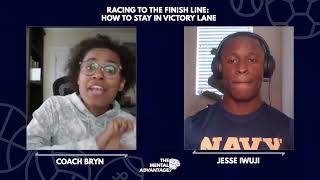
Jesse Iwuji, a former Navy officer and current NASCAR Xfinity Series driver, talks about funding his racing career with a side business while on active duty and how military discipline translates to the racetrack. He compares the physical demands of football and racing, from G-forces to heat stress, and discusses why mental-performance coaching remains rare in NASCAR.
Chapters
What would you say would be the parallel and then the difference mentally to going from football to racing cars?
There's definitely a lot of parallels between football and racing. You have to prepare your body physically to handle the physical stress of both. In football, there's the heat side of it. There's the physical side of it of tackling other people. In football, you have to prepare your mind in a way where, hey, I'm getting ready to go try to run my human body through another human body or multiple human bodies play after play after play after play and get the best of them. I need to literally out-will them and put your will on that. That's what you have to do in football. Whereas in racing, it's different. It is a contact sport in a lot of ways. But you don't want to contact as much because you're in a car. And too much contact means damage to your car, which means it could perform worse. And also in racing, there's a thing called crashing. Crashing sucks. It's physical. When you're in the race car, race cars are hot. These race cars get all the way up to 150+ degrees inside the race car. And you're enduring that for multiple hours.
I'm excited for you to see this week's episode. But before we get to that, I have a message for you. If you're a parent of an elite athlete or a coach of a high-performing team and you want— you're looking for some help or assistance with making them more mentally resilient, perform with more confidence, be more consistent, anything like that, then this is for you. I have an 8-week program all designed to address exactly that, to help your athlete be at their best on a more consistent basis and not get tripped up by those little voices in their head and get getting down on themselves for mistakes, but performing like we know they can. So what I want you to do is don't delay, schedule a— just grab a time on my calendar through this link, and let's set up a time to talk about your specific situation and how what I'm offering in my 8-week program can help. Okay, so it's brindresher.com/freeconsultation. So click this link, grab a time on my calendar. I look forward to talking to you. And now on to this week's episode. Welcome back, welcome back, welcome back to another episode of the Mental Advantage Podcast. I, as usual, as you guys know, I say this all the time, I'm super excited because we got a new sport that we're introducing you to today, one we haven't covered, one that most of us actually might not even know was a sport prior to, right, some parts of our life, because, you know, you just don't kind of do this as a kid, at least not where I grew up. And so I've got Jesse on with me, and I want to get correction because I did not do that. And forgive me for your last name. Can you say your last name for me, Jesse?
Iwoji.
Iwoji. Okay, so Jesse Iwoji on with me today, who's from the world of NASCAR. So Jesse, how are you today?
Doing good, doing good. How's it going?
Absolutely wonderful, wonderful. So tell us, because I'm always— I always say athletes are like superheroes. So I'm interested in how you got started, your origin story. How does one fall into NASCAR, especially— I mean, calling an elephant in the room— an African-American young man into NASCAR, which is, I know, a road less traveled?
Yeah, no, definitely a road less traveled for sure. And even just with my journey and where I had to go and what I had to do to get in is different than all the other drivers. All the other drivers, for the most part, started when they're 5, 6, 7, 8 years old in go-karts and then worked their way up into all the different series before they got up into the NASCAR levels of racing. You know, a lot of them, you know, either had parents that helped them out a lot or for some, you know, in some way they found some different sponsorship early. Whatever it was, they found their way up the ranks. For me, I didn't start racing until I was 26, 27 years old. So I was way, way, way behind the curve compared to all the other drivers. And my sport that I actually did, you know, back when I was in middle school, high school, and also college was football. I'm from Dallas, Texas originally, grew up in Dallas my whole life. Both my parents are immigrants from Nigeria. They came over here to the US with pretty much nothing, decided to settle in Dallas and built their life from there. And naturally, being in Dallas, you naturally gravitate towards football. So I gravitated towards football and worked really hard to get better and better at football so I could eventually go off to school and play college football. And eventually I got recruited by a few schools and some of those schools One of those schools was the Naval Academy. Decided to go there because it was a great opportunity to go to a good place, good school, get a great education, be able to play football for a great team, and then have a career for me started after I graduate. So took that opportunity, went to Naval Academy, graduated in 2010, played football there all 4 years, graduated 2010, became an officer in the Navy and started serving. I was on multiple ships, went on multiple deployments. And while doing that, when I would come back home to where my home station was, which was San Diego, I started gravitating and growing this passion for cars and racing. And that's what led me to getting into little amateur like track days with my personal car, where I would take it to tracks and do that. And then that grew from that little passion and hobby to eventually me deciding one day that I wanted to become a professional race car driver. And I had to figure out from there how to find the money, the time, the resources, how to figure out everything just to even get into a race car and to get into real races. I had to figure out that whole thing out, which is not, there's no roadmap for it. It's a lot of grinding and networking, But through a lot of grind, through a lot of networking, was able to make that happen and basically found myself into— I got myself into a race car in 2015 at lower rankings, lower levels of NASCAR late models, and then worked my way up into the series I'm at now, which is the NASCAR Xfinity Series.
Okay. That's awesome. For one, like you said, I think it's against the law to be in Texas and not play football. So thank you for acquiescing because I know that's a religion in Texas, not just a sport. Did you have any designs of playing beyond? I know you obviously, when you go to the Naval Academy, the route is not necessarily to go to the NFL, but to actually become an officer, I would assume. So did you have designs at that time to do something different? And then we'll, of course, I'll follow up some more questions about the NASCAR route.
Yeah, so for me, going to Naval Academy, yeah, for the most part, we're supposed to, when we graduate, we're supposed to become officers in the Navy. I would say in high school, there were some points where I had different, you know, dreams of going off and eventually playing in the NFL. But once I got to Naval Academy, I was like so stretched thin on time as far as playing football, doing all the educational obligations that you have, the military obligations, everything together. It was just a lot of stuff for me as an 18, 19, 20, 21-year-old. So at that point in college, I was just trying to survive. I was trying to have fun playing football, get through my school, and also you know, be able to just have something left at the end when I graduate so that I could, you know, be all I could be as an officer. So I think, I guess my dreams is going to the NFL. Like, just, I didn't put a lot of focus towards that once I was in college. I just was like, you know what, let me just get through here.
Gotcha. That makes sense. That makes sense. So when you were transitioning, like you said, and finding your passion to racing cars and kind of going up the ranks of NASCAR, and you mentioned something about, enjoying. And I've asked several athletes that have been on here before, how do you have fun? Um, but this is the mental game. So being that you played another sport and then you went into the rent— into the race car space, tell me a little bit about that. Like, was there anything that you felt was a parallel to the mental game you needed to play a contact sport versus a sport that's more individual? And, you know, like I would say, would almost seem largely mental because I know there's a physical aspect And maybe what happens on your body, I was learning about through the Bubba thing about the temperature in the cars and things like that that I didn't know about. But what would you say would be the parallel and then the difference mentally to going from football to racing cars?
There's definitely a lot of parallels between football and racing. You have to prepare your body physically to handle the physical stress of both. In football, there's the heat side of it. There's the physical side of it of tackling other people. Football, you have to prepare your mind in a way where, hey, I'm getting ready to go try to run my human body through another human body or multiple human bodies, play after play after play after play, and get the best of them. I need to literally out-will them and put your will on them. That's what you have to do in football. Whereas in racing, it's different. It is a contact sport in a lot of ways, but you don't want to contact as much, right? Because you're in a car, and too much contact means damage to your car, which means it could perform worse. And also in racing, there's a thing called crashing. Crashing sucks. It's physical. When you're in the race car, race cars are hot. These race cars get all the way up to 150-plus degrees inside the race car, and you're enduring that for multiple hours. I jump into a race car, And at the end of the race, when I hop out, especially on a summer day, I'll lose 5 to 6 pounds of water during that race. And that's still while drinking water through the race. I'll have a little CamelBak thing with water in there. I'll have maybe 2 liters or so. I might drink that whole thing and still lose 5, 6 pounds of water during a race, depending on how hot it is. So you go through that physical— that heat stress. And then the G-forces that you go through. When you're going through those corners lap after lap— I mean, we have 200 laps. So let's say on an oval track, there's, you know, turns 1 and 2, which is, you know, this corner on this side, and then there's turns 3 and 4, this corner on that side, right? You're going through those corners, let's say 200 laps, that's 400 times you're going through those corners. The G-forces that you're experiencing that whole time puts a lot of physical stress on your body, which also increases your body's heat, your temperature, and everything. So all this stuff you're going through while you're still having to keep that mental fortitude there so that you can drive the perfect line every single lap so that you don't get ran over by somebody else or run anybody else over, but you don't make any mistakes, any mental mistakes, all the stuff you gotta be able to go through while being in a race car. So for those people who think that like racing isn't like for, or isn't, you know, it's not a real sport or, you know, race car drivers aren't athletes, they're completely wrong. I've never cramped in football. I've cramped in a race car. Hmm.
So yeah, this is what I'm after. Yeah. 'Cause I want people to understand that there's definitely a component of every sport that you don't really understand until you've actually participated in it. So you're watching NASCAR and just being like, all they're doing is driving around in circles. But, you know, high speeds, high temperatures. Like you said, like you have to actually train to be in that race car. It's not just driving around and getting used to going in circles. It's so much more than that. And I think, you know, like there's, there's the simulators that you guys go through, obviously the physical workout, having a trainer. Like all of those components, like even knowing when to drink water, when to hold off on drinking water. There's a lot of components to that whole thing. I did have one quick question. How do you keep the water cool in 160 degrees, or is that the goal?
Yeah, well, you definitely want to keep it cool as much as you can, but what we do is, uh, the, the, the CamelBaks that we have, uh, with the water, it's actually insulated. There's, um, there's a, uh, almost like a— it's like a foil-type, fire-retardant-type thing around it, which keeps heat out. So as long as you fill it up maybe halfway with ice and then the rest with water, it'll actually stay pretty cool throughout the whole race. It shouldn't get hot.
OK, got it.
OK. And then you got to also keep it up. Don't have it sitting on the bottom of the car, on the floor. If it was on the floor, it's just going to heat up.
There's nothing you can do about it. Yeah, so it's just like they have to know how to put that and hang it somewhere so that it's accessible. Like you said, so it's just right up to your helmet. I'm assuming.
Uh, well, I'll— so only during the caution laps, once we're like slowed down and, you know, let's say someone wrecked or something happened on track and they throw out a yellow flag and we gotta slow down and just kind of roll around 50 miles per hour or something like that, we'll, um, we'll grab— we'll— I'll grab that and I'll start drinking it during that time. And you're guaranteed to have at least like probably 3 cautions or so, bare minimum, in almost every race. Yeah, so at least I have 3 opportunities. There's some races I got 10, 12 opportunities to drink. Wow.
So when you obviously, as you said, you were going up the ranks and I know like with NASCAR, like you said, the money is such a big part of it because there's so much with not only having a good race car, but being able to get a team and get the best personnel for your pit crew and the sponsorships and attracting the right things. And it can be challenging. Talk to us about the mental aspect of that process, if you can, because I know like that can take its toll, especially when you're proving yourself, you know, to, you know, have to show for these people to say, please put some money behind me.
Yeah, it's tough. Um, you know, as we're going through the ranks, you know, it takes money to race. Uh, racing isn't free. Tires aren't free. People aren't free. Transporting the vehicle, preparing the vehicle, purchasing vehicles, all that stuff, um, it's not free. It just costs money. So as a driver, you got to figure out a way to get it funded, whether it's You know, maybe you own your own business and you make enough money, you can do that. Or if you have really rich parents and they want to pay for it, whatever it is. For me, I didn't have rich parents or anything, so I actually had to start— I started my own business on the side while I was still active duty in the Navy. And any extra money I made from that I used to sponsor myself to even get into racing until I finally got through enough where I could find some more sponsorship. So I took the entrepreneurship route. In order to find the funding necessary for me to even get in a race car. And the funding that I had initially, it wasn't great. It was enough for me to get into a race car. It wasn't like the best race car, but it was a race car, you know? So I just had to do what I've had to do over the last few years just to grind and just get seat time as much as I can. And, you know, I still have a long ways to go to learn a lot. I still have a lot of learning on track to get better and better. But it takes time. It takes resources. It takes money. It takes people, good people. And it just takes time.
Yeah, absolutely. And I mean, kudos to you for, you know, like you said, doing that on the side. And you said you're active duty military. What do you feel like makes you different than everybody else on that track? I mean, besides the fact that you have this amazing story of being a naval officer, playing football, having this non-traditional route, um, what do you think makes you different than the others? Or do you bring from your military life and your entrepreneurial life that do you think makes you better at being in that car?
Some things I would say, like, I get from my military life that would probably help is just, you know, just maybe the way I'm able to present myself. You know, I have a lot of real-life experiences outside of racing that have been really helpful for me for managing stress, managing my time, managing resources, being resourceful, all that stuff. Things I learned at the Naval Academy, it's things I learned while in the military, it's things I learned while on deployments. Multiple deployments. All this stuff I've been able to translate to help me even get into the sport. And I continue to use all these different attributes every single day. That's what I would say the military has helped me to be able to really conquer anything I want to in life. Even getting my own businesses going now, I have multiple now. Being able to just really attack anything I want to attack and go after what I want to go after and achieve it. You know, that's the baseline came from really that military foundation and the discipline and the grind and the resourcefulness, all that stuff that came from the military. So, military has definitely been super important in my life and helped me get to where I've gotten to. And it's helped me shape my mindset in the right ways and just helped me learn that I can be unstoppable when I put my mind to something.
I love that. And I think that you're right. Like, in the— I mean, of course you're right. It's your life. But I mean, just the fact that I was just thinking about even on a caution flag or the— like, some drivers probably can lose their cool in the midst of a crash. Or, you know, some adversity on the track, and you're just like, this is just Tuesday. Like, this is nothing compared to what I was experiencing in, you know, even training, or if you had any live ops situations. So fantastic. Um, when it comes to the Bubba Wallace documentary, I did say I was going to ask you about this, so I want to kind of circle around to it because I know we're getting short on time. Uh, I did notice that he kept saying that he needed therapy and, um, like he needed to talk to somebody. He had some stuff going on, but I never saw him actually get any therapy. Like, it was like they were talking about it, but not that we needed to televise his therapy session. But, um, what do you think about— like, I'm a mental performance coach. I work with athletes on their mental game, but I don't see a prevalence of that in a sport like NASCAR. Do you know of any drivers that have a mental, you know, coach, or is that something that you think could be helpful in that field, or, you know, that type of thing?
I think it would be helpful for a lot of drivers. Um, you know, a lot of this sport, even just on, on the on-track side, a lot of it's mental. Um, you really got to have a good headspace. You really have to have your mind in a way where you can hyperfocus on that race day and hyperfocus on what you need to do to be successful on track. And it's very difficult because there's a lot of things that will seep into your mind while on the racetrack. I mean, you're going into a corner at over 180 miles per hour, sometimes 190, sometimes 200 100 miles per hour, it's not a natural thing for human beings. So you have to have your mind in the right place to be able to do that. And you have to be able to hyperfocus to be able to do it properly every single lap, not just one lap. You got to do it 200 laps, or in the Cup Series, 250, 300, 400 laps. It just depends. So to be able to do that, it just— it's difficult. It's not easy at all. And then not only are you trying to focus, and you're like, in your mind, you're not trying to mess up and you're trying to not be too hard on yourself and you're trying to push forward, you have the exterior noises, the exterior voices that are also creeping into your head, right? You got social media, you got all these trolls on there who have never been in a race car or don't know what it's like to be racing at these levels and don't know what it takes to even get on track. And then they're saying all the stuff that they say or even media writing whatever they want to write, whatever it is, that stuff sometimes seeps into your head. You're thinking about that stuff. And it just, you know, there's a lot of sucky human beings out there who don't understand that, hey, athletes, we're not robots, right? Like, don't— why everybody thinks they just have like that, like they just feel like they can just say whatever they want about someone. Like, yeah, if that person was in your face, you wouldn't say it. Obviously, we saw what happened the other night. Yes, yes, yes, yes. You know, that's a clear example of what probably like You know, could happen more often with people, the way people talk about people in this world. But, you know, just there's a lot of people out there who's just really disrespectful, you know, and you see it even in the NBA right now. You know, basketball players are complaining about it. Yeah. Yeah. Like, it's like, hey, the fans, okay, you're there to root on your team and all that stuff. And yeah, if you don't like the other team, you don't like the other team. Cool. But just be respectful, you know, you don't got to start calling them out of their name and it's just come on now. They're human beings. They're not animals. They're not robots. They're human beings just like you. They wake up. They can die just like you. They can get sick just like you. They're human beings. So having to deal with that also too, I think that adds another layer of stress on athletes that the athlete had to deal with. And I think that's part of what Bubba was even, I think, alluding to was he was dealing with family stuff, but also too, I think just the stress from everybody else, the haters. I think that was really—
living up to what they think he should be based on the fact that he's on this team that they chose. And yeah, I got you.
It's just, you just have to remember, like, anyone writing anything negative, it's just most of them are clowns. 99.9% of them are clowns. They're living in their mom's basement. They don't have anything else going on in life. They'll never achieve anything great, and they're just baseless clowns.
So, so normally I do rapid-fire questions, so I'm gonna do them quick. I mean, obviously I, I want more time with you because I'm like, I have so many more questions, but let's get to these rapid-fire questions. All right, number 1, what's your favorite snack right now?
Favorite snack is gummy bears, any kind of Haribo or Haribo, however you want to say it. Yeah, those.
Okay, awesome. Okay, you have a favorite flavor of ice cream?
Yes, favorite flavor of ice cream will always be cookies and cream.
That's a very popular one. Okay, if you could have any superpower, which one would you choose and why?
If I could have any superpower, honestly, it would be all the powers that Thor has because I feel like he's just a beast and no one I can stop them, and that's, that's just it.
Nice, nice. It's not super speedy. Yeah, you didn't need super speed because you're already doing that on the track, so you're like, yeah, I don't need that one, I got my car. All right, uh, next one is, uh, this one's an interesting one. If you had, uh, if you had— you, I mean, you do have toilet paper in your house, I assume. Uh, do you have a preference how you like it on the roll? Some people like it over the top, some people like it under the bottom. The military might even have a code about this. You tell me, which one does it have to be and why?
On the far side. Wait, so coming from the bottom. So, so, so if you're— if you, if you were grabbing it right there, it'd be on the far side. It wouldn't be— so yeah, it'd be coming from the bottom.
Yeah, it'd be coming from the bottom. Okay, see, most athletes are over the top. See, this is weird. It's weird, right? Now, is the military have any kind of thing about that? I know they're big about toilet, um, you know, sheets and beds and hats and shoes. They don't have a thing about toilet paper?
I've never been told any particular way. I've never had to do much that had to do with cleaning.
Yeah, they probably don't check your toilet paper, right? Did you— that's only a hotel, maybe that's hotel training. Okay, which they, by the way, always do over the top, interestingly enough. But anyway, and who's your personal hero?
Personal hero who's like alive right now?
Yeah, anyone, anyone. Yeah, anyone you want.
Oh, man, I don't really have a personal hero. I don't really— I don't do that. I don't really— I don't— I don't make many human beings personal heroes. Okay. But God is my one. There you go.
That's good. That's an answer.
I love it.
So there you go. Okay. And then the last question, what do you want to be remembered for?
I want to be remembered for the person who was willing to go after big goals and dreams when others told them it was impossible and then laid a framework, laid the groundwork for others to come behind me and be able to make their dreams come true too.
Love that. So Jesse, obviously we're at the end of our time. I want to make sure you're on time for your next thing. Tell us, where can we connect with you? What do you got going on? How can we support you?
All that good stuff. Yeah, just follow me on social media. I'm on all the platforms. Look up Jesse Iwuji. That's J-E-S-S-E. Last name is I-W-U-J-I. And just look me up on all the social media platforms. Follow me. Share everything we do. Support. Send any messages if anyone has any questions. That's how they can support.
All right. Thank you so much, Jesse, for doing this podcast. You guys have heard it first. Make sure you follow Jesse, follow what he's doing and support him because he's obviously out here doing big things in the world of NASCAR. And we need more people looking like us so the next generation can follow in his tire tracks, not his footsteps.
All right.
Yeah. All right.
More from Bryn


Who else hype for this upcoming season with Caitlin Clark and the Fever with all these great adds?







How to be nicer to yourself: Stop putting yourself down either out loud or in your head


Winning At The Net Game of Sports & Life No Matter The Score - Episode 60 w/ Jordanne Scott