When Preparation Meets Opportunity: The Fundamentals -Episode 26 w/ James Brown
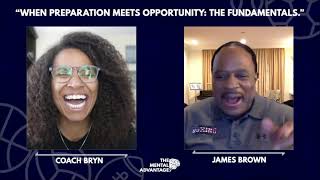
In this episode of the Mental Advantage podcast, host Bryn Drescher interviews veteran sportscaster James Brown. The conversation weaves through Brown’s philosophy on preparation, fundamentals, and compassionate interviewing, especially when dealing with losing coaches. Brown shares his most cherished broadcasting moments, including a transformative assignment climbing Mount Kilimanjaro with Special Olympians and a poignant story profiling a refugee family and a Chernobyl orphan for HBO’s Real Sports. The dialogue shifts to rapid‑fire personal questions—favorite snack, ice‑cream flavor, super‑power, and even toilet‑paper folding—revealing Brown’s personable side. He discusses his personal hero, Coach Tony Dungy, and articulates what he hopes his legacy will be: honoring his parents, spreading faith, and strengthening communities through his JB Awards, NFL Players Association work, and ordained‑minister ministry. The episode closes with reflections on building a robust social‑media presence and the importance of authenticity, empathy, and community‑building in sports broadcasting.
Chapters
And quite frankly, to fast forward and touch upon that, which I mentioned that I did not do when I was drafted in the NBA. Yeah, I lost sight. One could say I got cocky, although I know I'm not a cocky person. Yeah, but I certainly was resting on my laurels. And one of the messages that our high school coach drove home to all of us, whether it's in the business world or in the world of broadcasting or any others, as I mentioned, there's no such thing as standing still. You are either getting better or you're regressing. Whatever our chosen pursuit is, the overarching theme ought to be, it is continuing education to sharpen your craft and skills as opposed to getting self-confident, confident because then that begins the precipitous slide downward when you start getting cocky.
I'm excited for you to see this week's episode, but before we get to that, I have a message for you. If you're a parent of an elite athlete or a coach of a high-performing team and you want— you're looking for some help or assistance with making them more mentally resilient, perform with more confidence, be more consistent, anything like that, then this is for you. I have an 8-week program all designed to address exactly that, to help your athlete be at their best on a more consistent basis and not get tripped up by those little voices in their head and getting down on themselves for mistakes, but performing like we know they can. So what I want you to do is don't delay, schedule a— just grab a time on my calendar through this link, and let's set up a time to talk about your specific situation and how what I'm offering in my 8-week program can help. Okay, so it's brindresher.com/freeconsultation. So click this link, grab a time on my calendar. I look forward to talking to you. And now on to this week's episode. Hello, hello, hello everybody! We are back for another amazing episode of the Mental Advantage podcast, and I'm super excited about my guest today. We're taking a different turn on the world of sports. We got James Brown, who was a former athlete, okay? And we're going to talk a little bit about his career in athletics, but he's made a very different career trajectory going on the other side of the desk to the analyst side. And so he's also, I just found out, a proud girl dad and actually a proud granddad. So those are some other interesting facts. But James, tell us a little bit, how you doing, and a little bit more about you.
Well, first of all, Bren, thank you for having me on. I've had an opportunity to do just a little bit of G2 about you to see the wide-ranging roles that you have performed so exceedingly well. Your personality, your enthusiasm, by the way, is contagious. But I know you asked the question about me. So I've been at it for a while. I'm a native Washingtonian. We connected through Kelly Holmes, who is affectionately a niece of mine, play niece. Yes. I went to— I played basketball in high school, was high school All-America, was blessed to be recruited by a number of colleges, opted to go to a good Ivy League school. I guess it better be all good because my mother and father, God bless them, stressed the importance of academic excellence. To ensure success in the game of life. Drafted by the Atlanta Hawks in the NBA, unfortunately didn't make the team. But that experience and my failure to be supremely prepared for that opportunity is the reason that led to my work ethic, which is to never allow myself to be ill-prepared for an opportunity that may come my way. And from that, I worked in, um, in corporate America for Xerox and Eastman Kodak in sales and sales management before making the radical switch into broadcasting where I've been involved for over 35 years, first with CBS Sports, then the Fox Sports out on the West Coast, co-hosting their Fox NFL Sunday Football show with Terry Bradshaw, back to CBS to work for an outstanding leadership team. And I've been doing that with football, with actually all sports, but principally hosting two football shows, the NFL Today on CBS, Inside the NFL, previously on Showtime, now it's on Paramount Plus, and also being a special correspondent for CBS News. So that's it in a nutshell.
That's it. That's all. Yes, ma'am. He's just got a small resume, y'all. First of all, I find it absolutely fascinating. So as a former D1 athlete myself, I mean, you went Ivy League. I do have one question that I saw from your bio before we get into your high school and college basketball career. Cornel West, what was he like? Because I saw that, I was like, Cornel West was your roommate? That's pretty cool.
You know what, we, we shorten it so as not to elongate, right, the explanation of what it was. Most people just refer to him as my roommate. We were actually suitemates. We had a quad, okay, next door to the quad that he was in.
Okay.
We kept that common door open.
Got it.
So that we flowed back and forth between each other's rooms. And we had some wonderful, brilliant suitemates in each one. And Cornel was then exactly as you see now. Brilliant, personable, engaging, nothing— what's the word? One could think he probably harbors a lot of cockiness, hubris, if you will. He's as down to earth as they come. He can hang with the brothers on the corner or be the keynote speaker over at the Sorbonne and overseas in France to speak at a gathering of some of the members of Mensa. That is just who he is, and he's awesome.
That's fabulous. That's fabulous. Okay, so that— because I'm just like, you know, I find it so interesting because I don't know if you know, and you may— you probably do know this coming from the world of sports, but Nick Saben was roommates with Steve Mariucci in college. And so it's so interesting to me how these great names end up swimming in each other's circles so early in their— before they became the names that we know now. So pretty cool. Pretty cool.
Yes, ma'am. Indeed he did. And obviously everyone pursuing whatever the God-given gifts that they possess to do prayerfully, hopefully well in that chosen route for the benefit of others.
Yes, or maybe it's Tom Izzo. Anyway, two Michigan State guys, doesn't matter. That's fabulous. Okay, so you played at DeMatha High School, which is a very famous school in the DC area. And like you said, you were a standout. And we're not going to go into the specifics of all, every inkling of your career, because I think what I want to talk about more is your broadcasting side. But what was it like being such a standout athlete and then having this trajectory going to a top college and, you know, possibly even the NBA?
I would think akin to what you have focused on your podcast and your colleagues is laying a foundation of success in the game of life, whether it is in business, which is why I did pursue a business career with Xerox and Eastman Kodak, moving up the ladder, right, in sales and sales management, or whether it's in academia, yeah, or whether it's in broadcasting. The parallels, the commonalities are there. So it was important for me to understand that the way I was blessed to become a sought-after athlete, right, all the, all the awards and recognition that came with that was understanding that it was a, it was a matter of mastering the fundamentals. No matter what the pursuit, the foundation rests in fundamentals. I remember my high school coach, and by the way, You hear many business people use athletic or sports references, right, to talk about success in whatever the pursuit is because they're true. I believe that all truth is parallel. What's true in the natural is true in the supernatural and across the spectrum in terms of pursuits. So I wanted to make sure that I mastered the fundamentals. I maintain that Michael Jordan As great a basketball player as he was, as phenomenal, yeah, one who engaged in acrobatics and exploits on the court, that which provided the foundation for him to do that was mastering the fundamentals of good defense, being good shooting skills, passing, all of those things.
Yeah.
And it's the same thing in a game of life. And quite frankly, to fast forward and touch upon that which I mentioned that I did not do when I was drafted, in the NBA. Yeah, I lost sight. One could say I got cocky, although I know I'm not a cocky person. Yeah, but I certainly was resting on my laurels. And one of the messages that our high school coach drove home to all of us, whether it's in the business world or in the world of broadcasting or any others, as I mentioned, there's no such thing as standing still. You are either getting better or you're regressing. Whatever our chosen pursuit is, the overarching theme ought to be it is continuing education to sharpen your craft and skills as opposed to getting self-confident, confident, because then that begins the precipitous slide downward when you start getting cocky.
First of all, he used the word precipitous, y'all. That's that Ivy League education. I know I love big words, but I'm just, I just, I always highlight them. Like yesterday I heard someone say perseverate and I was like, did they just use perseverate in a conversation? That's fantastic. All right. So absolutely. I love that. I hope the people listening and watching get that. It's not about standing still. You're either getting better or you're regressing. That is tweetable right there. Thank you, Mr. Brown. Okay. So as you're going You had this moment where you, you got drafted. Now, where did you get drafted exactly? Like, were you in the first round, second round? I don't know how many rounds they have, or they had at that time, if it's changed.
So see, that question comes from a D1 athlete. I mean, look, in a Big Ten track team, I don't care if you were a walk-on or a shoe-in, right? The question is awesome. Because back in the day, before you were a twinkle in anybody's eye, was there were 10 rounds of the draft in the NBA. I was drafted in the 4th round of the NBA. So while there were rival leagues at that time, the American Basketball Association startup where Dr. J, Julius Erving, and so many other talented players played. And the established NBA, the National Basketball Association. I was drafted by each, Denver in the ABA, Atlanta in the NBA. I wanted the big time. I felt that I had the talent and the ability to be able to do it.
Right.
I was not dissuaded when I got there. But again, I make the point that I am very mindful that I didn't do everything possible to make certain that the choice was not a choice for the coach to make, that I should have been the one, and I will never allow that to happen again.
I love that, that you're taking personal responsibility, because that's something I work on with my athletes. It's all about like, how am I driving my life, right? So even if, right, let's say you had a bad coach, let's say you had a bad environment there, which you, you're, you know, you're saying you did not, so I'm not saying you're saying that, but I think it's really important that athletes get and people that are listening. And, you know, I had a conversation actually with your niece about this. It's always about how you respond to life more than it is about, you know, what— because here's what's happened and here's how I'm responding to it. So if you go into that situation with that full ownership, you have the ability to take those skills to somewhere else like you did, versus if I'm blaming, then I'm kind of stuck and I'm like, oh yeah, it was their fault, you know, whatever. And I'm— and usually that puts me in neutral because now all of a sudden I'm kind of like Well, I don't know. I don't have any power here. They, they, they didn't take me, so therefore it's their fault. I don't know what to do with that.
So, well, you know what, again, because I know in the common thread here, even with your business success and the many different avenues that are open to you to be successful and the group that you are a part of, that is a congregation, if you will, an amalgamation membership of very successful people.
Right.
Common threads are there. There are many circumstances that absolutely will come up.
Yep.
The question is, are you going to react or are you going to respond?
Yeah.
What respond suggests connotes or denotes that you are prepared, that you've got a proven foundation upon which you stand on. You understand the environment well, right? You understand that there are only certain variables that you can control, and those are things about yourself. If you can control those situations, those elements about yourself, your chances are of success are greater than those who are buffeted about by the winds of change and the circumstances that they could not foresee. That is not a healthy position to be in.
No, it is not. No, it is not. So as you were transitioning out of the NBA or kind of realizing, okay, I'm not going to make the team, it's not working out, how long did it take you to recover? Or were you just kind of like, look, it didn't work out and here's my next step? Because typically that's a hard transition out of athletics for someone of a high caliber performance like yourself who had that trajectory. So how did that happen for you? Do you remember it? Type situation.
Bren, I love your questions. And it also sounds like somebody who's been there with that, because again, I know you're focusing on me, but as a part of the conversation, Michigan State, correct?
Yes, that is correct.
And a walk-on on the track team. That's a D1 program. It speaks volumes about what you brought to the table. And that question certainly could rightfully be turned around and asked of you. But it's abundantly clear with what you're doing and the confidence. Yeah, not cockiness, but the confidence that you're exhibiting and exuding here. Yes, it did hurt.
Yeah.
Yes, it did take a moment. And you know what? It should have hurt because I've been a part of that arena, pun intended, for so long. I knew what it took to get to the top.
Yeah.
I did not put in the time to stay at the top. Usually, which requires even more effort and focus and determination in order to stay there. Witness, if you will, Tom Brady from the sports world at age 44, still dominating at his position. That speaks of focus and discipline and determination and fundamentals that are internalized so that he can stay there. Because the moment you start to think you're there, getting complacent again, That's when we said before, you start that slide downward, down the abyss. So what I did was to examine myself, understand what were my mistakes. Many people tried to offer excuses for me saying, wait a minute, the guy that they kept in place of you, he couldn't carry your gym shoe. Well, that's pointing a finger of blame at somebody else, right? And there are 3 pointing back at you. So I examined myself and realized what my mistake was. But I was not going to let that define my life from that point forward. And whatever the passion was that I had that I wanted to pursue, which ultimately wound up being broadcasting, that I was going to do any and everything necessary to perfect and master the craft and never ever think that I have arrived.
I love that. And I am thinking just now, it just occurred to me, is there a Hall of Fame for broadcasters or is it the same Hall of Fame?
You know what? Humbly, there is a Hall of Fame for sport broadcasters. And, and humbly, I was welcomed into the Sportscasters Hall of Fame. 2 years ago, a significant accomplishment because here was a guy, yeah, who made the radical switch from corporate America in sales and sales management into broadcasting. However, we know there's some common threads. Having worked at Xerox, it's about sales, it's about interviewing people, it's about being observant, it's about taking what you observe and what you hear to maximize that in terms of where you want to go. Broadcasting, my job is about interviewing a lot. So those skills were transferable from what I did at Xerox and Eastman Kodak. And I'm saying, okay, well, that's good. Plus it also provided a variety of things to do. I did not want to be marginalized or colonized to think that I could only do basketball, I could only do baseball. That's when my executive producer, my boss, said, JB, if you're looking to pursue this as a career, what you need to do is to become well-rounded and doing other sports. So I did hockey, I did water polo, wow, Tour de France, I covered rock climbing, I did it all so that people would understand we can do that. It's just a matter of understanding what the rules of the game are, mastering them, asking great questions. But most importantly, of all the skills that we talked about in communications, the listening skill is perhaps the most important. And take it from there, like what you were doing so masterfully, and just having a conversation. And listening and playing off of that. And we just met each other.
I know. I will. Because I love how— thank you, first of all. Thank you. I'm sorry. Not I know. Thank you for the compliment, because that's a huge compliment coming from a man who's, you know, this is your job. This is what you do. This is your career, your vocation. I would say a vocation is a stronger word than job, because I always say job is too low of a designation. But what I was thinking was, if you don't, if you make the Atlanta Hawks, we miss out on 38 years of this masterful broadcasting arc, right? And so, and that journey of what happens to an individual. And like you said, those skills are transferable. A lot of athletes don't really think about that. There's that whole thing of what am I gonna do with my life? And I, I talk about this athlete resume, like all these skills that you're developing through the, through being in a team, how, how transferable that is. And you talk about the corporate world sales and then taking those skills and then, you know, taking that into the broadcasting world. So I love the parallels that you're looking at. And I, congratulations on your Hall of Fame-ness. I had a feeling you were in there, but I was like, I don't wanna say in case he's not, 'cause I don't know. I think there's a Hall of Fame, but I think there is.
Well, you know what, but now one of the funniest but most rewarding circumstances is, Again, basketball player, right? Played baseball. That was my first love. Understood generally about football, but I didn't know football intimately, yet most people associate you with football. And then my first football game, Bren, involved my boss, the one who suggested I become well-rounded, right? He said, look, learn the rules well. You will get a chance this next season to do some football games, but master the fundamentals. There's a common thread here again. So I did that. And the first game that he gave me to do, he said, JB, just remember the basics. Don't try to get fancy. Don't get self-confident. Do the basics. And one of the things was when you're calling the football game, don't look up at the stadium clock in terms of how much time remains in the quarter because Many times it's going to be incorrect. And also the action that you're talking about, the viewers at home have the limitations of the size of that TV they're watching. So look at the TV that you have, the TV monitor in front of you, because you'll be seeing what the viewers are seeing. So, Bren, I go through the first half of this game.
Yeah.
And I'm thinking, hey, got cocky again. Football is not that difficult. Ah, major mistake, getting complacent. Third quarter, I mentioned that the quarterback got up under center, he took the snap, he went back to late handoff to the running back James Wilder. Wilder, he goes through the hole at the 45, he's at the 50, he's at the 55, he's tackled at the 60-yard line. My producer got in my ear, he said, JB, there's no such thing as a 60-yard line, go to commercial. I'm shook up.. And I'm, I'm, I'm, I'm knocked off stride. So I looked up at the stadium clock wrong and I read and I said, folks, we're gonna step aside for a commercial right now with about 8 minutes and 99 seconds left in the third period of play. Compounded the mistake. When we came back from commercial, my buddy who went to college with me, he played football up there. He covered nicely for me. He said, well, For those of you who heard JB say that there are 8 minutes and 99 seconds left in the third period of play, he just wanted to check and test your mental dexterity to see if you can make the conversion to realize there are only 9 minutes and 39 seconds remaining in the game. And from that inauspicious beginning, right, having worked hard at it humbly, and look, as a man of faith, unashamedly, I don't go around trying to beat people over the head with the Bible., but it is who I am. I thank the good Lord for helping me to overcome that and persevere. And 3 years ago, be inducted into the Pro Football, uh, Broadcasters Wing of the Hall of Fame. That's in football, the sport that I said a guy was tackled on the 60-yard line and there were 8 minutes and 99 seconds left in the third period of play. All of that came to be, and from the beginning, yep, When CBS lost football as a part of its major sports inventory—
you mean basketball or sport or football?
Well, they lost football.
I didn't know they lost football. Okay, sorry. Oh, right, right, right, right, right.
Way back in the day, my first tenure at CBS, they had the NBA basketball, college basketball, Major League Baseball. They had the whole nine yards. Football was significant, the NFC package. Got it. When they lost it or Fox outbid them for it. Now I'm thinking, where am I going to go? But you know what? Again, because I had that well-rounded experience, I got the opportunity to go over to Fox and work as well with the comfort and the confidence of knowing that I've covered a number of sports. But one of my colleagues— and it makes no difference who it is. I don't know who exactly the person was. They said, to a press, to a reporter, JB is going to go over to Fox to do football and they're going to realize he doesn't know a thing about the sport and he will be bounced out of there in a New York minute. And a New York minute is about 32 seconds. Well, 35 years later, here I am. But my focus was not on what this person had to say about me. The same as you business entrepreneurs. Corporate executives. You can't be focused on what other people say. You have to believe in what you know is to be the right way to do it. Put the time and effort in, and it will result in success at the end. And that's what I focused on. So hopefully that's encouraging to someone else out there.
Yes, I was gonna say, first, a lot, a lot, a lot to highlight there. One, you had humble beginnings in the sport of football. Because obviously you came from the world of basketball and there was a time that you had to transition from basketball to football because CBS didn't have basketball anymore. That's why I said what I said, because I remember you telling me that. So he was already, you know, like, and like you said, you had this great mentor. So there's mentorship in that story. You had someone that said, hey, go cover all the sports, make sure that they don't pigeonhole you, because if they get rid of basketball, what happens if they don't think you can do other things? Sorry, JB, we're not gonna go in that direction anymore. We're gonna look for somebody that's a little bit more well-rounded. But because you had shown such, you know, a breadth of what you could do, they were like, you know what, he can do this. Well, let's give him a shot. And you had a good relationship with your boss. So I love that. And then as you just talked about, you didn't let the haters, as we call them, 'cause there's always one, and that's how you know you're on the right track. Too, because someone is hating on you. And he said, yeah, he's not going to stick around for long. And you showed him. And I love that. And when you said we, we can do many things, were you talking about people of color? Because you obviously came up at a time where I don't know, you can tell me a little bit about the climate, but I do want to talk about it being a man of color in the world of broadcasting. What was there a color barrier for certain jobs? And, you know, how did you navigate that?
Oh, make no mistake about it. First of all, I love your listening skills, how you picked out those pearls in that story. Mentorship, you know, the haters. Well, you're awesome, Bren. Hey, Bren, so let me just say the answer to your question in terms of what I was referencing. Yeah. Has a range of— it's global. Okay. Because there are going to be many people who are thought to be different Even if they are the same color, same race, same neighborhood, same education, same socioeconomic status, if you will, people always find a way to differentiate, hate on folks. So it is global, it's universal. Yeah. Is it with respect to issues that we're still dealing with today that we've been dealing with since they first brought our relatives, our forefathers and foremothers here? Absolutely. That will be denying the obvious and that which is real. So yes, and I remember my daughter asking me one time when she saw a picture in my early years in broadcasting and we were at a company function, might have been a golf outing, whatever. And she said, Dad, you're the only person of color there. Yeah. Does that offend you? How do you deal with that. And I learned a long time ago that if I focus on, as you and I chatted before, about that which I can't control— yeah, it would drive me up a wall. There is an evangelist, a pastor, who gave one of the best examples I've ever heard. And he talks about, wow, using your sport as an example. Can you imagine running the 400 meters— thank you very much, Miss Bren— running the 400 meters, and there's some people in the stands yelling and calling you all kinds of names, everything but the child of God, they're calling you and debating you on what you can't do in this particular race. He said, you know what, if Bren took the time to stop and go up in the stands and try to convince this person that's spewing all kinds of hate and vitriol your way, what's going to happen in terms of the race? Clearly, obviously, you're going to lose the race. You may not even convince that person to think otherwise. Chances are you won't. And so that's one failure, and then you've lost the race. So I learned not to focus on that, to not allow somebody else's very myopic viewpoint bigoted viewpoint, whatever you want to call it, about me to determine where I was going to go and what I could do. Did I have to bite my bottom lip a number of times? You better believe it. There were times I even contemplated leaving the sportscasting business because the president of the division at the time, my first time around when I was doing basketball, yeah, he called me to say one of the reasons I didn't get a chance to do one of the advanced rounds in the NCAA basketball tournament is because I misidentified the defense that one team was playing. Mindful that the president, he played basketball himself, right? But I think he heard from somebody else who said JB called that zone defense a 3-2-1. 2 zone when in fact it's a 2-3 zone. And I said, no, that's not true. This is getting a little esoteric. Yeah, but the big picture is know what you're talking about and you'll be able to defend it, right? I said, no, sir, that's not the case. When the opponents came down on offense, the zone defense that the defense showed them was a 2-3 look. 2 men out high, 3 underneath, right? But when the ball went to the wing positions on either side, because the offensive opponent had great shooters and they wanted to minimize their strengths, it morphed into a 3-2 zone to take away their perimeter scoring ability, right? That's what it was. He knew it was right, but I just bit my bottom lip and moved on because there would be another time and another year So that's why we have to be prepared because there are going to be people who will either consciously, intentionally try to derail us or unconsciously, unawares, unintelligently still try to derail you. But we must stay focused on the goal.
I love that. You know, when you tell the story about the track race, that's such a vivid example of how much energy is wasted in being angry, right? And I'm not saying you can't be, you know, you cannot have disharmony in the feelings of like, you you know, you're not dissatisfied with what's going on in the world. Um, but the best antidote to that poison is to be successful, to be, you know, to go to the top. Because when you have that opportunity, every time you had to bite your lip, you got an opportunity that puts you, you know, in a higher platform that allows you to perhaps bring somebody else up. Because in physics— I don't know if you know this, James, because you are very smart— but in physics, there's a lot of people trying to lift people from the bottom. But it's in physics, it's actually better to lift them from the top. So it's, in other words, I gotta get to a height to bring you with me. And so I, I love that. And you're right, I don't have time to— if I'm trying to win this race or to be the best version of myself, I don't have time to stop and talk to the haters and to the people that don't understand and aren't in a place to hear me anyway, where I'm going to waste my breath most times.
That's why you were so critical to the success of so many people as well too. Given what you're doing, what you have done, and where you are heading. I could see you being an excellent— and maybe you are, or that's in the plans— yeah, an excellent adjunct professor. And that's not to say you couldn't be a full-time professor. But I also see you, in addition to being an adjunct professor, a good schoolteacher, period. And those who really need that in terms of internalizing those fundamentals are our young people, our young kids, to be encouraged because peer pressure is real. It's palpable, and it could be hurtful to hear and be encouraged and influenced by someone like you who's an exceptional listener, who is very upbeat, always looking for the pearl that's there as opposed to all the other muck and mire that's there. You would play such a great role, and I'm sure you have. With our young people. And that's critical because of all that you bring to the table. So I pray that your entrepreneurial success will also include you continue to really dust off and polish.
I don't know if I told you, but I do speak to youth. I don't know that I ever want to be a teacher, but I love to do speaking to youth. In fact, I'll be at a 3-day workshop next week with a bunch of high schoolers. I was at 100— I had 130 in a room last last week. So yes, I do love to mentor youth. It's really important to me. And most of my athletes, though I do do professional and higher level, most of my athletes are on the younger side, high school range anyway.
So as far as I'm concerned, you meet the definition of a teacher.
That's true, right? That's true. Everybody, right? You're right. You're right. One who teaches is just the suffix, right? -er. Yes. All right. Now, you, when you had to So you've already told us that you did this, this breadth of things and you learned about football. Thank you for the 60-yard line example, because I think I even thought there probably was a 60-yard line. I do know that the field goes 10, you know, and it goes down, but I don't think I would have thought about it that way. Like, oh yeah, I guess not. Like, he's at the 40, he's at the 50, he's at the 60.
It could well be in Canadian football, but not in American football.
Not in American football. Football. Okay, good to know. Good to know. Okay, now since you're on the broadcasting side and you've seen athletes through decades, and one, since you said you did basketball and you mentioned Michael Jordan, because I'm from Chicago, I forgot to tell you that part. I'm a huge Michael Jordan fan and I used to be a Kobe hater. I'm reformed now. He's one of the best mindset people. I know, I know, I know. I can admit that humbly now that it was all this thing about comparing the two of them. But now that I know about Kobe's mentality and what, you know, just the person he was, I I can't help but love the guy, but I didn't know that then when, when I was a Michael Jordan defender, I guess. But, uh, did you ever get to interview Michael since you were on the basketball?
You know what, I'm so sorry that I don't have the photo down here with me, the same as I have one of, um, Magic Johnson. My— most basketball fans will remember this, uh, and by the way, the football field in Canadian football, just so that I will let people know that I understand something about that. It's actually 110 yards, so it would be more like 55.
Okay.
All right. But Michael Jordan, I was blessed when I was covering the NBA in my early days, first as a sideline reporter, then as a studio host on site, and then as play-by-play. But yes, I did know Michael Jordan and that game against the Cleveland Cavaliers, the iconic shot where he's being defended by Craig Ehlo and he comes down and he goes up and launches that deep jumper that went in the basket, swoosh. And you see him jumping in the air. Yeah. His arm, his arm. I grabbed him right after that to conduct the interview. Where folks can probably go on NBA TV. Okay. But that was a skinny, much fuller hair Afro James Brown. And actually it was a teeny weeny fro, but interviewing Michael Jordan.
And yes, ma'am. Nice, nice, nice. So from Michael Jordan's days or your days starting in broadcasting to athletes now, what would you say is the biggest mental difference you see between the athletes that you've seen over the different decades? And I know you've done different sports. I happen to think mindset is similar across sports, but I would like to know if you notice a difference between, not necessarily a basketball athlete and a football athlete, but between an athlete in the '80s to an athlete in the '20, you know, whatever decade we're in now, 2021.
I'm going to coattail on what you just intimated. The mindset, no matter the era, no matter the sport, the mindset of those who were successful superstars, then part of championship teams, that's the common thread. Driven, focused, team-oriented, and getting the job done, doing what they bring to the table You know, there's a, there's a description in the Bible that talks about, uh, the, uh, the importance of the human body, which is comprised of many different parts. But the fervent, effectual working of the whole body is dependent upon each of those individual parts. And even though the little finger may be, you know, smaller than your forehead, your kneecap, your, your bicep, or whatever, every joint supplies for the fervent effectual working of the whole body. A great example to talk about the importance of teamwork. I remember hearing a pastor out on the West Coast, um, Bishop Charles Blake at West Angeles Church of God in Christ, say, if you think the little finger is not important, I want you to go out after service, open up your car door, put your little finger in that door jamb, and slam the car door on it. Because what you're going to find out in about 5 seconds, your feet are going to get involved as you're jumping up and down. Your tear ducts will get involved. You're going to start crying. Your lips will get involved as you bite your bottom lip. Every joint supplies. So the mental mindset is key. One of the big differences, though, that I think that the old schoolers, the old timers had is they truly did think more team-oriented. And if you look at The game today, I'm thinking specifically basketball. Yeah. But certainly football as well too, is it's got to be— look, the 4x400, again, your arena again.
Yeah.
It's about teamwork and getting it done. And people recognize that and did everything that they could to encourage, to push, to help develop the teammates to get it done. Right. Because of the amount of money that's involved in the game today, because of the preponderance of commercials and everything that's really about touting I, I, I, me, me, me, as opposed to team. Really, you can see that more evidenced today than back in the day. I remember Bill Bradley when he went to the New York Knicks, a great white basketball player who, by the way, was a hero of mine when he was at Princeton as I was in high school watching Princeton go further into the NCAA tournament with a good team. Bill Bradley was a star coming to the NBA. They wanted to knight him as the next whoever, but he wisely realized that he was going to a team that happened to be predominantly African American, and he didn't want to come in as the great white savior or whatever. He forsook all commercial opportunities to get to know his teammates, to play the role that he best served, for the good of that team. I will forever and a day admire him for that kind of attitude. So I would hope that even with the money that's there today and the commercial success that so many people are enjoying and seems to focus on the I or the me as opposed to the team, that that will change at some point as well.
Yeah, I love that. That's, that's so good. And I did not know about that story. So thank you for sharing that. And I, I, I think, you know, I mean, you're absolutely right. And thank you for the story about the Bible as well, because it's funny how the universe puts things in your awareness on the same day. So earlier on the Morning Meetup, which is the group that I know your niece from, someone mentioned that each part of the body has its own principal purpose. But like you said, working in conjunction for the team, right? The whole thing, right? Because if my hand decides to do its own thing, it can, but ultimately it's together. So I love, I love that because somebody mentioned that today and then you're backing it up. So obviously I needed that lesson and I'll be using that with my athletes as well because it's like, you know, that, that whole thing is we got to work collaborating together for this one vision and one goal.
And you know what, Brynn, so many people will shy away from that. But you know what, you can hear quotes, be it from Socrates, whoever, you know, great author, that you like, uh, Tana Hissy, uh, a coach, um, you know, whatever. You can hear quotes from folks and people will easily reference them. My gosh, what you just referenced from the morning meetup, that came from Ephesians chapter 4, verse 16, that talks about it. So people should not be so quick to dismiss something. Yes, like that, because it is a foundational truth that is proven to be true over the millennia.
Absolutely. Yeah, it's, uh, I use the Bible all the time, so I love, uh, the— there's so much applicable, right? Um, Reverend Ike was the first one to give me some really, like— I mean, I've had stuff from the Bible before, but Reverend, like, the way that he broke down the Bible to me, I was like, yes, I'm with you, Reverend Ike, I'm with you. And I wasn't— he's not a contemporary of mine, but watching videos is, I got a chance to access Reverend Ike. And yeah, definitely some smoke coming through.
You know what, I'm smiling because my friend Shannon Sharp, who used to work with us at the NFL Today, is on his own show with Skip Bayless, but talking about Reverend Ike. And it's amazing. And I should not be thinking just of this, but Shannon claims that Reverend Ike, when he passed around the offering plate said he didn't want to hear any jingling in the plate at all.
That's probably true. That's probably true. That sounds like Reverend Ike. That sounds like Reverend Ike. I'm sure he did. He was like, I want the money that folds, not the money that jingles. That sounds like Reverend Ike loud and clear. Yes. All right. So one, I had— so I took a sociology course as we were talking about the color barrier and the different things you had to do. I took a sociology course in college, and I'll be transparent with you. I grew up grew up in a predominantly white suburb outside of Chicago. My mom raised me, she was a white female, so I didn't have a lot of exposure to this type of stuff. So when I took this course in college, they mentioned the way broadcasters talked about white players versus Black players. And I want to ask you, because you're a broadcaster, but they talked about particularly quarterbacks and how they would talk about the athleticism of a Black player or a Black quarterback in particular. And the intelligence of a white quarterback and his ability to, like, you know, be a great facilitator or ball mover or whatever the case is. What are your thoughts on that as you've seen that transition over the years, or have you had to have conversations with— and no, no names. I'm not asking for any whistleblowing here or anything like that, but have you had to help anyone with that, or do you just think that people have kind of gotten hip to it over the time?
Not only help somebody else with it, but— and I'm not saying that I'm a representative of all broadcasters of color, but many of us have had to be helped with it because we subconsciously got influenced and would perpetuate that error by saying the same thing. Error meaning E-R-R-O-R. Right, perpetuating that same, uh, untruth. But if I can quickly— yes, love that you were candid about where you grew up. Yeah. And who raised you, because you know what?
Love knows no color.
Absolutely. And agape love is what they call in the faith unconditional love. I am very thankful for you that you were brought up by a loving mother in that regard. And even though I know in this time where the division in society is so wide and deep, the chasm in the public square is so wide and deep because we're not talking with each other but at each other, and it's full of vitriol and bombast and all of that. None of that equaling unity, success. The old expression, how can two walk together unless they be agreed? A house divided, and applicable to anything else, yes, will fall. Done with that. But I just wanted to commend you. So yes, I've seen that happen because you can listen. And I think I'm very thankful that a number certainly I can speak for CBS. Yeah, I think that others are doing this, that you're seeing more seminars, you're seeing more focus, you're seeing more education. Yeah. Announcers to listen to themselves because many of them don't even recognize the internalized bias that they're thinking what they said was right. Let me give an example. I'm doing an NCAA basketball tournament and I'm working with an ex-Boston Celtics great by the name of Tommy Heinsohn. Good guy. We had a great team together. And we were watching at this seminar where a video clip was put up and it showed Larry Bird, great Hall of Fame basketball player who happens to be white, making a great move in traffic under the basket and scoring. And the announcer said, What an intelligent move, showing the cerebral understanding of where everybody was and how he can make that move through traffic like that. Fast forward not much longer, Magic Johnson makes almost the identical move, right? The physical prowess and the brute strength of making that move And that's why he's Magic Johnson. So my buddy asked me very honestly, he said, JB, that was a great move by Magic Johnson. Why shouldn't it be described that way? And I said, that was a great move also by Larry Bird. Why wasn't his described the same way? Because in society, many people think they've got this ingrained notion of the title of the movie, White Men Can't Jump.
Right.
I beg to differ. I knew a bunch of white ballplayers who could fly. Yeah, but by the same token, the internalized understanding that Blacks did not have the cerebral capabilities. Witness, if you will, the infamous interview that Ted Koppel did with Al Campanis back in the '70s when he was asking him, why don't we have more Black managers in baseball and third base coaches as well to the positions identified with cerebral, you know, heft and dexterity. And he said, well, you know what? We just think that they just, they just lack some of the abilities to do that. Ted Koppel tried to give him an out. He says, I'm going to give you an opportunity to try to correct and take your foot out of your mouth. What do you mean by that? And he only put his foot in his mouth even more. So it just goes to show here was a guy who was an executive, right? Baseball team. So if he's got that mindset and he's in a position of hiring people, It may not be stated consciously, right, overtly, but that's what's in the thought process in making the decision about who gets hired. Hey, even the way people look at women thinking they're second-class citizens in the world of sports, period. Hey, take car manufacturing, for instance. There was a study done by McKinsey that looked at globally the makeup of boards and decision makers. And it talked about— the conclusion was diversity wins, inclusion matters, because on the boards that had more women representatives, they had a better bottom line than those that did not. And I think particularly about the car manufacturing industry. Not until there were more women in executive positions of decision influencing or decision making Did car manufacturers start making cars with safety features that were important to women who run the household, who make the majority of the decisions? And all of a sudden, oh wow, well, they— yes. And you know what, please, when you see diversity, don't think about division. Think about the strengths, the gifts, and the talents that it brings to the table that should result in a better decision at the end of the day.
Does that make sense, Bren? Absolutely. I mean, I think that that's the whole point. That's actual diversity instead of for the look or the appearance of diversity. And they talk about this like, I hired people and it looks like we're diverse, but they don't— we're not really tapping the benefit of, you know, tapping into what that diversity of opinion looks like, right? So we see this in the fashion world all the time with the faux pas that have been happening for brands that, you know, it's like Well, how is a person of color in that room and this gets through? Because they don't have a voice in that room. That's why you're not tapping that person's opinion. You're just, you know, some people are like, yeah, we're diverse, we believe it, or putting that on our website, we're an equal opportunity employer, but we're not actually, you know, having those people in person, in rooms or in positions of influence that make a difference.
So absolutely. And that's where the proof proof in the pudding comes because back in the day, working at Xerox and other places, well, to do business with the federal government, you had to be, you know, an equal employment opportunity company for sure. However, what we would see is when there was a push on, there was that revolving door at the entry level. Yeah, in numbers, on MAS, a lot of numbers. The key is whether or not we see the upward mobility. Are you hiring who have the ability, Ken Chenault, one of the finest, most successful captains of industry in industry history, 17 years as the CEO and chairman of American Express, having worked his way up the ladder, sharing the story in a profile that Alvin Patrick, my executive colleague at CBS News and I, were blessed to profile Ken Chenault upon his retirement. And he was like a rock star everywhere he went around the world to the American Express locations because they saw and felt and experienced the humanity in him. But his intellectual genius, his marketing savvy, and the success that he enjoyed through some major economic shifts, whether it was 2008, whether it was 9/11 and what he did even when they had to pare down, he pared down with humanity. People got significant severance packages and significant help in being placed elsewhere. It's called doing things the right way, making tough decisions, but doing it the right way, such that many people who no longer work in American Express speak fondly of him because it goes back to that old notion, however trite, people try to make it sound. Nobody cares how much you know until they know how much you care.
Oh, so true. So true. Okay. So I don't have much more time with you and there's so many things I want to ask.
No, no, no. As a matter of fact, you've got me going.
Let's go. Okay. All right. Because I'm like, oh my God, I have so many more questions for you. You're like, oh my God. Okay. You are, well, okay, let me ask this one first. Obviously the Naomi Osaka situation happened at the French Open. You're on the football and the men's side of sports, but I'm sure you're aware of it being from the world of broadcasting and also having a CBS News post. What are your thoughts about her pulling out of the French Open? Because I'll state mine so you don't feel like you're getting surprised. Okay. I personally feel like she did the right thing. Okay. As far as speaking for her mental health and what she needed at that time. But I do know that speaking to the press is a part of it. So where do you feel like the press has an obligation to be a little bit better in their job, or the athlete? Like, where do you feel like that, that kind of meets, if that makes sense?
And if I may ask you to drill down more granularly on that, from the press's standpoint, what are your feelings about where you think they may have missed the mark, particularly with respect to something as serious as mental health and clearly what the world's greatest gymnast, Simone Biles, what she went through on that global platform.
But let me hear your thoughts. I mean, actually, I don't— I do. Okay, so I won't say anything specific about how the press interacted with Naomi Osaka on any literal event because I don't know. But what I have seen from the press is after a devastating loss, the way that the questions are phrased and like, you know, seeing, for example, Serena Williams break down and cry and people are like, you know, so when did you first know that, you know, it wasn't going well for you? Did you like, and just drilling on these questions and kind of like, I understand that the press has an obligation or a duty in their job to report, but I have a question about that. When should that question be coming at them? And at what point does the does the interviewee or whoever the person is that's interviewing has some, can exercise compassion in the way that they, or the timing, or maybe there's a better time to ask that question. But I don't know. I mean, I'm not on that side of that job and you are. So I would love your perspective on that because I was more upset with the French Open's response. It wasn't about the press, right? Because the press is just doing their job. But if an athlete says, yo, I don't really wanna do press, I mean, you know, I guess that's where I'm kind of like, why isn't the organization supporting them? But I can't ask you about that necessarily. Necessarily, I want to more talk about you and the questions that you choose to ask and where you fall on that whole spectrum.
So with respect to that, and that's an excellent question, thank you very much. Many sports leagues and organizations are trying to— you would think, well, duh, shouldn't they always do that, right? Trying to inject some understanding of the athletes. They're not automatons. They're not robots. But yet the way the rules are structured as such, it would seem that they don't allow them any sense of humanity.
Yeah.
To be able to compose themselves, no matter the sport, the press will press and say, wait a minute, we're covering this sport, we need to have access to them to ask the questions. So for the most part, most athletes realize they're not expecting any degree of sensitivity, intelligence, thoughtfulness, or care coming from them. So therefore, it suggests one needs to be prepared and girded up for that. I would love to see if in fact the organizers could either look for a signal from the athlete, although I hear you, I'm in this business.
Yeah.
And many people, wait a minute, you allowed us, we're supposed to have 10 minutes of this or 15 minutes. You're cutting this short at 10, right? Yeah. I would think that if those who are asking the questions had something similar happen to them personally or with the family, which is still personal, right, that ought to be some sense of understanding, weights and balances here. What's important here? But many athletes are prepared and understand they're not prepared for that. Yeah. And there is what's called a 10-minute cooling-off period in the world of football. Okay. After the game, the athletes— look, you were a Division I athlete, you understand what it takes to do the job, the mental focus, getting yourself prepared, driven, determined. And it takes a little bit of time for that to calm down.
Yeah.
So the answer to your question is because you will see a situation happen like in the world of football where Aaron Andrews went up to talk to the great defensive back Richard Sherman of the Seattle Seahawks right afterwards. I mean, they're hyped and everything, and he was starting to go off. Now you could see a lot of the fears that a number of people have that situation from an optical standpoint.. And now they're getting scared. They're getting fearful without understanding the dynamic of emotions and competition that goes in. It will be better. Richard is not stupid, right? It would be better to give that a 10-minute cooling-off period than to try to capture something in the heat of the moment. Yeah. And that happened. So I'm all for balance and some sensitivity there as well. The athletes understand their obligation. They understand how the press plays an integral role in what they're doing and what they're paid to do. But pay doesn't give you the license to be disrespectful, you know, insensitive and callous in what you're doing. You're still talking to another human being. Does any of what I just said make sense, Brynn?
Oh, absolutely. It makes sense. And I think, you know, I think it is a balance, right? Because We as the fans love to know what are the thoughts on this athlete's mind as they're coming out of these big games and things like that. I don't need to know necessarily at what moment you knew the game was not going in your favor. I don't know if I need to know that, but I know there's people that maybe want to know that. They like the nitty-gritty details.
And so what if they mention the moment that most athletes wouldn't acknowledge that? Because it's bred in us to fight until the clock.
Exactly. Zero. There are—
I mean, look, sports history is replete with examples where people who thought that the game was over realized that the game wasn't over. Right. Mine doesn't even begin to compare from a high school standpoint to what we see at the professional or the Olympic level or what have you.. But I think more about my high school coach and how superb a motivator he was because we were playing a basketball game, one of the great— and my high school basketball coach, just for people to get some context, what do you mean talking about your high school coach? Well, he was the first high school coach, basketball coach, to get into the Naismith Basketball Hall of Fame for what he did only at the high school level. Number 2, you had the likes of great coaches like John Wooden, of UCLA fame, God bless him. Red Auerbach of the Boston Celtics fame, God bless him. Dean Smith of North Carolina. You had all of them saying that he was the finest coach that they knew on any level. In 46 years of coaching high school basketball in the area, he won like 35-plus Catholic League championships, 22 Washington, D.C. championships, whatever the number was of national championships. He knew what he was doing. And we were playing a game against a great team up on Long Island, New York, led by an All-American, Bill Chamberlain, who went to North Carolina, uh, Chapel Hill on a basketball scholarship. And we gave it everything we had. We were down by 6 points with 30 seconds left in the game. No shot clock back in the Peach Basket era, okay? Down by 6, 30 seconds left. The opponent had the basketball. My coach called timeout. We came over to the bench tired, exhausted, looking forlorn, thinking in our minds the game was over, right? Down on the bench, and Bren, he came up to us all excited. He says, fellows, we got him right where we want him. And we're like, we're looking at the scoreboard What's he been smoking? And he said, here's the deal, they think they've got the game won. They're calming down, they're relaxing, they're not as alert right now. We practice the scenario every week. Here's what we're going to do. JB, you're going to defend— no, no, Orman Ash, you're going to defend the out-of-bounds pass. The guy's going to try to throw it over your hand. JB, you're at midcourt, you're going to intercept the ball. Don't bounce it, that will take time off the clock. Pass it ahead to Aubrey. He's going to score. Now we're down by 4 points and there's only 1 second off the clock. Now they're going to be really nervous. You defending the out-of-bounds pass, turn around like you're running down the court. They're going to get complacent and throw it to the first man. You go over and steal the ball, lay it up again. Only another sec. We won the game because he convinced us what the opposition wasn't doing. And had relaxed and got complacent. There's that word again, complacency. And we won the game. So, you know what, to be asked, an athlete who's driven and understands, when did you know the game was over?
Not until the clock reached zero. Right, right. Do you think there should be more training for athletes on how to handle the press or more training or training on both sides? In that regard?
Both. Got it. Both. Now I can hear my brethren in the press saying, wait a minute now, what are we supposed to be sensitive about? Well, you know what, because you're talking to another human being. Thank you. Number two, we certainly don't want to give our industry a bad name. It's not like we're talking to some serial killer, right? Or somebody who's ripped people off for their life savings. Different story. We're talking sports, and most of those who play sports are still young people becoming adults. At the pro level, maybe a little different, but you have to understand everybody has a level beyond which it gets to be challenging. Yeah, tough and personal. And folks will take an apathetic attitude and say, well, tough, they ought to be able to deal with it, they get paid. Hey, getting paid handsomely doesn't mean that one is mature, has thick skin, doesn't have feelings, etc. And I'm not saying to be mamsy-pamsy about the interview, but you can certainly be very thoughtful and witness, if you will, when Doug Williams, the first African-American quarterback in a Super Bowl, you know, to win a Super Bowl and at the Super Bowl leading up to the game, You talk about inane questions. Yeah, they ask so many things that may not even be well thought of. One reporter asked him, Doug, how long have you been a Black quarterback? Are you kidding me? So please, let's not say that you're going to get the best possible questions from us out there. So there certainly can be some thoughtfulness there.
I think so. I love that. I love that. Yes. We of course talk a lot about remembering the athletes are human. Obviously, I have to have you back because I have two more questions I want to ask you, and then I'm going to move on to my rapid fire and we'll get out of here because I know you have things you need to do because we're on two different coasts. Who is— as we're talking about, this is the Mental Advantage podcast. There obviously is a mental game you're playing in the broadcasting side of the situation. Who was the toughest interview that you ever had? If you can remember, or do you remember a tough interview that you had that was like, ooh, this was— I had to do some shifting and some adjusting through that process.
You know, I want to make sure that I don't violate my—
Oh, you don't have to tell me the name of the person.
You can just say— Oh no, no. Even when I give the circumstance, it will still harken back to it. But I'm not mentioning the name.
Okay.
And I'm saying it for instruction purposes because I'd like to believe. And I hope this coach will at least respect that I'm prefacing my remarks with this because speaking of understanding, yeah, from a person standpoint, right. I understood what he was going through. He went through an entire season of being second-guessed by the press because of a, um, uh, a fallacy out there that he wasn't a good X's and O's, a good bench coach. Nothing could be further from the truth. Yeah, yes, he recruited great players, but you got to know what to do with them. You get some great ingredients to put together a fancy meal, you better know how to use those ingredients in the right portions. He is a good coach and has been a good coach, right? But because he had been criticized, chastised, vilified all season long being critiqued by the press, many of whom, who know nothing about the game in terms of having played or really understood it. And so he was getting very angry and thin-skinned about having to be subjected to that all season long. We get to the championship game. I'm a sideline reporter, a tough job when you have to interview the losing coach. Oh, That was my role. Yeah. And this team was playing well, but the opponents shot what appeared to be a game-winning shot, but there were still 6 seconds left on the clock. And the team— you talk about when did you think that you had lost the game, right? There was no effort to run a play. There was no effort to call a timeout to set up a play. Those valuable seconds ticked off the clock. Right now, I'm thinking I've got to go and interview this coach. And afterwards, how am I going to ask the question on what is a very obvious circumstance, but show some humanity? Yeah. So as opposed to running up saying, hey, why didn't you run a play with 6 seconds left? I mean, what were you guys thinking? What I did was to ask an open-ended question. Hey, Coach, if you had it to do over again, would you do anything differently? So he could go in any direction that he wanted. And he fired back at me and said, no, I would do nothing different. You guys in the press think you know all the answers. I wouldn't have done anything differently. Now, as opposed to getting angry myself, right? I bit my bottom lip, finished up the interview and said, Coach, Congratulations on a great season to get to the championship game. And that was it. Yeah, I was going to let it be until I read in a magazine not long thereafter where he had commented the most stupid question that had been asked of him was asked by me. Oh my God. I then picked up the phone and called him to talk to him directly rather than engage in a war of words. Right. I played the game just like you. Let me help you understand what my thought process was when I asked you that question. And here, not only on national TV did you attack me, I'm not one who was berating you. Then you go on and put it in print that that was the most stupid question you ever asked. Hey, my high school coach, we practiced those game-ending situations, right? So it wouldn't be foreign to us. We would just quickly go run a play or we would know to get the ball in half court to call timeouts.
We have good court position, right?
You didn't do either of those things. Your team wasn't well prepared. But did I go there on the court to undress you on a national championship game level? And he understood exactly where I was coming from and apologized. And we said, okay, fine, we'll move on from here. So that's the toughest situation. Yeah. That I've been in. And there are others where maybe a player didn't like what I was saying in an NBA championship game, and he thought that I had said something that I didn't say. He didn't hear it. I said, it's as if this player was thinking, but he didn't say that. And he walked by me in the hallway and threatened me physically. And of course I wanted to, you know, respond, but I didn't. But those are the things where we have to put on the callous, you know, outer garment, if you will, and just do your job and hopefully that you're doing it properly and thoughtfully.
I love that you had that presence of mind to have compassion for that coach because you knew that if you came at him any other way, it was going to probably met the same type of response. So at least this was the least explosive he probably would have been at that moment.
So shame on me if I didn't ask what was an obvious question. The key was how do you ask that question to try to get at it to see if you can get a response, understanding that one, the coach doesn't want to be there in the first place, right, in a losing interview. I don't want to be there interviewing the coach who just lost that way. So how do you make the best of a tough situation?
Yeah. And I think it's good for the public to hear how to have compassion for that reporter too, because, you know, you're just trying to do your job in a sport you love. And, you know, somebody has to do the interview of the losing coach, right? Because in every game they do talk to the losing coach, whether it be on the way out, whether it be at the table. You know, there's always a bunch of questions. And I do appreciate coaches that I always listen to the post-game interviews on how they're answered, and I think there's a lot to culture and philosophy that is revealed in that. I love, um, Blacco and Donoski of the women's national team. He does a good job. Um, I love, uh, watching— like, I've watched— I don't watch a lot of NBA games, but I watch the post-game interviews, and I'm very fascinated by what comes out in those. So I do find them valuable in, in a glimpse of the mindset of that player, the mindset of that coach.
So I think Absolutely. Absolutely. Absolutely. That is awesome. You know what? And even as you watch and learn from people who may have made a reputation of being, you know, the tough interviewer, always going for the juggler and the whole nine yards, which, you know, that's just not my style. Fallacies that you see demonstrated like that don't become the way to go simply because they become fashionable, if you will. And this is what folks do.
There is a humanity that can be shown and displayed and still get the job done well. Yeah. Okay. On the opposite side, and then we got to get to the rapid-fire questions. Your favorite person. Now, I know this is tough because you've interviewed some pretty amazing people throughout your career, but your favorite either moment in broadcasting or person that you interviewed, if you, if you have one. And I know it's a, it's a tough one, but if you got—
no, you know what, and it's going to surprise you, my favorite moment in all of what I've done so far, and there's probably two of them that compete for the top spot. One was when I was asked by that same boss who told me to become well-rounded, he said he had a great assignment for me. He wanted me— and this is during the NCAA season, I had just done a basketball game that features Shaquille O'Neal and some other people playing basketball. LSU was playing Loyola Marymount University. That was the group that I did the basketball game for. And I remember my boss saying to me, hey, I got a great assignment. I'm going to send you to Africa to climb Mount Kilimanjaro with some Special Olympians. I'm like, you know what? If you want to fire me, there's an easier way to fire me than to send a kid from, you know, you know, a big city. Yeah. City, Washington, D.C., over to Africa to climb Mount Kilimanjaro. But when I got to meet those 12 Special Olympians who were so psyched up for the opportunity to show the world they were just as success-driven as able-bodied athletes, and this meant the world to them, and I was going to be telling their story on CBS, my whole mindset changed. And the mountain, Mount Kilimanjaro, 19,346 feet high. We got to the 16,000-foot level with those Special Olympians, encountered one of the worst snowstorms in 25 years at that time. The organizer said this is unsafe for us to be taking the rest of them up the rest. Sent— they said the 5 strongest ones, they would go up and represent the rest of the team, right, doing that. And that's what they were going to do. So I was chosen as one to go down the mountain with the other 7. Yeah. And I started crying, and many weren't realizing that I was emotional because I wanted to go up there with the rest of those kids because they were crying as well.
Yeah.
But they all showed a team-oriented attitude when the other 5 got to the top, planted the flag, and showed the world that this meant all in the world to them. And they were just as driven as able-bodied athletes.
I felt good to represent those Special Olympics. Before you tell me your second one, because you said there were 2, my older brother is a Special Olympian and he has run. Yeah, he's— we're a track family, so he's a runner. But he competes in all the different sports. He's far more adventurous than myself. He was recently selected as the torch, to be part of the torch run in the International Special Olympics that's gonna be held in Russia in January, except if because of COVID they've now postponed it again, that it's gonna go to January 2023. But I just talked to him the other day and I volunteered in Special Olympics all throughout my childhood because of my older brother. You hit it bang on. Well, he said he's fine. He's like, it's not over. It's fine. It's good. It's still happening. He's like, I'm fine. I'm like, okay, just to check in and make sure you're good. Cause they just postponed it a whole nother year. Cause he's so excited. He's never been out of the country. So he's so excited. We got him a passport cause my mom passed away a couple years ago. And so that was a big thing she never got to accomplish before getting him a passport. So I got that taken care of for him. So he's, he's ready to go out of the country. But, uh, he, uh, the big thing that I noticed, cause I, um, we had a special gym class James, in high school and peer leaders. And there was this kid named Merrick, and I'll never forget him because he was so excited. But all he ever wanted was to be on the boys varsity basketball team. Like, to him, that was the Super Bowl right now. Unfortunately, he wasn't capable enough, like, you know, like skill-wise, not— I mean, he can walk and stuff, but he couldn't— he wasn't capable enough to be at the level that you'd have to be in a boys high school varsity team, but that would have been their Super Bowl, right? And, and Special Olympics, of course, you know, notwithstanding, they, they are so— it's the best place to be. Like you said, the joy, the unadulterated and unbridled joy of their wins and those type of things. But I just remember that, like, that would be— that's all he ever wanted was just to be on the team. And, uh, we make such light of such little things, so it definitely keeps things in perspective when you're around Special Olympians because they don't seem to take much for granted. And I'm so appreciative for that perspective as well.
So thank you for sharing that story. That's absolutely beautiful. Bren, this interview was just paid off to feel the— what you described and what you just showed as the unbridled joy that you felt for him and that group of special people who are Special Olympians, who I flat out love. And that's why I cried, because I felt that we had bonded and we all became one and they felt my heart. I can weep in a New York minute anyway. They call me the weeping minister at the church where I belong because that's— I've got such a tender heart and I loved hearing and seeing the smile on your face and on your heart come through.
Yes, ma'am. Okay. I don't know if you want to tell the second story, but we have the rapid-fire questions. So if you want to tell the second story of the one that competes or you feel like we're good.
You know what? It's a very short one. It was simply doing a story. I was working for HBO's Real Sports with Bryant Gumbel, went to profile a family that had two kids who were refugees, if you will. They were orphans. When the family, an Italian family, the Salomons, went over with their church to Russia to, to adopt a child. It was to be a young boy who was a double amputee in an orphanage over there in Chernobyl, a victim of the nuclear spill. Well, and when they went into the orphanage, it was a pretty tough environment because the kids were really rough on each other. I'm sure just venting, you know, a lack of love being shown, you know, not being adopted. Well, there was a young lady in that orphanage, a single amputee below her knee, who was protecting Al Salamone, the young man. Her name was Tatiana Salamone. She was protecting Al. And the family— when the family saw how close those two were, They went over there simply to adopt him. They wound up bringing both back home. I know she loved animals and was working towards becoming a veterinarian. Al has played in the Paralympics on the sled hockey team. Talking about your older brother, you know what? So those two stories— so the human interest stories, the personal stories like that touch me more than being blessed to have hosted a record-setting 10 Super Bowl pregame shows, covering NBA championships, NCAA championships, Winter Olympics, the Tour de France. It's those stories that have left the most lasting impression on me, Bren.
This has been a really great conversation. I got to get to the rapid-fire questions because we got to get you out of here. Okay. Number 1 question. First one, always really hard one here. These are really hard. I know you asked some hard-hitting questions, but I hope you're ready for this, James.
Okay.
Yes, ma'am.
What is your favorite snack? Right now, it's morphed into these honey roasted peanuts and cashews. Okay. You know, salt-free cashews. Now the honey roasted probably isn't the best for me. My wife would probably have something to say about that. But right now, that's one of my favorite snacks. But you know what, I'm an old school guy. I still like a good peanut butter and jelly sandwich, only it's almond butter now and, and jelly on fitness bread.
Are you a grape jelly? Are you a grape or a strawberry person?
You know, that's a good— you know what, that's a hard choice. But if I had to go and pick one, strawberry.
Me too, James. I feel like we're like kismet. We were supposed to be connected. I'm saying we have so much, so much resonance. Here with a lot of our stuff. Okay.
Favorite flavor of ice cream, if you have one? I'm still— I'm probably a vanilla guy. Chocolate runs a close second, but I think I'm probably still a vanilla.
So I call vanilla the gateway drug of ice cream because nobody brought home like the fancy ice cream first. They brought home the vanilla and that's how we all got introduced. And then we get, you know, like it got fancy. So yeah, the gateway drug of ice cream. Gateway, I love that.
All right, next question. I want to make sure because I'm going to use that, but I'm going to reference you.
You call it the gateway to the gateway drug, if you're okay with using that term, of ice cream. Yeah, yeah, basically, because that's how we started, right? They say marijuana is a gateway drug, so this is just the marijuana of ice cream. But don't say that. Don't say that. All right, so, uh, the other thing was— oh, Favorite superpower, if you ever could have one, which one have you always wanted to have?
You know what, boy, I'm showing my age, Bren. So, you know, Superman was the most, you know, exciting one on TV way back in the day. But if I had to do something now, would it be the one who stretches, the one who turns into fire? Would it be Hulk?
Nah, you know what, I'm still gonna go with Superman. I love Superman. I'm— I— now I gotta ask you, since you're Superman, are you Superman versus Batman? You still Superman? Uh, yeah. Okay, good. So you're— you see, I told you, James, we're, we're friends, you and me. We're supposed to be connected. A lot of people like Batman. I'm not. Well, yeah, but anyway, so Superman, flying. Okay, awesome. Next question, and this one some people feel some way about it. Some people feel like it's a first world problem question, so fine if you don't have an opinion. People put their toilet paper on in their bathroom. Some people like it over the top. Some people like it under the bottom.
Do you have a preference? Do you have a camera in my house? Did you see what my preference is that you would ask me that? Because, Bren, this is not— I have never been asked that question. I've never even spoken to this, but I will go in other people's house And if it's under, I'll turn it around and I'll even give the little, the little hotel fold. I'll do the hotel fold. I do the triangle fold there on their toilet paper. They know I've been there.
That's a first for me ever. That's awesome. I am also an over-the-top. You're an over-the-top, I'm assuming. Yes. Okay. Uh, and my next question was, do you change it? And you already answered that. So fabulous. Uh, Excellent. I don't change it at other people's houses, but I do change it at mine. I'm sure it would bother me at someone else's house, but I don't change it because I'm like, it's their house. But I like that you do because that's real conviction. Okay, we need conviction in this world. All right, next question.
Who is your personal hero? Coach Tony Dungy, Super Bowl winning coach of the Indianapolis Colts, Hall of Famer. He and his wife, Lauren Dungy, are simply salt of the earth people.
Yes, that's an easy one. Nice. And when you are done with this life, which is a long time coming, right?
But what do you want to be remembered for? Wow. And this probably ties into the last question that you meant that you asked me. Yeah, because clearly I was speaking more of a friend with whom I enjoyed wonderful relationship, impactful, iron— hopefully iron sharpening iron. I want to be remembered because, you know what, and I understand that this is a secular broadcast. Oh no, no, but I want people just to accept me for who I am, as we are to respect other people. My mother, God bless her, and my father, who reminded me of Joseph in the Bible— he was always a hard-working person, 2 jobs he held, 3 during the holidays. So that my mom could stay home to be the excellent homemaker that she was raising 5 kids, 4 boys and 1 girl, 1 girl. And she told me that of all the things that were happening in my life before she passed on back in 2006, that which meant the most to her was that I knew Jesus Christ as my Lord and Savior, that that was what was going to have eternal ramifications. She, like the mother who raised the brood. We followed her around. She was tough-nosed. We called her the sergeant, but she flat out loved us and the life that she and my father provided for us. Like most other parents wanting to see their kids do better, I want to make sure that my mother and father are proud that I've honored them. And this closes out with what you started with. Wow, isn't this amazing, Bren? Cornel West, whenever he talks about something that's really close to his heart, he always says that— and I'm so sorry, I forget his parents' names, so I'm just going to say Mr. and Mrs. West. He says, I just want to make sure that you all know that I am the son of Mr. and Mrs. West, and I want to represent them well. That is absolutely how I feel about Mary Ann and John Brown.
John and Mary Ann Brown. Yes, ma'am. You're not old enough to be the son of John Brown from history, right? I'm just kidding. You're quick. Okay. Now at this point, we always ask, is there anything you want people to connect with you about?
And where do you want them to connect with you? You know what? I mean, I have a website, but I've got to hire somebody to make it more robust. My daughter says, Dad, you are just about the squarest guy around. I mean, you can use social media positively. And so she's finally convinced me to do that. My daughter Katrina Brown, but now she's Katrina Walker. You know what, www.jbjamesbrown is my website, but I'm looking to make it more robust and active, which it hasn't been, only because I'm about kingdom building, encouraging people, you know, edifying folks strengthening people. That's what I'm all about in the football world. When I look at a lot of these athletes and what they're doing, and many people don't give these football players enough credit, but I worked with the NFL Players Association a number of years ago when we used to give out the JB Awards, and it was specifically given to athletes who were actively engaged in strengthening the fabric of those communities that they worked in and that they lived in. And there's so many of them. I think about Anquan Boldin, and so many others. He retired 2 years before his contract— the last contract offered him was up because he wants to see a better society. Yes, it happened as the impetus behind his cousin, I believe it is, or nephew being shot and killed. You know, but, you know, he's doing it for all the right— and they've made significant changes. So I want to be on the right side in that regard and helping to bring people together to be a unifier. I am an ordained minister. And Coach Tony Dungy and I spent a lot of time going to men's conferences and encouraging men to truly be men as God intended us to be. Tony Evans, um, down in Texas, uh, Dr. Tony Evans, who has a series of books, Kingdom Men Rising. No excuses, no explanations.
That's what I'm all about. I love that. And so anyone listening, a couple things I want to say about James real quick as we finish up. James you absolutely do exemplify that because you could have absolutely said no to this given the stature of your career. Not because you're not a nice person, but you could have, and you were, you were just so nice and welcoming and kind about the opportunity. Secondly, if you do social media, I'm going to say hit him up through his website. You might be the person that he's looking for because we need to get you on Instagram and get you—
I am on Instagram. It is JB Sportscaster, but I've got to make it active. And on Facebook, so Instagram feeds Facebook. But I promise, Bren, if I get the opportunity to talk with you again, I will have a robust social media platform and you will be one of the impetuses behind that.
All right. Awesome. Awesome. Thank you so much, James. Really appreciate this. If you like today's episode, leave a comment below. Subscribe for more awesome interviews like the one with today with James. Thank you so much, James.
This was great. Hey, let me tell you something. You are good. This is one of the finest interviews that I've been a part of. Yes, we were going to do it for an hour. We've gone at it now for about an hour and a half. Yes. Volumes about how much fun I was having, but how good you are.
Thank you. Yes, ma'am.
More from Bryn


Who else hype for this upcoming season with Caitlin Clark and the Fever with all these great adds?







How to be nicer to yourself: Stop putting yourself down either out loud or in your head


Winning At The Net Game of Sports & Life No Matter The Score - Episode 60 w/ Jordanne Scott