Winning Your Mornings With A Success Routine -Episode 27 w/ Coach Bryn
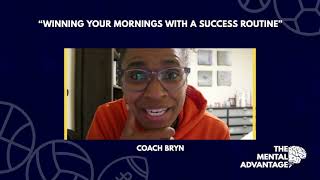
Coach Bryn Drescher breaks down a morning routine for athletes and high performers: no snooze button, skip your phone, do box breathing and visualization, use your non-dominant hand to engage both brain hemispheres, then mirror affirmations and hydration. Pick three or more pieces and adapt them to your schedule.
Chapters
This is activating a different part of your brain. Your brain is used to all of the activities being similar, and so this is a way to sort of wake up the other sides of your brain. They say if you use the right side of your body, you're activating the left side of your brain. If you use the left side of your body, you're activating the right side of the brain. The left side of the brain is the more logical side. The right side of the brain is the more creative, emotional side. So you'll find that this is sort of balancing things out because most of us are pretty strong on one side. I'm excited for you to see this week's episode, but before we get to that, I have a message for you. If you're a parent of an elite athlete or a coach of a high-performing team and you want— you're looking for some help or assistance with making them more mentally resilient, perform with more confidence, be more consistent, anything like that, then this is for you. I have an 8-week program all designed to address exactly that, to help your athlete be at their best on a more consistent basis and not get tripped up by those little voices in their head and getting down on themselves for mistakes, but performing like we know they can. So what I want you to do is don't delay, schedule a— just grab a time on my calendar through this link and let's set up a time to talk about your specific situation and how what I'm offering in my 8-week program can help. Okay, so So it's Bryndresher.com/freeconsultation. So click this link, grab a time on my calendar. I look forward to talking to you. And now on to this week's episode. Welcome, welcome, welcome, welcome back for another episode of the Mental Advantage Podcast. Today we are talking about a topic that is very important. Are you someone that has trouble getting up in the morning? Are you an athlete that wants to be successful? Are you struggling with enacting the very habits that you need that will get you right and on the path to success? Well, then this episode is for you. Hey everybody, it's Coach Brynn here, and we are talking about Morning routines. Morning routines. Do you have one? Well, if not, that's okay because we're going to talk about it. A lot of people want to be successful. They want to be the top of the top in their sport, and they don't do one thing, which is routinize their mornings. Setting the stage and setting yourself up for success is super, super, super important and crucial. So we're going to talk about how to have an idea of a morning routine. Of course, as I go through this, feel free to adjust, to sort of improvise and find the right flow for yourself. But I'm going to give you a general idea of what you need to do to win your morning, to set you on the right path to have a great day, to go into practice and finish strong at the end of your day. So So with that, we're going to get to morning routines. Why are they important? One, I used to be one of those people that definitely loved getting up as late as possible, particularly during the pandemic. I'm sure many of you can relate. I was just like sleeping and maybe just that was my way of coping. And it didn't seem like it was all that important to get up that much more before a meeting or before for something. I was just like, oh, I've got 10 minutes. The meeting starts in 10 minutes. I can get up, throw some water on my face and get on the meeting because that's the way that I was flowing at that time. But I, what I found was through going through that whole process, I felt very, you know, like kind of just like, I didn't feel like I was ahead of the game. And obviously in sports as an athlete, someone who, you know, proclaims to want to be their best self, we have to set ourselves up for success. And we gotta have a lot more lead time on going into any particular one thing. And the one part of our day when our mind is the freshest and it's the most quiet and still is the morning. So having the right idea and routine for your morning is going to make all the difference for your life because it's sort of setting your whole day in motion. Because a lot of athletes, and you know this yourself, struggle with bringing a lot of outside onto the court, onto the field, onto their sport. And that can also— that noise, that cacophony inside our heads can affect our performance. So if we start our day off right, we have a better chance of having just, you know, a better attitude, have the better mental state to go into our practices and our games with the best tools possible to have the most success. So that's why a morning routine is so important. So let's go through a few components of this morning routine that are really important. One, as we already talked about in the— in just a few moments ago, I was saying I used to wake up super late. So one, we have to get up in enough time to give ourselves the right ability to have a morning routine. So I would suggest anywhere between a half hour to an hour before you actually have to report to any particular thing, whether it be school, it be practice, it be something, but setting yourself up for success with enough time to get some time in with these various components. Usually that's going to involve setting an alarm. Now I believe, and if you don't know this, you could actually Well, let's, let's try it. How many of you just watching this, and you can let me know in the comments, have you ever woken up at a specific time every day because your body got used to it? It's like your body knew it was 6:30, or your body knew it was 7:30, 8 o'clock. You know, if you relate to that, let me know in the comments. And the reason I'm sharing that is because most of us need an alarm to wake up consistently, but there's a point where we can get our mind to a place where we can wake up at a specific time, uh, and without an alarm. But since most of us aren't there, we're going to talk about setting an alarm. Okay, so set your alarm. Let's say we're gonna— let's say we have to be somewhere at 7:30, 8 o'clock. We're going to set our alarm for 6:30. Okay, that gives us enough time to get through a morning routine of some of the things I'm going to talk about. But there is a cardinal rule about alarms. Do you know what it is? Come closer, come closer. No snooze button. And I know you're probably thinking, "Man, come on. I need that snooze button. Those extra 5 minutes make all the difference. Come on, man. I need it." But would you also be willing to bet that you don't just snooze once? You usually snooze up to the 3 times that your alarm will get you or maybe even for an hour if you don't have that type of, you know, alarm that doesn't stop you from snoozing. So the thing about snooze is it gets us into a habit of delaying. So it's like, it's like a breaking a promise to ourselves. I told myself that I was going to set an alarm for 6:30, get up at 6:30 when that alarm went off, or at least wake up and begin my morning routine. And yet I am pressing that snooze button and delaying the inevitable, which is essentially setting myself up for failure because I'm using all of that time to get these extra couple of seconds, but I'm not actually getting any extra rest. Rest. So it's an illusion. It makes us feel like we're getting extra rest because we're so tired. And so each more— and so that brings me to another point, and I realize this, I didn't— I— forgive me— you need to go to bed at a decent hour. So if you need to get up at 6:30, if the average person needs anywhere between 6.5 to 8 hours of sleep a night, it's different for everybody, you need to give yourself that. So every morning routine also starts with what time did you go to bed. Did you go to bed in enough time to set yourself up for success? Okay, so one, go to bed at a decent hour. Two, set an alarm that gives you enough lead time to go into your day. And then 2A, no snooze button. That's right, no snooze button. I believe it was E.T. that said that just by, you know, delaying something by a day could just, you know, imagine it could set your dream of being a professional athlete or playing in college D1. It could set your dream back by years, okay, or by months or whatever. That would feel absolutely ridiculous. It's like, what if by just getting up when your alarm went off put you that much closer to your dream versus the 5-minute snooze cost you months of your development? So I want you to think about it that way when you want— when you get the compulsion or the desire to press that snooze button, because ultimately it's a habit. It's something you've gotten comfortable with. I think I know we've all been there. It's It's just like, hey, it's a snooze button. It's no big deal. It's just 5 minutes. But then 5 minutes turns into 15, then 20, then all that. So we need to keep our agreement with ourself. And if we say 6:30 and we make a deal that we will not use the snooze function— in fact, on most mobile devices, in case you didn't know this, you can actually turn off the function to be able to do snooze. So you can on a mobile device. If you're using a regular alarm clock, I'm not sure that that is a capability.. But in— on all mobile devices, to turn off the snooze function is an option. I recommend you use it. Okay, so we're going to set our alarm up with enough time to get up to start our morning routine. We're also going to make sure that we don't press the snooze button. Now, I did mention a mobile device, so I want to speak about that now. Sometimes what most of us in this digital age of being addicted to our smartphones and our devices is that we immediately grab our phone and start scrolling social media, looking at notifications, whatever the case is. And obviously this is not helped by the fact that most of us use our phones as alarms. So one, I'm going to recommend that you put your phone somewhere that it's across the room. But in general, if you are going to use it as an alarm, you turn off that alarm. But in general, you don't grab your phone and begin immediately to give yourself an assault on the senses and start scrolling through social media. Okay? And while there may be some notifications, I promise you they'll still be there when you're done with this entire morning routine and you set your mind right You know, it's funny, they call it a mindset. So this is kind of like that set it and forget it. So we have to get to a place where we set our mind right, and then we can go into our day of checking all our notifications and distractions and all of that. Okay, so we're agreed. All right, no grabbing your phone. If that's a habit that you have, we're going to work on breaking that as soon as possible. Ways to do that, again, is to make sure that your cell phone is somewhere maybe further away from your bed, maybe using a conventional alarm clock even though tempting to use your phone, anything so that you're not immediately grabbing a device the minute that you wake up and open your eyes or whatever the case is. Okay, so no phones at first. Okay, no digital devices. And I am speaking to you as someone who has definitely been guilty of this more times than I care to admit. So please know that I'm not coming from a place of preaching. I'm coming from a place of I'm in there with you and I'm working on making that change myself. And I've been doing really well lately by just becoming aware that that was a habit that I had. And I don't need to look at my phone first thing in the morning, okay? Scroll on social media, any of those things, because it doesn't give me the right tone for my day. All right, as you are in bed and you've pressed the alarm, I want you to spend a few moments to sit up if you can. Uh, not necessarily have to get out of the bed, but sit up in a way that you're not completely prone, which is laying down in the, you know, in the horizontal position, because because your body is used to going to sleep in that position. But sit up slightly, keep your eyes closed, and I want you to do a bit of a breathing exercise. So we're going to practice a little bit of a breathing exercise right now to give you an example of what that might look like. Okay, first thing I want you to do as you're watching this is I want you to breathe in on a 4-count. Okay, so I want you to breathe in. Here we go. Breathe in. 2, 3, 4. Hold. 2, 3, 4. Release. 2, 3, 4. And I want you to do that for up to, you know, you can start at a minute, and each day I want you to grow in the amount of time that you kind of do that. Your mind should stay with your breath. So your mind has a tendency to want to wander and think about, did I— what do I have to do today? Go through my to-do list. What happened last night? All of those things. I'm gonna recommend that you focus. Excuse me, a yawn is coming on, so I'm just gonna allow it because it happens, okay? And yawning is just a sign of maybe there's need more oxygen, things like that. So that's not a bad thing. So you're going to allow— you're going to do that breathing cycle of what we call a box breathing. It's kind of inhale for 4, Hold for 4, exhale for 4, hold for 4, and then repeat, right? And you can do that as many rounds. The key is to find out how far in that whole box situation can you keep your mind on the breath. And when your mind does wander, because it will, and it's okay, there's nothing wrong with you, it's completely normal, you just have to remind yourself to gently refocus on the brain. Where were you at? And you can always start the cycle again. Obviously, if you're holding your breath, you'll probably— and exhale, inhale, all of that. But just go through the cycle. Okay, so as we've gotten through the breathing, that's a good thing to do. We've set our, we've set our alarm for 6:30. We've meditated for anywhere between 5 to 10 to 15 minutes. But again, I would recommend that you grow with that. So if you're not someone who's ever done mindfulness, start with a minute. Okay, if you're someone who's a little bit more experienced, you can maybe start at 5 minutes, and then you can always just grow with where you're at, right, as you grow that muscle. But that mindfulness moment of just stilling your mind and just focusing on the breath is so beneficial, okay? It's such a great way to kind of quiet that noise of that mind that wants to just chatter chatter away, and it's a way to kind of get still, okay? So that is the first thing I want you to do. The next thing is, as an athlete, as a person, as a human being, I'm always going to recommend gratitude. So something that I do is I lay there with my eyes closed after I've done my breathing, and I just think about some things I'm grateful for. As I've said in a previous episode about my gratitude situation, please give gratefulness for 3 new things each day that you hadn't given gratitude before. Don't be afraid to be wacky and weird with it. Like, I give thanks for stoplights, right? I give thanks for people who remind me to be grateful. Whatever the case So of course, as I've mentioned before, you can always give gratitude for family members and the regular usual suspects that you give gratitude for, but always think, stretch outside of things that you maybe haven't given gratitude before, just like my mic and things like that. Okay, awesome. So do that as you're still laying there in the prone position— I mean, in the sit-up, the upright position, uh, and all that. And then I want you to go into a slight visualization of your day. And what that is is just a mini movie of what you want your day to be like. Like if you got to orchestrate or architect the perfect day, that's what I want you to do. I want you to think about what kind of day do you want. Okay, okay. So now that you have all of that, you've done all that, now I want you to sort of swing your legs out of the bed And I want you to stand up, stretch just a little bit, stretch, stretch, get yourself stretching, kind of maybe get some blood, you know, rotating, maybe rotate your neck, just kind of wake up different parts of your body. And then as you go into your self-care routine, which is sort of your grooming habits, maybe washing your face, brushing your teeth, showering, I want you to think about intentionally doing things with your opposite hand. So for example, I am a righty, Okay, where my righties at? Let me know in the chat. Are you a righty? Are you a— are you a Lucy? I don't know why I was thinking of Lefty Lucy, but anyway, are you a lefty? Whatever the case is. Okay, so whatever you— like, normally when I brush my teeth, I put the toothpaste— I hold the toothbrush in my right hand, I put the toothpaste on with my left hand, and then I brush my teeth. So I'm going to recommend that you grab the toothbrush with your left hand. You're going to squeeze it in your, you know, with your right hand. And then you're going to brush your teeth with your left hand. This is activating a different part of your brain. Your brain is used to all of the activities being similar, and so this is a way to sort of wake up the other sides of your brain. They say if you use the right side of your body, you're activating the left side of your brain. If you use the left side of your body, you're activating the right side of the brain. The left side of the brain is the more logical side. The right side of the brain is the more creative, emotional side. So you'll find that this is sort of balancing things out because most of us are pretty strong on one side because we do everything with our dominant hands. Okay, so if you just by doing something with the opposite hand can sort of wake up different parts of your brain, which is going to, you know, foster more creativity, more, you know, harnessing the power of your brain. Okay, because we're using our 100% of our brain all the time, contrary to the myth that it's only 10%. Uh, we're just not aware of the 100%, which is where kind of the 10% comes in. So just by doing things with the non-dominant hand is really important. The other thing I want to mention, just because I think it's important here, is that you are looking— you're usually brushing your teeth in front of something called a mirror, but most of us don't actually look at ourselves. Typically when we're looking in a mirror, we're either like, oh my God, I look so tired, is that a bag under my eye? Or we're primping and going, you know, try to straighten something out. I'm going to encourage you while you're brushing your teeth, washing your face, that you do look in the mirror and you spend some time doing some affirmations. Okay? Affirmations, telling yourself that you're amazing, that— and using the words I am. I am amazing. I am beautiful. And you can say these things as you're brushing your teeth, as you're washing your face. You can do that. But I want you to be looking in the mirror and saying it to the amazing you. Okay, so using some statements that start with the words 'I am,' say some amazing things about yourself. 'I am beautiful. I am talented. I am creative. I am, you know, uh, hardworking. I am diligent. I am determined.' Those type of things. Give yourself a little bit of a mini pep talk, so to speak, in the morning to get yourself, get your juices flowing. And make sure you do that mirror work, looking at yourself and really loving on yourself. Because we have to love ourselves first. So as we've gone through our self-care routine, we've showered, we've washed our face, we've brushed, we've used the restroom, we've washed our hands, okay, we've done all of those things. Now we want to maybe put some fuel in our body. One of the things that we need to do that we put in first is water, agua, H2O, two parts hydrogen, one part oxygen. Most of us don't drink enough water. The best thing to do is not to necessarily put food in first, but put water in first. Hydration— helping— it helps with your circulation, it helps with your lung— I mean, your organ health. All of these things— we do not drink a lot of water, as much as we should as a society. So I'm going to tell you, as a young person who's still developing— brain's not developed until you're 25, uh, please— or regardless of your age, to be honest. It's important that you drink water, okay? So drink water, water, water, and make sure you're getting your water in, okay? So now that we got water, then we want to put some healthy fuel in— a smoothie, some breakfast, um, maybe not a heavy meal. Breakfast shouldn't be a typically very heavy meal. You don't want to start your day with the heaviest of meals like pancakes and eggs and bacon. I understand they're delicious, but it can be very heavy and draw— and bog you, bog you down. And this is also with brain health, and we're talking about the mind. We want to give our fuel— we just want to give ourselves energy in the morning, not necessarily something that kind of fills us up to the point that we're feeling overstuffed. Okay, so maybe a little bit of a lighter meal. Your heaviest meal could be lunch, and we can talk about that. Obviously, I'm not a nutritionist, but I do want you to know breakfast does not have to be the heaviest meal. It should be something that gives you some fuel so that you can kind of go the day long. Okay, so again, just recapping, uh, we've talked about food, we've talked about, uh, morning routines, we've talked about, uh, self-care, the alarm, we've talked about meditation, gratitude, doing things with the opposite hand, and putting the right fuel into our body. By doing this on a consistent basis, and the visualizing your day, which is very important because as you visualize your day you'll start to see things kind of falling into place about that day. It's really interesting as you start to architect your day, like, oh my God, it's going to be amazing. What is it? What do you want it to feel like? What do you want it to look like? What do you want it to sound like? Okay, what taste do you want to encounter? Those are the things that I want you to put into your visualization. If you're not a visual person, don't worry about it. Talk yourself through the perfect day, but speak in the present tense. I got to work, my perfect— there was a parking spot right by the door. I was so excited. So you can talk about it in present or past tense, okay, when you're visualizing. But do it in either pictures, words, whatever, or feelings is most important. Get the feeling in your body of what you want your day to feel like. This is very important, okay? We spoke about doing it in bed, but no matter when you do it, those are the components that would be really helpful. If you do all of this by having a morning routine, you'll find that you're going to arrive to the things that you need to do more, more focused, more able to focus, more energized, feeling more refreshed, replenished. These are the things that what a morning routine can give you, and you'll feel just more ready for action, whatever that is, whether it be school is your first thing practice, or an actual game. So finding a routine that works for you that incorporates any and all of these components is going to set you up for success. Now I know you might be saying, I don't have time to do all that. How am I going to fit all of that in? Do the best you can. Maybe just pick 3 of the things that I mentioned, 3 things that you can do on a regular basis to set yourself up for a wonderful morning that can set the tone for the rest of your day. So as you go through school and also practicing games, you'll find that you're going to feel more ready for those things as you set the tone for your day. I did mention, wanna mention one other thing, and that's the military talk about the gentleman that said making your bed is really important. But having these routines that make you feel like you're accomplishing something, you're doing something for yourself, is all going to make all the difference for your mindset but also your mental health. So morning routines are very important. I hope that you will actually incorporate some of this. Please let me know down below what, what of this were you already doing, and what did I mention that you're kind of like, huh, hadn't thought of that, but I definitely want to add it? I would love to hear that in the comments. This is important. All the greatest people have morning routines that are very important affirmations, visualization, gratitude, mindfulness, meditation, uh, eating the right fuel, self-care, um, you know, your grooming habits, visualization. All of the things that I've talked about are wonderful components of a miracle or a mental morning, if you want to say an amazing morning. And I know that you're going to do it. So remember, morning routines, very important. Make sure you share your morning routine below, or what you're going to incorporate, and I'll see you in the next episode of the Mental Advantage Podcast. See you next week.
More from Bryn


Who else hype for this upcoming season with Caitlin Clark and the Fever with all these great adds?







How to be nicer to yourself: Stop putting yourself down either out loud or in your head


Winning At The Net Game of Sports & Life No Matter The Score - Episode 60 w/ Jordanne Scott