
What I Would Do To Save Baseball | Ryan Daniel Moran
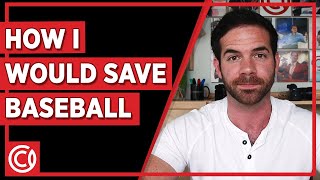
Ryan Daniel Moran says baseball needs virtual-reality viewing with selectable feeds, marketing players like entertainment brands with documentaries and rivalries, and smaller premium stadiums. Without these shifts, he argues, the sport's best days are behind it.
Chapters
Baseball season is finally happening. We hope anyway. But can baseball as we know it even be saved? The answer to that question is no. Not unless Major League Baseball makes some significant changes to the way that they do business. Most of the proposals that have been made to save any major sports league have been based in the assumption that we're just going to go back to normal at some point. That's not gonna happen. Society and how we consume entertainment has been permanently changed. And if Major League Baseball does the things we'll talk about in this video, baseball can still be saved. I'm Ryan Daniel Moran. This is Capitalism tv. Let's talk about baseball.
I'm about as big a baseball fan as they come, and I'm a really big Cleveland Indians fan. But if I was being fully honest, I wish that they had canceled this season. I'm not interested in a 60 game season. And even if the Indians win the World Series, I don't even really think that it counts. So we have to come up with a way to ensure that something like this never happens again. And if we don't act quickly, then Major League Baseball runs the risk of turning off even their most passionate fans. So if I was the owner of the Cleveland Indians or in charge of Major League Baseball, there's one very hard pivot that I would make right now. Major League Baseball has to lead the way on consuming sports via virtual reality. All the technology is already there for fans to have an immersive experience where they can choose their seat and choose which audio feed they tap into. Imagine being able to watch a sporting event from third base or from the dugout or from the pitcher's mound or from the catcher's view. Imagine being able to tune into the audio feed that's coming from the dugout of your favorite team. Imagine hearing the banter between the players on the field rather than listening to a commentator. Of course, you could choose to tune into your favorite commentator, but that doesn't need to be the person who is the officiator of the game or the official voice of whatever team you follow. Now in Cleveland, Tom Hamilton is kind of a legend, so I would choose that. But moving forward, I might rather hear a YouTube streamer talk about the game rather than hearing whoever replaces Tom Hamilton. Now, Major League Baseball has kept kind of a tight lid on the way that they operate, and if they want to stay relevant, they're going to have to loosen that lid and allow for more fluidity in how we consume the game. We already have all the technology via MLB TV and the Installation of cameras on the field. It's just a matter of rolling out that as an expectation to the fans. And if they were to do that, people like me would pay a premium to be able to consume that type of content and it would make a much more immersive experience. We can already see this type of sporting content being used by the esports community. In fact, esports is growing faster in terms of growth of fan base and than any major sport right now because it's just how young people are trained to consume content. So the old sports, meaning real in person sports, are under threat of becoming irrelevant because young people are more interested in streaming content and streaming sport than they are in the quote, real thing. Now, as an owner of a team, I would need to find a way to replace the revenue of ticket sales. So how would we do that in a way that didn't completely isolate the fan base? Well, if we have an in streaming experience, then there are more in stream purchases that can be made. Everything from the ads that we see could be custom to the person who is watching. And there's a lot more product placement that we could do if we're not burdened with the fixed advertising spots that we're used to by watching a game on TV or streaming it online. Now there's a couple easy ways that we could do this. Major League Baseball already charges $120 a year to have an MLB TV subscription. If you have a virtual reality experience where you can choose the camera that you're watching from and choose the audio feed that you're listening to, those prices could double or even triple. You add in the fact that there's going to be custom ads that are available due to the fact that the ads you see will be tied to your virtual reality device. And we could use my browsing history to be able to run custom ads straight to me through which there'll be a premium price on for the advertiser. So we will lose volume in terms of the amount of advertisements that we can run, but they'll be much more profitable for the organization. With that in mind, I still don't know if we'll be able to completely replace ticket revenue. And I think that you will see the sports industry become far less profitable without the ability to charge tickets for an in person experience. So watch for, get this, you heard it here first folks. Watch for the first time in history for athlete contracts to go down in value. There's one way to save that and that is if Major League Baseball changes the way that they Market their players. I would market my team like an entertainment business rather than a sporting team. Now that sounds like a little nuance, but the difference couldn't be bigger. You know who is a great Entertainment marketer? Vince McMahon. Vince McMahon does a beautiful job of setting up rivalries and building characters and writing drama into the script of World Wrestling Entertainment. And you might remember the glory days of wrestling when it was WWF versus WCW versus ECW and everyone had their team and the teams were fighting against one another. That was the time that wrestling had the biggest foothold in our culture. Well, sporting teams tend to run a lot less like entertainment companies and worry about putting the best product on the field. Now, as a business owner, that's usually a really good thing to focus on, putting the best product on the field. But when it comes to entertainment, the best product does not necessarily mean the team that wins the most. Often the best product is the team that is the most entertaining, that has the most emotional response from the fan base. A great example of this is the Cleveland Browns. I grew up in Cleveland. I'm a Cleveland Browns fan. And they're the losing team in football most years, and yet the team sells out. And as the biggest international fan base of any other team in football, why is that the case? It's because the fans have an emotional connection to the team. The fans have this.
Deep desire for the team to be not even good, but just like better than average. Baseball teams have had a hard time with this. This is especially true because of some provisions in the collective bargaining agreement that limit the way that you can market players. But if the sport is going to succeed long term, then that's going to have to be loosened. If I was the owner of a team, I would be marketing my players like Vince McMahon markets his wrestlers. There would be storylines, there would be rivalries, there would be drama between the players. Now, if that sounds weird, here's a practical example. The Cleveland Indians have some of the most fascinating players on the team. One of them is Jose Ramirez. The third baseman. Jose Ramirez has a fascinating life story. He basically kept slipping through the cracks and getting to the next level. And the Cleveland Indians took a chance on him when he was a teenager. He kept just doing enough to prove himself to keep going, but the team kept working with him and developing him and now he's a perennial MVP candidate. There's a fascinating story behind this man's life that is never told. And if I was at the helm, I would be doing docu series and I would be doing full length movies. About this person's life in order to generate interest and to tell the stories of these players which are so rarely told. If we look at some of the great baseball movies like the Rookie, which I think is the greatest baseball movie in it tells the story about how a no named baseball player rose to prominence. And unfortunately we only tell those stories in the rearview mirror. If we tell those stories about the players that are playing right now, watch how fast the fan base starts to generate interest in these players and create this excited emotional connection to players that are on the team right now. We also need to build up rivalries in baseball. Cause there aren't really that many good ones outside of New York versus Boston. But those rivalries exist because those fan bases have long histories of hating each other. We could benefit from some more of that in Major League Baseball. There's a reason why those are two big market teams is because there's so much tension and so much drama between the fan bases and as a result they get the most attention. There's a lesson there. If we can generate that with, you know, some marketing, we'd be able to generate the exact same type of intrigue and drama for every other Major League Baseball team as well. Major League Baseball is really nice to each other. It's a gentleman's game. But if we're going to save the sport, we're going to have to create more drama. Now lastly, one other way that we can generate extra revenue for the teams themselves is we can dramatically change the way that we build stadiums to where the in person experience is more of an intimate experience rather than being part of a 40,000 person crowd. Now I love hearing the roar of the crowd when the crack of the bat sends the ball over the fence. I mean it's, there's just nothing like it. Unfortunately. It's just not going to come come back. That experience is probably behind us. So instead we have to cater to more corporate events and make them more intimate and more high touch with the players. Up until this point, players have been a little bit resistant to interact with fans during a game setting. And that's because there's 40,000 of them. But as the crowd sizes get smaller, you'll create more opportunities for experiences between the fans and the players. And, and that creates more of a high touch and also premium experience at the stadium, which wasn't possible before. So all this to be said, the game still has a chance if it pivots really quickly. However, right now the cards are stacked against us because Major League baseball has over 100 years of history and over 100 ways of doing things. Things tend to change really slowly in Major League Baseball because we love our history and we love the way that we play the game. So rather than change the way we play the game, we have to change the way that we experience the game. Just like television change the way that we experience the game. Virtual reality will do the same thing and Major League Baseball can lead the way on this and perhaps even patent some technology that they could license to other sports. If the game does not adjust to the times. I think that the best days of baseball are behind us. But if we adapt to the new demands of the marketplace by creating a virtual experience, by creating drama between the players and between the teams, and by creating a more high touch experience for when you do go to the games, Major League Baseball can be saved. I'm Ryan Daniel Moran. This is Capitalism tv. And if you work for a Major League Baseball team, please reach out to me because I want to help save the game. Thanks for watching this video. Subscribe to the channel and see you next time.







