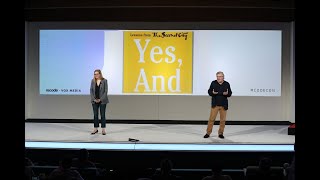
Kelly Leonard | Learning Lessons Through Improv | TEDxZumbroRiver

This is a YouTube video titled "Kelly Leonard | Learning Lessons Through Improv | TEDxZumbroRiver" featuring a talk by Kelly Leonard. In this presentation, Kelly shares personal stories and insights about improvisation, its origins, and its application to social skills, creativity, and parenting. The talk emphasizes the importance of saying "yes, and," listening, overcoming fear, and using improv principles to improve human connection and innovation. The content is a solo talk without multiple speakers.
So it's 2006, and I'm in my office at the Second City finishing up work. It's a Friday, and my son Nick is upstairs finishing his first week of improv classes at the Second City Training center. And Nick is 8 years old. He's chubby. He has weird theater parents, so he's a weird theater kid. And he gets bullied at school. But this week, he's thrilled. He's having so much fun. And he comes downstairs, and we get in the car, and as we're leaving the garage at Second City, Nick says to me, dad, do you know why I love improv classes? And I go, no, buddy, why do you love improv classes? He said, because in improv, if you're nice and you're funny, you're popular. That's the world I want to live in. The world where if you're nice and you're funny, you're popular. So I started at Second City in 1988, and my first job was as a dishwasher. It is not as glamorous as it sounds. The back bar at the Second City in those days was filled with alcoholics and sociopaths, but the work on stage was absolute magic. Mike Myers, Bonnie Hunt, Jane lynch, they were all in the professional company. Chris Farley had just been hired in the touring company and was constantly getting in trouble for breaking things. And I don't know if you know how Second City is set up, but we do two acts of scripted content and a third act that is improvised. And that's where the actors are writing the show and they're making it up. And it took me not too long to realize that the work on stage at Second City was not magic at all. It was a practice. And I'm not going to bury the lead here, okay? Improvisation is yoga for your social skills. Improvisation is loud group mindfulness. Improvisation is practice in being a better human being. Knowing that, it might not surprise you then to learn that improvisation has its roots in children's games. Viola Spolin was a social worker in the 20s and 30s working at Jane Addams Hull House on the south side. And her job was to better assimilate the immigrant children who were coming into Chicago. And so she created these theater games, many of which were gibberish or silent because the kids didn't all share language. But all the games were about kids coming together to play and collaborate and listen and empathize. And Viola's son, Paul Sills, was studying at the University of Chicago, and he loved these games. He loved playing Them, and they were entertaining. So he taught them to his friends Mike Nichols and Elaine May, among others, and they formed, with a gentleman named David Sheppard, the first improvisational theater in America, the Compass players, in 1955. And a few years later, the Second City was founded in 1959. So what is improvisation? Improvisation is groups of people making something out of nothing. So think about that. Groups of people making something out of nothing. And the founders of Second City realized that if you have groups of people making something out of nothing, they need some rules of the road. So first rule of the road with improvisation is the concept of yes. And it's almost a bumper sticker now, but it's very important, which is when you are improvising in a group making something out of nothing, you can't start with no, and you can't just start with yes. You have to say yes, and you have to affirm and contribute in order to explore and heighten. So I give these talks a lot to business groups, and invariably when I talk about the importance of yes and in a business setting, there's a dude, a guy in the back with his arms crossed, and at the end, he raises his hand, he says, if I had a yes and every terrible idea that came into my office, I'd get nothing done. So there's two things I that guy is a nightmare to work with. And two, he's missing the point because yes and is at the front end of innovation. It's at the beginning because when you say no to an idea, you're actually saying no to a person. And you say no enough to a person, they're not going to give you more ideas. And the irony of all of this is, is that when you yes, and let's just say 10 minutes at the beginning of meeting, it makes it so much easier to say no later, because everyone's had their ideas, listened to, vetted, explored. Hugely important. Another thing that's important about improvisation is listening. So, folks, we are all terrible listeners. Hated to break it to you. Terrible listeners. If we're having a conversation and you're speaking a sentence to me, at what point on my arm am I stopping to listen? When am I ceasing to listen? Elbow. Mostly because I get the gist of it. I have the idea of what you're saying, and you can't do that in improvisation because the actors are making up the script as they go along. And the last couple of words might be crucial information, but we don't do that in real life. So one of the exercises we teach At Second City is a listening exercise. So two people get together, they have a conversation, but your job, before you speak, is to say the last word that the other person just said. Try it at home. It will drive you crazy. It breaks up the rhythm. And you know what? It's breaking up the rhythm of you not listening, because we don't do it. So what is it about people who say no and people who don't listen? It's about fear. It's about fear of failure. It's about fear of shame. I'm turning 50 this year, so I'm in that, you know, that mode. And one of the things I'm doing is reflecting on what I know. What do I know to be true? So here's something I really know to be true, which is 99% of us think we're frauds. We do. We don't think we're smart enough or pretty enough. And we're not good friends. We're not good husbands. We're not good co workers. We're not smart enough. I think that I don't deserve to be here, and I have a bodywork behind me that maybe says I do, but I don't. 99% of us think we're frauds. And the 1% who doesn't, they're dangerous. And I think we know who I'm talking about. Fear of failure is a creativity killer. A few years back, a company hired us to work on a psa, a public service announcement for people suffering from social anxiety disorder. And so I sent out an email to all the actors on stage to sort of say, hey, did anyone have any experience with this? Maybe a family member, maybe a friend? 75% of the people working on stage at Second City at that time suffered from some level of social anxiety. Astounding to me, because if you had social anxiety, why are you going up on a stage? And then why are you going up on a stage with no script? And then an actress came to me and said, what you don't understand, Kelly, is that when I'm improvising, that's the only time I don't feel anxious, because I can't worry about before, I can't worry about after. I have to be fiercely in the moment, in the now, fiercely present, loud group mindfulness. And beyond that, I'm improvising with another person. And their job is only to save me. I wrote a book last year, and when I was working on it, I would come into the office from 8 to 11 and I'd shut my door, never Shut my door. Shut my door and work on the book. And I would think about these principles. And I'm not a teacher. I'm not an actor. This is my relationship to the work is thinking about it and writing about it. And after the book was published, my staff came to me and said, we're going to tell you a secret, which is when we had a big problem to deal with. We made an appointment to see you at 11:01, because for the next two hours, you were a great boss. You became mediocre afterwards, like usual, but in that moment, you listened to us. And I've been thinking about what I'm going to write about next. And I was talking to my kids, and my son Nick is now 18, and my daughter Nora is 13. Yes. My kids are Nick and Nora. I'm a weird theater guy. And I said, you know what I'm thinking about, guys, is like, what if I wrote an improv parenting book? Because you've played all these games around the table, and your mom and I have taught you certain things, and we use improvisation, and both my kids just sent to me and go, that's a terrible idea. You are not the person to write this book. So I have a favorite improv phrase, and it's bring a brick, not a cathedral. And what that means is so many of us try to solve these big problems by coming in with one big idea, and we enter rooms with our cathedrals when we really should be entering with a brick. And so what's today been right? All these things that we've heard about, you know, bees tapping the unconscious, prairie land, tech tales of addiction that would break your heart. So what's our job? Our job is to listen to these stories, these ideas to. Yes. And them into our own communities. And when we do that with kindness and a little bit of humor, it doesn't matter if we're popular, because we will change the world. Thank you.
More from Carina


Friday Foundations: How to Get a Seat at the Table w/ Carina Clingman, CEO, Recruitomics Consulting