Two Second City directors show how improv can be used the workplace | Code 2018
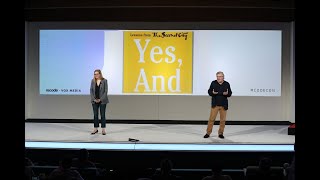
Second City directors Ann Libra and Kelly Leonard demonstrate how improvisation techniques improve workplace collaboration and communication. They share improv exercises and explain how the skills transfer beyond theater to business and behavioral science.
My name is Ann Libra. I'm every parent's worst nightmare. I run a college degree in comedy. I've also worked at the second City for 32 years. Thirty years ago, I was the box office manager, and I hired Kelly Leonard to work for me in the box office. And then five years later, I married him. So that was a good hire.
So we're very lucky in our careers because we've been able to work with people like Stephen Colbert, Steve Carell, Tina Fey, Amy Poehler, Seth Meyers, Jordan Peele, Keegan Michael Key. I am name dropping like mad, but it's absolutely true. And when you work with people like that, you start to think that this stuff is magic. But then you work at Second City for a while, and you realize it's not magic at all. It's a perfect practice. So I'm not going to bury the lead here. Improvisation is yoga for your social skills. Improvisation is loud, noisy, group mindfulness. Improvisation is a practice in being unpracticed, which is how we all walk through the world. And if that surprises you, it maybe wouldn't surprise you to now know that all these exercises in the pedagogy of improvisation started off as children's games. Back in the 20s and 30s at Jane Addams Hull House on the south side of Chicago, a woman named Viola Spolin, who is a social worker, was hired to better assimilate immigrant children coming into her care. So she created these exercises and games that brought them together to improvise, collaborate, communicate. Many of the games were silent or in gibberish because the kids didn't always share language. Her son, Paul Sills, was studying at the University of Chicago, and he taught these games to his friends Mike Nichols and Elaine May. You get where I'm going with this. They formed the first improvisational theater in America in 1955, the Compass Players. That becomes the second city in 1959. So fast forward to the work we're doing right now. And while the work on stage is still amazing, we kind of think the work off stage where improvisation has gone is even more amazing.
Improvisation games were created to help actors recreate recognizable human behavior. And what's great about this is that not only does it allow you to create recognizable human behavior on stage, it allows you to recreate behavior for yourself in real life as well. And one of the things we have over 3,000 students in our training center, many of whom are not interested in being on Saturday Night Live. They are interested in taking improvisation because it makes them better coworkers. It makes them better leaders, and it makes them work better in their real lives. About two years ago, we partnered with the University of Chicago at the Booth center for. Sorry, the Harris center for Decision Research at the Booth School. And we started to use improvisation in partnership with behavioral science. The situation is that we can use these improvisational exercises to study behavioral science because they recreate recognizable behavior. But we also do two other things. We use these exercises to help people understand their own behavior and to show insights into behavioral science as well as to give you skills that allows you to alter your own behavior in your real life. So we're going to make you improvise. This is an interactive exercise, and you're going to all work on some exercises that are classic Second City exercises and then an adaptation of those exercises that we created based on behavioral science. So I'm going to ask you all to get into groups of three, find someone that you can talk to, get into triage.
This will require you to put your phone down.
Yes. It'll require you to put your phone.
Down, get away from the screen for once in your lives.
Right. It will require you to talk to somebody who you don't know.
The phone is not a third person.
A phone is not a third person. Oh, you can do four.
Four is fine.
Four is fine. If you need to do. Four is fine. Great. I'm going to ask you to quiet. Quiet down. Find your group of three. I'm going to give you some instructions. If you're in a group of four, that's fine. Within your group, I want you to decide who's A, who's B, who's C, and who's D. Okay? So just within your group, decide who's A, who's B, who's C, and who's.
D or ABC or abc if you're.
If there's only three of you, great. Okay, so I'm going to let you talk in a second, but listen for one moment. Here's what I want you to do. You have had such an amazing time at the 2018 Code Conference that you are going to plan a reunion for everyone to come back and have a reunion. The budget for this reunion is limitless. You can do anything. So take a second and just in your own head, think of the things that you might do for a reunion, for the Code Conference with unlimited funds. Just take a second. Just think about what you might do. Okay, here's what we want you to do. Person A. Your job is going to be to pitch to the other people in the group your ideas for this reunion, persons B and C and sometimes D, your job is going to be to find as many ways as possible to negate, deny and tell them they're wrong. Alright, I'm going to give you a little over a minute to do this. We ready? And go it. And 5, 4, 3, 2, 1. Give yourselves a round of applause.
Give yourself applause.
Okay, I want to hear from you. Just shout out a couple of words. What was. If you were person A, what was that experience like? Just shout out some words. Fun. What else? Inventive. Challenging. Most. What? Creative. Creative.
Creative.
Adventurous. Adventurous. Fast.
Fast.
What good did you say? Exciting. Exciting. How did it feel to be negated by your partners? Sucks.
Fun.
Fun. What was fun about it?
Challenging.
Okay, so it was challenging to be negated by your partners. Other people have different experiences. It was helpful. What was helpful about it? They had some good ideas. Okay, interesting. What's over here?
Disappointing.
It was disappointing. What made it feel disappointing? Okay, you have your idea. You want to hold forth with it. I know sometimes we've had someone say it feels like being a woman in a meeting. Okay, we're going to do another exercise.
So we're going to do another exercise. And in this case, you're in your same groups. Person B, you're going to do the pitching for the reunion. And the job of everyone in this group. Every suggestion is to. Yes. And the idea and what you're doing there is you. You can use the words, but you are exploring and heightening based on the offer, which means you're building and you have to keep building. There's no stopping. And remember, there's no budget. And don't worry about laws of any kind. This is a safe space for us. It's not like this is going to be broadcast. We're cool. All right. We're going to give you about a minute to do this. Yes. And every idea. Go, Sam. Five, four, three, two, one. Give yourself a round of applause. Okay. Person B, how did that feel?
Exhilarating.
Exhilarating. Great. How else?
Easy. Easy.
Felt like a man.
Yes.
Oh, the irony. For the other folks in the group. How'd it feel? Fun. Kind of the same, right? Because we all get to participate. All right, a couple things you need to know. So we teach the yes. And exercise. And I do just all over to tons of business groups and especially for the corporate groups that we teach this to, inevitably when we're sort of unpacking it, there's a guy, it's always a guy in a suit in the back who says, if I yes. Anded every idea I'd get no work done. Two things. I know that guy's a fucking nightmare to work with, and he's missing the point because. Yes. And operates at the front end of innovation. It is five minutes at the beginning of a brainstorm. It's about getting to an abundant amount of ideas. It's rapid prototyping of creativity. Maybe to use some of your language, here's another thing, because most people do know about yes. And has become kind of a bumper sticker. A very smart person said to me once, if it can't be used for evil, it's not a superpower. Yes. And can be used for evil. People can manipulate it to get what they want. So know that.
Great. So did anybody have the experience in doing. Yes. And of feeling like the idea got, like, out of control, you couldn't possibly do this thing, and you really did want to sort of step in and stop it? Yes, absolutely. Over here. Huh? I should have given you more budget. So it is important, particularly when we're working in diverse groups, particularly when we're in a situation in which we do need to be able to say no. And one of the things that we find in improvisation is sometimes our yes and ability can get us into trouble. We'll get really excited about something. We'll yes. And each other. And then spend. Spend two hours on something that's really just not going to work. So we need to have another way of working. When we have genuine things that we want to say and genuine disagreements, that keeps that yes. And spirit. And keeps that collaborative spirit. And the exercise that I want to give to you now is one that we created as part of the second science project, which is our partnership with Chicago, Booth and Harris School for Decision Research. And it's based in data, it's based in behavioral science. And there's behavioral science that has shown that gratitude, that being thankful for something gives you an opportunity to have more negative conversations, to give someone negative feedback, to dig into what is happening. That when people hear genuine gratitude, they're more likely to listen and respond. So we're going to give you an opportunity to talk about this idea again. And this time what I want you to do is if you have an authentic disagreement with something that somebody has said, I want you to say that disagreement. But before you do that, I'm asking you to say this phrase or some version of this phrase. You don't have to use this exact phrase, but say thank you. Because. And that. Because I want you to follow with something that you Genuinely heard. What did you hear them say that you found valuable, and then you can state your disagreement. So we're going to demonstrate for you. I've got this great idea. I think that for our reunion, that we should go to the moon, literally build, like a dome and get those robots that were in the earlier presentation. Right, right.
Thank you. Because there's such poetry in that idea. But Budget, you know, I'm concerned about this. And if we have to raise the money and, like, I don't want Elon Musk to show up and, like, you know, this is.
Thank you. And I appreciate that you are both grounding me, but also looking for a way to find a way to make my vision realized. Okay. Does that make sense? So you don't. Again, you don't have to say thank you because each time. But I encourage you to play with that concept. Really listen for what you find valuable in what your partners are saying. So for this C, I want you to start the pitch. Everyone else can join in using thank you. Because Ready and go. And 5, 4, 3, 2, 1. Give yourselves a round of applause. Okay. Shout out some words for me. How. Okay. One of the things I think is really interesting about thank you. Because is that whenever we demonstrate it, it's the hardest one for people to stop talking.
Yep.
How was that different from the first two? I was listening. You were listening. Great. What else? There's empathy.
Collaborative.
Collaborative. What did you say back? Productive. What made it more product? Okay. It felt like you could move forward. Someone was understanding where you were coming from. There's a tremendous thing that happens when we really genuinely try to see someone else as they want to be seen. Right. That makes them feel not only heard, but willing to build with you. It's fascinating. When we first started working on thank youk, because we thought that it was sort of. Did anybody have the feeling of, like. I wasn't really grateful. I felt a little disingenuous. Anybody? It's okay. Because that's what our team thought. Our team thought that it was a little disingenuous. And then we got into a big argument over a way of working. It's very hard when improvisers and scientists get together. There's a lot. We sometimes are talking across each other. We started using thank you because as a way of manipulating each other. It works brilliantly. One of the things we want to do now is. So first of all, I want to encourage you. Go ahead, take this. Take. Yes. And take. Thank you. Because use it or use versions of it in your Real life and see how it works for you. One other possible takeaway, a behavior that you can use that helps people feel heard, is to either, in your head, work or actually verbally state the last word of whatever the person is talking to you says before you start saying what you're going to say next. It's going to force you to listen all the way to the end of what they're saying, as opposed to starting to think of what you're planning on saying about halfway through.
Here's another thing you can do in your industry and in all our industries, we need divergent thinking. But that's like saying to someone, like, be innovative and walking away. We have a thing that Mick Napier, a director at Second City, started doing during the Second City process, because invariably people started bringing in the same ideas, and they got a bit boring. He said, okay, we're having a thing called Taboo Day. You need to bring in an idea that Second City would no way in hell allow to be put on stage that it is either too offensive, it is too expensive, or whatever. Invariably, three, four of those scenes would end up in the show because people were thinking beyond themselves. You can do this in your office, like Bad Idea Day. Bring in an idea that will sink the company. Let's talk about it. Allow that to exist in the space for a little while, because you might find something really rich and honest.
And finally, we're going to give you one to the parents in the group. Kelly and I have two kids, and when my kids were young, they're about five years apart, and they would fight like cats and dogs in the car. So I would use an improv exercise to get them to shut up. And we played a basic Second City game called One Word Story, where you literally tell a story one word at a time. And we would go around the car and they would. And of course, the deal is you have to. Yes, and you have to agree. And that would keep my kids occupied for many, many minutes in the car on the way home from school.
And this is all about building ensembles, right? So that's very important at Second City. And our friend Sheldon Patinkin, the late Sheldon Patinkin, had a great phrase, which is, we've all heard your team is only as good as its weakest member. And that's not the way we approach it. At Second City, we say your ensemble is only as good as its ability to compensate for its weakest member.
And that weakest member could be any one of us at any point in time. So ensemble is not a specific group of people. An ensemble is a way of practicing where you build something with someone else that you wouldn't necessarily build on your own.
Thank you.
Thank you.
More from Carina



Friday Foundations: How to Get a Seat at the Table w/ Carina Clingman, CEO, Recruitomics Consulting