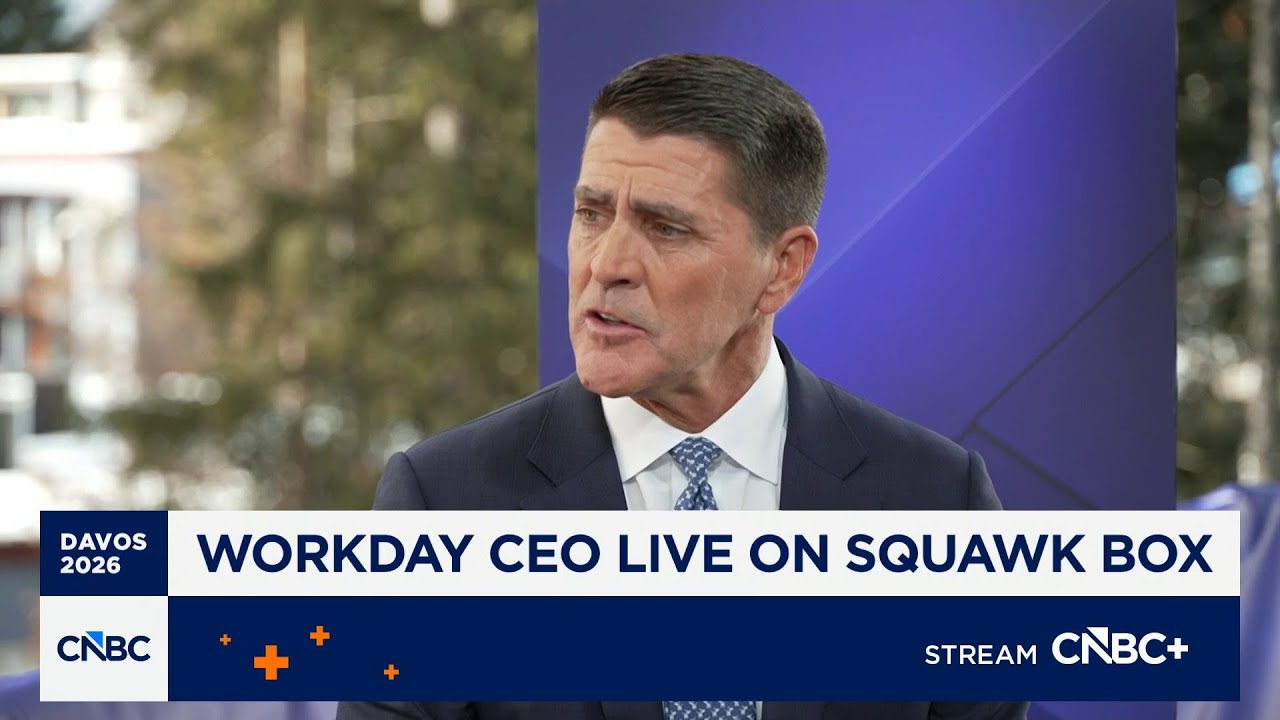
Workday CEO Carl Eschenbach laid off 8.5% of staff to fund AI talent and technology, hiring two senior leaders from Google. He argues AI is a tailwind for the company, not a threat, citing 11,000 customers and 75 million users as a durable moat against newer competitors.
Chapters
AI has dominated the conversation here at Davos, with major implications on the future of the workforce. Joining us right now to talk about just that and more is Carl Eschenbach. He is Workday CEO. And Carl, thank you for being here.
Thank you for having me again.
AI is everywhere. It's changing things pretty dramatically, and I think it's changing your business pretty dramatically too. Last year, almost a year ago, you put out an announcement that you were going to be laying off about 8.5% of your workforce, but you told the workforce it was because you needed to hire hire in different areas, to expand in different places internationally, and to hire in AI. So what's happening? What are you seeing internally? And then we'll talk about what's happening.
Yeah, absolutely. Yes. Last year we did a workforce optimization exercise so that we get more dollars available for us to invest specifically around AI and AI talent. And that's worked out really well. Our hiring has been pretty robust this past year. We continue to lean into the opportunity of bringing incredible talent. Just in the last year, we hired 2 incredible technology leaders, both of them out of Google. One is our president of product and technology and the other is a CTO. In the lineage of AI talent they're bringing into our company is pretty exceptional. So the strategy to optimize the workforce around AI talent, which allows us then to deeply invest in AI on the Workday platform, is paying off. And I'm super proud of how we've executed in the last year on that strategy.
The market is not necessarily seeing it yet. Your stock, I think, is down about 27% over the last year. I think there are some concerns about revenue growth. What do you say? To, to investors or potential investors?
Yeah. So first, let me just say I'm super proud of our performance. We're coming up on our year end here in January. Our FY26 has been a really strong year and we're building a lot of momentum as we go into the new year, FY27, specifically around AI. To be honest, Becky, there's a narrative out there in the market that's impacting our stock, and I think it's an overblown narrative and it's not true.
What's the narrative?
The narrative that AI is going to disintermediate or just replace mature software companies like us. Let me ask a simple question. If you were to start an AI company today, would you as an enterprise go and support a VC-backed, vibe-coded, you know, HR platform? Or would you rather partner with someone who has 11,000 customers, 65% of the enterprise or the Fortune 500, A 98% retention rate, and we have 75 million users on our platform today. This is not a platform that services a function in the company. It's across every single employee. And we have the most highly curated set of data when it comes to enterprises supporting their most critical assets, their people and their money. We are uniquely positioned to be one of the AI winners in the enterprise. Because of our incumbency. And lastly, because of the trust we get from our customers. Our customers aren't saying, Becky, they're replacing Workday. They're asking us, how can you bring more AI to market so we can build it into your platform? It's not bolted on. It's built into the fabric of our data. We have the cleanest set of data in the industry, and AI is a tailwind for us. It's absolutely not a headwind.
Are you feeling like you're getting those AI tools developed quickly because of the changes that you've made over the last year? We are.
I think the innovation engine here at Workday is as good as it's been. I'm super excited about how rapidly we're bringing AI solutions to market, including our own first-party agents. I'm also excited about how we're really executing on our platform strategy. So if someone else, meaning a customer or one of our partners, wants to bring an AI agent into the enterprise, they're going to do it on top and through Workday. We are the enterprise AI platform for your workforce. Force, whether it's agents or it's humans.
And we've been talking all morning and frankly the last 72 hours about this idea in a, you know, in the world of AI, where's the moat? Right. And I think you're trying to say here the moat for our business is we've, we've already, you know, organized the data, we have the relationship and we're the trusted player. I get that. The question is, and you said vibe coded, but there are these players. And the amazing part about AI is just how quickly I could sit here maybe with the new Anthropic at Claude App and try to build something that looks crazily enough like Workday. Now, it may not be Workday in its first incarnation, but not only can you create the, the sort of user interface piece, you can actually go resort and re-tabulate the underlying data that you've already sorted. And that's the thing that I think people say to themselves, oh my goodness, actually the moat isn't as wide, the alligators in the moat aren't as hungry in a new world where we can do so much and what that ultimately looks like.
Yeah. And fundamentally, Andrew, we think that narrative is out there, but it's not true.
Right.
Our customers are saying, you have our data. It's highly curated. It's data that no one else has. Why wouldn't we look to you to get all of our agents of the future? Workday, you're in a unique position. Leverage it. And I can't under— you can't underestimate what trust means in the enterprise. We have not seen an enterprise replace Workday, and we have 65% of the Fortune 500, and we're working with new customers. When new customers are looking for an HR system or a financial system, guess who they're coming to? They're coming to Workday. So yeah, there's going to be these third-party agents. And oh, by the way, If they want access to the Workday data, we'll give it to them, but we're also going to monetize it. We're not just going to allow people to come through open set of APIs, get access to our data, and try to replicate what we're doing. They can't do it.