How to Become a CEU Provider in 3 Months (Even If You've Never Taught Before) with Michelle Risser
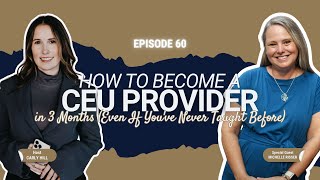
Michelle Risser, a licensed clinical social worker, walks through how therapists can become CEU providers in about three months. She covers choosing an approving organization, aligning your topic to client benefit, and pricing around $20 per credit hour. She offers templates and a self-paced course to guide the process.
Chapters
Hello, my friends. Welcome back to another episode of the thriving Therapeneur podcast. Today's guest is somebody I've been excited to bring on. Michelle Risser. She's a licensed clinical social worker. It's L I csw. I just learned for her. She's. Oh, I sw. Oh, L I sw. We were just talking about why does it have to be so, so complicated? And it's different in different states. She's social worker. Okay.
Yep.
She is the go to expert when it comes to helping therapists turn their expertise into additional income, all through continuing education. So she's helped countless therapists become approved CEU providers without drowning in that red tape, overthinking it to death. And she's going to pull back the curtains and she's going to share that. How you can do this too, if you have been thinking about being a CEU provider. So, Michelle, welcome to the show.
Thank you so much for having me. I'm happy to be here.
Yes. So let's start with your origin story. I always like to just start with the human behind the business. What inspired you to even get into social work and then also move into being a CEU provider yourself and then helping other therapists diversify their income in this way too?
Absolutely. Oh, my goodness. Getting into being a social worker. I started school way back in the late, I guess the late 90s, early 2000s. I graduated in 2003 with my master's in social work. My undergrad was in anthropology. I've always been fascinated by people and what makes them tick. And I was actually going to be an archaeologist. I specialized in archaeology. I did an internship at the Hopewell culture, the Hopewell Mounds. I don't know that that means anything to anyone who's not in Ohio, but there are prehistoric mounds in Ohio. And what I found was that it's a very hot, not well paying, you know, it's not Indiana Jones, it's, you know, putting dirt through a screen on the side of the road. So I was like, okay, well, I'm really interested in people, though. What if I help people who are here now instead of, you know, learning about people who are no longer here? So I switched gears and I wanted to be a therapist and someone suggested I go the social work route. And I just fell in love with it. I did the, the agency work. I was a case manager for many years working with people with hiv, aids. I was a medical social worker. So sometimes when people say you're not really a social worker because you're a therapist, I'M like, oh, no, I'm a social worker. I did the agency work, I did the hospital social work. And I've been in private practice for about 15 years now, and I've taught continuing education since the very beginning. My very first agency job was a CEU provider. And if we wanted to, we could go teach. So I did. So I got comfortable with speaking, and then later I decided to throw my hat in the ring for a big national or international addictions conference that's here in my town in Columbus, Ohio. So I spoke there several times, started to get more comfortable with speaking. And then during the pandemic, I decided to become a CE provider on my own through the state of Ohio, and I started offering courses. So, of course, you know, when I first started my coaching business back in the early 2000s, right during COVID my focus was on more of a life coaching. And I created a program, helping therapists moms overcome burnout. But meanwhile, I was also teaching continuing education. And that's the thing that people kept asking, how do I do that? How do I do that? So I just ran with it and created a course which grew into a consulting business and a group program. And it's and vip. So I services. It just has taken off because so many therapists are interested in how to do this.
Yeah, it's much needed.
It is. And one quick thing I want to throw out there. Carly, I know you talk a lot about, like, messaging and marketing, and I use CEUs and CES interchangeably in case anybody out there is just curious, like, why are they saying ceu? CES technically at ces, but what everybody good. Google's is ceu. So that's the language I use in my copy and my messaging. So you'll hear me say both, but technically it's ce.
Got it. What a unique origin story. I mean, all over the place, I think two things stood out to me. One, you had a different path, but then someone suggested social work, and you went that path, even though part of you just really also wanted to choose a path that you were going to make more money. I. And people usually don't get into social work to make money. I similarly was early childhood education. I wanted to be a teacher, but then I wanted to do more than just change their lives in this way. I really wanted to, like, deep dive into their life. Somebody told me to do social work. My mom was a social worker, she's a teacher, suggested it. And I also thought, oh, well, I can make more money doing social work, but that's not always the case. Right. Like, right. But there is so many avenues that you can do in social work and just being a therapist in general to get out of that back to back client session work, doing CEs, having a coaching and consulting business, you know, writing a book, having a podcast. There's so many different avenues that we can go down that stood out to me, but also how you had that exposure to the CES so early on, I feel like that is wonderful. It really set you up for success.
Being it did as well, it really made me feel like it was doable and that, you know, it wasn't really that big of a deal. You just get approved and you go teach what you want to teach about, you know, and of course, I've learned so much more now about all the different ways that you can get approved and all the different caveats and everything like that. But at the time, you know, the biggest fear for me was the public speaking part. And I got over that just by doing it over and over, a little exposure therapy.
So what about for the therapist who's looking. They're stuck in that back to back grind. They're. They're looking for additional revenue streams. Why do you believe that, Cesar, becoming a provider and providing those CEUs, why is that maybe a next best step for them? Why does it tend to do really well?
Yeah. So first I want to say just about the back to back sessions, I could not do that. I found out very early in private practice that I was limited by how long I could sit, you know, how long I could listen. There was no way for me to make what I needed to make or only doing one on one therapy. So I figured that out soon. And I've done a lot of additional income streams. I have taught CES myself, I've created courses, I've done coaching, I've done consulting. I'm an EMDR consultant. You know, I do a lot of different things, but I personally feel like CEs are one of the easiest things to start with because number one, unlike what Carly teaches about with having to separate coaching, you do CES under your therapy license. You do not need a separate business. You're using your credentials for that.
Right.
So I think about kind of which hat I have on and I'll ask myself, am I using my license or not? So for my therapy, my CEUs, and my EMDR consultation, I use my license. So that hat is on. That's under my therapy practice. So you don't need a separate business. You can just start under your existing therapy Practice. You can do a DBA if you want. Some people like to separate that I do. But still, it's okay that it's under your license. Now, if you want to start a whole big, like the next Pesi and have a million courses, you might want a totally separate business. But if you're just offering a couple courses as an adjunct to your therapy practice, same business is fine. People always need ces. People are out there looking for ces, so they're easy to sell because people need them.
Right. And it doesn't have to be super niche. Right. It can be more broad.
It can be more broad. Although I'm finding lately that there is a lot of competition out there, and there are a lot of just, you know, pay $19, read this magazine article and get your CE. You basically just paid for your credits. You get really nothing out of it. And what I'm finding is doing well now are kind of more niche, more newer, exciting modalities. You know, those are the things people want to learn about. People don't want to just phone it in and get their credits. They want to learn something new. Yeah.
And if they're going to do it, you know, might as well learn something instead of sit through something boring. Just. Just.
Exactly. Exactly.
You make the process seem so easy. I mean, probably because you've been doing this for so long. But I feel like for a lot of therapists, this seems like something very big. It's like this overwhelming mountain. What are some of the misconceptions or even the biggest mistakes that therapists make when they dive into this process?
Absolutely. So. So one of the biggest mistakes that I see is people reach out to me and they say, hey, Michelle, I created a course. Can you help me get CES for it? And I immediately kind of cringe because I know it's going to be a lot harder. And there are a lot of reasons for that. So, for one thing, the organization that you apply to, and there are tons. There's aswb, there's nbcc, there's nasw, there's apa. Every state has multiple options. They have a state chapter of the nasw, maybe the state itself, the state board approves ces. So there are literally hundreds of options just in the United States alone, and they all have different requirements. So here is a perfect example. Someone comes to me and says, I created this wonderful course about burnout for therapists. Well, guess what? Burnout for therapists can't be a ce, at least not under NASW or aswb, because the CES cannot be for the benefit of the therapist. They have to be for the benefit of the client. So you have to rework that course and make it more like burnout and how it affects the therapeutic relationship or, you know, burnout and clinical mistakes or something like that. You have to make it client, serve the client ultimately. So I see that a lot things that are therapists facing, I also see like NASW is very, very strict on the topics they allow. In fact, I recently found out that they, there are people who are actually lobbying for them to open this up because it's very, very restrictive and they don't offer anything that's holistic or alternative or complementary, you know. So what I suggest instead is you choose which organization you want to apply to based on your goals. Do you just want to do a couple little trainings in your state? Do you want to go nationwide, you know, what are your goals? And then choose a topic from their list. So you're already choosing a topic that's allowed and then you're following their guidelines to build your course. They have guidelines about how long it needs to be, what, whether or not you can include breaks, you know, how long you have to go before you can include a break. They really dictate a lot. So if you come in with a training already done, we're going to have to dismantle it and try to reverse engineer it. And it is just so much harder.
That is valuable insight. That way they don't have to work harder. It just works harder when you want to go down this path. Right. But you don't know what you know.
You don't know what you don't know. Yeah, that's true.
We have you here educating us on this. Right. I'm really curious, can we talk about the money for a second?
Sure.
Like, how lucrative is this?
It can be very lucrative. And it all can also be fairly quick and easy money. And what I mean by that, I don't want to give any false expectations. It usually takes three months or so to get your application approved and then you do have to market and sell your training. But I'm talking three months to get your application approved and then maybe a month or two to market it. And then you're giving this training and you can do it over and over and over again. The same training, it'll be approved for that period of time, you know. So when I say pretty quickly sell them for. Well, before I go there, I wanted to say before. No, that's okay. Before I say it's quick and easy. Compare it to creating a coaching business.
Or even, I mean, RX practice. There's so many.
Or a private practice or a consulting business. You know, my consulting business, I'm in my fifth year and it's, I'm still growing it. So this is something that's pretty relatively. Compared to other things. Relatively easy to put together and market. Now, what do you sell for? A lot of people are not going to like what I have to say. So everybody brace yourself, okay? Because people are, are upset about this all the time. Because we know we, we don't want to undervalue our expertise. But CEs are a numbers game, okay? You want to get as many people as you can into your trainings because it doesn't take you any additional time or energy if you have 100 people versus 10 people. So I recommend pricing them fairly low. I'm talking like, I usually go with $20 per credit hour. So a 3 CE training would be $60. A 1 CE training would be $20. But keep in mind, that's just one person. You know, if you charge $60 and you get 20 people, that is pretty good money for a few hours of your time.
I also passive. It's leveraged income. As I like to.
It becomes.
Yes, on the front end. It's income.
It is. And it can even be even more leveraged if you record it and put it on demand. You do still have to continue to sell it. But then it's a course that people can take any time it takes you no extra work for anyone that you sell. But for the live trainings, it's scalable. You can get a hundred people in there. You can have 10 people in there.
Yeah. So do it. Live record it, then put it on Evergreen 100%.
That is absolutely. That's exactly what I suggest.
Yes. Yeah. Again, working smarter, not harder with the whole situation. So.
That's right.
Let's say. I love this. This is just so interesting. Now I'm racking my brain, like, we need to have a side conversation. What CES can I provide? But let's say somebody gets over their imposter syndrome. They're like, okay, you know, I really can be an educator because I do think people think, well, who am I to teach? You know, nobody's going to listen to me. Do I really know enough knowledge? Let's say they get over that hump and they're, they're diving in. What are the practical first one to three steps that they have to take to move forward?
Absolutely. So the first step is to research your options and decide which organization you're going to apply to. Get a copy of their application and their checklist so you know exactly what they want. Then choose your topic and then start working your way through their checklist. Cause there are things that you're gonna need that you may not have handy. For instance, they're gonna need a copy of your resume. So this is a great chance to polish up that resume. Whatever topic you're gonna be teaching about, you need to make sure that's on the resume. Here's another thing. Misconception. People think, oh, well, I don't have any teaching experience, I haven't taught before and that's not on my resume. I'm like, they do not care. What they care is if you say autism in your training, it better say autism on your resume. They want to know that you have experience and training in the topic. They don't care if you're experienced as a trainer.
That makes sense.
Makes sense. So you want to get out that resume, polish it off, make sure that you show either clinical experience, training, some sort of experience in that topic. And it needs to be pretty front and center so they can skim and see it quickly.
So, Michelle, I know you have a program for therapists to help them map all of this out. Can you tell us a little bit about what that looks like, what kind of support people get with this process?
Absolutely. So what I have right now is I have a self paced glass course that takes you through the process step by step. Everything I talked about from deciding which organization you're going to apply to. And there are lots of links and resources to help you do that. There's a workbook that you can work your way through, helps you discover your own unique expertise and choose your topic. It walks you through the actual application process. And I have templates in there for you for ASWB and NBCC to make your life a whole lot easier. You can just plug and play those templates. Lots of advice about writing objectives and just really step by step how to do the whole entire thing. Not just the application, but also putting together your training. I have a template for a slide deck in there that you can just pop your own information into. Stuff about public speaking, stuff about managing nerves. If you have a fear of public speaking, speaking, just really anything you could need to get this done.
Wow.
And if you go to my website. Yeah. Www.mrisser.com checklist. I have a free checklist that actually takes you through every single one of these steps that I go through. And when you sign up for that checklist, you'll get a chance to buy this course for 79. It's usually 197, so it's 119 doll for all the step by step, all the templates, all the inside secrets, all the information you need to become a CE provider. Now if there's someone out there who needs more help who says, hey, I'm really just more of a one on one, can we just jump on a zoom and bang this out? Yes. I do offer consulting as well. And for someone who has, say you're planning a large conference or you maybe want to build a larger CE business and have an ongoing thing, I can talk to you about that as well about my VIP services. That just really depends on what you need. That's more of a done with you where we walk through it together, you know, step by step. So.
Wow. Incredible.
Yeah.
Go to my website, Mr.com a freaking steal. I'm gonna include all of that in the show notes. Michelle, this has been so helpful. I already know my listeners are gonna have all these light bulb moments going off. So besides your website, they can also find you on Instagram as well. Right. You're very active on there. What's your, what's your Instagram handle?
Yes, it's Michelle Risser.
Got it.
Okay, so find me on Instagram, follow me over there. And anyone is also welcome to send me a DM if you have any questions at all.
Perfect.
Happy to help.
Love it. Well, thank you so much for being on the show today and I'll see you around town. Thank you for listening and you're so welcome.
Yes, I'll see you soon.
See you soon. And thank you for listening, everyone. My love is with you. I'll see you in the next episode.
More from Carly


How Therapists Can Use Mentaya To Get Private Pay Clients Reimbursed (Without a Superbill)



How a Seven-Figure Therapist Actually Builds Wealth (It's Not What You Think)

“There was always this idea in my head, but I didn’t know how to formulate it until I met you.”




