Practical Copywriting Strategies for Therapists and Coaches with Linda Malone of The Copy [Ep 18]
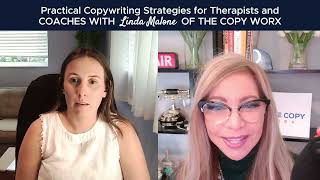
A podcast interview (Thriving Therapeneur) where host Carly Hill interviews Linda Malone, a conversion copywriter and founder of The Copyworks. They define the difference between content (inform/entertain) and copy (marketing with a specific action/CTA), explain buyer-awareness stages and the need for stage-specific landing pages, and teach practical frameworks (PAS — Problem/Agitate/Solve; AIDA) and hook anatomy for social posts. They discuss using AI as a brainstorming/outline tool (but not a replacement for human storytelling), common copy mistakes for clinicians-turned-entrepreneurs (self-focused copy, unreadable/clinical language, weak CTAs), and the importance of testing, niching, and customer-centric messaging. Resources: TheCopyworks.com, weekly blog/podcast, freebies ("21 phrases to never use", humor in copy, power words).
Chapters
Welcome back to another episode of the thriving Therapeneur podcast. Today I have Linda with us. She is a copywriter. We're going to talk about what copywriting actually is. We were just talking off camera. A lot of people don't even know the difference between content and copywriting. So we're going to go into that. Marketing strategies, creating customer centric messaging. We're going to cover AI, of course, course. So welcome to the show, Linda. Please introduce yourself for everyone who's listening.
Thanks so much for having me on, Carly. Yeah, my name is Linda Malone. I am a conversion copywriter. I'm the founder of the Copyworks, spelled W O R X. I've been a copywriter for about probably seven years, but before that I was a content writer for magazines about 15 years. All in the fitness and health space space.
Incredible. So a lot of my listeners are therapists somewhere in the fitness and health space. A lot of them are in the mental health space. And yeah, with that, it could be relationships, it could be self help, it could be hobbies that they're coaching on. Majority of my listeners are therapists who are transitioning into coaching, transitioning maybe into the online world of entrepreneurship. And this is where it gets confusing. Some people don't even know what copywriting is. Right. And then you add it. Well, some people get confused between copywriting and content. So can we break this down for a minute? Maybe you have a simple definition for everyone to conceptualize.
I mean, the simplest definition is to look at content as writing that is used to inform or entertain. You think magazine articles, blogs, that sort of thing. Copywriting is more on the marketing end. And it starts with the end in mind. What is the action that you want the person to take who is reading this copy? So, excuse me, it could be an ad, it could be a landing page, it could be a marketing email. There's some overlap there. I mean, you can have an article about, say, mental health and have a call to action at the end. Like, if you need further information, contact such and such, but it's generally just put out there for your information. I mean, that's probably the simplest way to kind of define the two.
Okay, so to recap, content is more broad, general, that can really be for entertainment purposes. Right. And a lot can fall under content. But copywriting specifically is more used for marketing, especially when you want to get your potential client or a lead or prospect to take a specific action. You're telling them exactly what to do next with very strategic copy. Is that right? Right.
There's A goal. There's a goal in mind for what you're writing.
Okay, so it's.
Yeah. And it can be entertaining. It doesn't mean it can't be entertaining or informative. But at the end of that copy there you want them to do something, to take action.
What are some common call to actions that we want them to do in copywriting?
Well, usually it's you know, signing up for, for a course. It could be booking a free consulting session, signing up for a webinar. It could be even just opting into a free lead magnet. You know, something that you have that you're offering. I mean it could be anything. There's so many just you want them to do something when they get, when they see that copy and they the end of it.
Right. And it could be maybe a more passive call to action like double tap if you agree with this or leave a comment below saying yes, if this resonates with you. But the point is we're telling them exactly what they need to do. I think most people, right, they don't realize we have to tell people exactly what to do and how to execute those steps.
Yeah, exactly. And I'm what's called a conversion copywriter, so I've taken a lot of classes. Like some people say that's a bogus term and it's, it's not because I've studied with the like the top conversion copywriting coaches. And it's, it's a little more like what we take into account is things like the decision making stage that a person's at. So if I'm sure you've heard this, being in marketing, you know, if you're pain aware, if you're product aware, where are they coming from? So example, if it's an ad that you're placing, they are product aware, they know that you're there, they saw your ad, they want to know more. So they're going to go to your website and you should have a landing page specifically connected to that ad that picks up on the conversation that that ad began with them. So they already know what you do. You don't have to take them through this whole thing about your background and you don't have to send them to your homepage, which that's one of the mistakes a lot of marketers make is everyone goes to the homepage. But that's sort of a catch all page. You want to have them go to a specific page because of that ad or whatever it was that they saw that you know, kind of continues that conversation. As I said in the, in the first piece they read.
Yeah. The different levels of buyer's awareness. Right. And this is important for you to know as a coach or even a therapist. If you're marketing in your private practice, you have to know and cater to where your ideal clients are in the stage. Do they need to be educated more? Is there certain objections that we need to try to proactively overcome? Do they even know they have a problem? Are they so much in the woe is me stage that they don't even know maybe what their problem is? Or do they know they have a problem, they just don't know what the solution is? Or do they know they have a problem? They know there's a solution, but they don't know you're the solution. Right, exactly.
Yeah.
So we have to create different copy that speaks to all the different stages. Is that what you would say?
Well, the homepage, and this is like the hardest page to write in copywriting is the homepage because you don't know where people are coming from. They could be coming from a search engine, they could be coming from an ad, it could be a referral, some they heard about you from someplace. So the homepage does not take into account where they are in the decision making process or their stage of awareness doesn't know. That's why it's the hardest to write, because you want to address all of them except for the unaware. Somebody who doesn't think they have a problem aren't even going to be looking, you know, but most people are in that pain aware stage where they're looking for a solution to a challenge. So that's where you want to catch them. But you have to include enough information to engage the people who don't know about what you do yet, as opposed to, you know, like you've heard and seen. I'm sure all these sales pages that are super long, like they seem to go on forever a lot of times. The reason is, and there's a lot of debate in the marketing world about this, like, is it necessary? Well, the idea is that you're moving people through every stage of awareness. So if they're pain aware, then, okay, so now you really, you know, letting them know that you're aware of that and, and then the solution could be, you know, this is what the solution is and then you are the solution and here's why. So you kind of take them through all those stages, which is why those sales pages tend to be super long. I always just skip to the bottom if it's something I know I want. I just scroll all the way, just how much is it?
Right? Yeah, but there is sales pages that I have sat on for longer because I wasn't sure. Right. And so we're catering, catering to the different audiences. So let's go to copywriting frameworks for a minute. Because I'm a therapist by trade. When I became an online entrepreneur and coach, I did not know anything about copywriting frameworks. And it really wasn't until I was in multiple different business coaching programs and had multiple different mentors that I kind of pieced together all the different copywriting frameworks because I feel like so many coaches talk about content pillars and your over our overarching brand message and consistency on social media, but they don't talk specifically about the anatomy. And I'm talking about like social media. My mind's going to Instagram captions like the anatomy of a caption and how you need to have a strong hook that stops the scroll because we only have like three to five seconds to get somebody's attention. So okay, you know, you need to have a hook. But what should be in your hook? What are the rules of a hook? And then what are the different copywriting frameworks that you can kind of plug into your content pillars other than just trying to sit down on a Wednesday and be like, okay, I gotta post today because I need to be consistent.
Right.
I'm pulling from my content pillar. Now what do I do?
I think the easiest way there's, there's over 20 something copywriting formulas out there. I rely on two and this, these are the ones that work in pretty much every situation, especially social media. The pas, pain agitation solution formula. And that one, when you're in like the, you know, a therapy or health, the mental health world, you have to be really careful as you know, I mean especially if it's an ad. But you do want to let the people who are reading know that you understand where they're coming from. The best content, the best copy for something like that usually comes from people who are talking about it. Like when I do, when I work with, work with a client, I will do. I have like a 50 point checklist that I go through and a lot of it is social media. What are people saying about this topic? And especially like my clients, competitors, what are they saying about this? What is it that's missing that's maybe out there that no one's talking about? And then you want to fill in that gap. I mean that's the biggest hook you can put in there is knowing what they're looking for that they're not getting and then having that be like the hook. When it comes to, like, a short social media post, the hook should be really something they're thinking about right now. Like, what is it that is on their mind to the point where you. You go and look at it, you know, and it's like, are they reading my mind? This is exactly what my problem is. Like, you have to. And I don't know, you know, everyone's business as far as the type of business. Like, for health and fitness. I had a course for women over 50, so a lot of it was belly fat. That was the number one thing over and over and heard that I just can't get rid of this belly fat. And obviously you can't just come out and say, you know, do you feel like you're tired of the belly fat? So it's something I would try to make light of it just because it. It just made it more appealing. You know, I would say something like, you know, when you're lying on your bed trying to zip up your pants, like something like describing the scene, you know, if you're tired of this, let's. You know. And you don't go right into the solution, but you. You want to have it like a sentence in between. If it's a short, really short paragraph that lets them know you get it and that it's not their fault.
Right.
And then you lead into, here's how I can help. Yeah, I know that's really broad, but there's so many different ways you can go with that.
No, it's my favorite copywriting framework too. And I feel like it's actually one of the easiest for my clients to execute is the pas. I call it a PAS pro tip post because, like, you're throwing in a little pro tip before you get to your solution and your call to action. But you're bringing up another really good point between. I call it, like, showing and telling. So when you said you're laying on your bed and you're zipping up your pants, I had an image of a woman who was struggling with body fat. We think in images versus you're just struggling with body fat. You're frustrated. You're. And naming all of these emotions. Right? We're actually painting the picture of them standing in front of their closet, taking everything off the hanger and then throwing it on the ground, trying to stretch it out, and then texting their friends, saying they're not gonna make it versus just again saying you're frustrated.
Right. You very. You paint that picture. And that's when it's important to talk to your clients or people who you have worked with or, you know, it might be hard in, in your type of business. But with, with me, I had a lot of surveys that would go out to the women I worked with. You know, what is it that you're real. It's really bothering you. And if I get some on, on the phone, I would say, just walk me through your day. You know, what is it? Because that's the most powerful question, I think walk me through your day problem pop up. And, you know, when did you first notice that this was an issue? I love those questions because people, for one, they love telling you because they're usually things I don't tell people, you know?
Right.
It's like I was going to go to a party and I had a dress I was looking forward. And this is just off top of my head. No one ever actually said this, but you know, I was going to wear this dress I was really looking forward to. I just couldn't zip it up and I was in tears. And like, that's the kind of scenario that you want to get. Like, what made you go, okay, it's time to take some action?
And that's where people will come to you and be like, did you bug my house? Like, this was almost creepy. Like, you were inside my brain. Right. And that's, that's a key sign to really bomb copywriting when people are coming and telling you that. So if it's on your consult calls, if it's previous clients of yours, if it's strangers who you're just doing market research with, like, market research never ends. Use that as content to, to pull from when you are going to write your copy. Yeah. Okay, so PIs, post, pain, agitate, solve. We don't want to always speak to the pain. Right. We want to sometimes speak to the pleasure. Although we know that people are always buying their way out of something, not into something. Like businesses solve problems. So it tickles me, all of the people who are like, I don't agree with pain point marketing, but yeah, they're doing pain point marketing just in a different way. They're still hitting people's pain.
Like, right.
You're never not doing pain point marketing even when you're speaking to pleasure and desire. Right.
I'm glad you said that because there was a huge debate on LinkedIn recently about this and I wrote about it because somebody said exactly what you Said, I disagree.
I was gonna say, tell me, what are your thoughts on this?
Well, there's another formula that's very popular, ada attention, interest, desire and action. Which I think the company that does it best is probably Apple. I mean, Apple's like, you know, the gold standard for all copywriting. And they get your attention and that is so you can get somebody's attention in either way. What I do, I do a lot of writing for SaaS service software as a service companies. And so a lot of times that's what they like to use. They. But like to your point, they weave in the challenge without you really realizing it.
Right.
So it could be, it looks like a. They're. They're presenting you with the ideal situation, but yet they're also letting you know that we know you're not there yet kind of thing.
Exactly.
I don't have any off top of my head that I can think of, but I would like I said the Apple ads are probably the best, best way. And they use a lot of imagery too. So it's kind of, it's kind of hard. But. But yeah, you can do that. You can present the solution, but then let them know that you know about the problem and that would get their attention and then interest, you know, what is it that they really would. Would catch their interest and then desire, what do they really want? And then the action that you want them to take.
Yeah. And to your point, study big companies, study other people's copywriting. Next time you are scrolling on Instagram, scroll with intention to go on a hook hunt. And what got you to stop the scroll? Right. Go look up Apple's post and take notes from their copywriting. And I love that you agree with me on this, but we don't want to also be like, are you struggling with belly fat, belly fat, belly fat all the time? Right. Like, we don't want to only hit their pain. We do need to speak to the pleasure and the desire. And some people are pleasure and desire motivated and some people are pain motivated. And I feel like usually we like to write copy or it's more natural for us to write copy and how we are motivated and how we buy. And so this is again where like having different copywriting frameworks to pull from, I feel like is helpful to make sure that we are switching it up. Right?
Yeah.
Okay.
I just find a lot of it doesn't even follow frameworks, you know, because I've studied these. I actually have an ebook I'm reworking at the moment. That's all the different frameworks, and the only one I really use is the PAS or the ada. It's. The other ones are sort of. And even my coach that I worked with, she said, you know, there's so many acronyms out there. I mean, you can go crazy just trying to figure out which one to use. And the bottom, you know, the bottom line to all of it is you need to know what your customer, your client is going to respond to. And maybe, you know, what is it that. And here's actually a tip on how to decide if you're going to use pain or pleasure to start out an ad or your copy is how does your prospect, your potential client, talk about their challenge? Do they talk about how much better they want? Like, you know, they talk about the solution? Do they talk about how much they want to feel better? What. What is this situation in their mind that they aspire to achieve? Or do they talk a lot about how frustrated they are? And this is just, you know, all the challenges that they're facing, what are they. What seems to rise to the top the most? And then use that. And always. It's always testing, you know, it's always just putting it out there and seeing what floats. I mean, I've done a lot of Facebook ads and I work with a Facebook. I'm not a Facebook ads expert. I mean, I write the ads, but it's a. I have a strategist I work with. And it's so funny how the ones that I think are not going to work are the ones that convert the best.
Yeah.
So you can't also let your own opinion get into it too much, because if it's what people are saying and they're responding to it, you have to go with that. So, touche.
Put it all out there. See what gets you crickets, see what flops, see what does really well. And that's also where you can take what does well organically. Then you can be smart about turning it into a paid ad because you already know that it converts versus testing it all in paid ads first. Right?
Yeah, exactly. I do that with my emails. I have a weekly email and I try to do a B testing. I don't do it all the time, every week, but I did it this week. And one was a quote that a person would say. In fact, it was, are you reading my mind? Because it was about the stages of awareness that I was writing about. And then the other. I forget what the other subject line was, but the one where I quoted somebody actually like saying, are you reading My mind that one won because it'll. I use ConvertKit and they automatically will send it to whichever one is the winner of the testing. I didn't know which one was going to win.
Right.
So. And that doesn't cost anything. If you're sending out a newsletter, something like that, using a platform like that doesn't cost anything. You can try out different things.
Yeah. Just last week I did something similar where I just pulled the last three months of data from my email marketing. All of my subject lines. Which one had the highest open rate? How can I use those again? Or make something similar? Is there a common theme or pattern? So we're just kind of giving you ideas right now of a different way of thinking when you look at copy. And I feel like when I started to understand copy, I started looking at people's websites differently and I was like, oh, I see what they're doing now here. Or when you do understand the frameworks, you start to look at things differently or the hooks, or you're like, oh, that was a good call to action. I'm going to use that one and I'm going to test that out too. So hopefully this conversation, if anything, because I know this is a lot of information, is just enlightening you all to think about content and copy in a different way. I also want to talk about AI for a second. How can we not talk about AI when it comes to copy? I'm just going to open it up to you, like, what do you want to say about AI? I have a million questions I could ask you, but I was going to.
Say, when it comes to subject lines, a lot of times that's where AI is actually pretty good. I use AI for everything except the actual writing. So I keep it open. I pay the $20 a month, mainly because my copywriting coach said, just pay the 20 bucks a month and just stop asking me like, just do it. So I just did it. And so. But when you have that 20amonth plan, you can create, like, there's different ways you can create your own chat GPT. Like, mine is based on my. Have you seen this?
Yes.
It's like you can create your own chat. So mine is based on the. My co. My. All my copywriting coaches, I plug their names in. I plugged my own name in and I said, this is the information I want to base all this on. And it's funny because it comes back with the voice of one of my coaches all the time. But I will ask it, like for a podcast because I have my Own podcast that I have. I will take the interview and pop it in there and say what you know, can you come up with like a good title? And it usually is a. I'll ask it for 10 and I will piece together what I think would work best.
Right.
Because it's usually very. It always has a colon in it. I don't know why. It has this thing about colons. And it's always very long. I say to shorten it and it doesn't. But I use it for outlining, for distilling down a lot of information. When I have a discovery call with a client, I will take the conversation and plug it into AI and say, what are the most important points? Can you create an outline for me? But the thing is with AI is you always have to double check it.
Right.
Just because it will miss points. And sometimes I go back, I'll go back always through the original piece and make sure I got everything. But it is. It's such a great way to really sum up and distill down and to get to brainstorm. I think brainstorming is probably where it's most useful.
Yeah.
Or come up with ideas.
Yeah. I call it like brain dumping. Right. Like a starting point.
So.
So if you've never written a PAS post before, you're new to the copywriting framework, you have a thread going already with ChatGPT, play around with it and be like, hey, write me a PAS post. But then take that and put your own spin on it. Like, I feel like people can tell if ChatGPT wrote a post or not. Like, where's your personality? Where's your little, you know, quirks or sayings that you say? Or weird dot dots or emojis? Or just. Yeah, humor. Right. To make it fun in reading it. Like, if they wanted to read something from Chat, GPT or a blog, like, they would just go search it on the Internet. Right, Right. Okay.
Because it won't start, it won't tell you stories. Like, that's where you have to put your own story in. Because chat doesn't have a story. So what I typically do is if I'm writing a blog, because I do write some blog posts, which is considered content, but for clients, some clients, I will do it and I will. I'll ask it for the main. Like, give me some stats on such and such. And you can ask it for sources. Where are you getting this from? And then you can check out the sources, which it's not always accurate, but you always have to check. But that I found really Helps saves a ton of time. And then what I do is I'll look at it and then think of how can I start this in an interesting way and just conversationally, like, just start with a story. And then it's like when I used to write about, like heart health, for example, I would start with. Usually it was an actual interview with a person who had had a heart attack. And just. And I wrote for a lot of like women's heart health. And so it would start with, you know, so and so took a yoga class, thought she had food poisoning. This was an actual story. She thought she had food poisoning. And she was very sick to stomach. And she went home and her mother said, you are going to the hospital. Took her to the hospital. She had a heart attack. So that's going to pull somebody in a lot faster than, you know, out of 50,000 women, like stats and analytics, people don't remember those, but they'll remember that story. I remember her telling me that. And this was probably 10 years ago, just because it was so impactful story. So that's something chat can do.
Story sells for sure. I feel like it bypasses our conscious mind. It goes directly to the subconscious mind. We just understand. It's like why we love analogies so much. We can just conceptualize things in a different way. And especially when we can put in our own stories too. Like 90 of us are our own ideal client. I always say, so what is your story? And how can you weave that into a copywriting framework?
Right? And I. AI doesn't create. It pulls from what's already out there.
Right.
It even says it. I've asked it, like, what? You know, just seemed funny, but it was like, I'm writing, you know, a post about what AI, how AI falls short of human, of actual person, you know, writing. How can you. What would be the differences? And one of the things it said was, you know, AI does not create anything new. It just gathers what's already out there. So if you want to be original. And that's the thing too, with titles, it's giving the same ones. You'll know if somebody has been using it. If they use words like unveiling or. It loves that. There's just some words that use this over and over and it's in every headline. Yeah, it's like, just find a new word.
Give it something to work off of. Give it your hero's journey. If you have typed that up and then that's the context where it can pull from that story into a caption. Right? Or an email or a sales page or whatever it is that you're writing. What about copywriting mistakes? This is probably a loaded question, but is there maybe like a top three that come to mind?
Copywriting mistakes is probably number one for business is making it all about you. And I think you had said earlier, and you want to make it customer centric. Most of the websites, they say, it's like, this is what we do. This is who I am. And it's important, but not right off the bat. Your qualifications are important, but that's not what's going to pull somebody in. You want to be, as I said earlier, relatable to what they're going through, what challenges are they having that you understand and that you know they're going through? So it should be about them always. And even your about page should weave in. And there's been some debate about this too. But I always say, you know, you should really make it about how you can help other people. Like, I have this degree or this experience because so I can help, like I have, you know, all this content writing experience so I can help other writers. I know how to get an editor's attention. I did it for so long. And how, you know how this is going to help you. So that's probably the number one thing.
Good one. I see that a lot.
It's really, it's rampant. And whenever I see that on a website, I think this is just for one. It's like, this is my ideal client because they don't know what they're doing wrong, but a lot of times they don't care. And so, you know, what are you going to do? But the number two thing is just not making things readable, not putting it in conversational prose. And it doesn't mean it has to be flippant or, you know, sassy or any of those things. But to just write as if you're talking to your prospect, like somebody who you want to work with, what would you say to them? You meet them out somewhere. Because if you can look at your headline and it doesn't sound like something that your client or customer would say, you probably need to change it. Because a lot of the words I see are AI words. No one wakes up in the morning and says, you know, I'd love to catapult my business into the next level. I mean, you know what I mean? They don't say that. They're like, I'm just frustrated with not getting anywhere. So making it more conversational and breaking it up to make it More readable. So by this I mean bullet points mix up the. The length of sentences. That's the other thing AI does horribly is every sentence is a run on sentence. Usually one sentence. If I like what it says, I'll break it up into three and put my own spin on it. Yeah, but you want to vary it. It's like music. When you have a long sentence, short sentence, even a single word or two words, it has a beat to it. And you won't know that it's not there until you realize you're just bored from reading. Whatever. Because a long sentence, run on sentences are like talking in monotone, right?
Yeah. Chunk it down. It's okay to speak in fragments in your captions. It's okay. Yeah, yeah. For a clinician specifically, it's getting out of the clinical jargon and kind of speaking in layman's terms. Or I would say like fifth grade language. Right?
Yeah.
Not being.
And that's where Chad can actually help. Right. You can put that, you can put your technical terms in chat. Because I've done this when I've read something that's like, I want to use this information, but how would I explain this in more simple terms? It can help with that.
Yeah.
So that's another way.
Okay. So not making it so much about yourself. Make sure it's readable. You have lots of spaces or bullet points. Don't get too clinical or sophisticated. Fifth grade language. Use AI to help you. Is there a third mistake? These are really good.
Probably calls to action. They call that like micro copy, like button copy. People just tend to throw anything on a button. Click here, you know, and it's not. You want to think about that because a button on your website is literally the conversion point. It's like opening a door. The person doesn't know what's on the other side of that. And there's two things that I want to say about this. One is that putting it too early on, if they don't know enough about what you do, and you have a button right up front that says sign up or schedule a call, but they're not ready. But they see the button and they click it and it takes them to the sales page. They'll bounce because they're not ready. So it could be that you lead them down further down the page. They call it a call to value. So it's like, find out more and then it takes them to something else that will help them make a decision. But the button should complete the sentence I want to. And then what would the button say sign up or you can even use the word I because it's shown that people, when you put it in the first person, they're more likely to convert. I want this for example, or I want to sign up something that makes it sound like they're saying it right. But you can put like all. Like you can say you have three different buttons on your website, but they all go to one page. Try out different copy on each button, even if it takes them to the same page. See which one converts better because maybe one people are more responsive responding to. But never just put something up there just to get. Get it on the button because it's. You really want to think about it.
Your buttons is important and to your point, it's all about testing. I recently read somewhere about how arrows on your buttons can help you subconsciously convert. So I started adding some arrows on all of my buttons to test. Right. So it's always and forever testing. These are great points. Anything else you want to add on being customer centric, we kind of touched on it, but I know this is something that you speak a lot about in your brand.
I think, and this is sort of customer centric. But it's. It's a combination of things. But the one thing I find lacking a lot is that people don't have their own value proposition really fleshed out. Like, what is it especially you're in a very competitive business. What makes you the person that someone should hire versus another therapist?
Yeah.
And it should be like for me as a copywriter, I specialize in health and fitness. That's my niche. And my differentiator is I spent 20 years in that business. So I'm on both sides of the fence. I was working with people. I have the certifications for that. I have been, I've written for every magazine out there. And now I'm a copywriter. So there's not many people with that background. So what is it that you have that makes you a solution for a particular niche for, you know, one type of person? Like I always use example, I had a personal training client who had bad shoulders and she went to a specialist, a shoulder specialist in New York City who only worked on women's shoulders. And you would think that's really like niching down. How did she do that? She was booked out for months.
Yeah.
And it's shoulders. Only women. And that was it, you know, so you can get specific and really target who you, you know, you can best serve.
There's a beauty in hyper niching, especially in the High ticket space. So I'm a high ticket coach. All of my clients sell their programs, you know, one $2,000 to start and then we double it upwards from there. So they really. I call it being the Beyonce of this their space. They really have to stand out and be the Beyonce in, in the saturated market. Right?
That's it.
Yeah.
Yeah.
I love it. I feel like you have so many resources that you can offer to anybody who's listening. Where can everybody find you? Do you have any free gifts for anyone?
I have three freebies on my site. One is a 21 phrases to never use in your copy. It's a lot about marketing speak. The other is how to add humor to your copy. And the third is power words like how the words that are most powerful to include in your copy. I have a blog that I write weekly and that is. And I have my own podcast, B2B Marketing and Copywriting. I do that every week and I have guests on. And sometimes I do solo episodes. There's a ton of that. And then you can poke around my website, TheCopyworks.com and there's a lot of information there you can see. But probably those are the, the top resources.
Fabulous. And where do you hang out Most? On Facebook?
LinkedIn.
LinkedIn. Okay, cool.
I have a presence on the other ones, but it's, it's. I'm not super active, but LinkedIn. I'm very active. Okay.
And I. Yeah, makes sense because you probably like that long form content, being a copywriter.
No, it does. Well, the carousels. I just had another carousel go viral. Yeah. And it's, it seems to be the easiest place for me to get the word out. And, and I meet a lot of people that way that are, you know, other business people. So.
Yeah.
And it's very supportive. You don't always get that on some of the other platforms. So.
I do agree. And this going back to testing, you have to go with the platform that works for you. Right. You got to kind of dabble in all the different platforms. So find Linda on LinkedIn. That's her home. That's where she hangs out. Well, thank you so much for being on the show. It was a pleasure having. And thank you for all of these gold nuggets. Everything will be listed in the show notes below for everybody who's listening. And until next time, I will see you on the thriving Therapreneur podcast. Take care.
More from Carly


How Therapists Can Use Mentaya To Get Private Pay Clients Reimbursed (Without a Superbill)



How a Seven-Figure Therapist Actually Builds Wealth (It's Not What You Think)

“There was always this idea in my head, but I didn’t know how to formulate it until I met you.”




