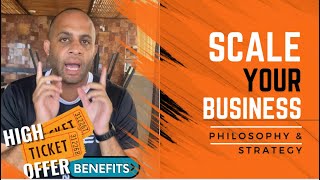
In this solo motivational monologue, Koveh – who brands himself as an “Inspiration Engineer” – challenges coaches and entrepreneurs who focus on low‑ticket products to consider selling high‑ticket offers. He recounts a conversation with a coach who, despite having $22K and $45K programs, is fixated on low‑ticket funnels due to fear and comfort. Koveh argues that high‑ticket pricing (e.g., $22K, $45K, $150K, $250K) unlocks faster growth, reduces the need for massive volume, and aligns with a creator’s authority. He cites a company spending $3.6 million on ads and generating $36‑360 million in revenue, and a peer who has sold a $150K offer for six years, to illustrate the scalability of premium offers. Drawing on 30 years of experience and a 27,000‑person organic network, he emphasizes the importance of mindset, energy, and product‑service alignment to attract high‑ticket clients. While acknowledging that low‑ticket paths can work, he urges listeners to develop the confidence and strategic positioning needed for high‑ticket sales.
Chapters
What up, what up, what up? It's your boy, Koveh, Inspiration Engineer. You already know what it is. I got a message I wanna impart on you, some wisdom in this moment. Are you selling a high-ticket offer? Are you selling a high-ticket offer? And if you're not, my question is, why are you not selling a high-ticket offer? I was talking to a coach She was telling me she was building out her systems, she was building out her processes, wanting to scale a subscription, wanting to build a low-ticket funnel. And that's great, like, there comes a time for that. But I said, why not go this other path where we can leverage your authority so that we can sell your $22,000 or your $45,000 offer? She has a $22,000 and a $45,000 offer, but she's focused on the low ticket. Why? Because fear, uncertainty. I feel much more comfortable probably selling that. I'm not as comfortable selling this high-ticket offer over here. And I understand that from the standpoint that I'm working on a $250,000 offer. It makes me a little uncomfortable, I'm not gonna lie. But I say that saying that's where the growth is. So if you're focused on something low-ticket, a book, an album, a podcast, podcast sponsorships, um, you know, fill in the blank, anything that's not even $5,000 it's really low ticket. So if it's low ticket, that's not a bad thing. It just means you gotta do more volume. You gotta do more volume to be a six-figure-naire. We just brought in a company that spends $3.6 million in their ads a year, which means that they're making somewhere between $36 million and $360 million on their middle line offer, 'cause they also sell a millionaire club offer, okay? I wanna leave you with this one last thing. Another coach of mine, been a friend of mine for about 6 years, He said, "I've been selling a $150K offer for 6 years." He said, "So $5K isn't high ticket." My point to that would be, well, yeah, but if you're working on merger and acquisition deals, you're doing million-dollar deals. So then the $150K isn't high ticket. I mean, that, that continues onward. But my point here is if you're focused on selling larger packages, services, products, and offers, it's going to save you time in the long run. And again, I've been at this for like 30 years now, and I've built a 27,000 network organically. But had I had me talking to me telling me what I'm telling you way back when, I would have gotten here so much sooner. So by all means, do your low ticket if that's what you want to do, or be wise, learn how to get your mindset, your energy set, and your product set or service set to match what you're offering and attract the people energetically that need those higher level, high ticket services. It's your boy, Corvay. I love you. I appreciate you. And until the next time, you already know what it is. Boom!